When trawling through Norwich history I catch rare, tantalising glimpses of ’Sons of Flora’ and ’Florist’s Feasts’, intriguing allusions to the story of horticulture in this city that promised to stretch back hundreds of years.
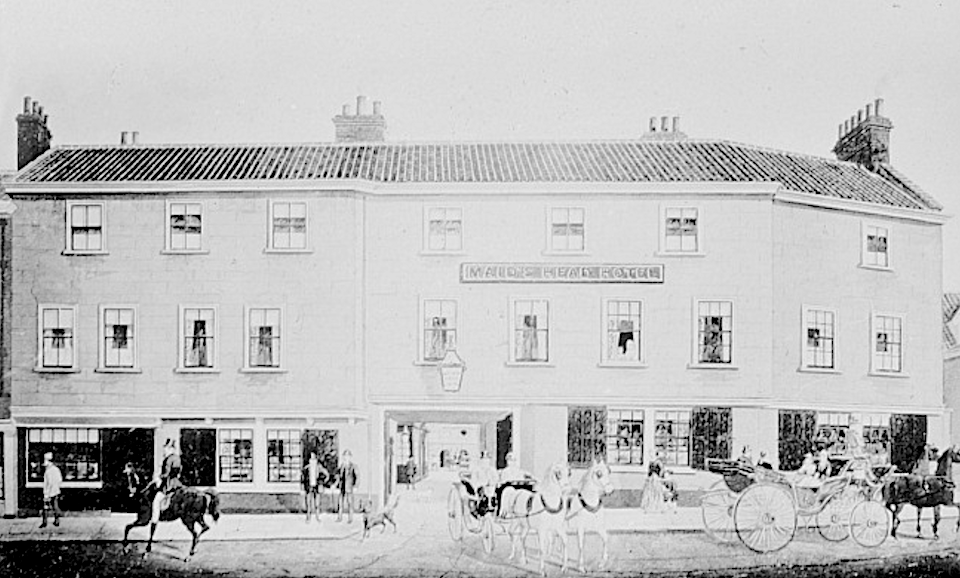
One such peep behind the scenes was from Stanley Wearing’s book on Thomas Ivory, the architect of Georgian Norwich (Octagon Chapel, Assembly House) [1]. Wearing tells us that Ivory was a steward of the Sons of Flora. He quotes the Norwich Mercury of 1750: ‘The Sons of Flora will hold their Annual Venison Feast at the Maid’s Head in St Simon’s … where all Gentlemen, who are admirers of the Beauties of Nature, are desired to come and view the greatest variety of New and Well-blown (i.e. in full flower) CARNATIONS that this Year produce.’ A similar but earlier advertisement from the Sons of Flora appeared in the Norwich Gazette.
Norwich Gazette July 18th 1729. Norfolk Heritage Centre
Lantern slide of The Maid’s Head, viewed from Wensum Street. Undated C18. Courtesy of Norfolk County Council at Picture Norfolk
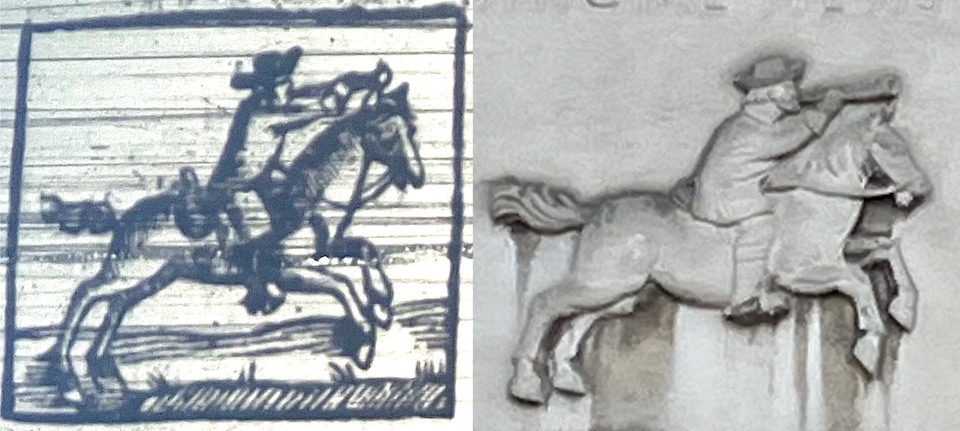
The Norwich Gazette, in which the Sons of Flora’s advertisement appeared, was established in 1707, just six years after the country’s first provincial paper, the Norwich Post (1701). The Post’s symbol of a messenger announcing the news by clarion call can be seen, carved in stone, at the original site of of the newspaper, now Norwich University of the Arts’ Francis House in Redwell Street [2]. It is from local newspapers that we trace the rise and fall of florists’ feasts.
Left, from the banner of The Norwich Post; right, commemorating the original site of the Norwichpressin Redwell Street.
A scroll through the microfiche records of eighteenth century Norwich newspapers turns up several announcements by the Sons of Flora but, as Ruth E. Duthie outlined [3, 4, 5], floral meetings and feasts were not restricted to Norwich and are recorded in London, York, Gloucester etc. Nor was the title ‘Sons of Flora’ specific to Norwich as illustrated by this call from Kings Lynn.
Norwich Mercury 14th July to 8th August 1740
It has been claimed that Norwich’s special position in the history of floral feasts and competitions was due to our worsted weavers importing a taste for florists flowers from the Low Countries [6]. In 1567, the brutal suppression of Protestantism in the Spanish Netherlands by Phillip II of Spain forced thousands to flee, causing the population of Norwich to swell by as much as a half again [7]. Our ‘Strangers’ are likely to have brought with them a tradition of plant breeding and flowers not found in the English garden. Duthie, however, is sceptical about the Strangers as a source of Florists’ Feasts and societies for she found no evidence for the existence of societies of flower lovers in the Low Countries some 70 years before ‘tulipomania’ [5]. A stronger claim for Norwich’s early adoption of Florists’ Feasts comes from a different direction but before proceeding too far it’s worth settling the definition of a ‘florist’.
Its original meaning was ‘a person who grew plants for the sake of their decorative flowers rather than for any useful property the plant might have. Later it came to refer to one who grew only certain kinds of flowering plants and these to a very high standard, their excellence being tested at competitions held with fellow florists. It was only towards the end of the nineteenth century that the word came to have its modern meaning.’(Ruth Duthie [5])
I first came across Florists Feasts when researching the life of Norwich-born Sir James Edward Smith who founded the Linnean Society in 1788 [8]. In a letter published by the Linnean Society [9], Smith refers to a play by Ralph Knevet: Rhodon and Iris. A Pastoral as it was presented at the Florists’ Feast in Norwich, 3 May 1631 – dedicated to Nicholas Bacon Esq. of Gillingham in south Norfolk [10].
Frontispiece to Rhodon and Iris by Ralph Knevet. Courtesy of Norfolk Millennium Library Heritage Centre
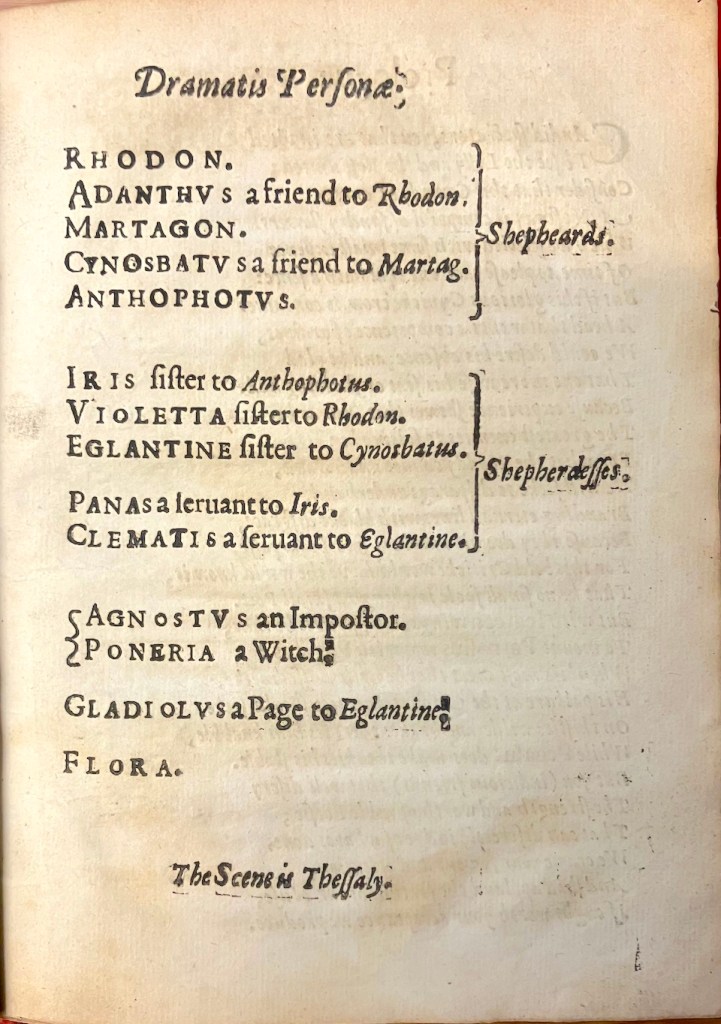
Knevet (1600-1671), member of a Norfolk landed family, Rector of Lyng and friend of the Paston family, was described as a ‘learned and spasmodically talented poet’ [10]. The dramatis personae for Rhodon and Iris gives an idea of the high-flown tone of the play in which flowers appear as the major characters.
As well as glimpses into the tangled love lives of Eglantine, Violetta, Clematis, Gladiolus et al we learn that a Society of Florists existed in 1631, which appears to be its first mention in England. The author’s preface also refers to the Society of Florists as ‘a conflux of Gentlemen of birth and quality in whose presence and commerce (I thinke) your cities welfare partly consists.’ Not entirely sons of the soil.
Two poems from the time before local newspapers also refer to Florists’ Feasts. The first is A Prologe crown’d with Flowers. On the Florists Feast at Norwich, by William Strode [3, 12]. Strode was chaplain to his friend and fellow poet Richard Corbet, Bishop of Oxford who became Bishop of Norwich from 1632 to 1635, which probably dates the poem. In Ancient Rome, Flora was goddess of flowers and fertility who, during the spring festival of Floralia, was called on to bless the emerging plants and the harvest to follow. Strode, a florid preacher, had already been summoned before a parliamentary committee in Oxford and in his poem he was careful to disavow Flora’s pagan origins: ‘… Our feast we call/ Only with Flowres, from Flora not at all’.
Credit: Flora holds the bow and arrows of Cupid while Cupid acts as a gardener. Aquatint with engraving by S. Alken, 1790, after E. Crewe. Source: Wellcome Collection.
The second poem is by writer of droll verse, Matthew Stevenson: ‘At the Florists Feasts in Norwich. Flora Wearing a Crown’ [see 3]. Flora’s complaint about the absence of Floral Feasts – ‘How I have been neglected of late years’ – is explained by the Civil War. As ‘a Cavalier wit’ [13] it is surprising that Stevenson could write in 1645 about ‘seeds of discord’ in a city that had just raised a troop for Cromwell’s Ironsides.
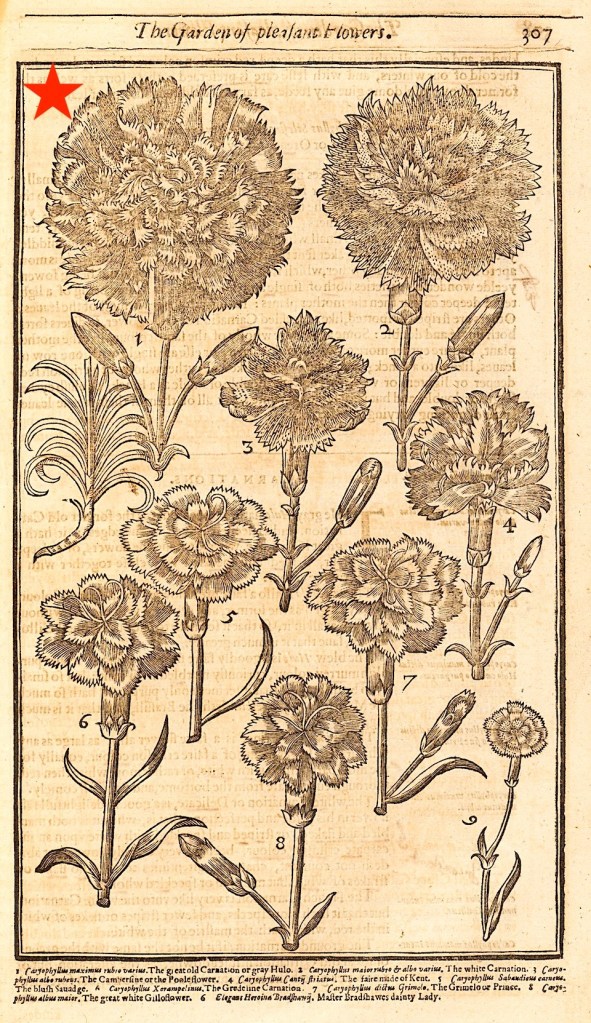
What is interesting to garden historians are Stevenson’s numerous mentions of florists’ flowers, although not all of the old common names can be traced. He does mention the ‘gray Halo’, which is listed in John Parkinson’s celebrated book ‘Paradisi in Sole, Paradisus Terrestris’ (1627) where it appears as the ‘gray Hulo’ or ‘the great old Carnation’.
Plate 307. from Parkinson’s ‘Paradisi in Sole, Paradisus Terrestris. Top left is ‘Caryophyllus maximus rubro varius, the great old Carnation or gray Hulo’. Courtesy of metmuseum.org
No. 1, the gray Hulo (starred), was described as deep-red striped and speckled very close together with a darkish white colour. Another early illustration features carnations.
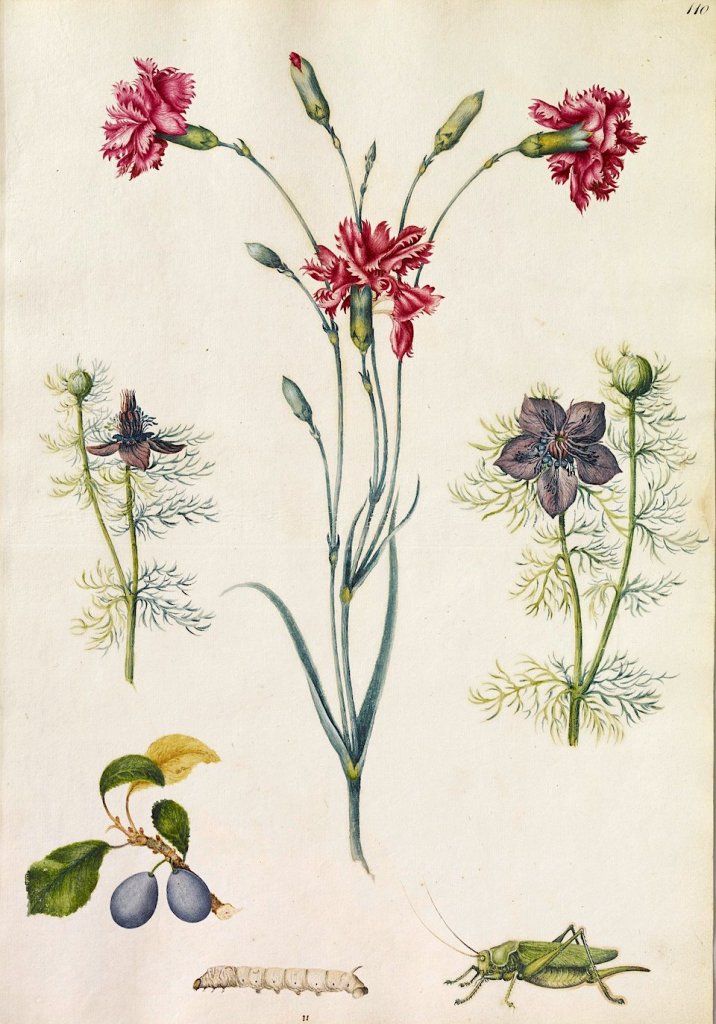
Sprig of carnations, centre. Alexander Marshal (c1620-1682). Courtesy of Royal Collection Trust RCIN 924377
The advertisement by the Sons of Flora in the figure at top of this post was published when carnations were in bloom but since no invitations were made to bring flowers, nor prizes offered, it would appear that this was an exhibition, a ‘Shew’. On the 24th July 1729, one day after the Sons of Flora met in the Maid’s Head, Thomas Baldwin held his own show in the Flower-in-Hand public house, this time offering a ‘gratitude’ for the best July-Flower, as carnations were called.
Norwich GazetteJuly 19th 1729
In its entry for the aptly named Flower-in-Hand public house at the north end of Duke Street the ever helpful Norfolk Pubs website [14] mentions that carnation shows were held there throughout the eighteenth century. (Incidentally, the website lists five old Norwich pubs with floral associations: Flower-in-Hand (two), Flower Pot (two) and one Pot of Flowers, implying a long-standing association with flower shows.) The Pot of Flowers in St Martin’s at Oak is known to have held a show in 1829 [15]; other venues include ‘At Mr Thomas Riggs’ in St Swithin’s Lane (1707)[3] and Quantrell’s pleasure gardens in 1780 [3]. In the eighteenth century The Shoulder of Mutton on St Andrew’s Hill, staged cock fights but by 1871 there was a gentler pursuit – a ‘Show of Free-blowing Carnations‘ followed by a Florists’ Feast [14].
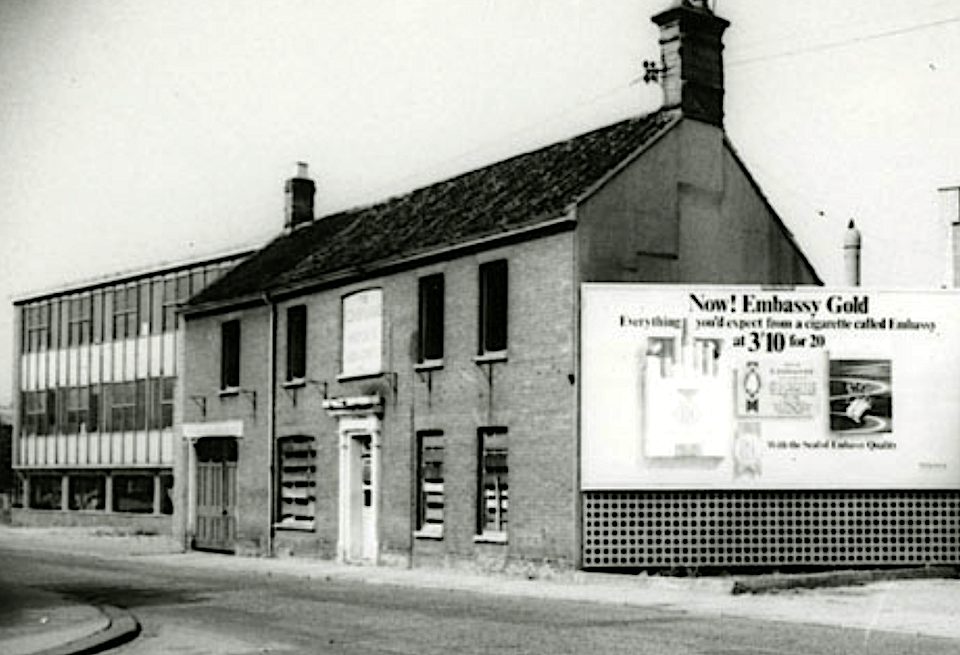
The derelict Flower-in-Hand pub 1969. Closed 1965 by Bullard & Sons. Courtesy of Norfolk County Council at Picture Norfolk.
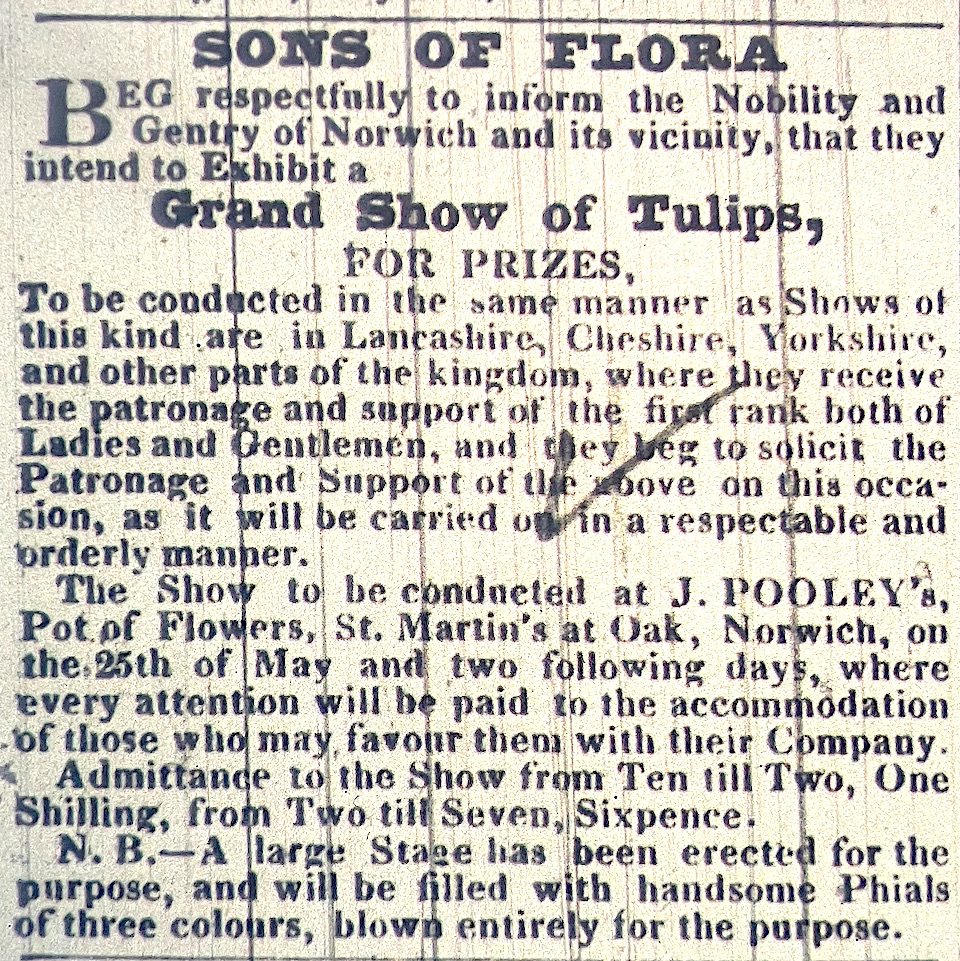
The nature of the feast seems to have varied over time. Initially, competitions or displays held in public houses were followed by a midday lunch – ‘a good ordinary’ costing one shilling and sixpence. Later, as at Quantrell’s garden, flowers were judged at six and supper was ‘on the table at eight’ [3]. By 1829 things had changed and the SoF were announcing a grand show of tulips in an ordinary pub with no mention of a feast. From their appeal to ‘The Nobility and Gentry of Norwich’ it would appear that the Sons of Flora were still aiming for the higher echelons of society whereas, in reality, Duthie suggests that the active membership was comprised of tradesmen and shopkeepers with support from professional nurserymen and florists [3].
Norfolk Chronicle and Norwich Gazette May 23 1829, announcing a tulip show at the Pot of Flowers. There is no mention of a feast.
The range of florists’ flowers also changed over time: early on, many were native plants, double-flowered, striped or speckled that probably arose naturally and were then bred on to ensure stability [3]. The selection and propagation of new cultivars (cultivated variety) became the oblective of the dedicated florist, explaining how a single type of plant could occupy an entire show.
Variety was also provided by the exotics that had begun to arrive in England in the seventeenth century, including flowers cultivated in the gardens of Turkey and Persia as well as wild flowers from the Americas. Hyacinths, ranunculuses and tulips came to us largely via The Netherlands. By the mid-eighteenth century the plant grower had access to hundreds of new plants yet the classic list of florists’ flowers was restricted for many years to just eight: primula, polyanthus, auricula, hyacinth, anemone, tulip, ranunculus and carnation [5]. Pinks (dianthus) were only added in the latter part of the century after lengthy improvement to produce semi-double flowers with less-fringed petals [4]. By 1780, Quantrell’s Pleasure Garden in Norwich – near the present-day St Stephen’s roundabout – could boast that their show of pinks was an annual event. Fifty years elapsed before the list of classic florists’ flowers was extended by the addition of pansies and dahlias [5].
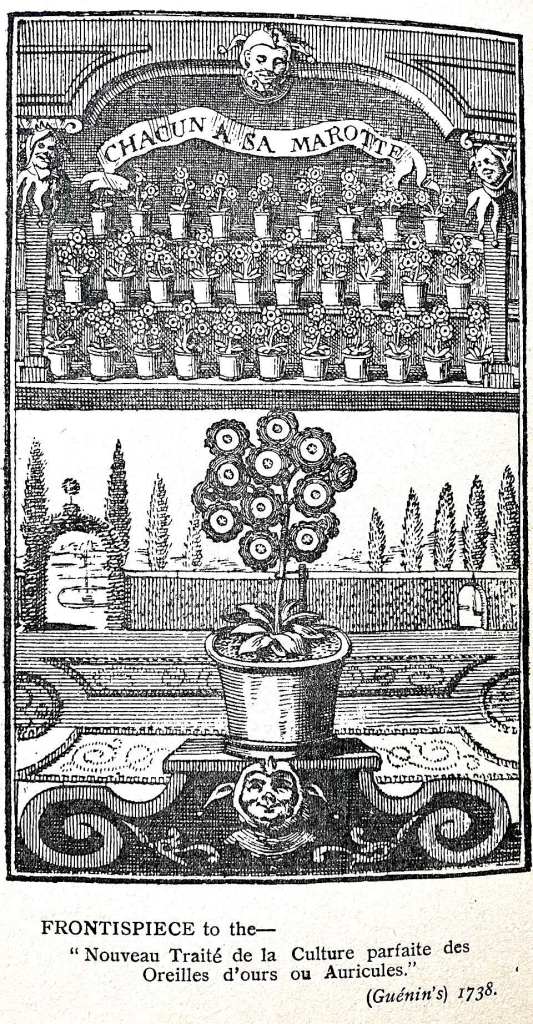
An auricula theatre, reproduced from Guénin’s 1738 work on Bear’s Ears or auriculas, from Payne’s book of 1908 [15]. Courtesy of John Innes Special Collection.
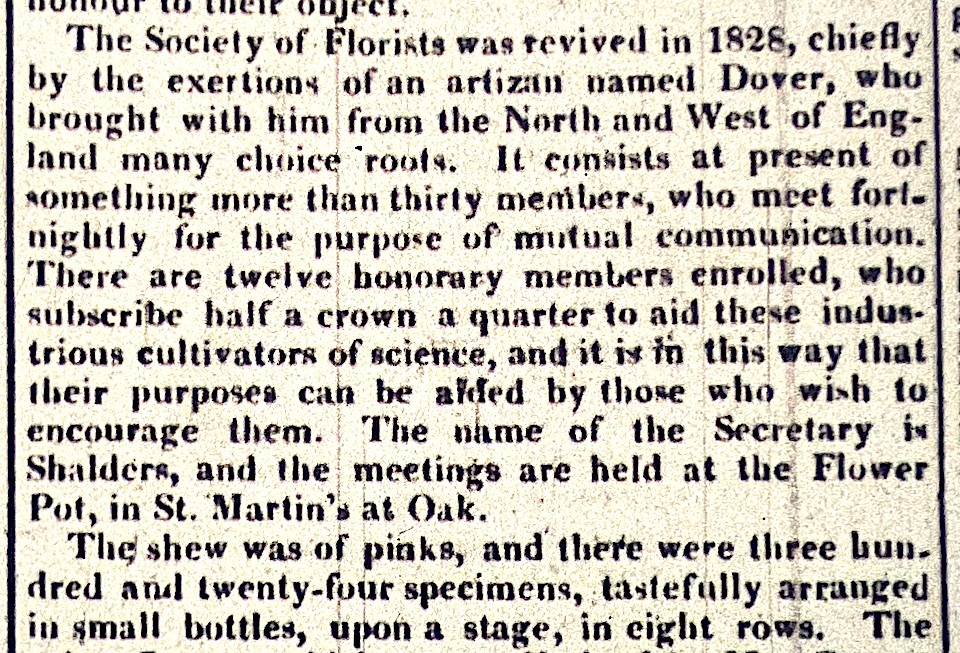
Nationally, florists’ societies were at their peak from 1740 to 1785 [4]; in Norwich, newspapers advertisements for florists’ feasts were scarce after 1781. The decline has been attributed to economic conditions associated with the Napoleonic Wars but an alternative explanation is that the feasts were now considered to be no more than drinking parties [5]. However, after an apparent silence of nearly 50 years the Norwich Sons of Flora advertised their resurrection with a tulip show. Then, on July 11th 1829, an article in the Norwich Mercury declared that the Society of Florists had also been dormant but had been ‘revived chiefly by the exertions of an artizan named Dover …’ Their show consisted of 324 pinks in eight rows.Jim Marshall, who holds National Collections of pinks and carnations verified that none of the eight pinks listed in the Society of Florists’ 1829 show (e.g.,Fountains [Green’s] Lord Nelson) are still in existence. Propagated by stem cuttings they become prone to virus and would nowadays be micropropagated to avoid this.
Norwich Mercury July 1th 1829; a show of pinks at the Flower Pot public house
Was it a coincidence that this revival of florist’s shows in 1829 coincided with the founding of the Norfolk and Norwich Horticultural Society [17]? The Sons of Flora and the Society of Florists reverted to type by holding displays dominated by single species (tulips and pinks respectively) but the newly-formed NNHS reflected a wider taste in horticulture by showing fruits, flowers and culinary vegetables. At the first meeting Mackie’s Nursery (now the site of Notcutts Garden Centre, Norwich) showed 46 varieties of apples, Mrs John Middleton (mother of the Norwich School artist) presented a coloured drawing of various plants, the President (Edward H Evans-Lombe Esquire) showed a ‘very dainty dish of mushrooms grown on shelves at the back of his vinery’, and the Reverend EJ Howman ‘sent some Mangel Wurzel of great size and weight.’
Credit: Norfolk and Norwich Horticultural Society
The first rule of the constitution was that the society should consist of ‘Ladies and Gentlemen (amateurs in horticulture), and of practical gardeners.’ The foreword of the centennial volume will sound condescending to modern ears: ‘a still greater benefit … is the encouragement it will afford to Cottagers, by the distribution of small prizes, to make the most of the little plots of ground which they may chance to occupy.’ A further objective was to ‘raise the moral character of the poorer classes of the community … I do (said the chairman) regard it as a means of reviving the character of the good old English peasantry …’ [ref 17 page 18].
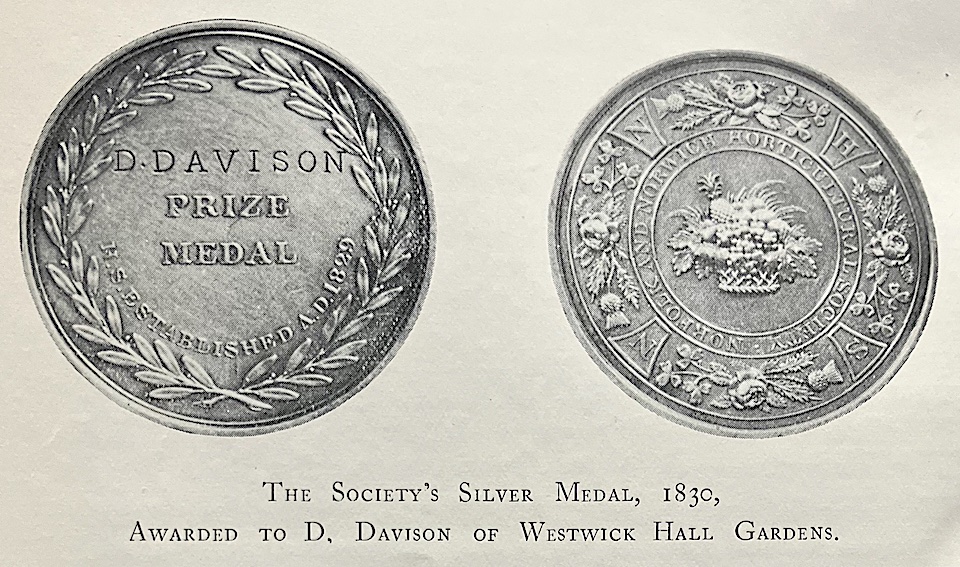
Since the ‘class of persons to whom prizes might be awarded would not be willing to accept a pecuniary acknowledgement, the Society would have a medal of its own.’ Accordingly, in 1830, Leonora Norgate of Hethersett Old Hall designed a medal to be struck in silver and bronze and, later, gold. However, two years later it was agreed that winning gardeners (i.e., Cottagers) could accept silver spoons in lieu of a medal ‘as a valuable and useful appendage to his household cupboard or his wife’s tea-board.’
Courtesy of reference [4]
NNHS exhibitions were held in what was the New Corn Exchange where the north end of Jarrolds’ department store now stands at the junction of Exchange Street and Bedford Street. In 1834 the society closed its season with a Déjeuner in the Assembly House for almost 400 guests. The cold collation was extensive – a long way from the ‘good ordinary’ of earlier years:
By the mid-nineteenth century the definition of ‘florists’ flowers’ was sufficiently lax for it to include any plant entered in a separate competitive class – plants such as chrysanthemums, woody plants like roses, and bedding plants like pelargoniums [5]. The single-species monomania of the Sons of Flora from the previous century was replaced by a new diversity, often displayed in the most humble circumstances. The 21 houses of Ebenezer Terrace, in the north of Norwich, were different from the insanitary ‘yards’ on the other side of St Augustine’s Street in that they had outdoor privies and, importantly, 20-foot-long south-facing front gardens.
OS map 1912-1914 showing Ebenezer Terrace (red lines, now demolished) off St Augustine’s Street, just inside Norwich’s old city wall. Courtesy of Ordnance Survey.
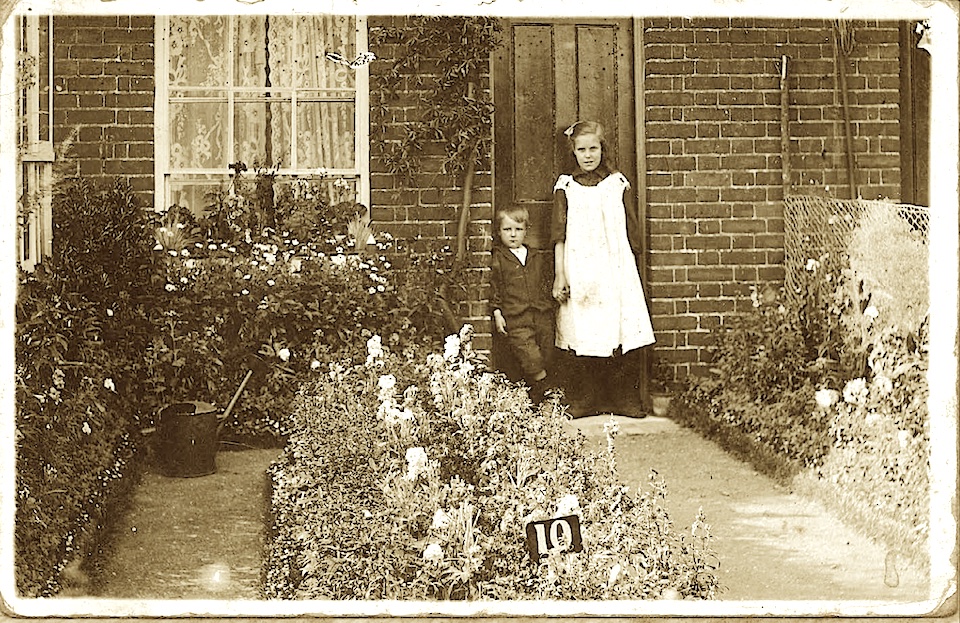
In an article from the Norfolk Gardens Trust Magazine [18], Marilyn Taylor describes how, from 1886 until 1911, the street held famous garden competitions that, according to the Eastern Evening News (1903), turned it into ‘Paradise Row’. Many of the gardeners worked in the surrounding shoe and textile factories and their diligence was held up as a healthy example for the artisan class. The Earl of Kimberley and Sir Maurice Boileau of Ketteringham Hall sent their garden staff as judges, and local businessmen such as J.J. Colman, and Henry Trevor of the Plantation Garden, gave prizes like silver teaspoons and boxes of cigars. It would be surprising if none of the old florists’ flowers were included but the ‘glorious bewildering mass of bloom’ seemed to be largely due to an eclectic mix of geraniums, calciolarias, coleus, feverfew, asters, stocks and nasturtiums.
Willie and Hilda Benn 1911, when their garden at No. 20 Ebenezer Terrace was 10th in the competition [18]. Courtesy of John Sayer
Join the Norfolk Gardens Trust The NGT publishes two magazines each year on landscape history and gardens. We visit at least three gardens (many not open to the public), and hold a series of talks in the winter months. Annual membership is only £10 per person (£15 for a couple). Press this link for further information
Sources
Stanley J. Wearing (1926). Georgian Norwich: Its Builders. Pub: Jarrolds, Norwich.
Ruth E. Duthie (1982). English Florists’ Feasts in the Seventeenth and First Half of the Eighteenth Centuries. Garden History (Pub: The Gardens Trust) 10: 17-35.
Ruth E. Duthie (1984). Florists’ Societies and Feasts after 1750. Garden History 12: 8-38.
James Edward Smith (1804). Transactions of the Linnean Society. vol 7: 295-301.
Ralph Knevet (1631). Rhodon and Iris. A Pastoral as it was presented at the Florists’ Feasts in Norwich, 3 May 1631. Available in Norwich Millennium Library
Norfolk Chronicle and Norwich Gazette May 23 1829.
C. Harman Payne (1908). The Florists’ Bibliography. Pub: William Wesley & Son, London.
A.W. Preston and J.E.T. Pollard (1929). The History of the Norfolk and Norwich Horticultural Society1829-1929.
Marilyn Taylor (2021). Ebenezer Terrace Garden Competition. Norfolk Gardens Trust Magazine No. 32 pp.11-14.
Thanks: I am grateful for the assistance of Sarah Wilmot of the John Innes Historical Collections; Jim Marshall, Vice Chair and Trustee of Plant Heritage; the staff of the Heritage Centre in Norwich; and Clare Everitt of Picture Norfolk.








 COLONEL UNTHANK'S NORWICH