• About
  • Colonel Unthank and the Golden Triangle (Unthank #1)
  • Colonel Unthank’s Norwich #2
  • Contact
  • Latest Colonel Unthank’s Norwich Book #3
  • Posts

COLONEL UNTHANK'S NORWICH

~ History, Decorative Arts, Buildings

COLONEL UNTHANK'S NORWICH

Category Archives: Norwich buildings

The Plains of Norwich

15 Tuesday Sep 2020

Posted by reggie unthank in Norwich buildings, Norwich history

≈ 12 Comments

Tags

Kett's Rebellion, Norwich Plains

I recently came across that quotation by Dorothy Parker about members of the Bloomsbury Group living in squares, painting in circles and loving in triangles. They couldn’t have done that in Norwich for although we have circles and triangles we don’t have squares. Instead, we have plains, an import from the Low Countries. 
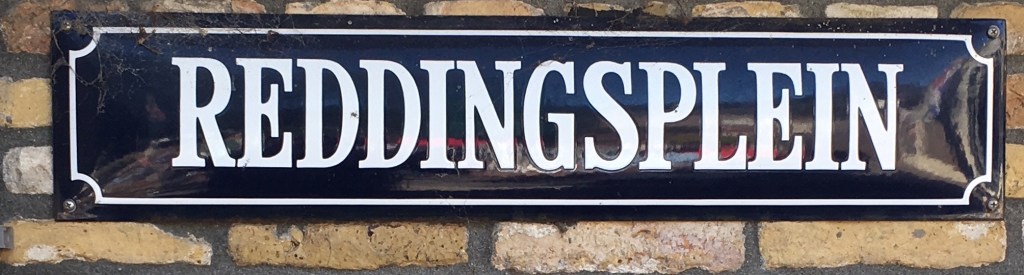
In modern Amsterdam, a ‘plein’ is an open rectangular space surrounded by buildings

Plains aren’t restricted to Norwich for you’ll stumble across them in Norfolk and Suffolk; I came across this one in Great Yarmouth.
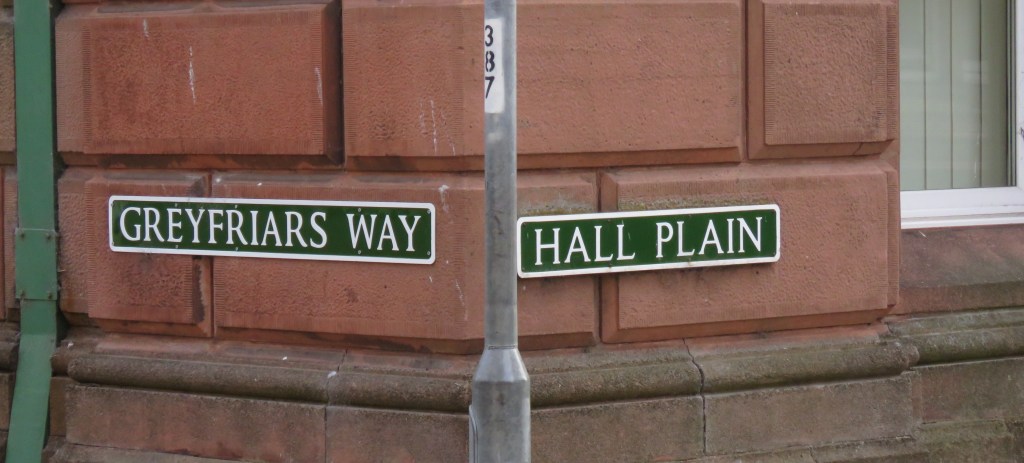
Hall Plain, just off the Quayside in Great Yarmouth

It was in 1566 that the Fourth Duke of Norfolk requested Queen Elizabeth’s permission to invite ‘thirty Douchemen’ to help revive Norwich’s flagging textile trade. The following year this trickle became a flood when Protestants from the Spanish Netherlands escaped the religious intolerance of Philip II of Spain [1]. But the word ‘plain’ for an open space predated these arrivals: Nicholas Sotherton’s eye-witness account of Kett’s 1549 rebellion refers to ‘the playne before the pallace gate’ [2] so the word was an earlier introduction, part of the city’s already long association with the Low Countries.
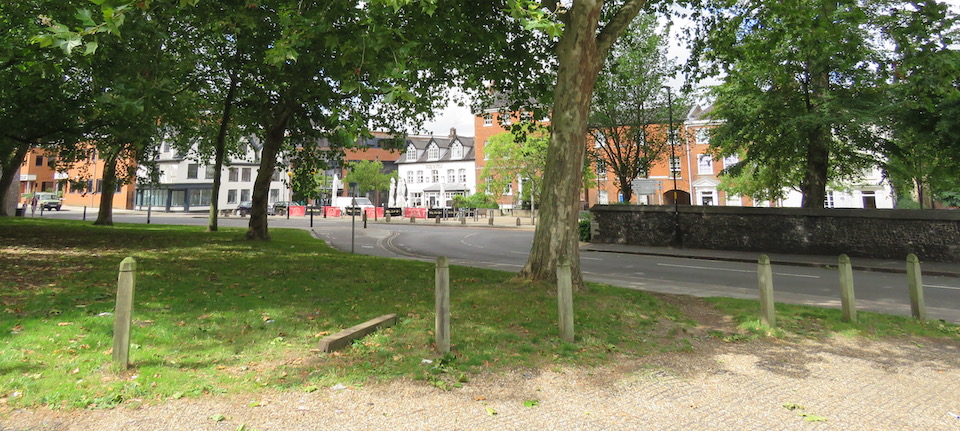
‘The playne before the pallace gate’. Looking out from the gate of the Bishop’s Palace towards St Martin at Palace Plain. Cotman’s house is the tallest of the red brick buildings, the churchyard of St Martin at Palace is to the right

St Martin at Palace Plain – now the site of the Wig & Pen pub and John Sell Cotman’s house – was the site of a pitched battle between the King’s forces and Robert Kett’s men.
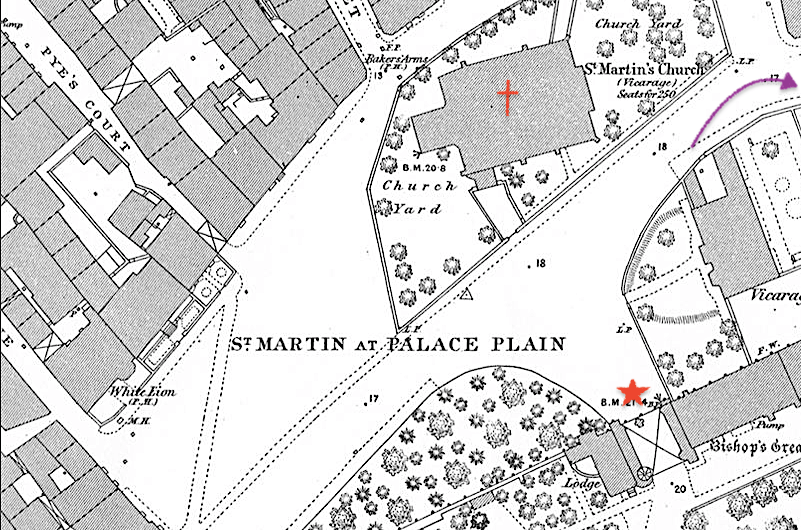
St Martin at Palace Plain. The church of St Martin at Palace is marked with a cross. The gate to the Bishop’s Palace is marked with a star and a plaque marking the death of Lord Sheffield is further along the Cathedral wall (arrow). 1884 OS map courtesy of [3]

Lord Sheffield fell from his horse and, as was the custom, he removed his helmet expecting to be ransomed. Instead, he was bludgeoned to death by a butcher named Fulke. Sheffield and 35 others were buried in the adjacent church. 
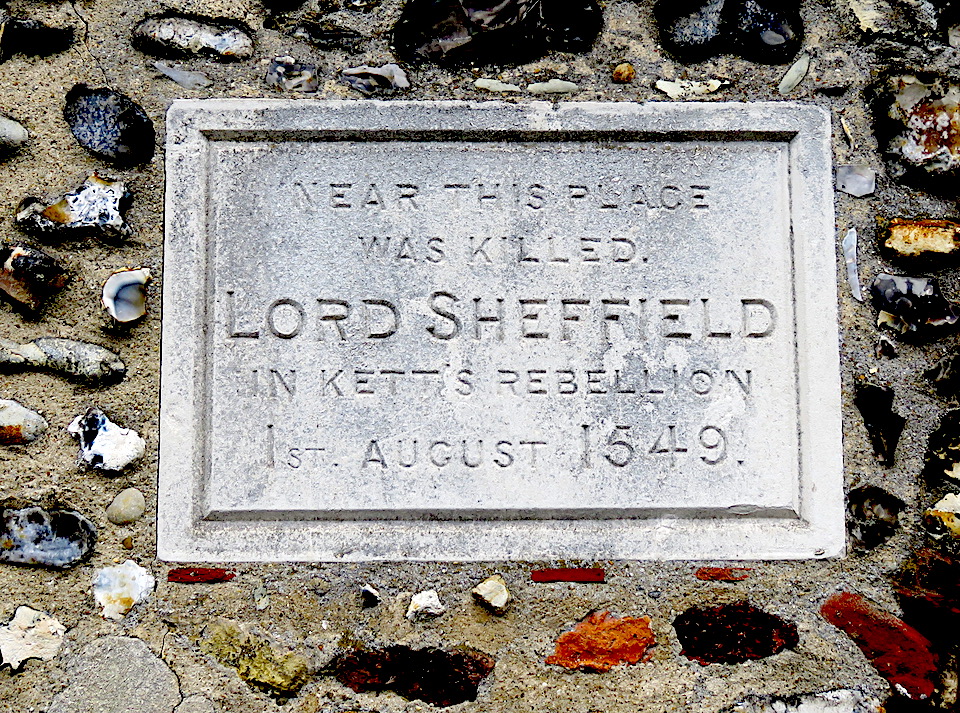
In his book The Plains of Norwich, Richard Lane wrote that only five of the fifteen Norwich plains are officially marked by a street sign; St Martin’s at Palace Plain is one of them as is Agricultural Hall Plain, at the east end of Castle Meadow [4].IMG_2805

At one time the castle was ringed by various livestock markets for which the Agricultural Hall of 1882 provided formal focus. The sloping plain outside the Hall stands at the top of Prince of Wales Road, a wide, curving street.  It was built in 1865 to connect Norwich Thorpe Railway Station to the city; it was never finished as planned and is only graceful in parts.  However, the buildings on the plain at the top of the road ‘dignify the new entry to the city’ [5].  From the left (below) we see: part of Barclays Bank – a huge banking hall designed like a Roman palazzo by the local firm of E Boardman & Son with Brierley & Rutherford of York (1929); next, a monument to the Boer War – the statue of Peace sculpted by George and Fairfax Wade (1904); then the Royal Hotel, another local masterpiece by the Boardmans (1896-7), decorated in  moulded red brick from Gunton’s Costessey Brickworks [6]. To the right we get a glimpse of the Agricultural Hall itself. It was built in 1882 in local red brick and alien red Cumberland sandstone, again relieved with decorative Cosseyware.
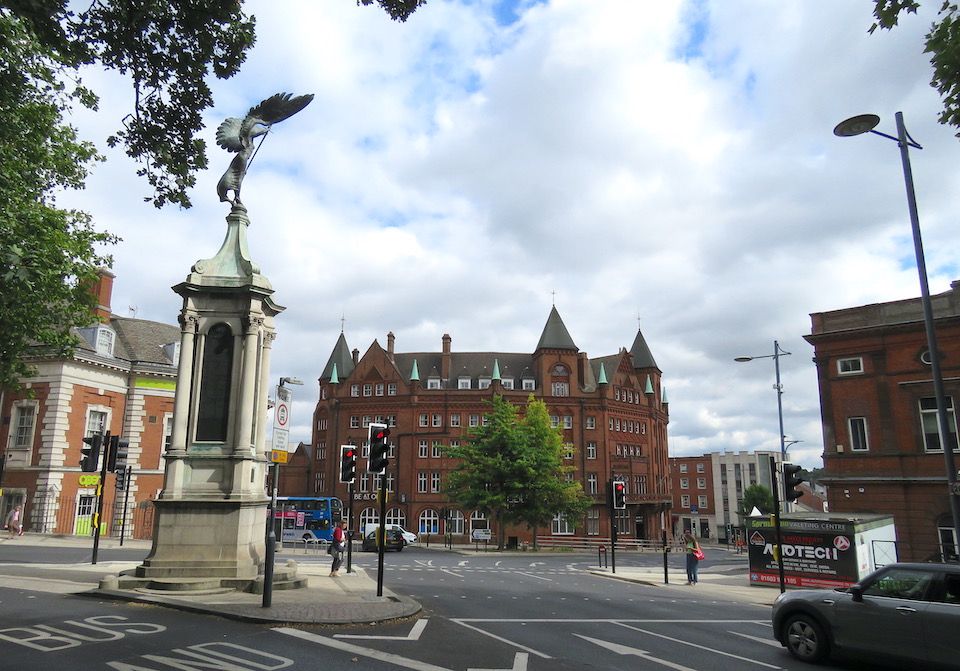
The Agricultural Hall was inaugurated in 1882 by the Prince of Wales, the future King Edward VII, who was Patron of the Norwich Fat Cattle Show Association. This was the year that Oscar Wilde started his lecture tour of America where one of his topics was ‘The House Beautiful’. Two years later he came to the Agricultural Hall to deliver the same lecture, no doubt well received by cattlemen on both sides of the Atlantic.
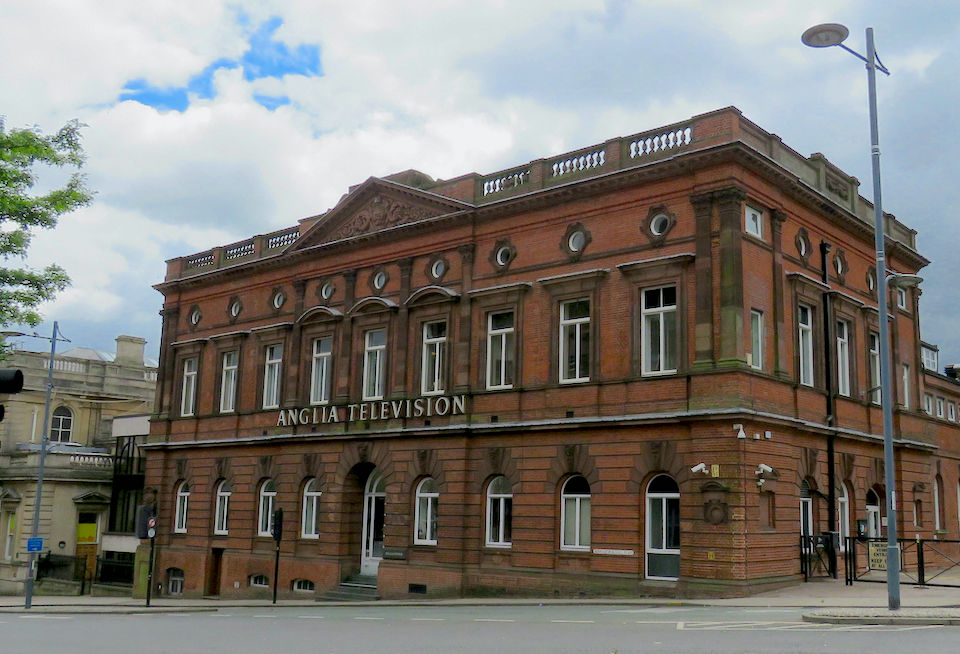
The Agricultural Hall

Just visible to the left is the former Crown Bank of 1866 built by Sir Robert Harvey. As we saw in The Norwich Banking Circle, Harvey named his Crown Bank after the Crown Point estate, just outside the city at Whitlingham. The estate was bought from the aptly named Major Money – intrepid balloonist and someone who had served in the army at Crown Point fort in North America.
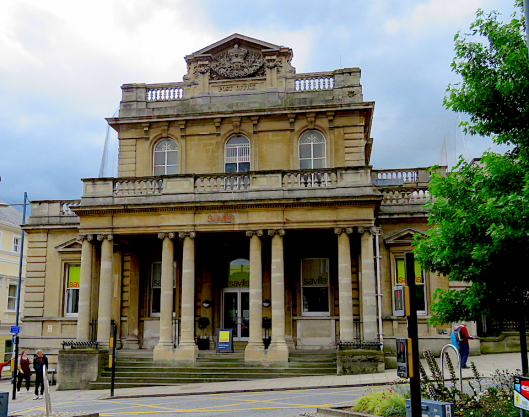
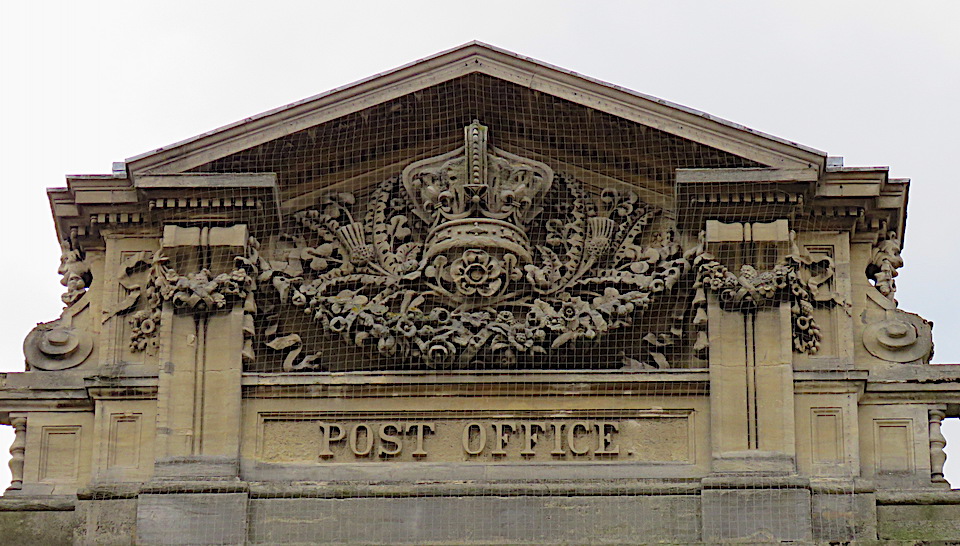
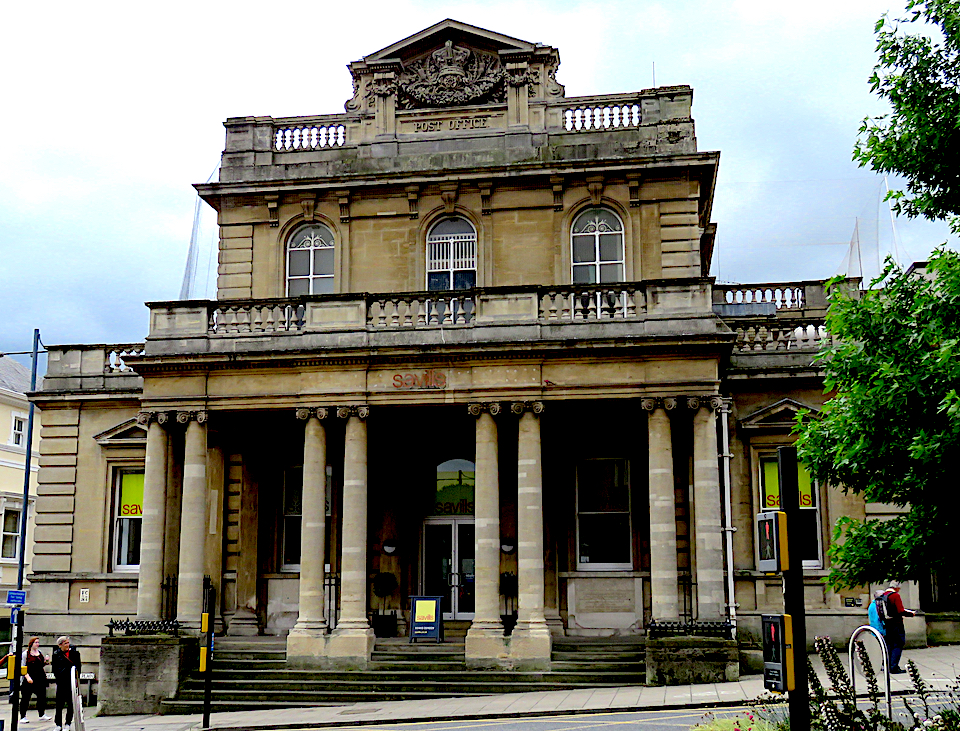
Harvey shot himself after his dubious investments discredited the bank. The crown carved into the pediment of the Crown Bank then doubled as an appropriate symbol for the Post Office until 1970

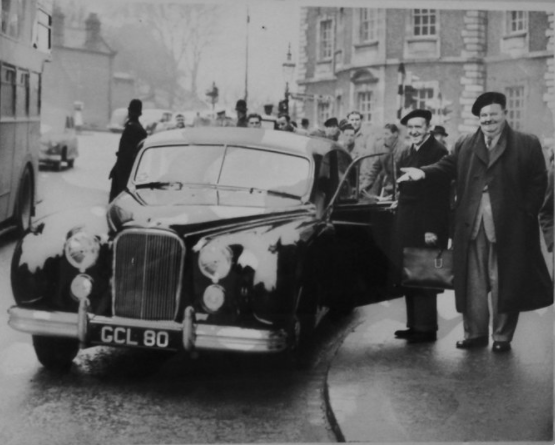
Before we leave Agricultural Hall Plain we should take some cheer from knowing that Laurel and Hardy stayed in the Royal Hotel in 1954.
Looking out from the Hall (now Anglia TV), across Agricultural Hall Plain, is its conjoined twin – Bank Plain.
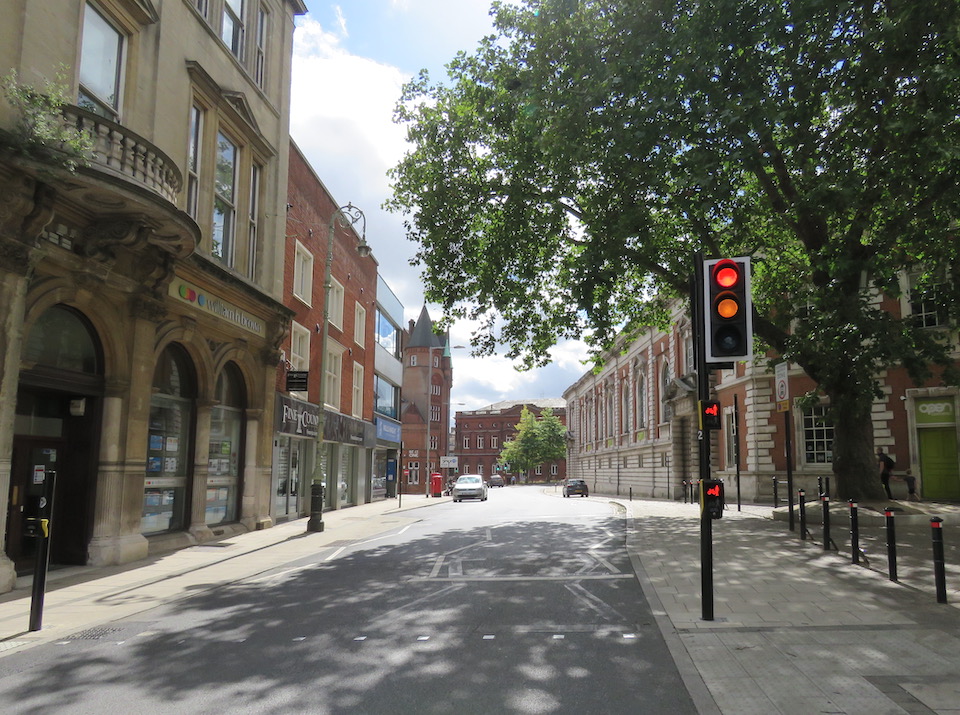
Bank Plain, with the balcony of a Boardman building to the immediate left, the turreted Royal Hotel in the distant left, the Agricultural Hall ahead and the former Barclays Bank to the right.

On the site now occupied by the former Barclays Bank stood its predecessor, Gurney’s Norwich Bank, established in the late C18.
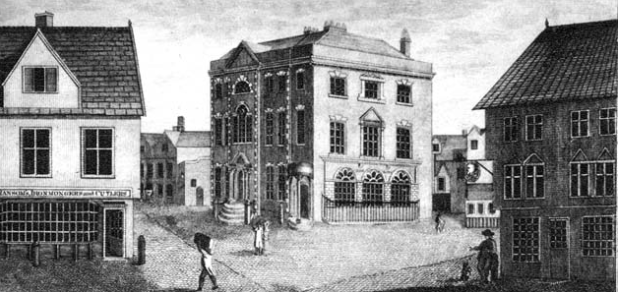
Gurney’s Bank and the adjacent Bank Plain. Courtesy of the Library at Friends’ House

At the time, the open space was called Redwell Plain but after Gurney’s opened it became known as Bank Plain. The well is still commemorated in Redwell Street, which runs between Bank Plain and St Andrew’s Street.
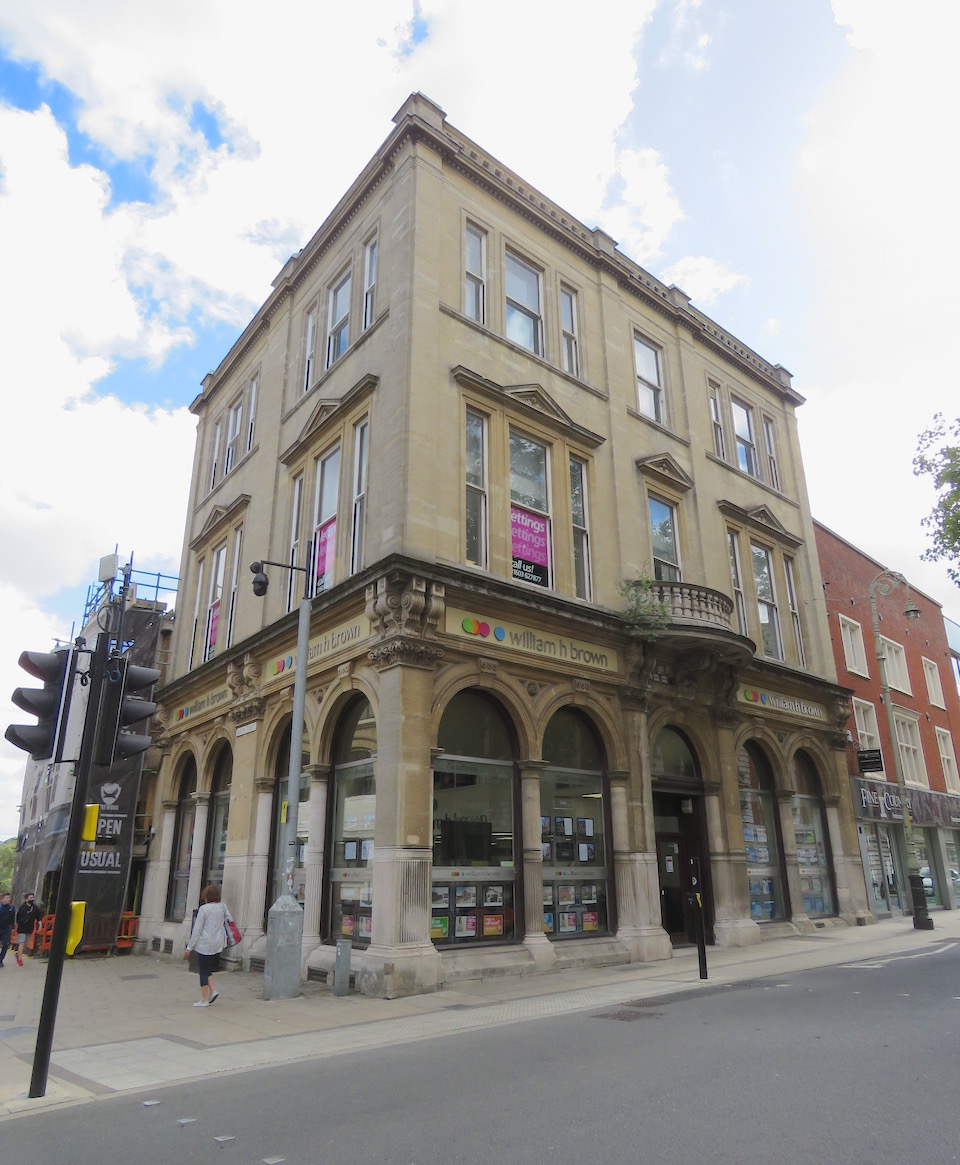
img_2728
In 1899, E Boardman & Son designed this Classical building for the Royal Insurance Company. It stands at the junction of Bank Plain and Queen Street, where the Boardmans’ own offices were situated in Old Bank of England Court.
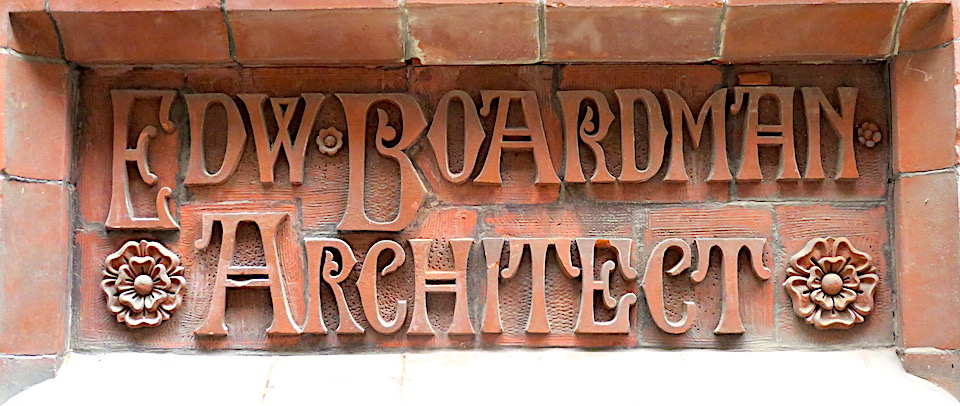
Edward Boardman’s sign, carved from Costessey clay. Old Bank of England Court, Queen Street

Today, it is possible to travel to St Andrew’s (Hall) Plain by following the bend in the road down the hill to Suckling House/Cinema City. But, as the map shows, this extension of St Andrew’s Street did not exist in 1884; it was created so that the new electric trams, which ushered in the twentieth century, could avoid the tight corner where Redwell Street meets Princes Street.
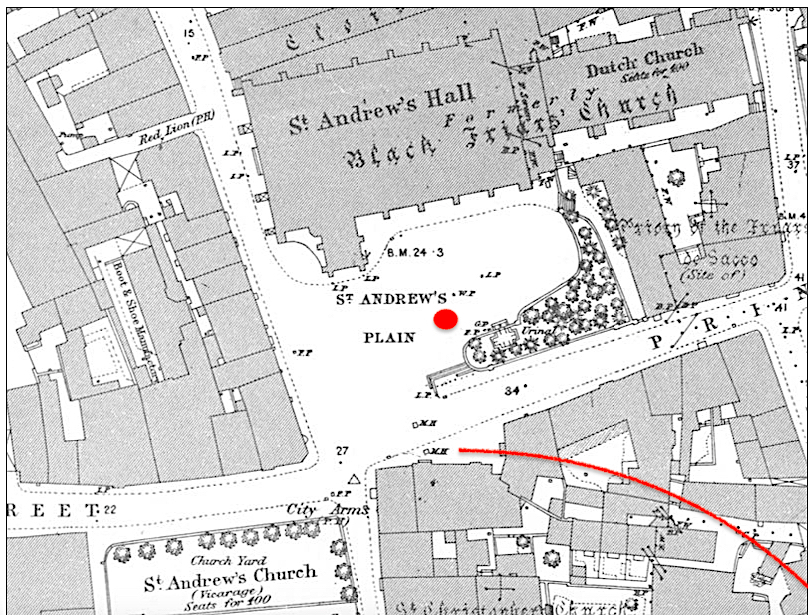
The curved line shows the approximate route of the new tramway constructed in 1900, joining Bank Plain to the plain outside St Andrew’s Hall. 1884 OS map courtesy of [3]

Garsett House – also known as Armada House since it was reputedly built from the timbers of a ship wrecked during the Spanish Armada – was bisected in the process.
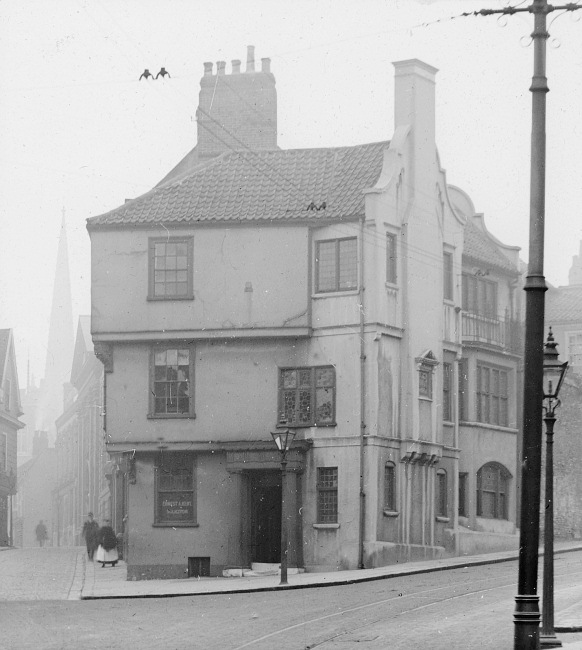
The right-hand side of Armada House, also known as Garsett House (Sir Robert Garsett d.1611), was demolished to make way for the electric trams. Note the overhead wires.
St Andrew’s Hall Plain. This scene was prior to 1892 when a public lavatory was built in the curved piece of wall. ©Norfolk County Council at Picture Norfolk

St Andrew’s Hall is the nave of what was the Blackfriar’s or Domican church of Norwich – the most complete surviving medieval friary in England. Present-day Blackfriars Hall was formerly the friars’ chancel and, as the map above indicates, was also once the church of the Dutch-speaking community [1].
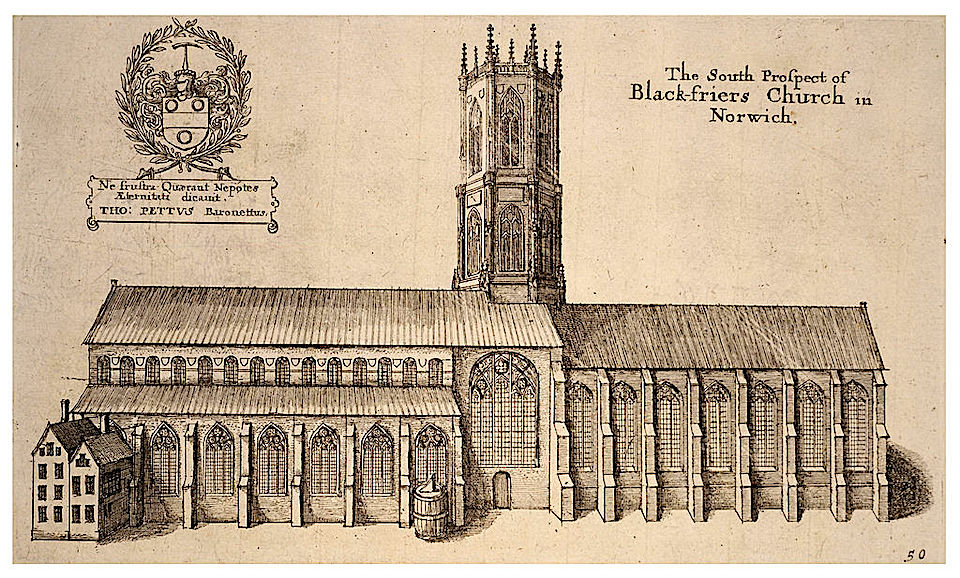
The engraving by Wenceslas Holler (1607-1677) shows the nave and chancel meeting beneath an octagonal tower that collapsed in 1712. Home to the ‘Order of Preachers’, as the Dominican Friars are known, the large internal volume of St Andrew’s Hall was designed for spreading the word [7]. Outside, St Andrew’s Plain was also used as a preaching yard but during Kett’s Rebellion it witnessed less peaceable activity for it was on the plains, rather than the tortuous medieval alleyways, that pitched battles could be fought. Sotherton saw the rebel bowmen let loose ‘a mighty force of arrowes’… ‘as flakes of snow in a tempest’ but Captain Drury’s band of arquebusiers, with their early versions of the musket, replied with ‘such a terrible volley of shot (as if there had been a storm of hayle)’, leaving about 330 dead [2]. St Andrew’s Hall was used as stables until the uprising was quelled.

Maddermarket Plain is one of the city’s smaller plains [4]. It is situated at the junction of St Andrew’s Street, Duke Street, St John Maddermarket (formerly St John’s Street) and Charing Cross. The latter two names provide a thumping clue to the history of this district. ‘Charing Cross’ is thought to be a corruption of ‘shearing’ – the process where the raised pile on woollen cloth was cut to a standard height with shears. ‘Madder’, of course, refers to the red/deep pink dye derived from madder roots and used to colour fabric the famous ‘Norwich Red’.
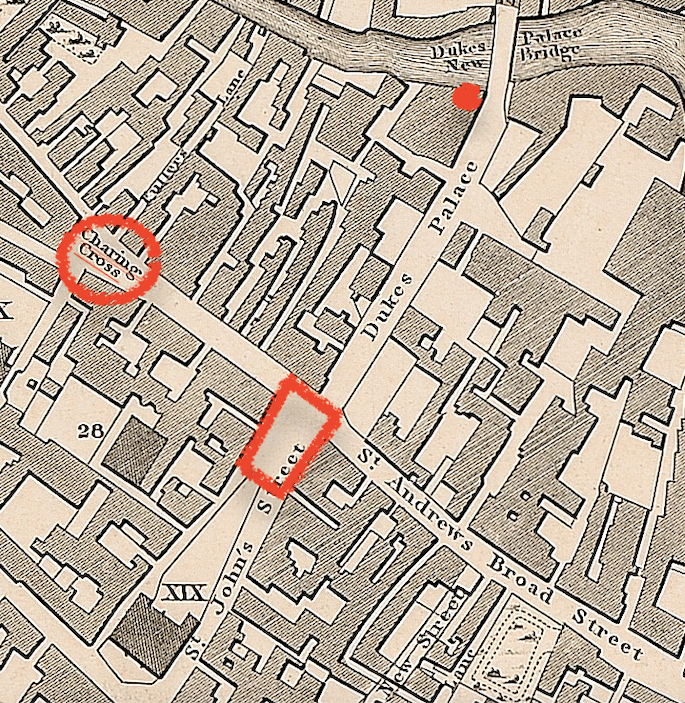
Maddermarket Plain at the end of the raised graveyard of St John Maddermarket. Charing Cross is circled; the red dot marks the site of Michael Stark’s dyeworks adjacent to Duke’s Palace Bridge. The church of St John’s Maddermarket is marked XIX. Millard & Manning’s Plan of the City of Norwich 1830

The Charing Cross/Westwick Street area was at the heart of the textile industry [4] and the river was where its waste products ended up. Just above Charing Cross on the map is Fuller’s Lane – fulling being a process in which cloth is cleaned. In a previous post [8] we saw that in the C19 the master dyer Michael Stark emptied his dye vats into the Wensum from his factory next to the Duke’s Palace Bridge but this kind of pollution had been happening for centuries. On his journeys through England in 1681 Thomas Baskerville noted that the duke’s great townhouse was ‘seated in a dung-hole place’, surrounded by tradesmen cleaning and dyeing cloth [9]. The palace was later abandoned.

At the beginning of the 1500s, Norwich had been devastated by two fires that destroyed over 1000 houses [10]. The extent of the damage was such that some 70 years later the mayor was discussing how to deal with unrestored plots. When Queen Elizabeth I visited Norwich in 1578 she commented on the number of derelict properties despite the steps taken to shield her from the worst. To convey her from the Marketplace to the Cathedral (centuries before Exchange Street was open) the east wall of St John’s Maddermarket was rebuilt in order to widen the street [4].
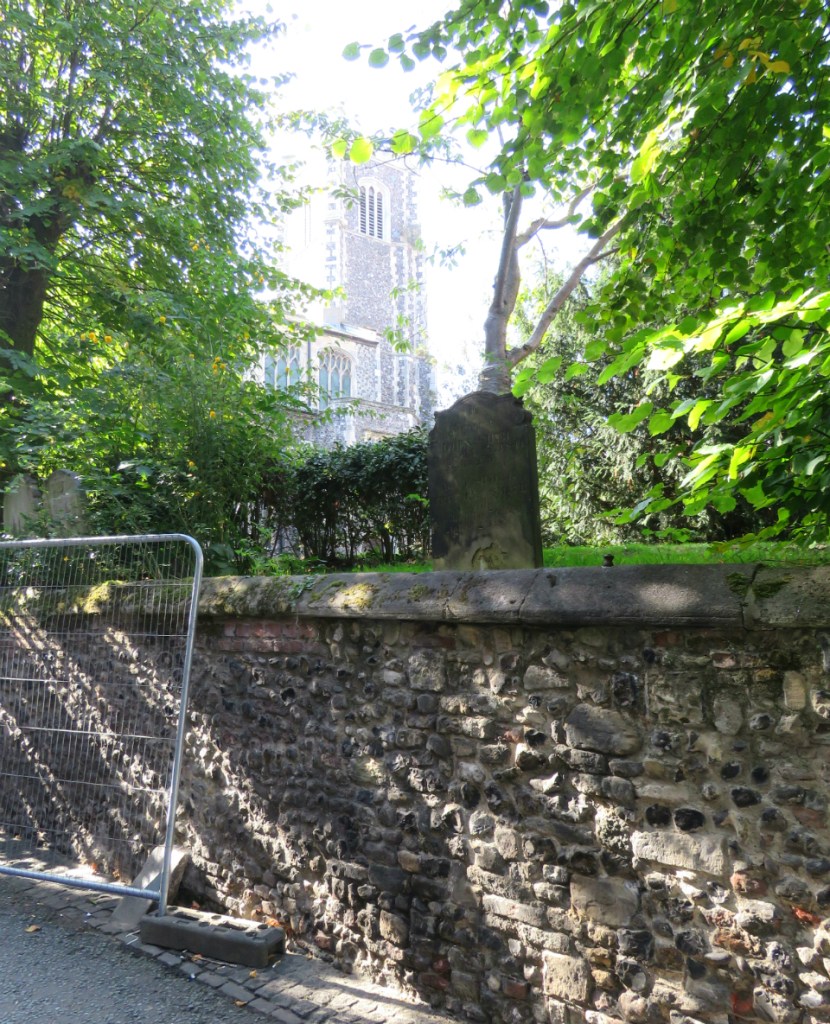
In 1671 John Evelyn noted that the city’s churchyards were filled to the tops of the walls. Today the wall, perhaps the one rebuilt for Queen Elizabeth I’s visit, awaits repair.

 In his book, Richard Lane [4] skips forward a few centuries to end with the last recorded plain of the twentieth century. This is University Plain, the site of the University of East Anglia where Sir Denys Lasdun built his 1960s paean to concrete. You might imagine the plain to be an open meeting space, such as the amphitheatre-like Central Court, but it appears to refer to the large site as a whole.
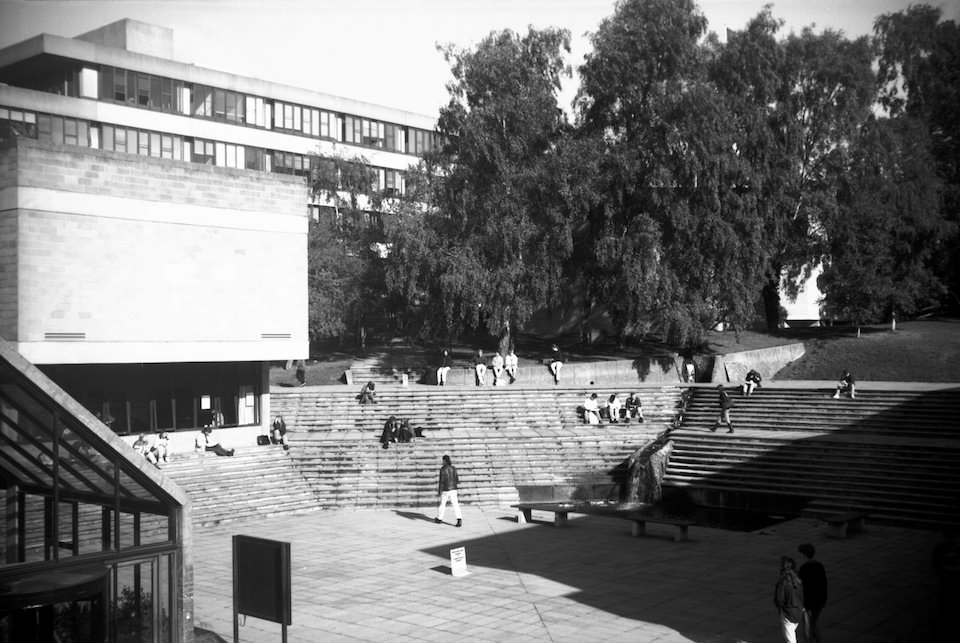
University Central Court and waterfall 1990 ©georgeplunkett.co.uk

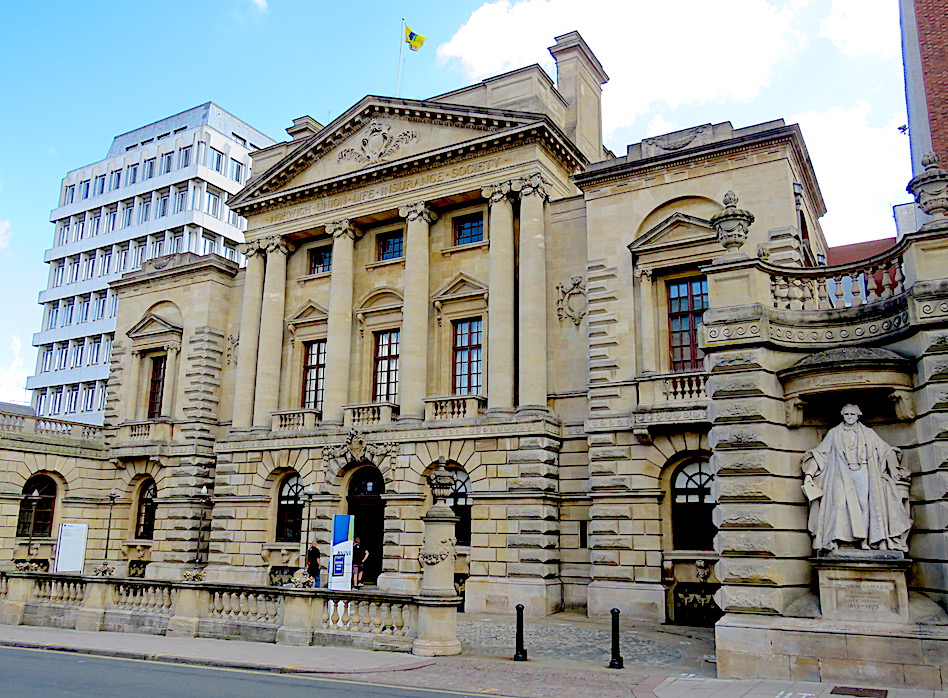
The use of the word ‘plain’ continues into the twenty-first century. In 1771 William Fellowes, a wealthy and philanthropic squire, built in Shotesham (ca. eight miles south of Norwich) what is claimed to be the earliest cottage hospital in England. Benjamin Gooch was the first surgeon and he, together with Fellowes, went on to propose a new general hospital for the city of Norwich. Designed by local architect William Ivory, the Norfolk and Norwich Hospital was built just outside the city wall at St Stephen’s Gate on land provided by the council at a nominal rent. Fellowes laid the foundation stone in 1771 and it was completed in 1775.
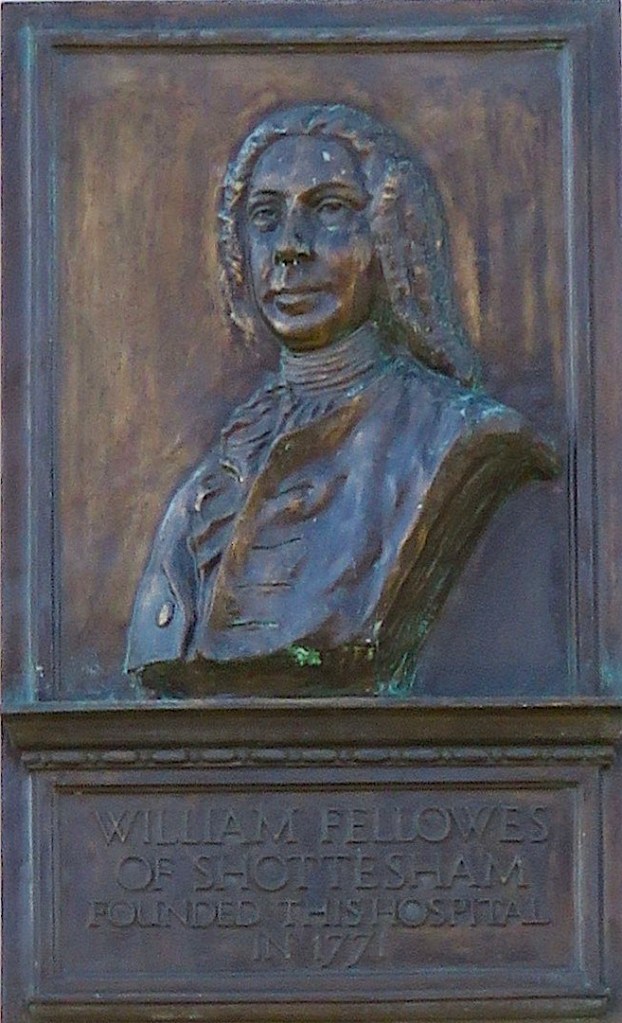
Memorial plaque to William Fellowes on the former N&N Hospital in St Stephen’s Road

In 2003 a new hospital was built on the outskirts of Norwich at Colney leaving the old N&N site to be developed for housing by Persimmon Homes on the newly-coined Fellowes Plain [11].
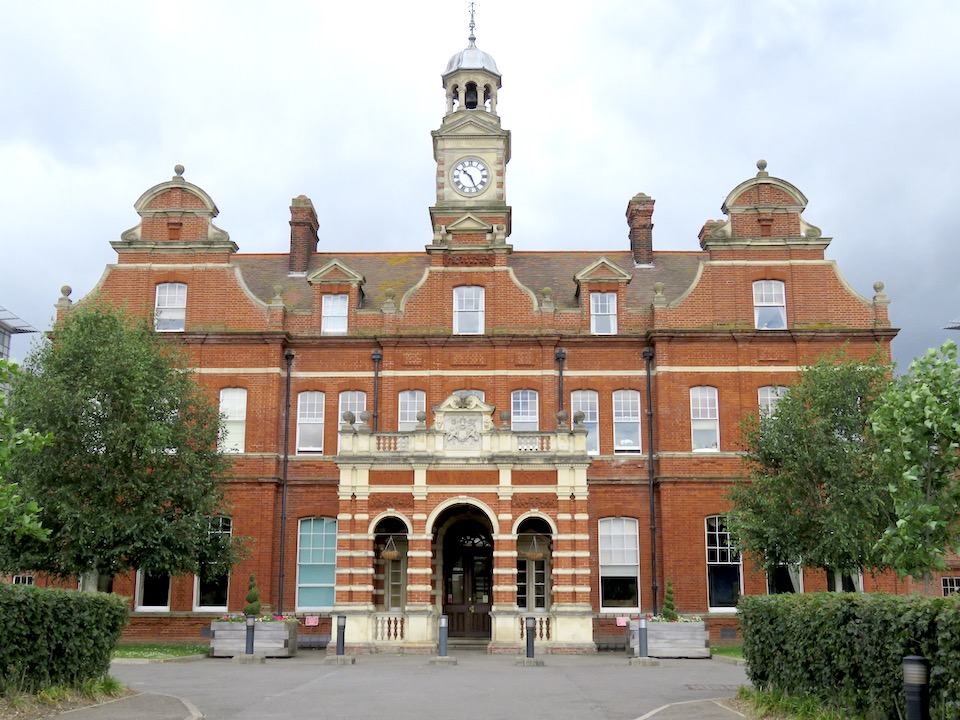
The Norfolk and Norwich Hospital, refurbished in the C19 by Edward Boardman

The word ‘plain’, as applied to Fellowes Plain, seems to refer to the entire site although three open spaces within this are named ‘plain’ in their own right. The first is Kenneth McKee Plain, dedicated to Ken McKee CBE (1906-1991), orthopaedic surgeon at the N&N who pioneered the total hip replacement.
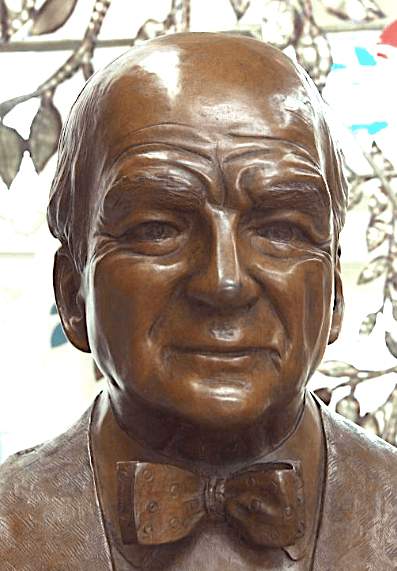
Kenneth McKee CBE, sculpted by his daughter in law, Gina McKee 1988. Courtesy racns website [12]

The second is Edward Jodrell Plain. Dozens of searches provide no insight beyond repeating the salient fact that he was a major benefactor. The Jodrell family of Bayfield Hall, near Holt, were known to have been benefactors to the N&N [13]. As far back as 1814 Henry Jodrell left £200 to the hospital in his will. His nephew Edward (1785-1852) and Edward’s son Captain Edward Jodrell have the necessary forename but it was Captain Jodrell’s youngest son Alfred who seems best remembered for his philanthropy. He sent baskets of fruit and vegetables each week to the hospital and at Christmas gave 40 oven-ready chickens and the same number of turkeys, underlining the Jodrells’ tradition of giving to the Norfolk and Norwich Hospital.

The third plain on the site of the old hospital is the large green known as Phillipa Flowerday Plain.
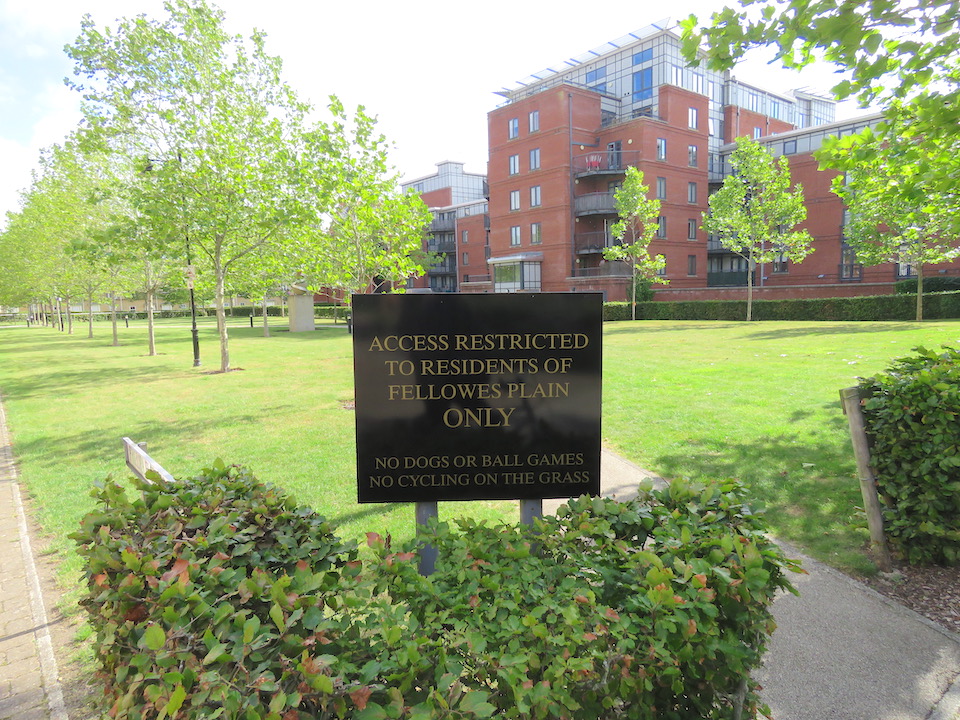

Variously spelled ‘Phillipa’ or ‘Philippa’, the former is the spelling given in the UK 1881 National Census for Phillipa Flowerday, ‘sick nurse’.

Before being employed by Colmans at their Carrow Works, Phillipa Flowerday (1846-1930) trained and worked as a nurse at the Norfolk and Norwich Hospital. According to Rod Spokes, former Colmans manager, when the company’s dispensary was founded in 1864 a man was employed to visit male employees at home and report on cases of need. In 1872, Phillipa was employed to visit the families of the workpeople as well as assisting the doctor in the dispensary. She is therefore celebrated as the first industrial nurse in the country [14].
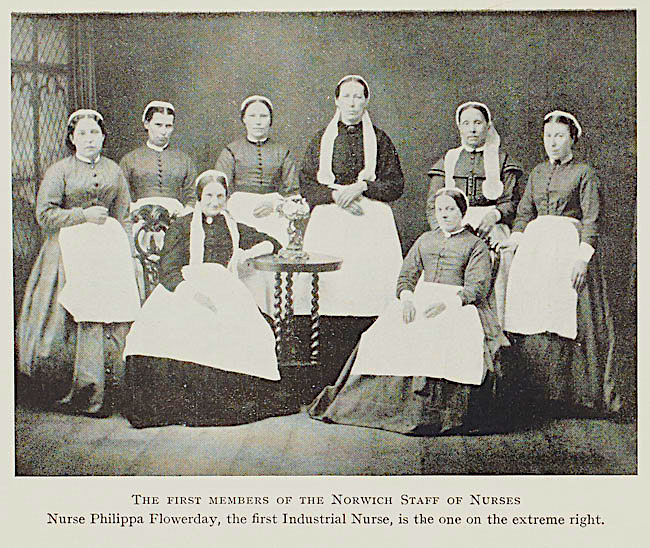
Phillipa Flowerday far right. Image courtesy of Norfolk Record Office at www.picture.norfolk.gov.uk

To be continued …

©2020 Reggie Unthank

Sources

  1. https://colonelunthanksnorwich.com/2019/08/15/going-dutch-the-norwich-strangers/
  2. https://archive.org/stream/kettsrebellionin00russuoft/kettsrebellionin00russuoft_djvu.txt
  3. http://www.norwich-heritage.co.uk/norwich_maps/Norwich_map_1884_zoomify.htm
  4. Richard Lane (1999). The Plains of Norwich. Pub; Lanceni Press, Fakenham.
  5. Nikolaus Pevsner and Bill Wilson (1997). The Buildings of England. Norfolk I. Norwich and North-East. Pub: Yale University Press.
  6. https://colonelunthanksnorwich.com/2016/05/05/fancy-bricks/
  7.  https://historicengland.org.uk/listing/the-list/list-entry/1220456
  8. https://colonelunthanksnorwich.com/2018/07/15/the-bridges-of-norwich-1-the-blood-red-river/
  9. https://colonelunthanksnorwich.com/2018/12/15/the-absent-dukes-of-norfolk/
  10. https://colonelunthanksnorwich.com/2019/12/15/norwich-shaped-by-fire/
  11. https://en.wikipedia.org/wiki/Norfolk_and_Norwich_Hospital
  12. http://www.racns.co.uk/sculptures.asp?action=getsurvey&id=797
  13. https://en.wikipedia.org/wiki/Bayfield_Hall
  14. https://en.wikipedia.org/wiki/Philippa_Flowerday

Thanks: I was inspired to write this post by Richard Lane’s excellent book on Norwich Plains and I have drawn upon it freely. I am grateful to Clare Everitt of Picture Norfolk for permissions and the George Plunkett website for the use of photographs. I am grateful to Rod Spokes for information about the Colmans dispensary.
Share this:

  • Click to share on Facebook (Opens in new window) Facebook
  • Click to share on X (Opens in new window) X
  • Click to share on Pinterest (Opens in new window) Pinterest
  • Click to email a link to a friend (Opens in new window) Email
  • Click to print (Opens in new window) Print
Like Loading...

Twentieth Century Norwich Buildings

15 Saturday Aug 2020

Posted by reggie unthank in Norwich buildings, Norwich history

≈ 17 Comments

Tags

Denys Lasdun, Edward Boardman, George Skipper, Rick Mather, Sainsbury Centre, The Forum Norwich

The confrontation between the Classical Revival (based on Greco-Roman principles of symmetry and proportion) and the Gothic Revival (based on the pointed arches and pinnacles of  English medieval cathedral-building) dominated this country’s architecture in the nineteenth century. There is very little Victorian Gothic in Norwich but the Classical influence endured well into the twentieth century as the preferred style for temples of commerce. It took World War II and the post-war clearances before the modern took hold.

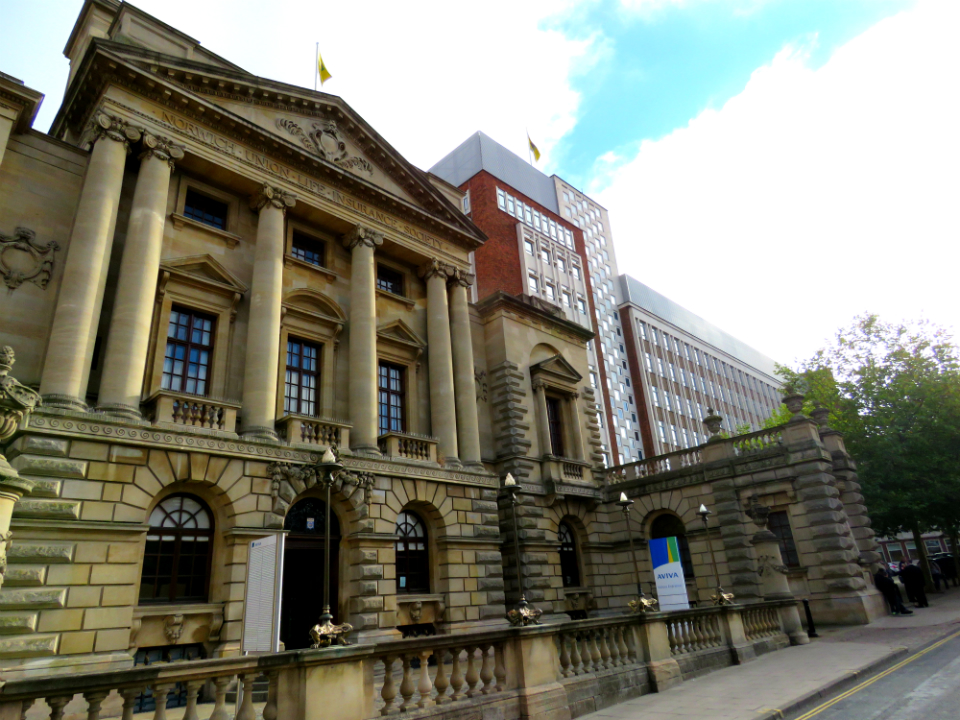
At the beginning of the century, George Skipper designed his masterwork for Norwich Union: “Without any doubt … one of the most convinced Edwardian office buildings [1].

IMG_2518.jpeg

George Skipper’s Surrey House for Norwich Union (now Aviva) 1904

In 1926, FCR Palmer and WFC Holden designed a ‘splendid’ building for the National Westminster Bank in London Street. Pevsner and Wilson wrote that it was modelled on a Wren city church: “One would assign a much earlier date to it [1].”

IMG_2553.jpeg

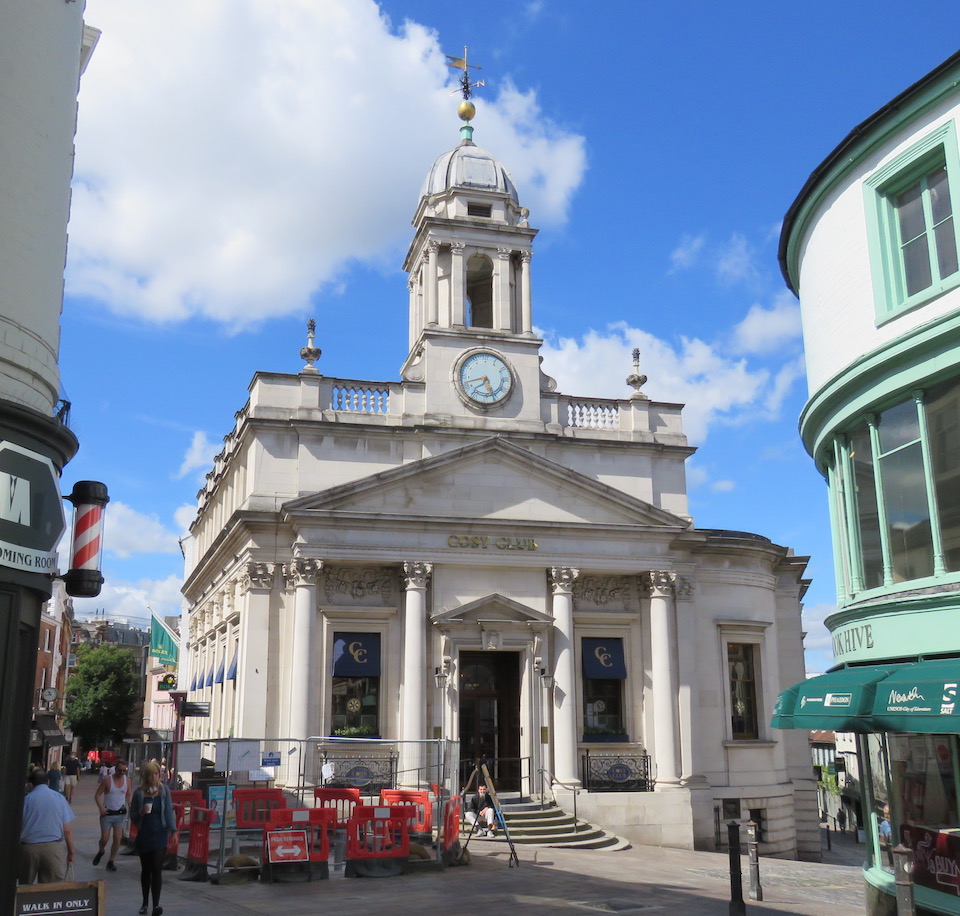
A Wren-like church in the first pedestrianised street in the country. Now the Cosy Club.

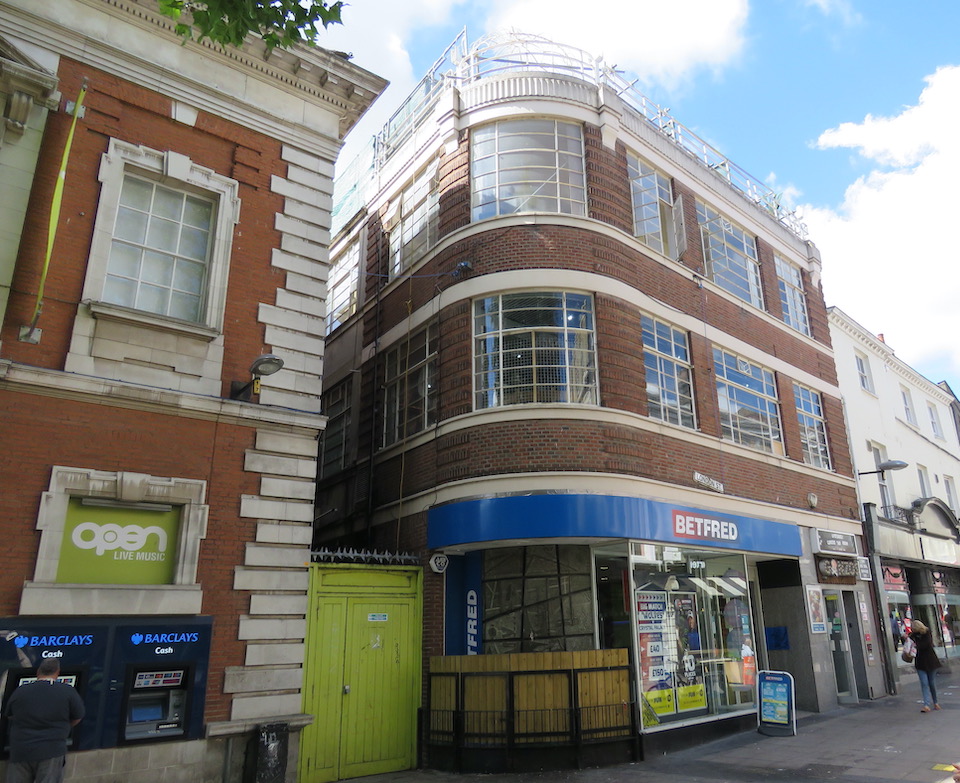
And as late as 1929 “a kind of Renaissance [1]” style was employed for the large Barclays Bank on Bank Plain that replaced the C18 bank of Gurney & Co, formed as an amalgamation of Quaker banking interests.

IMG_2546.jpeg

Designed for Barclays Bank by Edward Boardman & Son with Brierley & Rutherford of York, it was last used by the Open Youth Charity, now in liquidation.

Below, the Stuart Court apartments in Recorder Road show that the Arts and Crafts Movement also survived into the C20. These were built in the manner of almshouses by ET Boardman; he had married into the Colman family and designed the Dutch-gabled houses in memory of his brother-in-law James Stuart who had been concerned about the poor quality of housing for the elderly. The Dutch gables are a perfect example of vernacular revival in a city whose population at one time contained one third or more religious refugees from the Spanish Netherlands.

IMG_1963.jpeg

Stuart Court, designed by ET Boardman in 1914 but not completed until after the war

Behind the traditional facade the Stuart apartments were built around reinforced concrete but this material, and metal framework, had been used in the Boardman practice for decades. In fact a more forward-looking kind of architecture – neither Gothic nor Classical but proto-modern in the suppression of detail – had been introduced to the city by Boardman Senior with his factory buildings nearly half a century earlier.

Bally.jpg

Haldinstein and Bally shoe factory (1872) by E Boardman 2-4 Queen Street

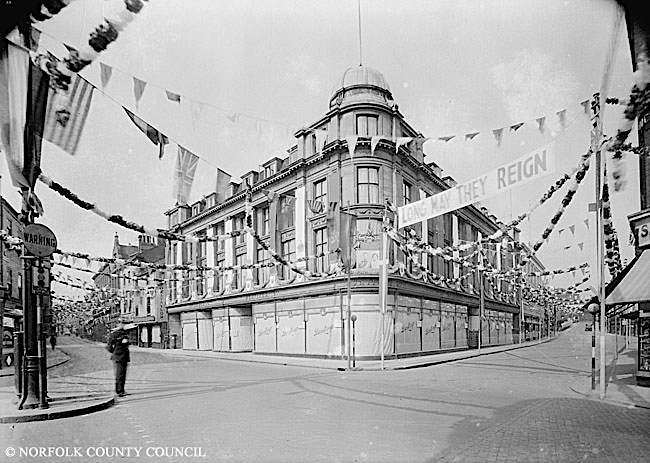
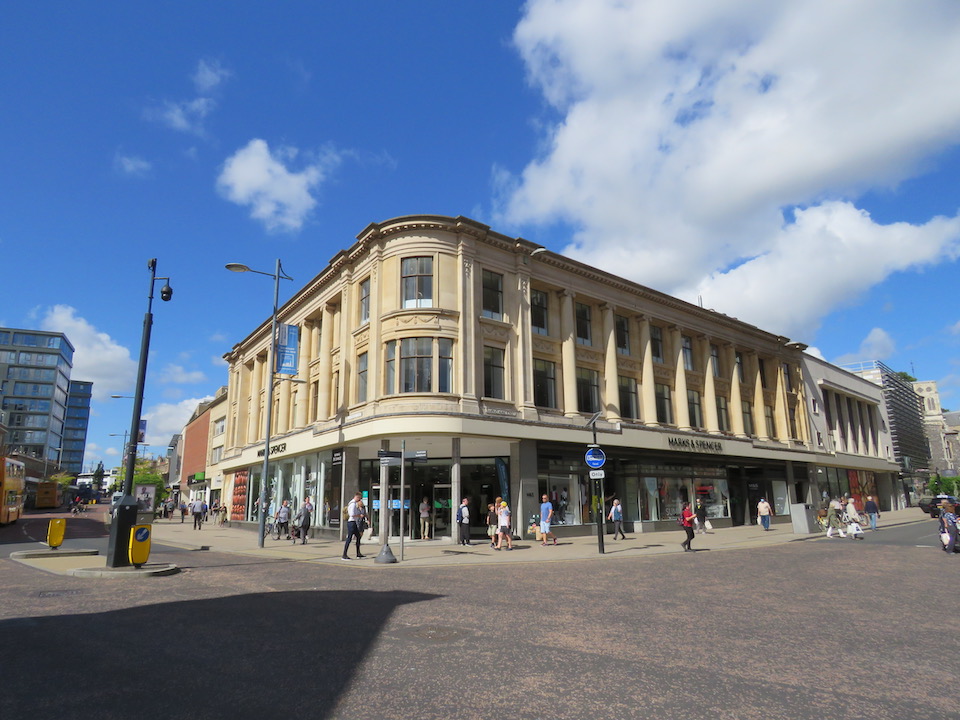
In 1912, Bunting’s Drapers and General Warehousemen of St Stephen’s Street was constructed by Norwich-based architect AF Scott using non-traditional techniques. Here, an internal steel support was clad with stone curtain-walling but there was still a diffidence in giving it a more modern external appearance. Instead, the building was decorated in a genteel Classical Revival style, the stone panels beneath the windows carved with ‘Adam’ swags.

0 N

Buntings Department Store, early C20. It was to be bombed in WWII.  ©Norfolk County Council at Picture Norfolk

The structure was topped by a cupola of the kind that George Skipper had used as a signature on his buildings around 1900 [3].

skipper cupolas2.jpg

IMG_2520.jpeg

‘Buntings’ site at the corner of St Stephens’ and Rampant Horse Streets is now occupied by Marks and Spencer, minus the dome. The more modern infill to the right is the former site of F W Woolworth.

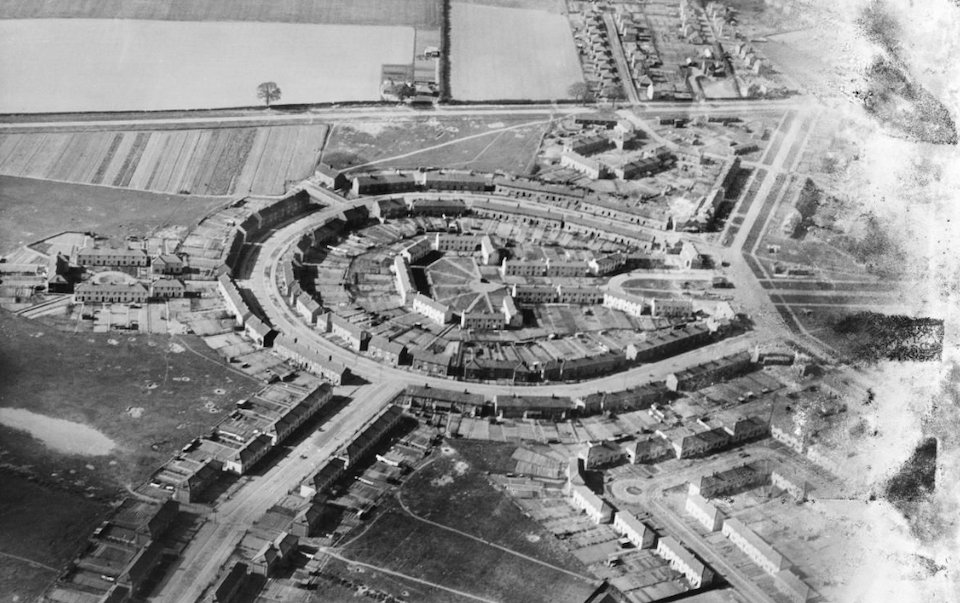
After WWI the city’s priority was to build, in Lloyd George’s words, “homes fit for heroes”. This involved massive slum clearance followed by a programme of local authority house-building that led to 40% of the population living in council houses by the end of the 1950s [1]. The most notable of the municipal estates was at Mile Cross, north of the city centre (1918-20). This was the council’s first foray into large estate building, for which they engaged Stanley Adshead, the first Professor of Town Planning at University College London, who laid out the estate on Garden City principles [4].

Mile x use this.png

Mile Cross 1928. ©http://www.britainfromabove EPW021219

Variety was achieved by modifying standard house plans. Local architects such as George Skipper (a long way from his ‘fireworks’ of the turn of the century) and AF Scott (better known for his work on Methodist chapels) adapted these to reflect early C19 Norwich neo-Georgian housing; others incorporated Arts and Crafts details, such as pin tiles on the first floor elevation that seem more reminiscent of Kent and Sussex than Norfolk [4].

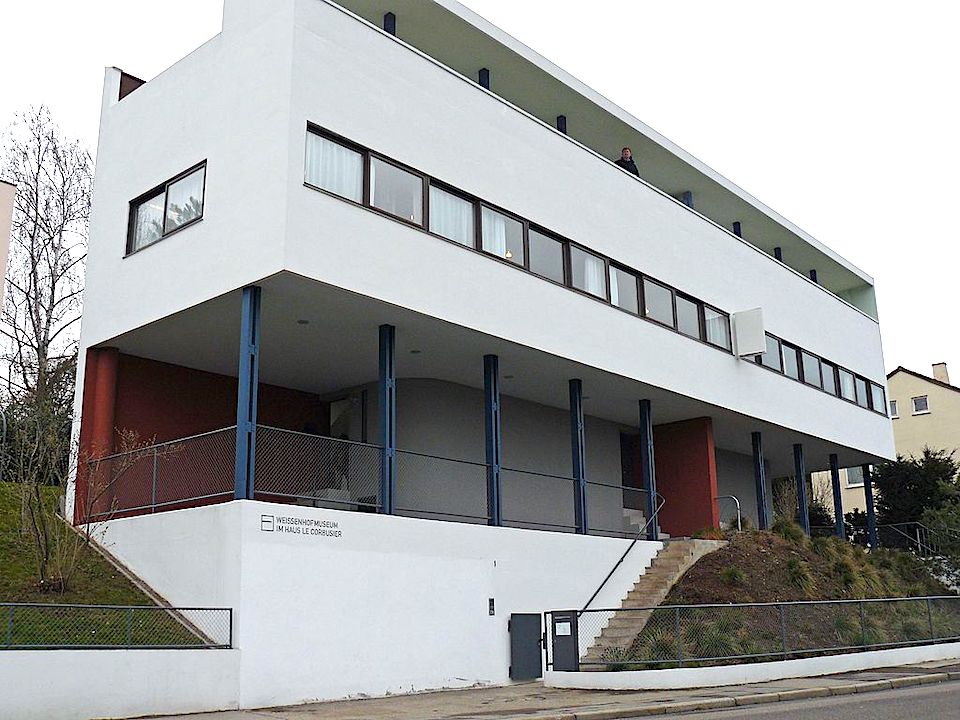
While social housing was adhering to the traditional, a revolutionary new international movement was evolving. In 1927 the Bauhaus, founded in Germany by Walter Gropius, began teaching a new kind of architecture in which reinforced concrete was used to produce sweeping layers, its minimalist horizontal lines emphasised by long runs of ribbon window.

1024px-thumbnail Gropius.jpg

The uncluttered International style of the Weissenhof estate housing designed by Le Corbusier in 1927. Photo by qwesy qwesy. Creative Commons Attribution 3.0 unported licence

It would be some years before the International style took hold in Norwich. Diffident nods towards Modernism were provided by the rounded steel windows of the Streamline Moderne version of Art Deco: first at the former Abbey National Building Society offices in London Street …

IMG_2542.jpeg

Designed in the 1930s by FH Swindels of the Boardman office who also helped design Barclays Bank to the left

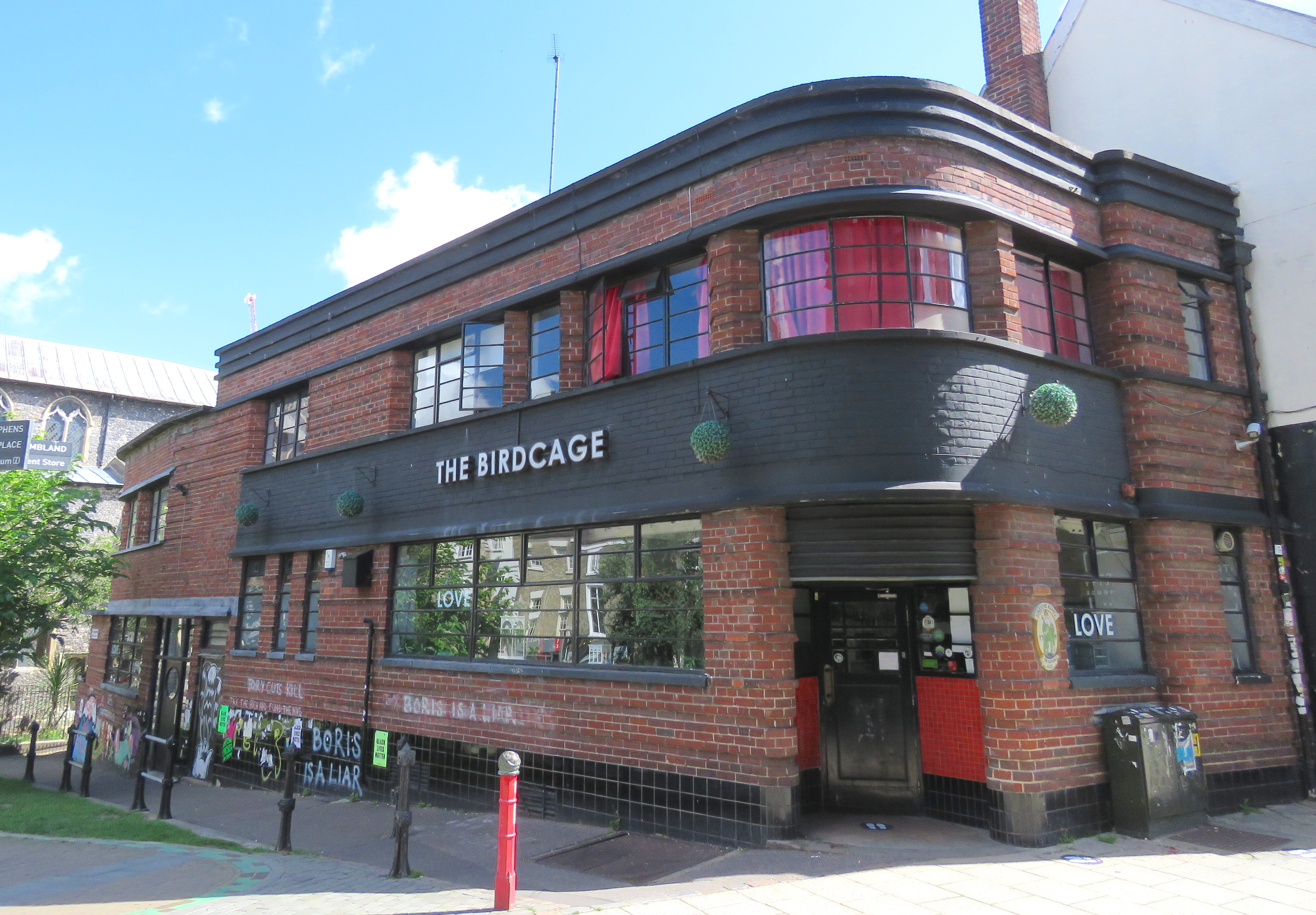
… and in the Pottergate Tavern.

IMG_2541

The Pottergate Tavern, now The Birdcage, 1930s

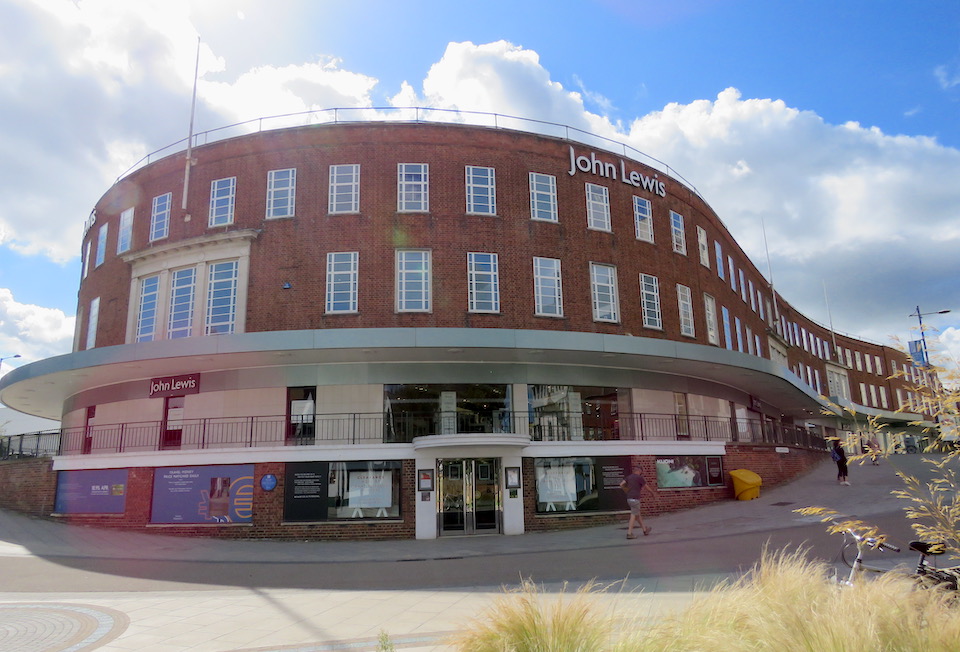
Pevsner and Wilson [1] presumed the pub to have been designed by J Owen Bond, a protégé of George Skipper, possibly because of the much larger building he is known to have designed with similar Streamline Moderne influences. J Owen, third son of Robert Bond, designed this replacement for his father, whose department store was damaged by bombing in WWII. A follower on Twitter said that her neighbour could see the flames from Arminghall, to the south of the city.

IMG_2524

Bond’s of Norwich (now John Lewis) designed by J Owen Bond. One of the first modern buildings to spring up after the war (begun 1946). 

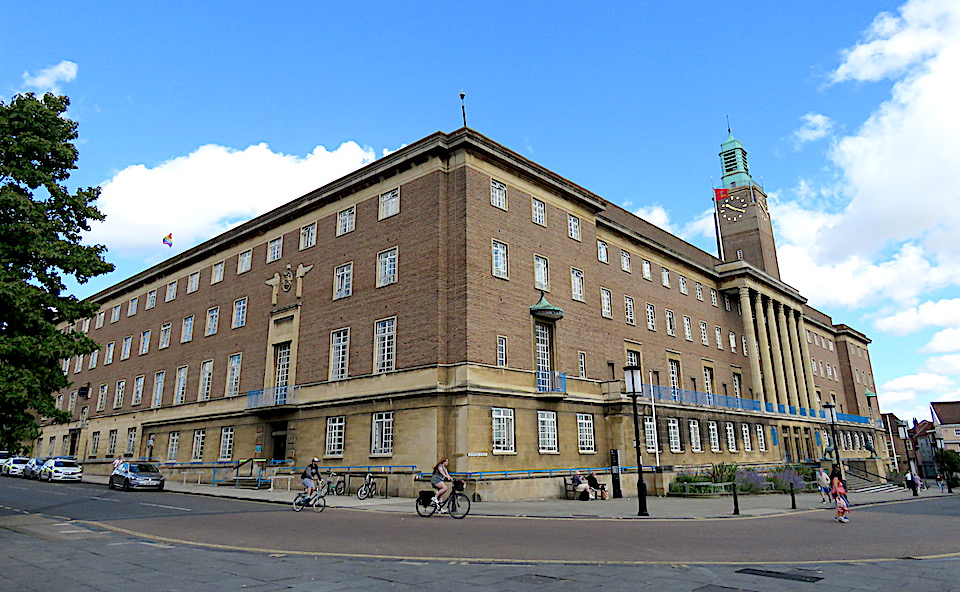
By sticking with its medieval Guildhall throughout the C19, Norwich missed out on the grandiose Victorian town halls erected by its competitors in the industrial north. In the late 1930s Norwich did build a new city hall and Pevsner and Wilson [1] wrote that it “must go down in history as the foremost English public building of between the wars.”

IMG_2534.jpeg

Norwich City Hall designed by CH James and SR Pierce in 1931, completed 1937-8

The essentially plain style was borrowed from the Swedish Classical of Stockholm’s City Hall with the colonnaded portico of that city’s Concert Hall. But, because of these backward-looking references, architectural historian Stefan Muthesius felt that the term ‘modern’ didn’t quite apply to Norwich City Hall [5].

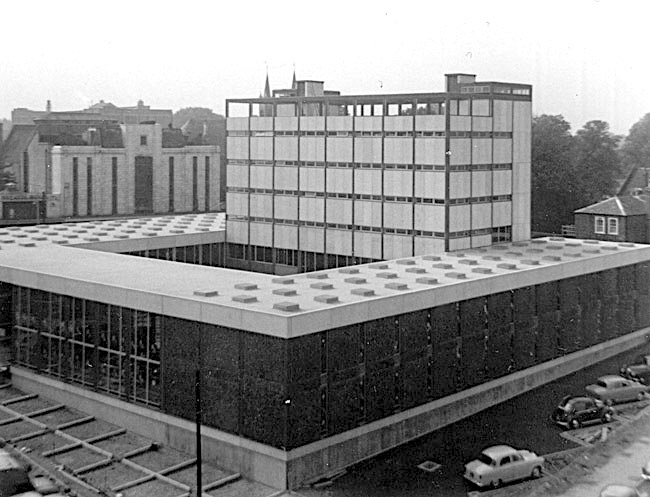
Instead, Muthesius awarded the accolade for the city’s first real International Modern-style to David Percival’s City Library, opposite the City Hall. Percival had come from Coventry in 1954, “then the hot-bed of civic-minded modernism”; as Norwich’s new City Architect he designed the new library, which was completed in 1962 and burned down in 1994.

30129041226409

Norwich Central Library destroyed by fire in 1994. City Architect, David Percival; Job Architect, Jim Vanston. ©Norfolk County Council at Picture Norfolk.

Percival was responsible for introducing mainstream Modernism into Norwich’s postwar public buildings though he strove to soften its hard edges with regional references, especially on domestic-scale projects. By tempering Modernism with the local spirit, Percival is credited with pioneering the Vernacular Revival style [6]. The impact of massed concrete panels on the library, for example, was moderated by pre-cast panels of split-flint cladding (although a glance at the nearby Guildhall shows just how far this was from vernacular techniques).

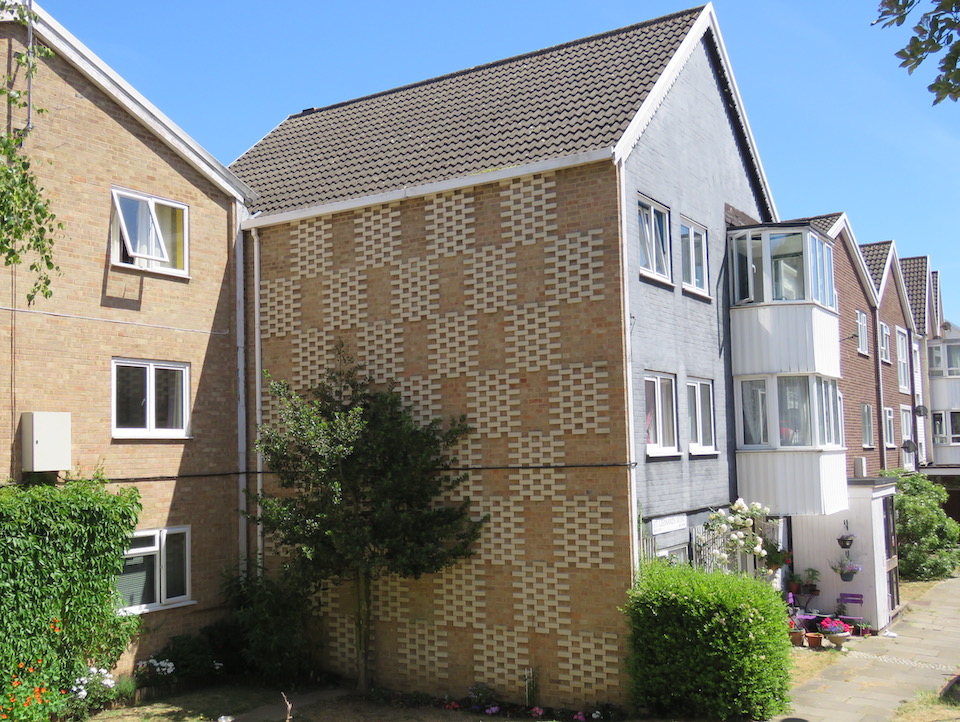
Perhaps the most famous example of Vernacular Revival in Norwich’s public housing is the Camp Grove scheme off Kett’s Hill. Here, Tayler and Green’s signature decorative brickwork and patterned bargeboards – combined with changes in roof pitch, four different pantiles and 16 types of brick and flint – provide an unexpected degree of variation [7].

IMG_2317.jpeg

St Leonard’s Road 1973-6.

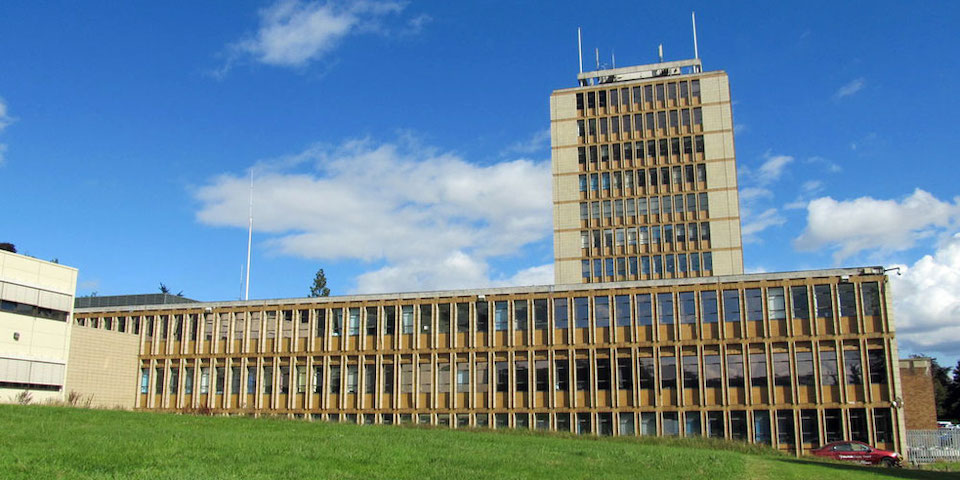
In contrast to the City Hall, Norfolk County Hall – built in 1966 in the International Modern style – never attracted much praise. Pevsner and Wilson dismissed it as “an ordinary steel-framed office tower.” 

norfolkcountyhall.jpg

Norfolk County Hall 1966 by Reginald Uren. Photo: Keith Evans geograph.org CC BY-SA 2.0

Other forays into the International Style, such as the eight-storey block to the right of Skipper’s building for Norwich Union in Surrey Street, were also poorly received. Never one for mincing his words, Ian Nairn thought it “a completely anonymous slab” [8]. Evidently not a style for an ancient county town.

SurreyHouse.jpg

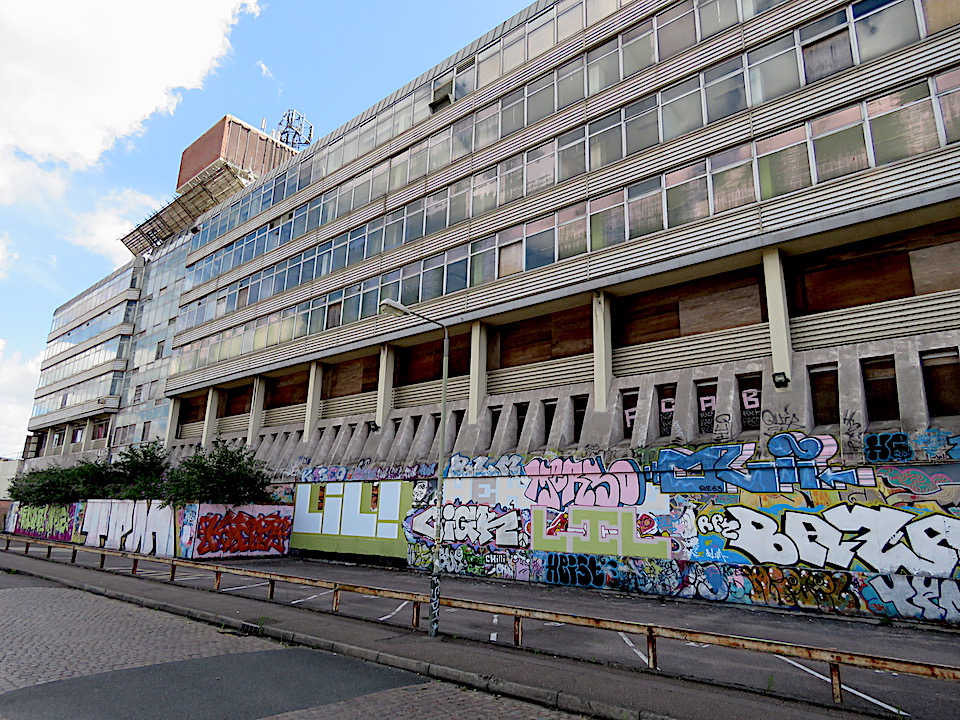
The 1945 City Plan envisaged a post-war Norwich in which the car played a major part [9]. In 1971 the inner ring road split Norwich-over-the-Water: the two halves were to receive different treatments. The northern half was to be the site of the Anglia Square development with a large cinema, offices, multi-storey parking plus that symbol of the new age – a pedestrian shopping precinct. Her Majesty’s Stationery Office at Sovereign House was a key part of the scheme and it was this New Brutalist building that marked the rise and fall of the site as a whole – the HMSO pulling out well short of its 40-year lease, leaving the building derelict by the new millennium.

IMG_2579.jpeg

The raw concrete and glass of Sovereign House by Alan Cooke and Associates 1966-8. 

Currently, we await the outcome of a planning application to redevelop the entire Anglia Square site with 12-storey blocks and a 20-storey tower. The scale of the proposal shows that no lessons have been learned from the brief history of Anglia Square in which an ‘out of scale’ [10] development was imposed upon a historic site. For an appreciation of the Gildencroft area see [11].

There was no such grand project on the city side of the inner ring road and this part of Norwich-over-the Water fared better.

IMG_2583.jpeg

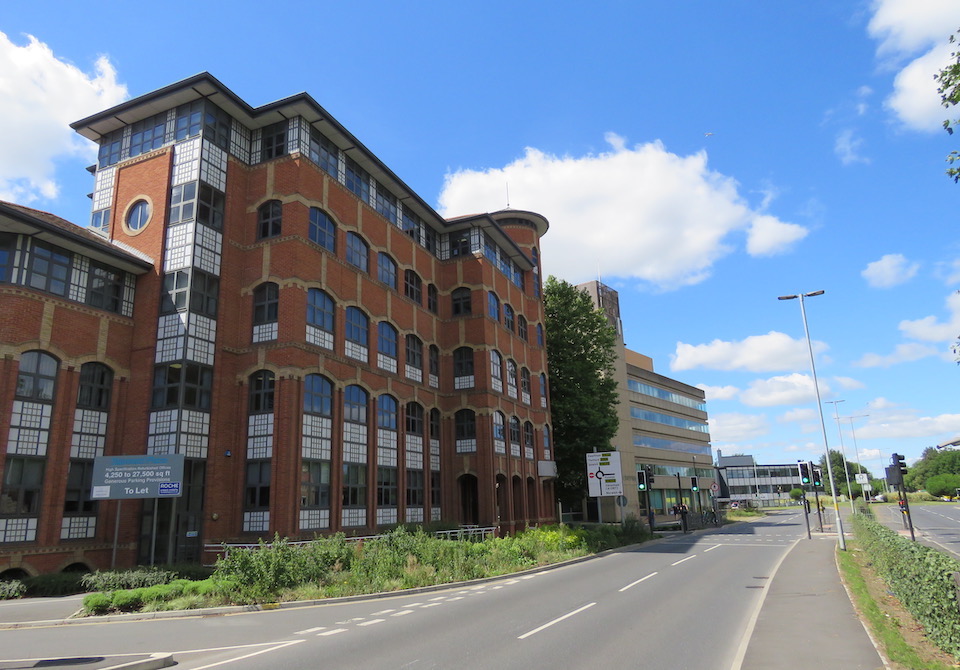
Inside the inner ring road, looking westward: in the distance, St Mary’s House; the glass and concrete St Crispin’s House; and the red brick of Cavell House. 

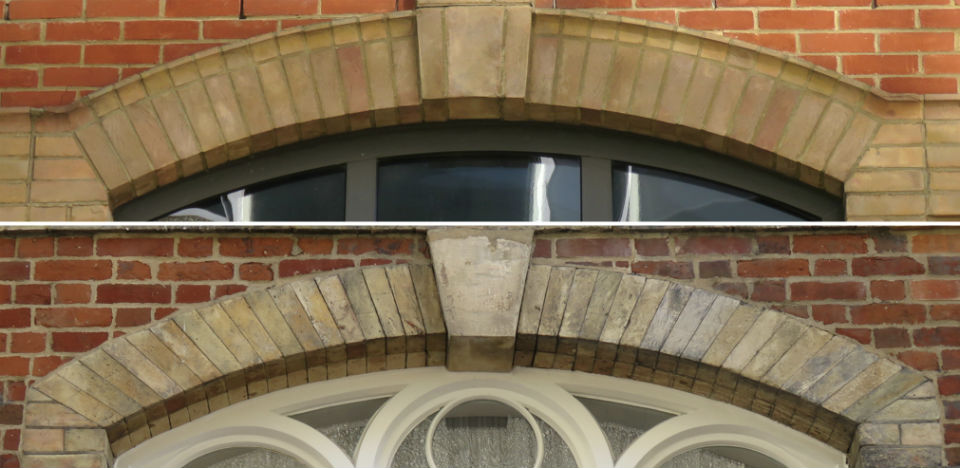
In this snapshot from the evolution of office building, the 1960s curtain-walling of St Mary’s House on the far side of the St Crispin’s roundabout was succeeded by the 1970s layers of concrete and glass in St Crispin’s House, built for HMSO when permission was denied for an extension to Sovereign House at Anglia Square. A starker contrast was between the Brutalist concrete of St Crispin’s House juxtaposed against the red brickwork of 1990s Cavell House. This was part of what has been recognised as a “welcome softening of approach since the late 1980s” [1] for, as part of the Postmodern credo, Cavell House reacted against Modernism by providing local context missing from Anglia Square. Here, the windows on the upper floor referenced the long through-light weavers’ windows once common in this, the heart of the city’s textile trade. The flat arches heading the lower windows were borrowed from Sherwyn House, an old brush factory (now renovated apartments by Feilden & Mawson) further down St George’s Street. (See [12] for more about this district).

Two windows1.jpg

C20 Cavell House above, C19 Sherwyn House below

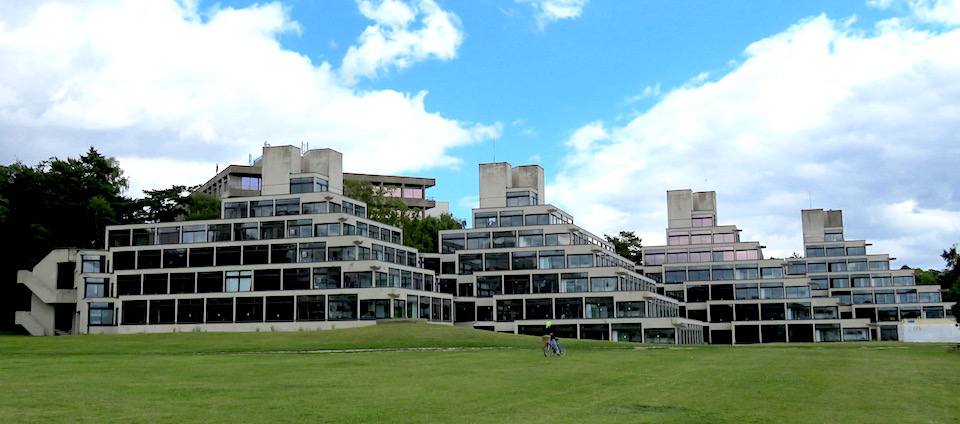
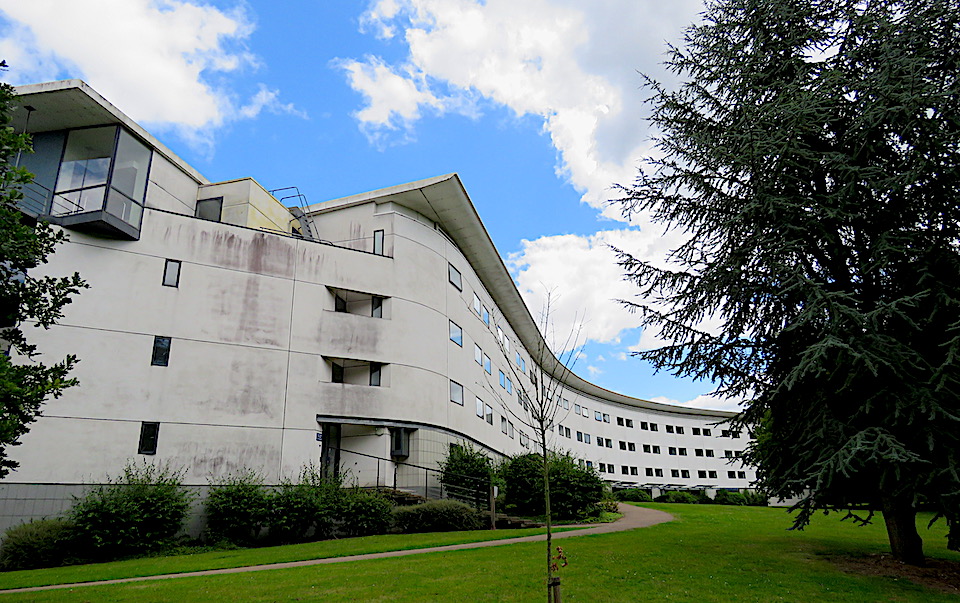
There was no such confrontation between new and old at the University of East Anglia where Denys Lasdun in the 1960s (replaced by Bernard Feilden in 1969), and Rick Mather in the 1980s, were able to build on a green-field site without planning constraints [1]. A Teaching Wall snaked through the original scheme, separated from the residential blocks by a first-floor walkway. Lasdun’s residences consisted of a cascade of study/bedrooms forming the ziggurats that have become emblematic of the UEA.

IMG_2608

 Denys Lasdun’s concrete ziggurats of 1966-7

As part of the second-phase of the masterplan, Rick Mather’s Constable Terrace echoed the serpentine form of Lasdun’s original layout but its smooth white rendering was a deliberate break from the hardline grayness of the earlier student housing.

IMG_2611.jpeg

Rick Mather’s highly energy-efficient Constable Terrace of 1991-3

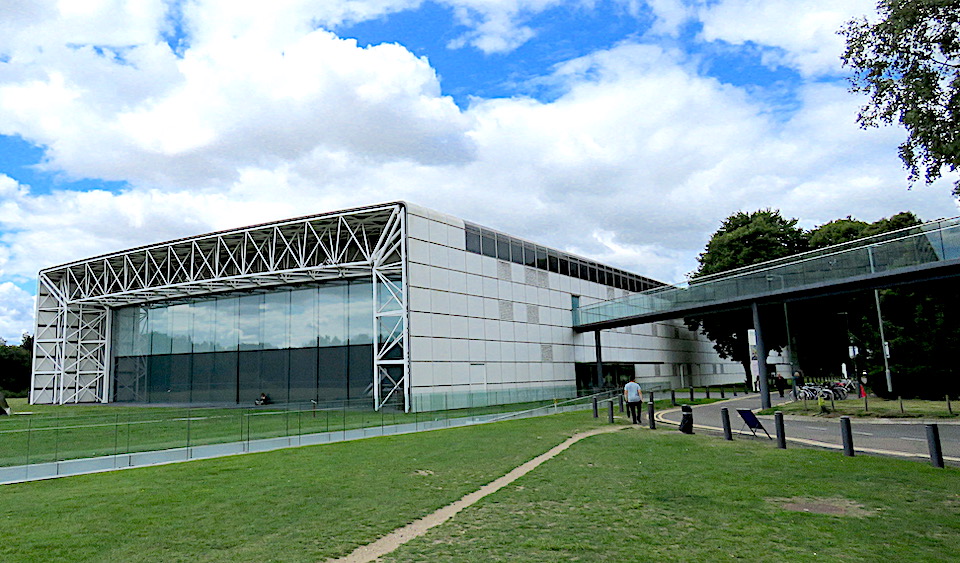
Facing Constable terrace is the Sainsbury Centre for the Visual Arts (1974-8). Designed by Norman Foster and Wendy Cheeseman, the tubular steel exoskeleton represents what is probably this country’s first use of High-Tech industrial architecture applied to a museum or gallery. The superstructure encloses a magnificent open space, some 130 metres long, that accommodates Sir Robert and Lady Sainsbury’s art collection, along with university teaching areas.

IMG_2609

The High-Tech Sainsbury Centre by Foster & Associates. The glass bridge is a continuation of the pedestrian walkway that winds at first floor level along the university’s spine.

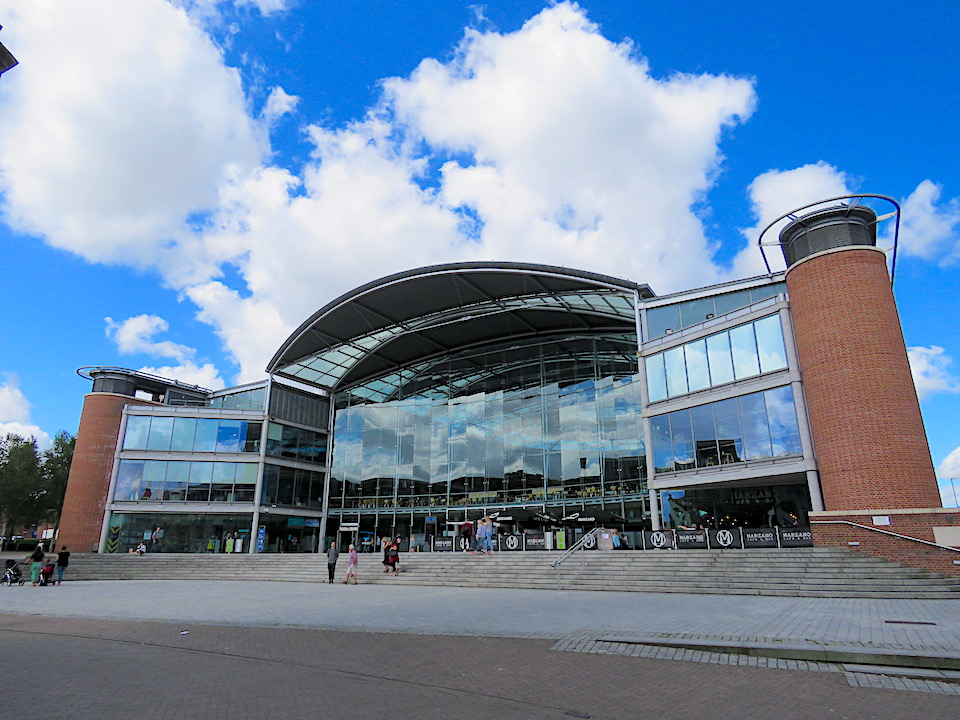
Just squeaking in at the close of the twentieth century The Forum, funded by the Millennium Commission, was begun in 1999. Designed by Hopkins and Associates the Forum replaced David Percival’s flint-clad Central Library of the 1960s, destroyed by fire. This ‘Son of High Tech’ building [2] houses BBC studios, a restaurant, a café and what has become the most popular library in the country. The  jaws of the horseshoe-shaped plan are closed by a glazed wall that – in a display of good manners – withdraws from, rather than confronts, the glorious St Peter Mancroft opposite.  IMG_2530.jpeg

©Reggie Unthank 2020

Sources

  1. Nikolaus Wilson and Bill Wilson (1997). The Buildings of England. Norfolk 1: Norwich and the North-East. Pub: Yale University Press.
  2. Vic Nierop-Reading (2013). Twentieth-century Norwich in a nutshell. Norfolk Historic Buildings Group Newsletter No.25 pp 14-15.
  3. https://colonelunthanksnorwich.com/2017/02/15/the-flamboyant-mr-skipper/
  4. Mary Ash and Paul Burall (2019). Norwich leading the Way: Social Housing. Pub: The Norwich Society.
  5. Stefan Muthesius (2004). Architecture since 1800. In, ‘Norwich since 1550’ by Carole Rawcliffe and Richard Wilson pp 323-342. Pub: Hambledon and London.
  6. John Boughton (2018). Municipal Dreams: The Rise and Fall of Council Housing. Pub: Verso.
  7. Elain Harwood and Alan Powers (1998). Tayler and Green, Architects 1938-1973: The Spirit of Place in Modern Housing. Pub: The Prince of Wales’s Institute of Architecture.
  8. Ian Nairn (1967). Norwich: Regional Capital.  Reprinted, with an introduction by Owen Hatherley, in Nairn’s Towns (2013). Pub: Notting Hill Editions.
  9. CH James and SR Pierce (1945). City Plan of Norwich 1945. Pub: Norwich Corporation.
  10. Charles McKean (1982). Architectural Guide to Cambridge and East Anglia since 1920. Pub: ERA Publication Board.
  11. https://colonelunthanksnorwich.com/2017/10/15/gildencroft-and-psychogeography/
  12. https://colonelunthanksnorwich.com/2017/11/15/reggie-through-the-underpass/

Thanks: to David Rimmer, Martin Shaw, and Clare Everitt of Picture Norfolk.

Share this:

  • Click to share on Facebook (Opens in new window) Facebook
  • Click to share on X (Opens in new window) X
  • Click to share on Pinterest (Opens in new window) Pinterest
  • Click to email a link to a friend (Opens in new window) Email
  • Click to print (Opens in new window) Print
Like Loading...

Thomas Browne’s World

15 Wednesday Jul 2020

Posted by reggie unthank in Norwich buildings, Norwich history, Sir Thomas Browne

≈ 20 Comments

Tags

Browne's Meadow, Quincunx, Thomas Browne's Garden House

Knighted by King Charles II in St Andrew’s Hall, Sir Thomas Browne (1605-1682) was probably Norwich’s most famous inhabitant of the seventeenth century. He was born in London, the son of a silk merchant and, after being educated in Oxford, Padua, Montpellier and Leiden, settled in Norwich where he practiced as a physician until he died [1].

IMG_2486

Sir Thomas Browne, from St Peter Mancroft, Norwich

He was famed as a polymath whose writings reveal an inquisitive mind that explored subjects as diverse as: the fault line between his training as a physician and the Christian faith (in Religio Medici, 1643); his debunking of myths and falsehoods (Pseudodoxia Epidemica, 1646); the incidence of the number five in patterns in nature (The Garden of Cyrus, 1658); and his celebrated and lyrical musings about death, prompted by the discovery of funerary urns in a Norfolk field (Hydriotaphia, or Urne-Buriall, 1658).

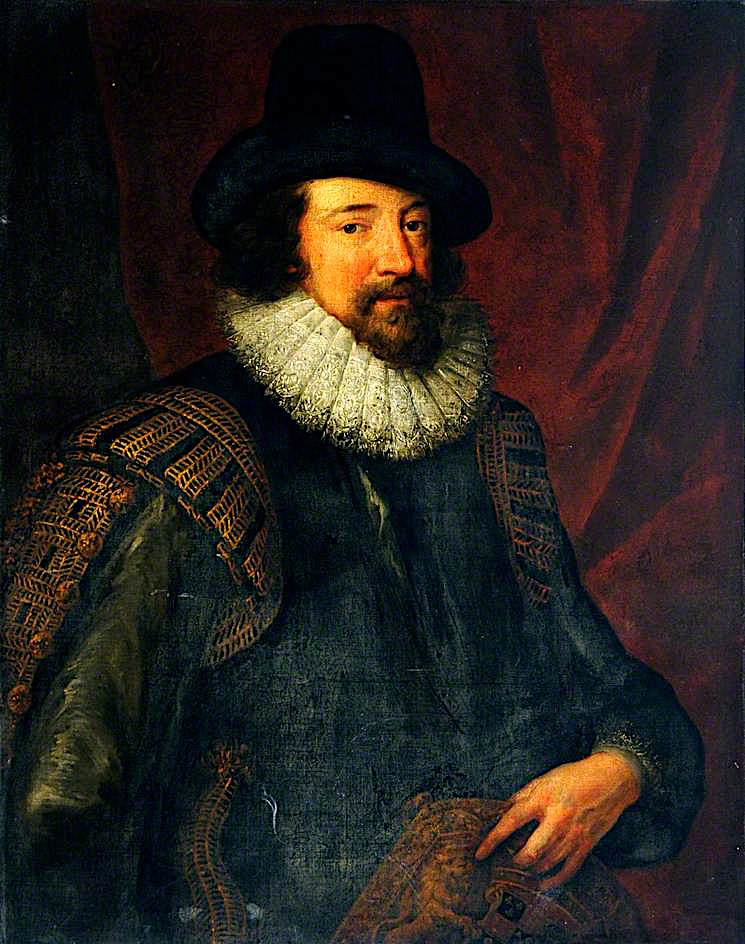
This was at a time when modern science was in its infancy. The scientific method, promoted by Sir Francis Bacon (1561-1626), involved framing hypotheses based on observations viewed through the filter of scepticism.

Portrait_of_Sir_Francis_Bacon_(1561-1626).jpg

Sir Francis Bacon 1561-1626. From Gainsborough Old Hall, artist unknown

Browne was appropriately sceptical in his examination of Vulgar Errors (Pseudodoxia Epidemica) like: Does a carbuncle give off light in the dark? and, Do dead kingfishers make good weathervanes? He even attended the trial in Bury St Edmunds of two women who were hanged for witchcraft. But the Enlightenment had barely got going and the proto-scientist Browne found himself straddling two worlds that had yet to drift apart – even Sir Isaac Newton sought the philosopher’s stone that would turn base metal into gold.

My first encounter with Sir Thomas was when I was trying to understand how plant cells and other solid bodies pack together [2]. I had gained some insight from another early scientist, Stephen Hales (1677-1761). By squashing a pot of pea seed then counting the number of flat faces impressed onto each seed by its neighbours, Hales came up with the number 12. You can make a dodecahedron by joining together 12 pentagons, making one of only a handful of ‘ideal’ solid bodies (another is a cube made of six squares). Plato knew this [3].  

Dodecahedron

Rotating dodecahedron. By André Kjell, Wikimedia Commons CC BY-SA 3.0

But in real life, the shapes of plant cells are far from perfect and don’t pack together neatly like Platonic Lego. Instead,  they tend, on average, to be 14-sided and each side tends, on average, to be a pentagon [3]. Nevertheless, this idea of fiveness took me back a further century to fellow citizen Thomas Browne.

IMG_2488

Frontispiece to The Garden of Cyrus (1658). The founder of the first Persian Empire, Cyrus, is believed to have based the optimal spacing lattice for planting trees on the quincunx.

In The Garden of Cyrus or The Quincuncial Lozenge (1658) [4] Browne developed his ideas about the quincunx – the X-shape with four points forming a square or rectangle with a fifth point in the centre.  IMG_2496

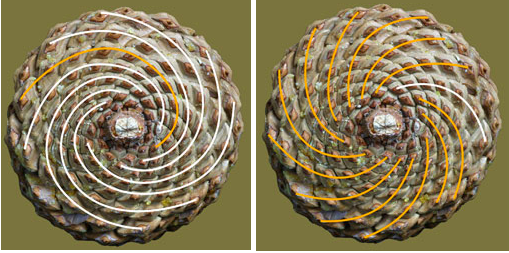
Browne saw this pattern throughout nature; he saw the quincunx on the trunk of the ‘Sachell palme’ and in the fruits of pineapple, fir and pine. In ragweed and oak he also noted that successive leaves followed a spiral, with every fifth lined up along the stem. These were, before the word, explorations into phyllotaxis or the pattern in which leaf buds emerge from the shoot tip (paired, alternating, spiral). Now, more than 300 years later, the spiral pattern is known to be far more complex than the quincunx. The number of intersecting left-handed-and right-handed spirals tend to be successive numbers on the Fibonacci series, usually 5 and 8, or 8 and 13. (Fibonacci’s series is 0,1,1,2,3,5,8,13,21 etc, where the next number is the sum of the last two). Browne may not have been correct but he was there in the first flush of modern science and deserves credit for offering a mathematical basis for patterns in nature.

Screenshot 2020-06-23 at 18.53.53

Left- and right-handed spirals in the base of a pine cone. Picture © Paul Garrett [5].

Many of the words from Sir Thomas Browne’s writings have found their way into the  Oxford English Dictionary; indeed, he stands 25th in the list of contributors [1]. Sadly, ‘retromingent’ – for peeing backwards – never made it into the OED but many others did, including:

electricity, pubescent, polarity, prototype, rhomboidal, archetype, flammability, follicle, hallucination, coma, deductive, misconception, botanical, incontrovertible, approximate, and an early example of ‘computer’.

Despite the scepticism required of a follower of Bacon, and ‘the scandal of my profession‘, Browne remained a convinced Christian who examined his spiritual beliefs in his most famous book, Religio Medici [6].

monro13_tp

1736 edition of Browne’s Religio Medici. Courtesy of Glasgow University Library

He was surprisingly tolerant for his time. In the first unauthorised edition of Religio Medici (The Religion of a Physician) in 1642, Browne expressed unorthodox religious ideas including the extension of toleration to infidels and those of other faiths. When the authorised version appeared the following year some of the controversial views had been excised but this didn’t prevent its inclusion on the papal list of prohibited books.

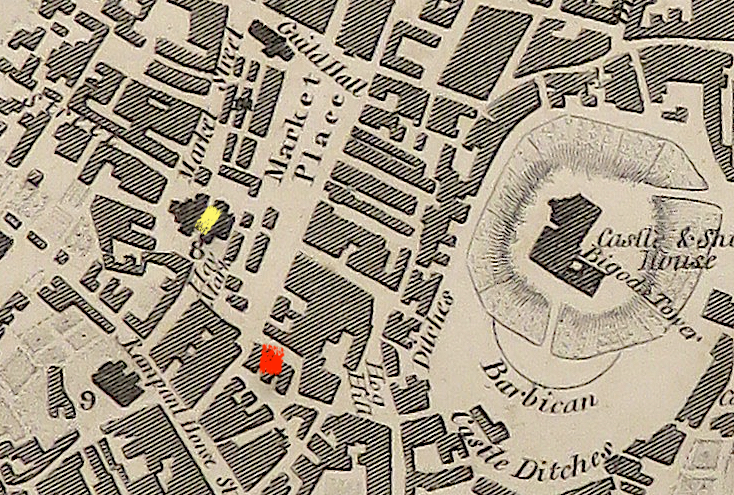
Browne’s major works were written in Norwich, at his house near St Peter Mancroft, close to the Norman marketplace.

Cole

Browne’s world. Cole’s map of 1807 shows Thomas Browne’s house (red) and St Peter Mancroft (yellow) with the Haymarket between.

large_gbad2742

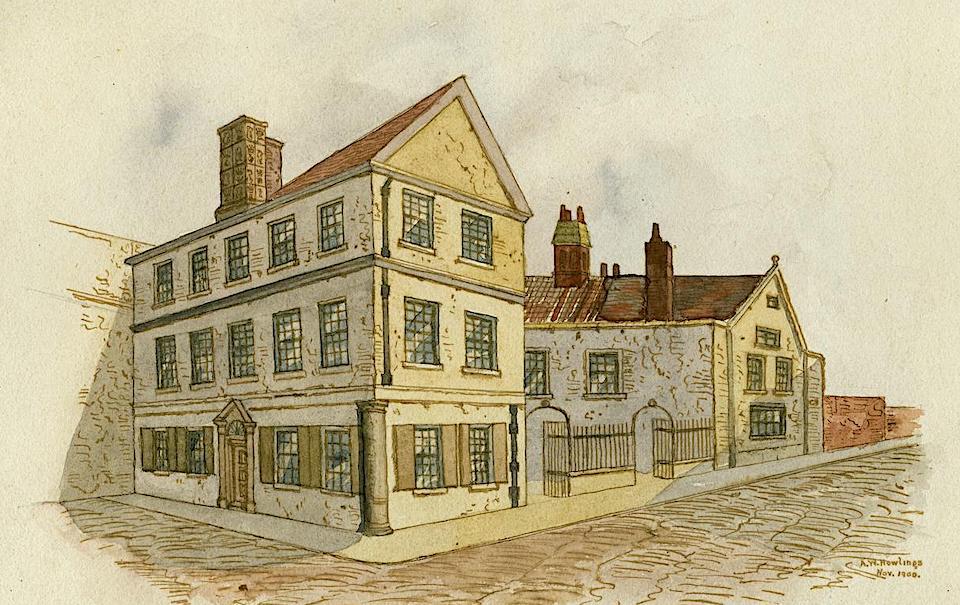
Thomas Browne’s House off the Haymarket, by AW Howlings 1907. This version is changed little from a drawing of 1837 when the pairs of windows either side of the corner pillar were bow-fronted. Norfolk Museums Collections NWHCM: 1907.33.2.  

inside house

The fireplace and overmantel from Sir Thomas Browne’s House by Miss Ellen Day and Mrs Luscombe 1841.Norfolk Museums Collections NWHCM: FAW19.

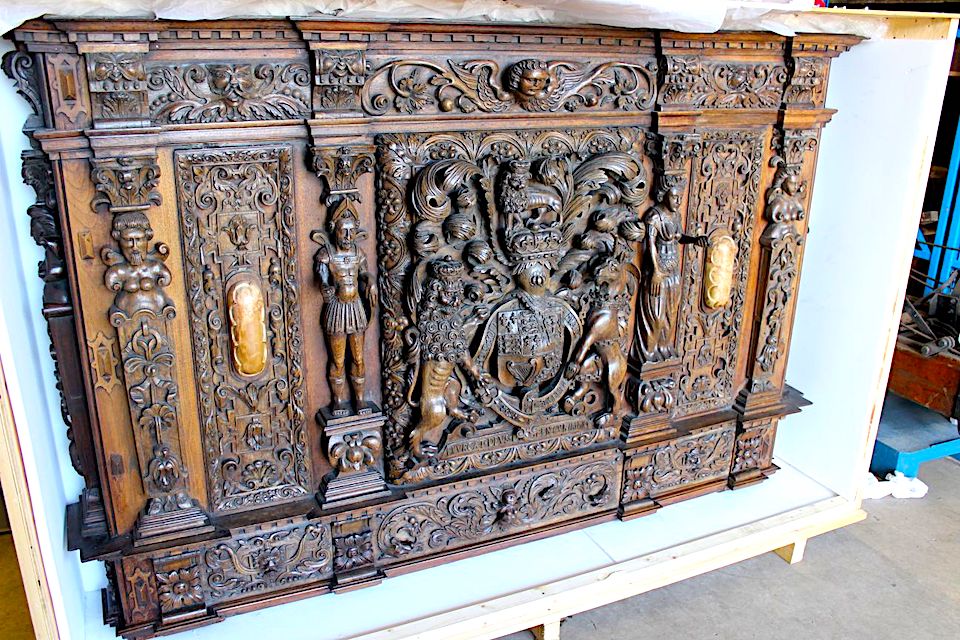
After posting this article, Wayne Kett of the Museum of Norwich informed me that this overmantel was in storage as part of their collection. One source had indicated that the coat of arms was that of James I but it seems to be that of Charles II, which makes more sense since – as we will see – it was he who knighted Browne.

Dr Browne’s overmantel ©Norfolk Museums Service

In 1671, the royal court of Charles II came to Norwich. The diarist and gardener John Evelyn was part of the entourage and wrote, “His whole house and garden is a Paradise & Cabinet of rarities, & that of the best collection, especially Medails, books, Plants, natural things” … “amongst other curiosities, a collection of the Eggs of all the foule & birds he could procure … as Cranes, Storkes … & variety of waterfoule” [6]. What Evelyn saw was the first attempt at listing the birds of Norfolk.

The house was demolished in 1842 but we know – because a green plaque tells us so –that it stood approximately where Pret a Manger is now housed in Haymarket Chambers, at the junction with Orford Place. Historian AD Bayne confirms that ‘Sir Thomas Browne is supposed to have lived in the last house of the southern end of the Gentleman’s Walk, where the Savings Bank now stands’ [7]. But the bank stood in the way of progress.

Haymerket chambers norwich ribapix.jpg

Former site of Sir Thomas Browne’s house. Pret a  Manger currently occupies the ground floor of George Skipper’s Haymarket Chambers (1901-2). It was originally home to JH Roofe’s superior grocery store with the Norwich Stock Exchange above. ©RIBApix

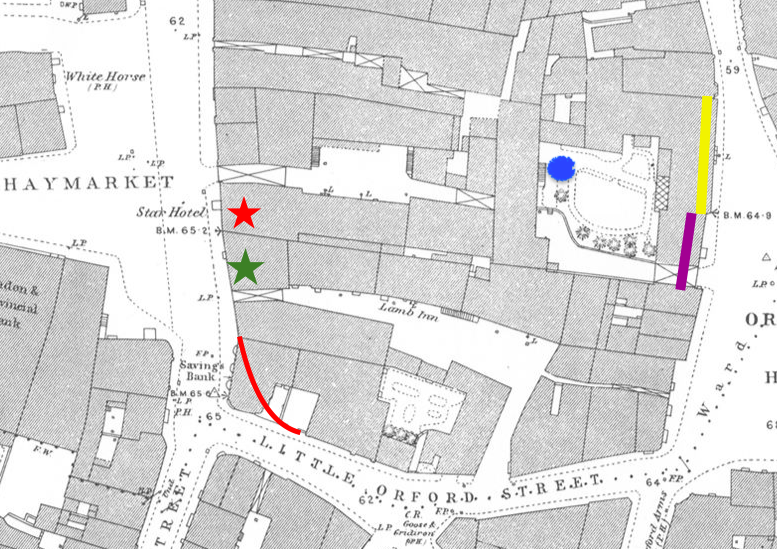
To allow the new trams to turn the corner more easily into Orford Place, the Norfolk and Norwich Savings Bank was demolished and replaced with Skipper’s curved design. The corner-cutting is shown on the 1884 OS map that we’ll bear in mind while trying to figure out where Browne’s Garden House lingered on from 1844 to 1961.

Browne's Garden House

Green star = Green’s Outfitters; red Star = Star Inn; yellow line = Livingstone Hotel; purple line = Green’s Orford Place branch; blue circle = approximate site of Browne’s Garden House.  OS map 1884

According to George Plunkett, numbers 3-5 Orford Place (Little Orford Street on above map), which was demolished in 1956, had a stone inscription stating that this was the site (probably the side) of Thomas Browne’s house [8]. But Plunkett placed Browne’s timber-framed garden house a little distance from the main house, between the Livingstone Hotel (yellow line) and Green’s shop (green star). He said, ‘only the peak of its tall attic gable visible above the roof of the adjacent Lamb Inn’. So it couldn’t have been in Lamb Inn yard, adjacent to the former site of Browne’s house.

Orford Hill 16 Livingstone Hotel [1361] 1936-08-30.jpg

The Livingstone Temperance Hotel 1936 ©georgeplunkett.co.uk

Later, Green’s the Outfitters, whose main shop faced the Haymarket, opened a branch next door to the Livingstone in Orford Place and this will furnish us with an eye-witness description of Browne’s Garden House. In 1961, both buildings were demolished to make way for a Littlewoods Department Store, in turn replaced by Primark.

30129032931934Greens.jpg

Green’s Orford Place Branch, post 1936. ©Norfolk County Council at Picture Norfolk

On the opposite (Haymarket) side of this block of buildings, Green’s main branch stood adjacent to Skipper’s Haymarket Chambers. The slight bend in the building line marks where, around 1900, Green’s expanded into the former Star Hotel.

Greens

Green’s in 1959. The upper floors of Skipper’s Haymarket Chambers are just visible, right, separated from Green’s by the entrance to the Lamb Inn. Photo courtesy of Archant Library.
Browne’s main house disappeared long before modern ideas of conservation, but the loss of his garden house in 1961 now seems an inexcusable loss. His botanical garden had been admired by John Evelyn and ‘Fellows of the Royal Society (thought it) well worthy of a long pilgrimage’ [7]. Our Protestant Dutch refugees – who held annual competitions called Florists’ Feasts [9] – imported a love of plant breeding and it would be surprising if, in such an environment, Browne’s garden was restricted to medicinal plants.

In 1950, Noël Spencer visited Greens when they ‘were using the Livingstone as a shop and, while making a purchase there (i.e., Green’s Orford Place branch), I noticed an ancient building in the yard behind, and obtained permission to draw it [10].’ This places the Garden House in the yard marked with a blue dot on the 1884 map, above.

IMG_2506.jpg

Drawing by Noel Spencer, former Head of the Norwich School of Art, of Sir Thomas Browne’s Garden House before its demolition in 1961. From [10] ©Estate of Noel Spencer. 

Further confirmation for the location of Browne’s Garden House came after this article was posted. On Twitter, Bethan Holdridge – Assistant Curator at Strangers’ Hall Museum – replied, mentioning that two of Browne’s Garden House doors in the museum were listed as being given by ‘Messrs Littlewood’ 1961. Also, ‘lying behind former Livingstone Hotel, Castle Street; part of premises of Messrs Green, outfitter 9 and 10 Haymarket.’

To supplement his home garden Sir Thomas leased a plot of land from the Cathedral, known as Browne’s Meadow. In his Adventures of Sir Thomas Browne in the 21st Century, Hugh Aldersey-Williams writes that Browne ‘let it go’, to see what would grow if untended [1]. After Browne died, the ground was used to produce vegetables for the Cathedral, then used as allotments for residents of Cathedral Close. Now it is a car park.

IMG_2492

‘Browne’s Meadow’ on the south side of the Cathedral Close 

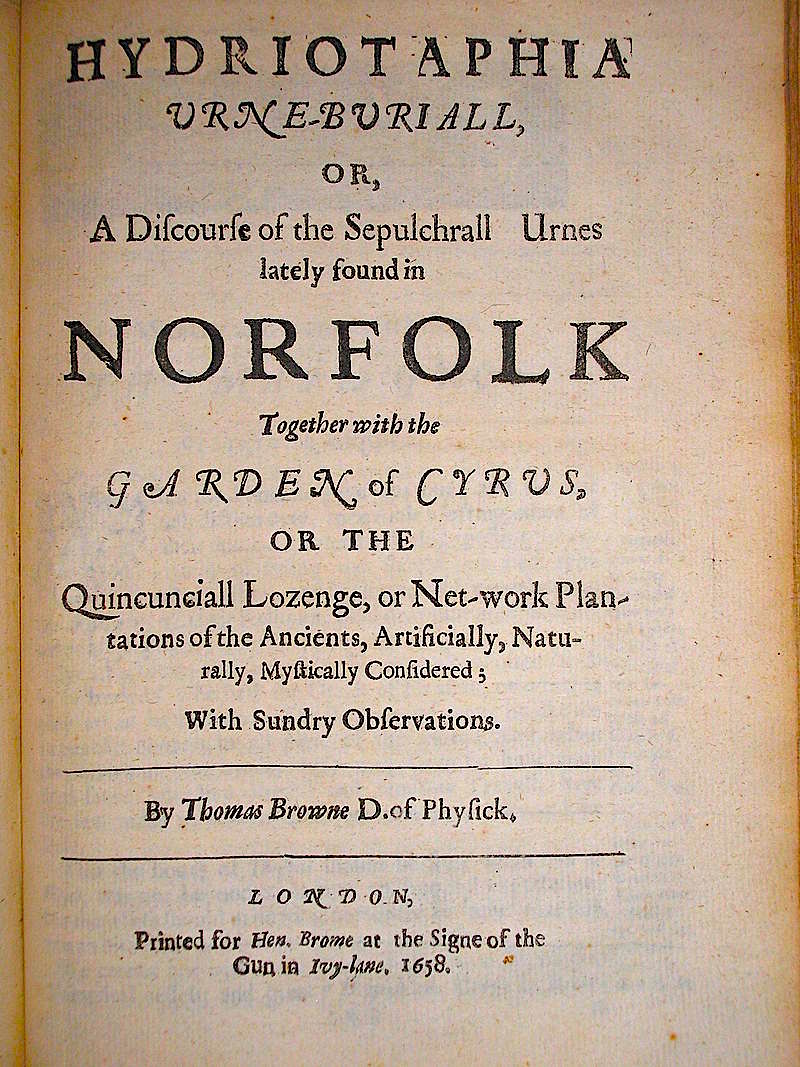
In his book, Urn Burial (1658), Browne explored thoughts prompted by the discovery of funerary urns in a  field some 12 miles north of Norwich: ‘Life is a pure flame, and we live by an invisible Sun within us’.

Title-page_of_1658_edition_of_'Urn-Burial'_and_'The_Garden_of_Cyrus'

Title page of Sir Thomas Browne’s Hydriotaphia, Urn Burial 1658

This was in the parish of Brampton, near the Pastons’ Oxnead Park where Sir Robert Paston had dug up urns containing ashes and coins (perhaps to pay the ferryman). In the early 1800s the historian Blomefield visited the field where he observed that urns were buried close enough to the surface to have been skimmed by the ploughshare. He observed that this site was near a fortified Roman town and that the Roman name Brantuna meant ‘the place where bodies were burned‘ [11].

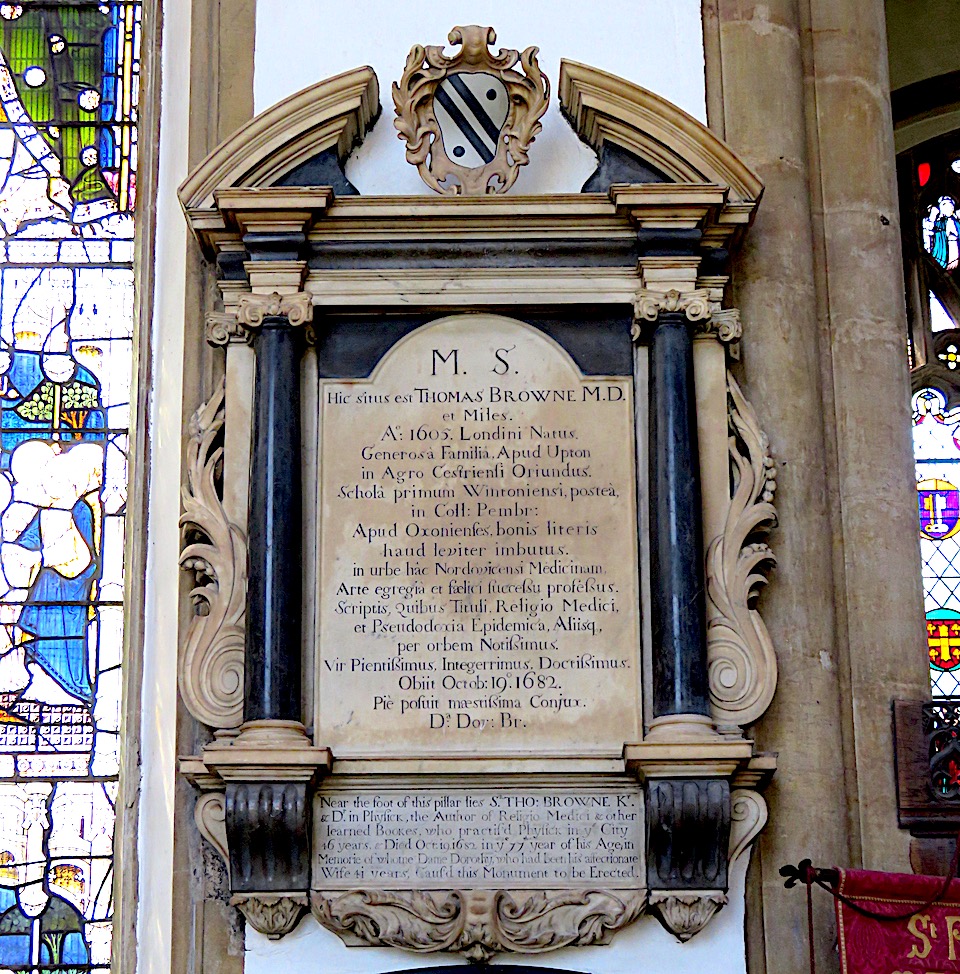
Sir Thomas Browne died on the 19th October 1682. One claim is that he died, having eaten too plentifully of a Venison Feast [12] but others believe this was out of character for such an abstemious man. He was buried in the chancel of St Peter Mancroft, some 200 yards from his house.

IMG_2482.jpeg

Sir Thomas Browne’s wall monument in the chancel of St Peter Mancroft. The lower panel records that he lies near the foot of this pillar.

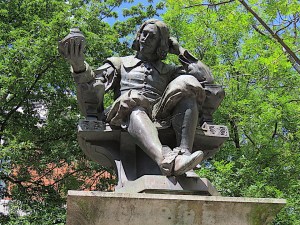
In 1905, equidistant between his house and church, the city commemorated an adopted son by unveiling one of its rare statues. From his vantage point above the old hay market, Browne holds the base of a Romano-British funerary urn and meditates on death.

Browne asked,  “… who knows the fate of his bones, or how often he is to be buried? Who hath the oracles of his ashes, or whither they are to be scattered? … To be gnawed out of our graves, to have our skulls made drinking-bowls, and our bones turned into pipes to delight and sport our enemies, are tragical abominations [13].” This turned out to be a premonition.

Sir Thomas Browne lay undisturbed until 1840 when workmen are said to have broken the lid of the lead coffin with a pickaxe while digging the grave of Mrs. Bowman, wife of the then Vicar of St. Peter Mancroft. Mr Fitch, a local antiquarian, was suspiciously at hand and it is not clear whether the desecration was accidental or deliberate. Either way, the sexton, George Potter, removed the skull and some hair. The skull came into the possession of the surgeon, Edward Lubbock, upon whose death it passed to the old Norwich and Norfolk Hospital Museum on St Stephen’s Road (read various explanations of this dubious episode in [12-15]). Despite requests from the church, the skull remained on display at the hospital and was only reunited with Browne’s bones in 1922.Screenshot 2020-06-25 at 15.31.29.png

At the time of the reinterral the registrar recorded Browne’s age as 317.Screenshot 2020-06-25 at 15.50.17.png

Sir Thomas’s coffin plate, which had broken in two during attempts to remove it, had also been ‘mislaid’. One half of this 7×6 inch brass plate lies with other Browne memorabilia in a glass case in the St Nicholas Chapel of St Peter Mancroft.

IMG_2477 2

The accompanying text makes interesting reading, stating that it was collector and antiquary Robert Fitch who further disturbed Browne’s peace by removing his skull. 

An impression of the coffin plate revealed an inscription probably composed by his eldest son Edward, physician to Charles II, and President of the College of Physicians [15].

1359.jpg

Impression from the coffin plate of Sir Thomas Browne [14].

The inscription ends, ‘With the dust of this alchemical body he converts lead into gold’  –  something denied even the great Sir Isaac Newton.

Postscript

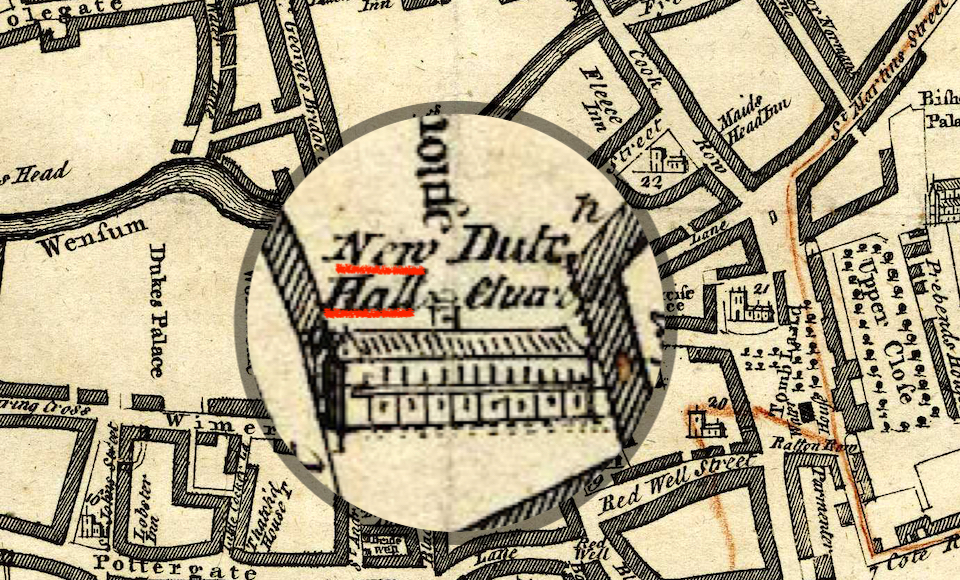
Thomas Browne’s knighthood: Ambiguity surrounds the circumstances of Thomas Browne’s knighthood. In 1671 King Charles II and his court came to Norwich where he stayed at the Duke of Norfolk’s Palace off present-day Duke Street (causing the famous indoor tennis court to be converted into kitchens). The corporation paid £900 for a sumptuous banquet at the New Hall (now St Andrew’s Hall) after which the king conferred honours.

King2

The New Hall, where Browne was knighted, once belonged to the Black Friar’s but was bought for the city from Henry VIII. The Duke’s Palace is to the left. From Samuel King’s map, 1766

According to some accounts Browne was unexpectedly knighted when the mayor, variously named as Henry Herne or Thomas Thacker, ‘earnestly begged to be refused’ and so the honour passed along the line. This played into the idea that a promiscuous monarch with several mistresses was as free in conferring honours as he was lax in his private life. Apparent confirmation of the king’s fickleness came within 24 hours when King Charles knighted 13-year-old Henry Hobart at Blickling. But Trevor Hughes picked out inconsistencies between various accounts, such as uncertainty about the name of the reticent mayor [16]. A more sympathetic  interpretation was given by historian Philip Browne who wrote: ‘After dinner his majesty conferred the knighthood on Dr Thomas Browne, one of the most learned and worthy persons of the age. The mayor, Thomas Thacker esq. declined the honour’ [17]. That is, the internationally famed Dr Browne was not accidentally knighted but honoured in his own right.

©2020 Reggie Unthank

––oOo––

Recently reprinted.  ‘Colonel Unthank and the Golden Triangle’ contains much more about the development of the Golden Triangle than covered in my blog posts, including photographs of the Unthank family. 

Available online. Click Jarrolds Book Store  or City Bookshop

Sources

  1. Hugh Aldersey-Williams (2015). The Adventures of Sir Thomas Browne in the 21st Century. Pub: Granta. Highly recommended.
  2. Clive Lloyd (1991). How does the cytoskeleton read the laws of geometry in aligning the division plane of plant cells? Development, Supplement 1, pp 55-65.
  3. Peter S Stevens (1976). Patterns in Nature. Pub: Peregrine Books.
  4. https://en.wikisource.org/wiki/The_Garden_of_Cyrus
  5. https://www.projectrhea.org/rhea/index.php/MA279Fall2018Topic1_Phyllotaxis
  6. Ruth Scurr (2016). https://www.the-tls.co.uk/articles/thomas-browne/
  7. AD Bayne (1869). A Comprehensive History of Norwich. https://www.gutenberg.org/files/44568/44568-h/44568-h.htm
  8. http://www.georgeplunkett.co.uk/Norwich/old.htm#Orfoh
  9. https://colonelunthanksnorwich.com/2019/08/15/going-dutch-the-norwich-strangers/
  10. Noël Spencer (1978). Norwich Drawings. Pub: Noel Spencer and Martlet Studio
  11. Francis Blomefield (1807). An Essay Towards a Topographical History of the County of Norfolk vol 6. Online at: https://www.british-history.ac.uk/topographical-hist-norfolk/vol6/pp430-440
  12. https://penelope.uchicago.edu/skullnotes.html
  13. http://www.cabinetmagazine.org/issues/28/dickey.php
  14. https://wellcomecollection.org/works/ykn7hdpz/items?canvas=5&langCode=eng&sierraId=b30623340
  15. http://drc.usask.ca/projects/ark/public/public_image.php?id=2384
  16. Trevor Hughes (1999). Sir Thomas Browne’s Knighthood. In, Norfolk Archaeology vol XLIII, part 11, pp 326-331.
  17. Philip Browne (1814). The History of Norwich from the Earliest Records to the Present Time. Pub: Bacon, Kinebrook & Co.

Thanks: I am grateful to Chris Sanham, verger at St Peter Mancroft, for his assistance.

Share this:

  • Click to share on Facebook (Opens in new window) Facebook
  • Click to share on X (Opens in new window) X
  • Click to share on Pinterest (Opens in new window) Pinterest
  • Click to email a link to a friend (Opens in new window) Email
  • Click to print (Opens in new window) Print
Like Loading...

A few of my favourite buildings

15 Wednesday Apr 2020

Posted by reggie unthank in Decorative Arts, Norwich buildings, Norwich history

≈ 26 Comments

Tags

ely cathedral, favourite buildings, kings college cathedral, kings lynn custom house, norwich cathedral

This was going to be something quite different but in this fifth week of isolation I haven’t been able to take new photographs, the library and record office are closed, so I’m revisiting a few of my favourite buildings to remind us of life outside this bubble.IMG_1317.jpg

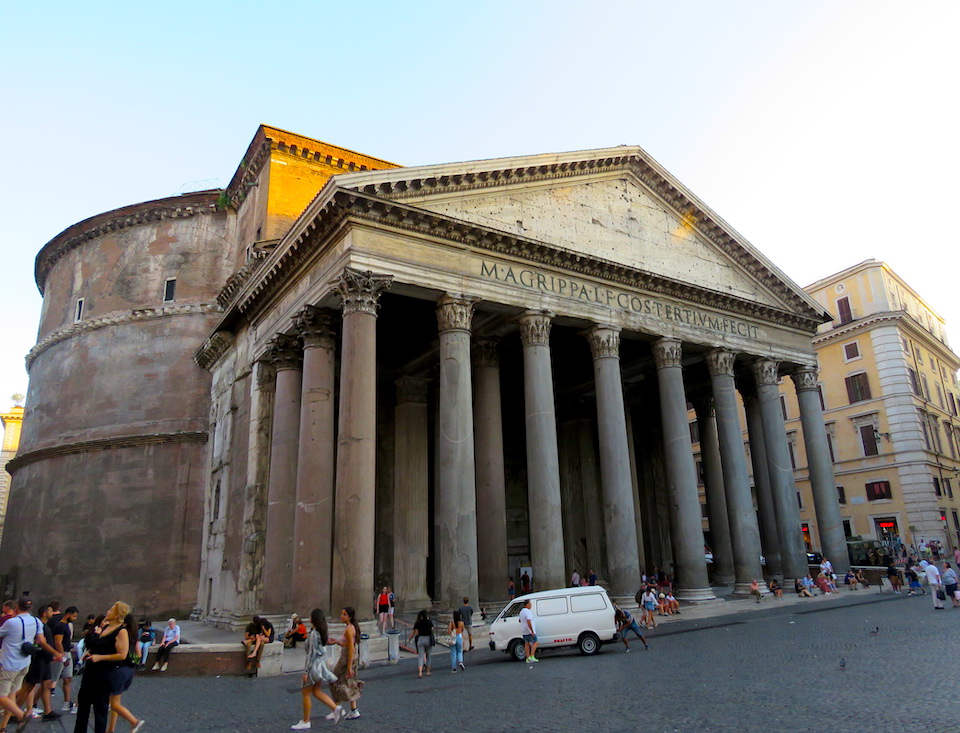
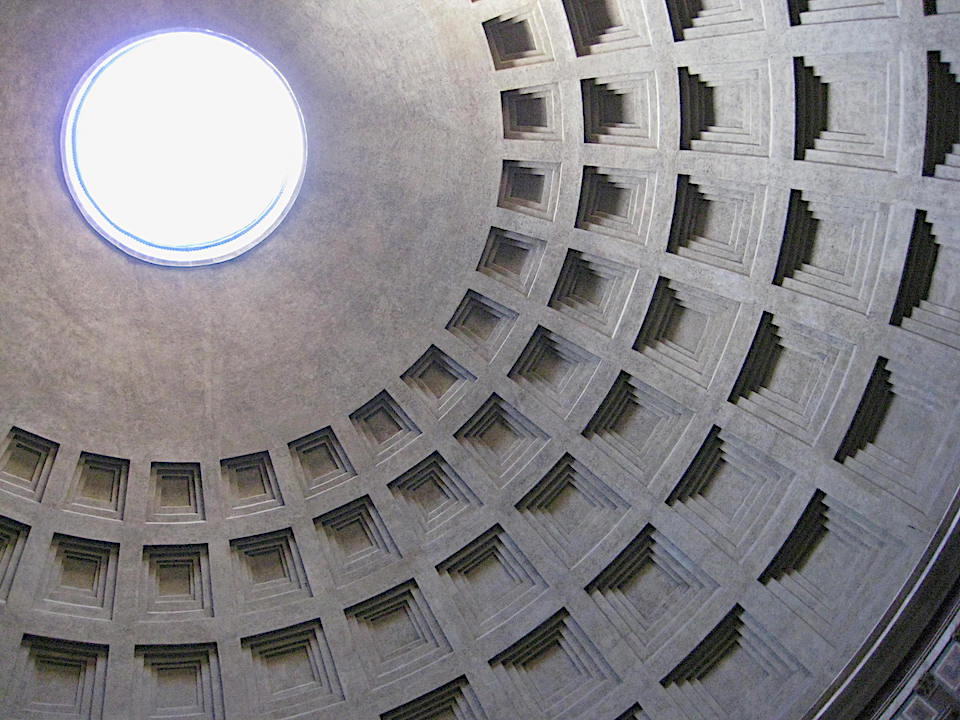
Possibly my favourite building, the Pantheon in Rome was completed around 126AD by the emperor Hadrian. The generous classical portico leads into a rotunda of staggering beauty. The coffered (sunken) panels reduced the weight of the roof, helping it remain the world’s largest unreinforced concrete dome for nearly 2000 years. On our visit, no-one seemed to mind when the rain came in.IMG_1927.jpg
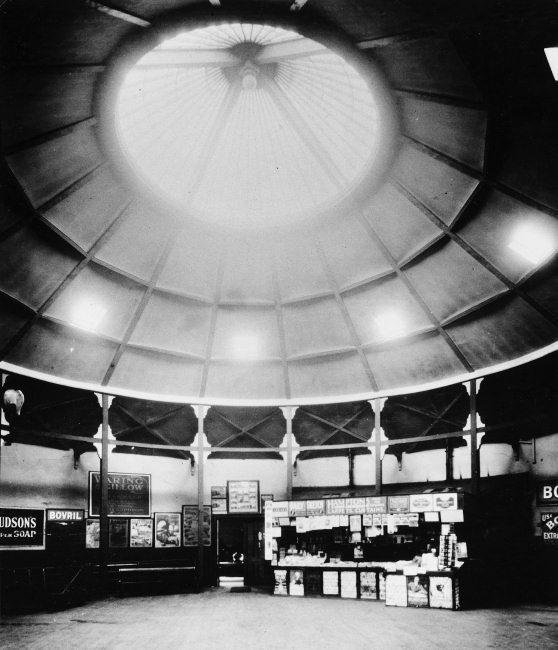
Local pride compels me to mention that Norwich had its own Pantheon [1], although with a modest diameter of 74 feet – about half the Pantheon’s – it would have caused proportionately fewer jaws to drop.

Pantheon30129028206374.jpg

The Pantheon in Ranelagh Gardens, just off the St Stephen’s roundabout, became the booking office of Norwich Victoria Station (1913). Courtesy Norfolk County Council at Picture Norfolk

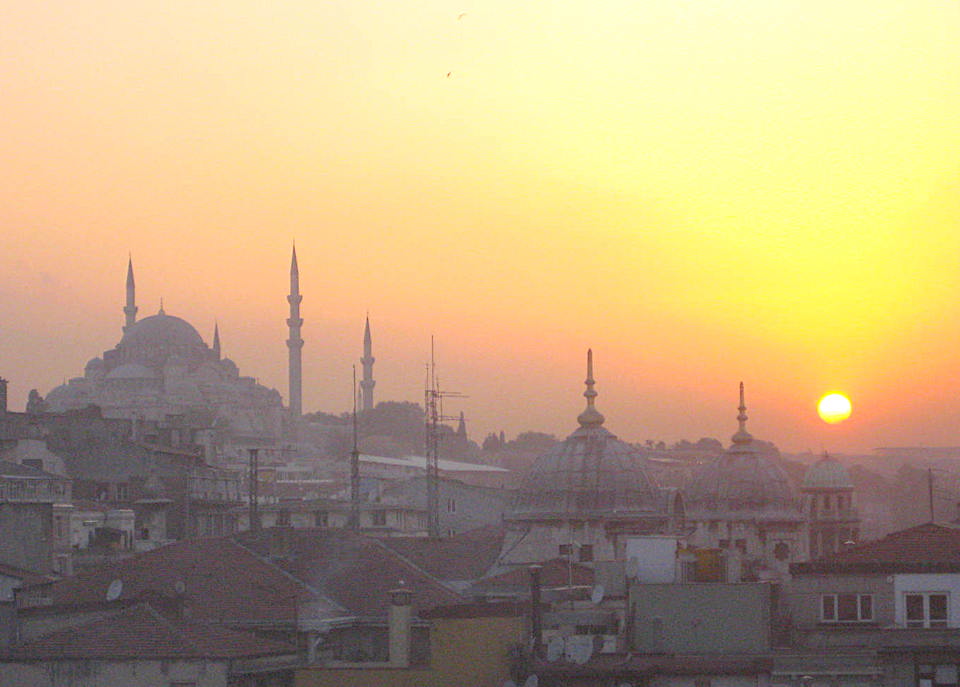
Another stunner is the great dome of Hagia Sophia in Istanbul, its diameter only marginally less than that of the Pantheon.

IMG_0355.jpg

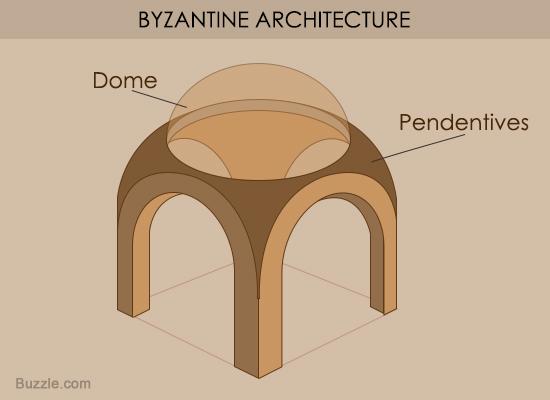
To construct what was, in AD 537, the largest building in the world, the Byzantine Emperor Justinian I commissioned a geometer/engineer (Isodore of Miletus) and a mathematician (Anthemius of Tralles). Literally, their task was to square the circle: how to support the circular base of the dome on top of a square base? To make this transition they made innovative use of pendentives – curved triangular segments that allowed the weight of the dome to be spread over the four supporting pillars.

550-byzantine-architecture-pendentives.jpg

 Image courtesy of Buzzie.com

HS2.jpg

Hagia Sophia at sunset

Another sunset. Approaching Ely from the south, one of the great sights of East Anglia emerges as you crest the brow of a hill and the ‘Ship of the Fens’ rises up.

TELEMMGLPICT000198223657_trans_NvBQzQNjv4Bqek9vKm18v_rkIPH9w2GMNoGXySPv9M1Jbe0Fc3Bi1Fk.jpeg

Ely Cathedral, with the octagonal Lantern at the central crossing. (The taller tower is at the West Front) ©Andrew Sharpe/Geoff Robinson

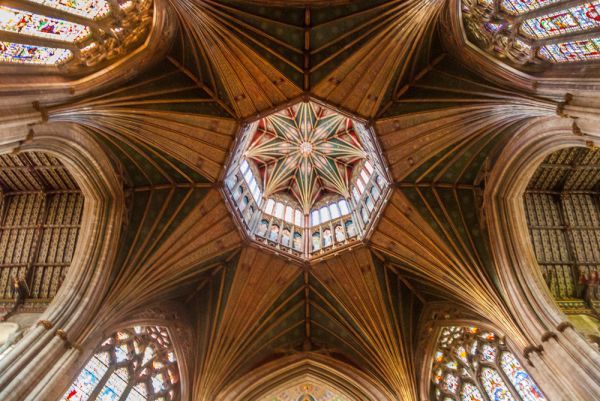
In 1322 the Norman tower at the central crossing collapsed and when it was realised that it was unfeasible to rebuild in stone the King’s Carpenter, William Hurley, was drafted in [2]. The 70 foot span was beyond the capacity of available timbers so, first, he erected an outer wooden octagon, which was painted to resemble the eight stone piers on which it stood. Then, at the centre of this platform, he constructed a lantern around a vertical octagon of eight timbers. Each a prodigious 63 feet long, these beams were obtained from Chicksands Priory in Bedfordshire [3].

Ely-Cathedral-2989.jpg

The central light well, the lantern, is based on an outer octagon of wood painted to look like stone. Photo credit: David Ross and Britain Express

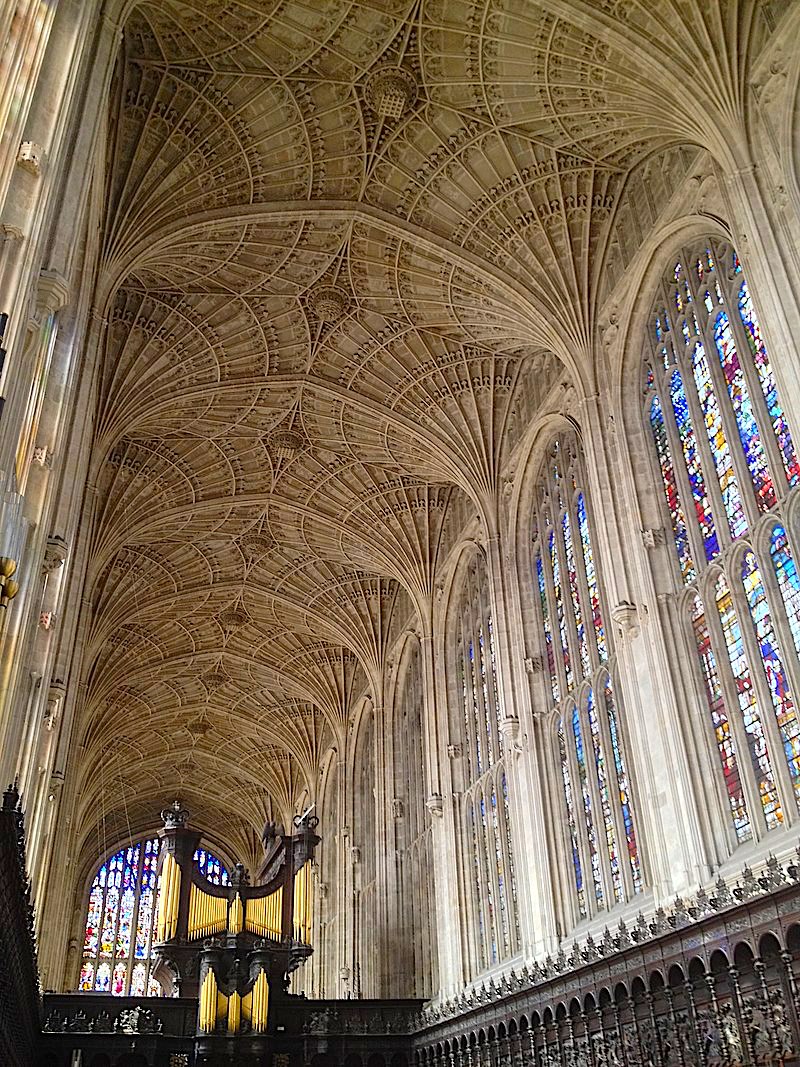
King’s College Chapel Cambridge – another East Anglian treasure – also gives joy. John Wastell built the beautiful fan-vaulting, giving the chapel the unified appearance of a building completed in a single campaign, but it was started by a Plantagenet (Henry VI) and completed by a Tudor (Henry VIII), with the Wars of the Roses in between (1446-1515).

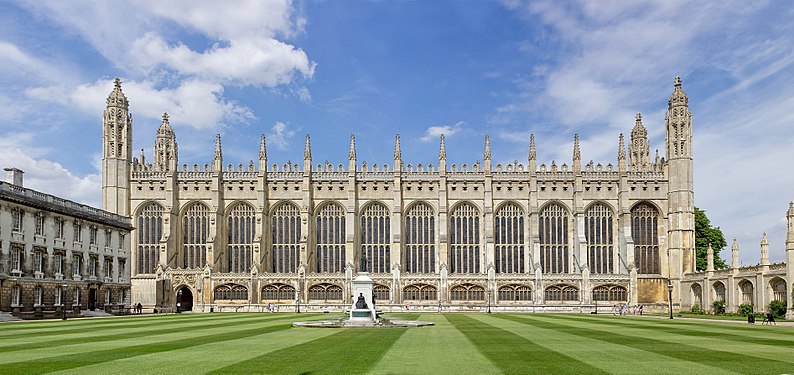
The chapel has ‘the largest fan vault in the world’. (‘world’ meaning England, for fan vaulting was a native invention). The skin of the stone fans is surprisingly thin and their radiating ribs largely decorative. The main work of supporting the prodigious vault is performed by the transverse arches and tapering external buttresses topped with heavy stone finials to counteract the outward thrust [4]. This external support – no flying buttresses here – creates the illusion of internal lightness, a single space tented with a delicate lacework of something less than stone.

800px-Cambridge_King's_College_Chapel_Vaults.jpg

The world’s largest fan vault, King’s College Chapel Cambridge. Creative Commons Licence BY-SA 4.0 by ‘Cc364’

796px-20130808_Kings_College_Chapel_01.jpg

King’s College Chapel. CC BY-SA 3.0 by Dmitry Tonkonog

Even closer to home is the Sainsbury Centre for Visual Arts on the UEA campus, a bike-ride away. Here there is no illusion, for the superstructure that supports this vast open space is in plain view. Fascinated by the fibres that wrap around plant cells I remember looking up to the SCVA’s tubes and struts, waiting (unproductively, as it happens) for architectural inspiration.IMG_9854.jpg

All these buildings offer solutions for enclosing and defining large spaces. This negative space is a fundamental element of architecture that Rachel Whiteread captured in her sculpture ‘House’ (1993). She made a concrete cast of the inside of the house in East London then demolished the skin brick by brick. Jonathan Jones of The Guardian said it was: ‘The solid trace of all the air that a room once contained.’

WHITEREAD-1993-House-View-1_photo-by-Sue-Omerod.jpg

‘House’ by Rachel Whiteread, 1993. It was decided to demolish the sculpture the day she won the Turner Prize. Photo: Apollo Magazine

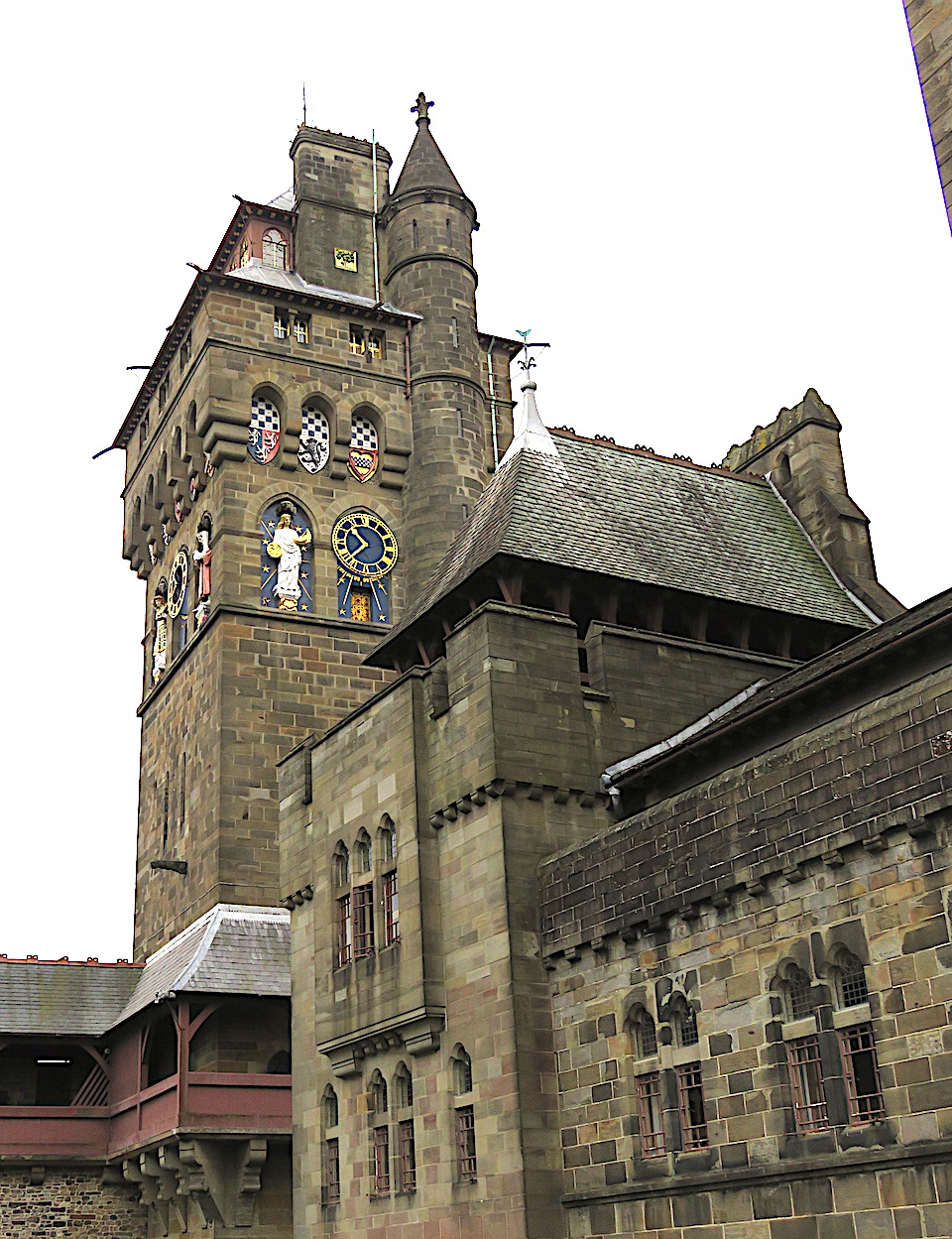
The first building to make an impression on me was Cardiff Castle, a Gothic fantasy built on the profits from Welsh steam coal.

IMG_9727.jpg

The Clock Tower, circled with figures representing the planets

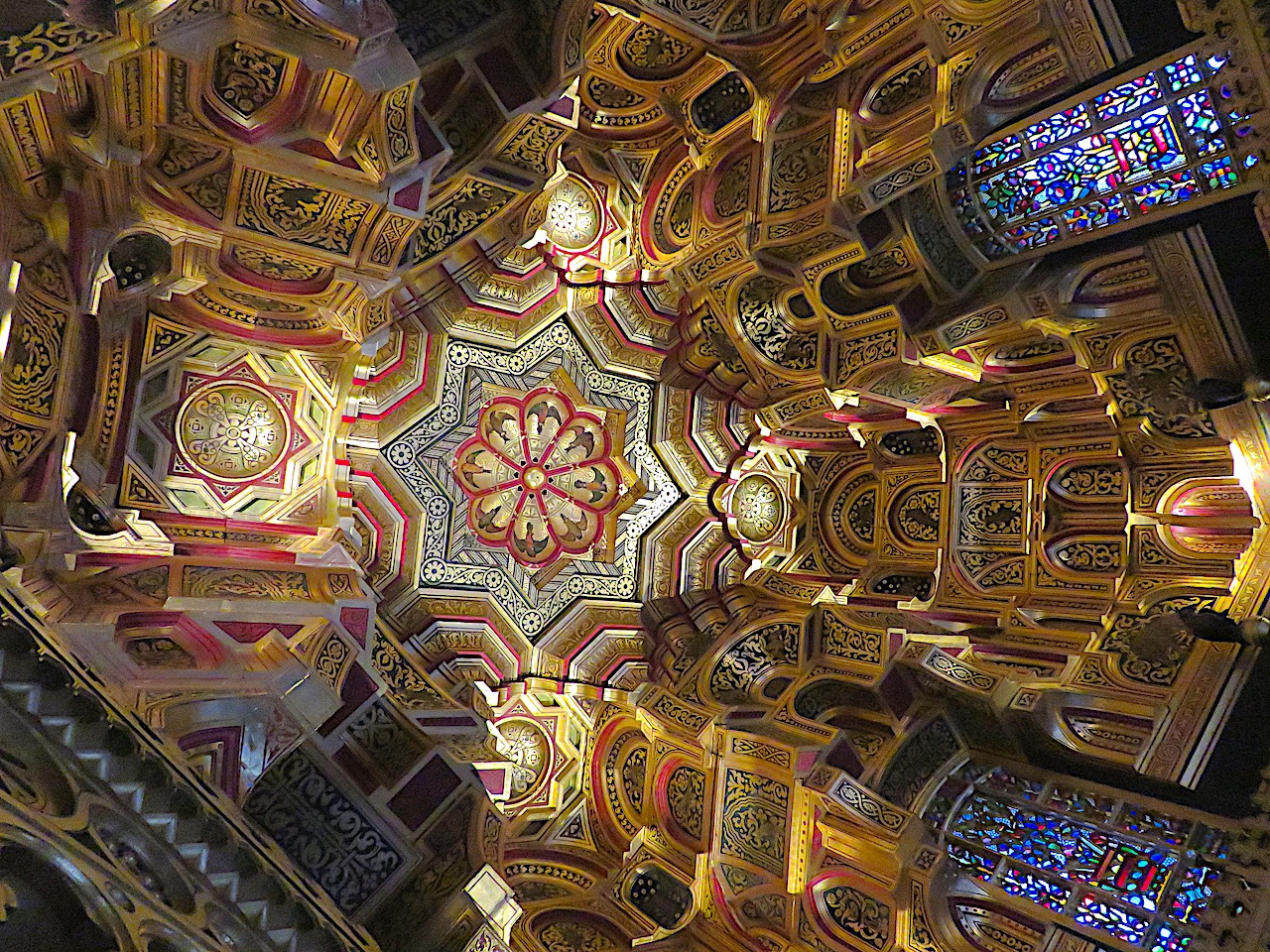
The designer William Burgess restored the castle for the Third Marquess of Bute at the height of the Gothic Revival. On his last visit (1881), Burges worked on the Arab Room with its fabulously intricate ceiling lined with gold leaf. ‘Billy’ Burges built this room in homage to the influence of Moorish art on medieval design. It is considered to be his masterpiece [5]. 

IMG_9730.jpg

The Arab Room, Cardiff Castle. 

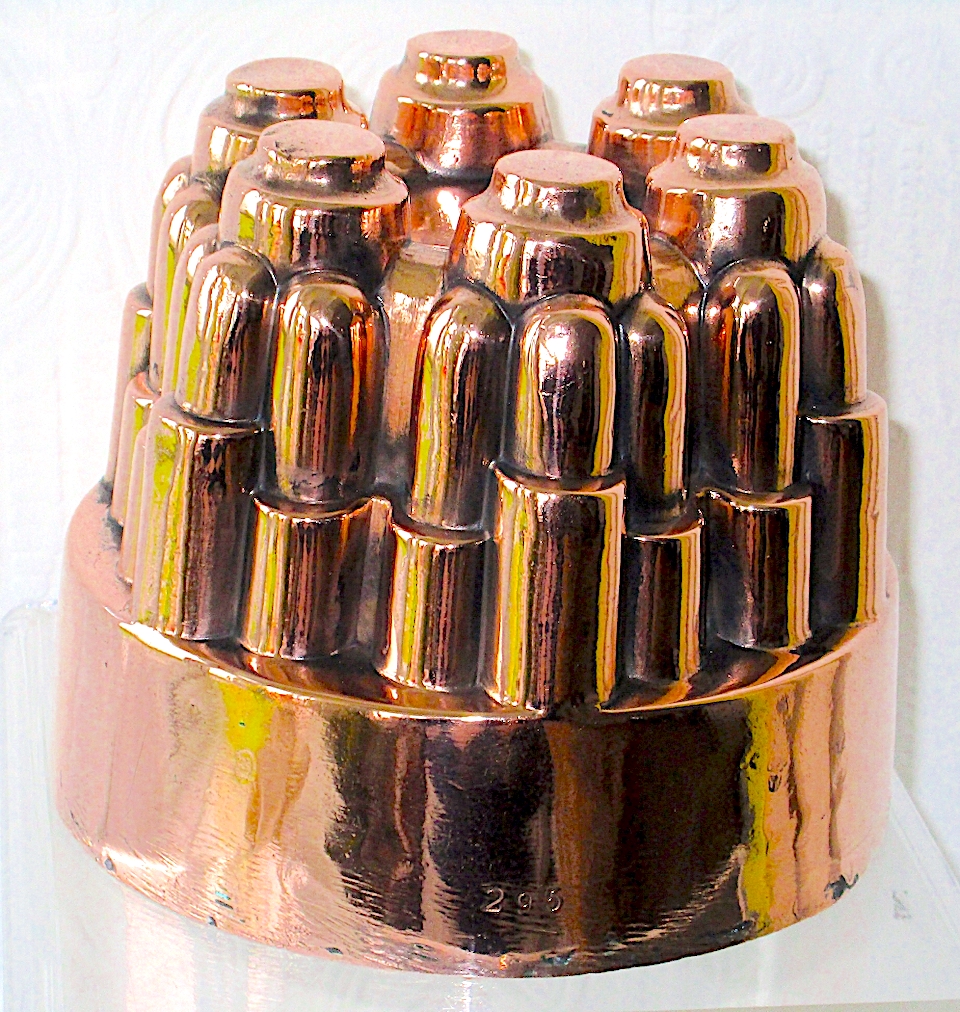
If Rachel Whiteread were to cast the space inside this room it would resemble a Victorian jelly.

copperjellymould2951a(996x1050).jpg

Victorian jelly mould. Credit: loveantiques.com

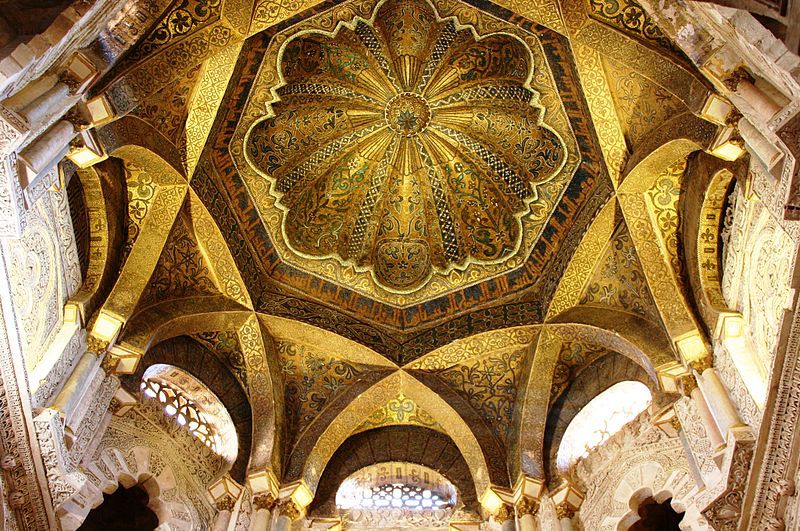
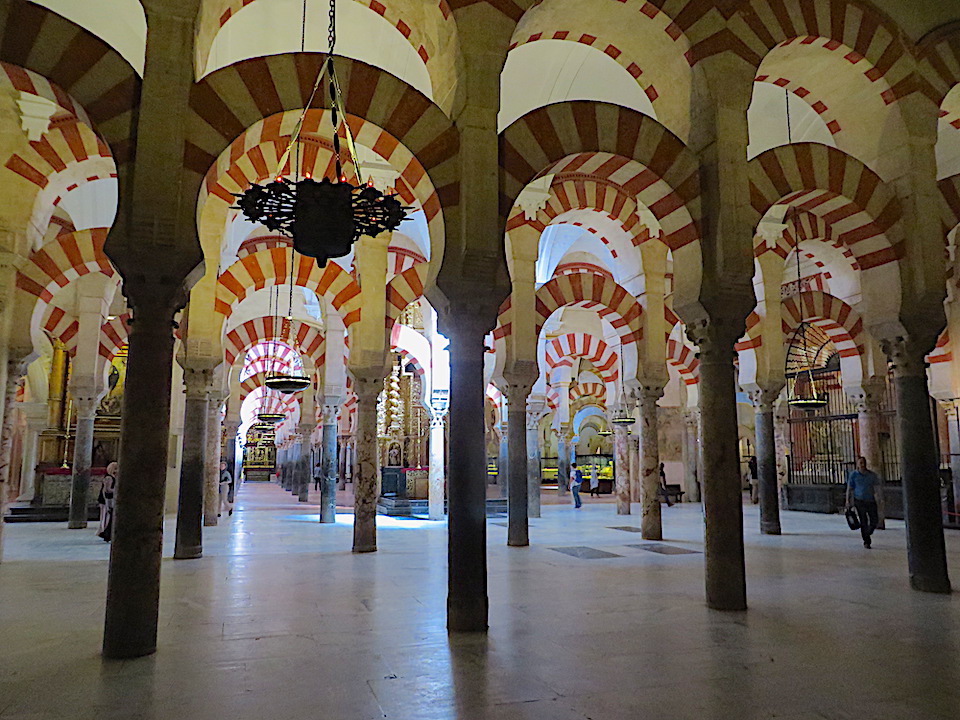
After the Muslims conquered Spain they used the site of a shared Muslim/Christian church to build and extend (C8-C10) the Grand Mosque in Cordoba. When Christian rule was reestablished a Renaissance cathedral was constructed in the middle of the Muslim complex.

Mihrab Dome Cordoba.jpeg

The Mihrab Dome, Grand Mosque Cordoba. ©José Luiz Bernardes Ribiero/CC BY-SA 3.0

Perhaps the most inspiring aspect of the mosque is the enormous space punctuated by 856 columns rescued from Roman buildings. The innovative double arches allowed for a greater ceiling height above the relatively short columns.IMG_1345.jpg

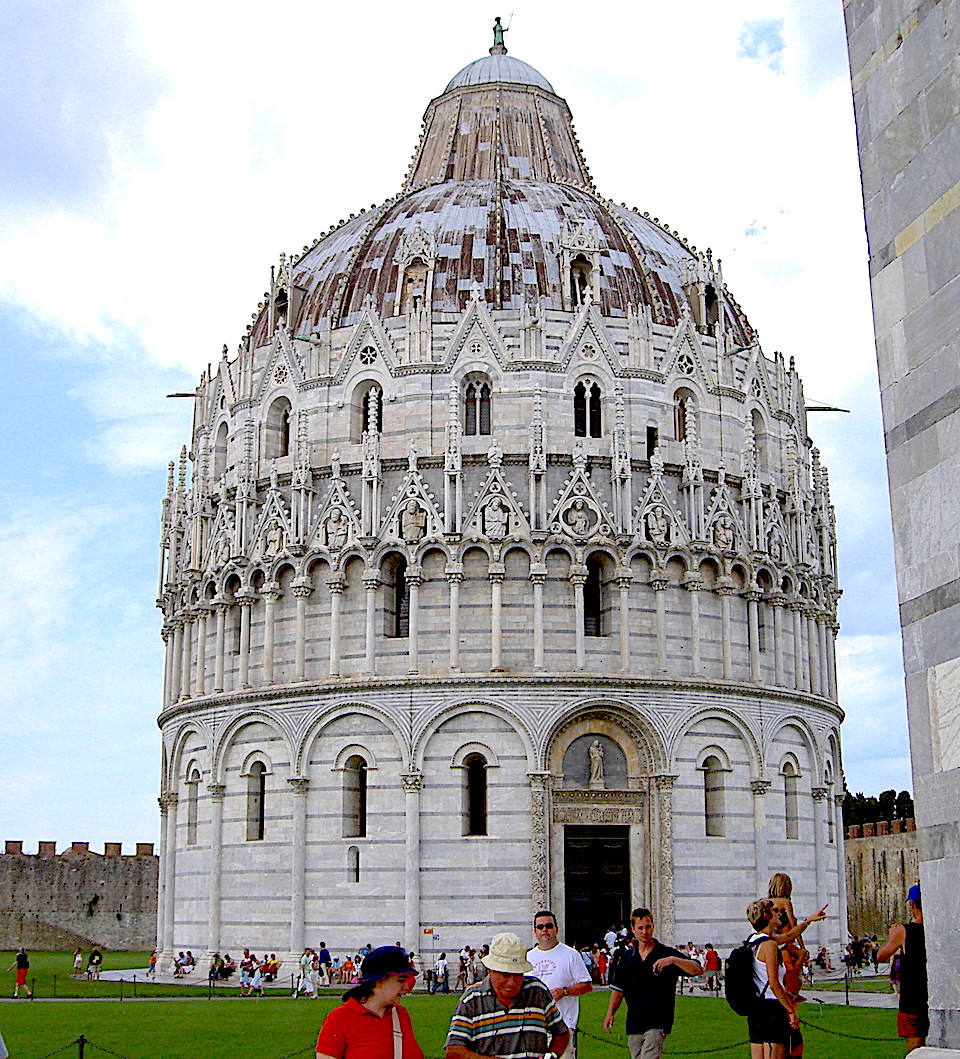
Of the three buildings in the Piazza dei Miracoli in Pisa, the one on the left fascinates me most.

PICT1244.jpg

The Baptistery, Duomo and Leaning Tower, Pisa

The Baptistery was begun by Duotisalvi in 1153 but wasn’t completed for over 200 years, allowing us to see the transition between the rounded Romanesque and the pointed Gothic.  

PICT1235.jpg

The immense interior is surprisingly plain.

Toscana_Pisa7_tango7174.jpg

Photo: Tango7174. CC BY-SA 4.0

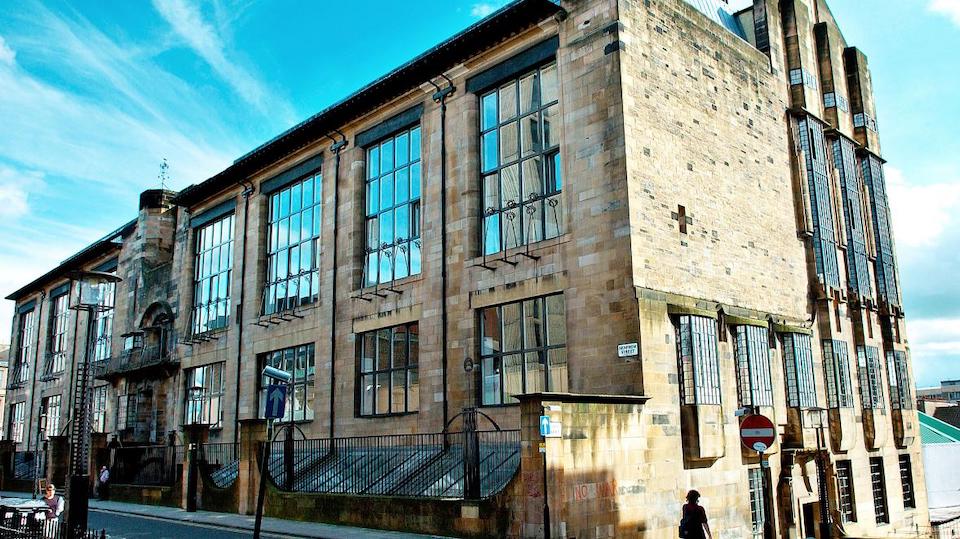
I last saw Charles Rennie Mackintosh’s masterpiece in 2012, before the disastrous fires of 2014 and 2018.

GSA2.jpg

Glasgow School of Art, 1896. The compositional asymmetry of the Renfrew Street entrance, pictured here in 2012

GSA.jpg

Photo: Robert Perry/TPSL/Camera Press

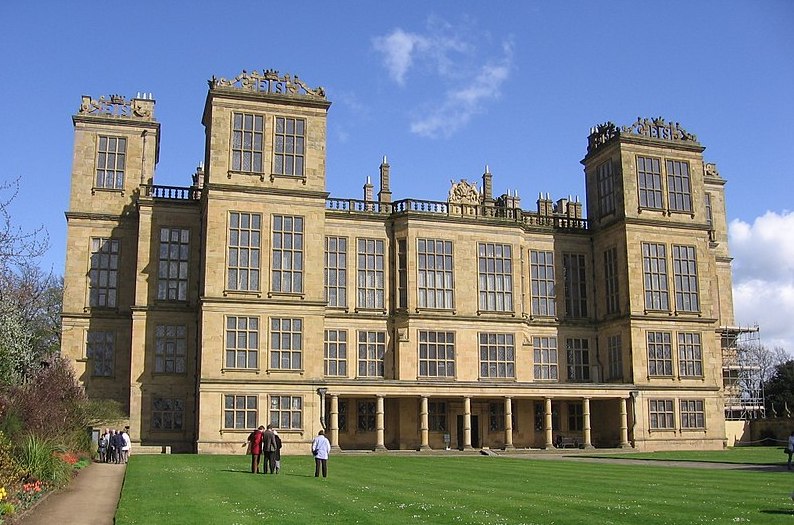
Mackintosh’s unique buildings were filtered through a range of influences.  For example, the parade of window frames on the north front are reminiscent of Elizabethan ‘prodigy houses’ with their runs of rectlinear windows …

800px-Hardwick_Hall_in_Doe_Lea_-_Derbyshire.jpg

Hardwick House, Derbyshire, 1590-7. Photo: chachu207. Creative Commons licence CC BY-SA 3.0

… while the sheer planes on the east and west elevations echo the high defensive walls of the Scottish Baronial Style [6].

Maybole Castle.jpg

Mackintosh made sketches of this baronial tower-house, Maybole Castle, Ayrshire. ©South Ayrshire Libraries

Mackintosh’s reputation was highest in Austria. When he and his wife Margaret Macdonald were invited to design a room for display at the 8th Secessionist Exhibition of 1900 [7] students paraded them through Vienna on a cart garlanded with flowers, and architect and designer Josef Hoffman– co-founder of the Wiener Werkstätte – described Mackintosh as the leader of the modern movement. This high point contrasted starkly with the latter part of his career when commissions declined and he descended into alcoholism.

PICT0647.jpeg

The Secession Building designed by Josef Maria Olbrich, Vienna, 1898. Locals refer to the dome as the golden cabbage.

Back in Norfolk, King’s Lynn possesses ‘one of the finest late C17 buildings in provincial England’ [8].  The beautifully proportioned Customs House was commissioned by a local wine merchant, Sir John Turner MP, and designed by local architect, Henry Bell. It was built as a merchants’ exchange at a time when the town was one of the nation’s busiest ports and a hub for trade with Europe.

IMG_0124.jpeg

The Customs House, 1683

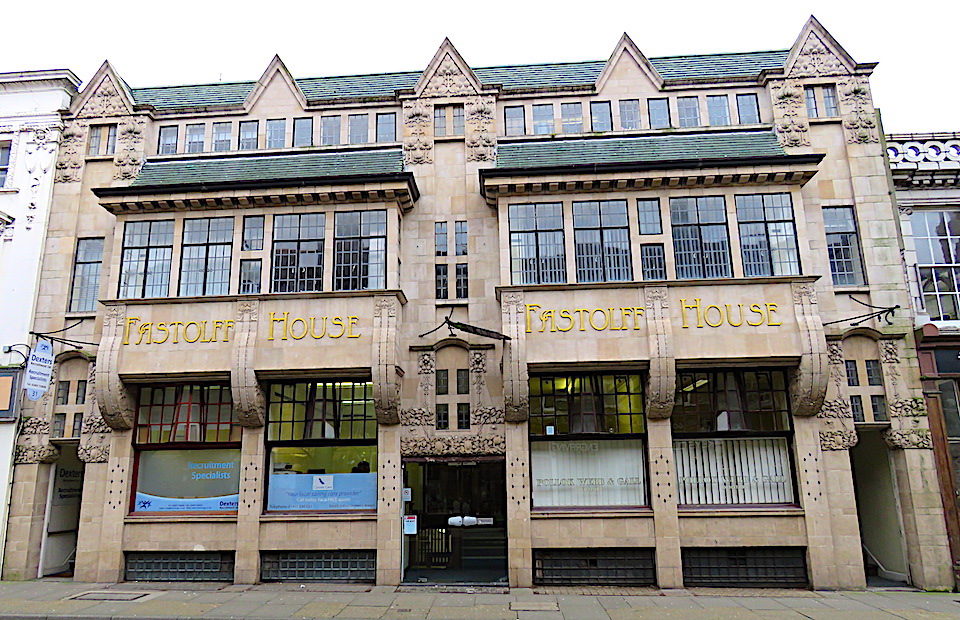
On the opposite side of the county, the ‘only one remarkable building’ of Great Yarmouth, (according to Pevsner and Wilson [9]) is Fastolff’s House. I have written about it previously [10] but it is a neglected gem, one of few buildings in the art nouveau style in this country, and I have been back a few times since.

Feb2016.jpg

Fastolff’s House, Great Yarmouth. Designed by RS Cockrill 1908

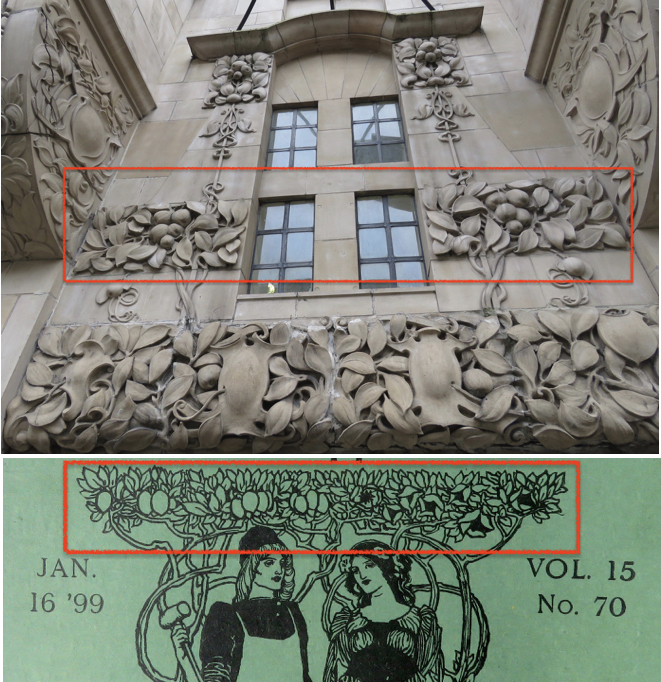
The building is made of red brick but what transforms it is the facade of white faience. Fastolff’s House is elevated by its applied decoration just as the exterior of Norwich’s Royal Arcade was transformed by WJ Neatby’s Carraraware tiles. Carraraware was developed in Doulton’s Lambeth factory by the head of their architectural department, Neatby, as a weatherproof facade resembling marble. It is not known who made the Yarmouth tiles but the panels of leaves and fruit are in the restrained form of art nouveau – as opposed to the sinuous variety favoured on the Continent – illustrated on the front cover of The Studio around the end of the nineteenth century.

Fastolff Duo.001.jpeg

Above, the art nouveau frieze in white faience (red rectangle) echoes, below, the cover design of The Studio from a dozen years earlier.

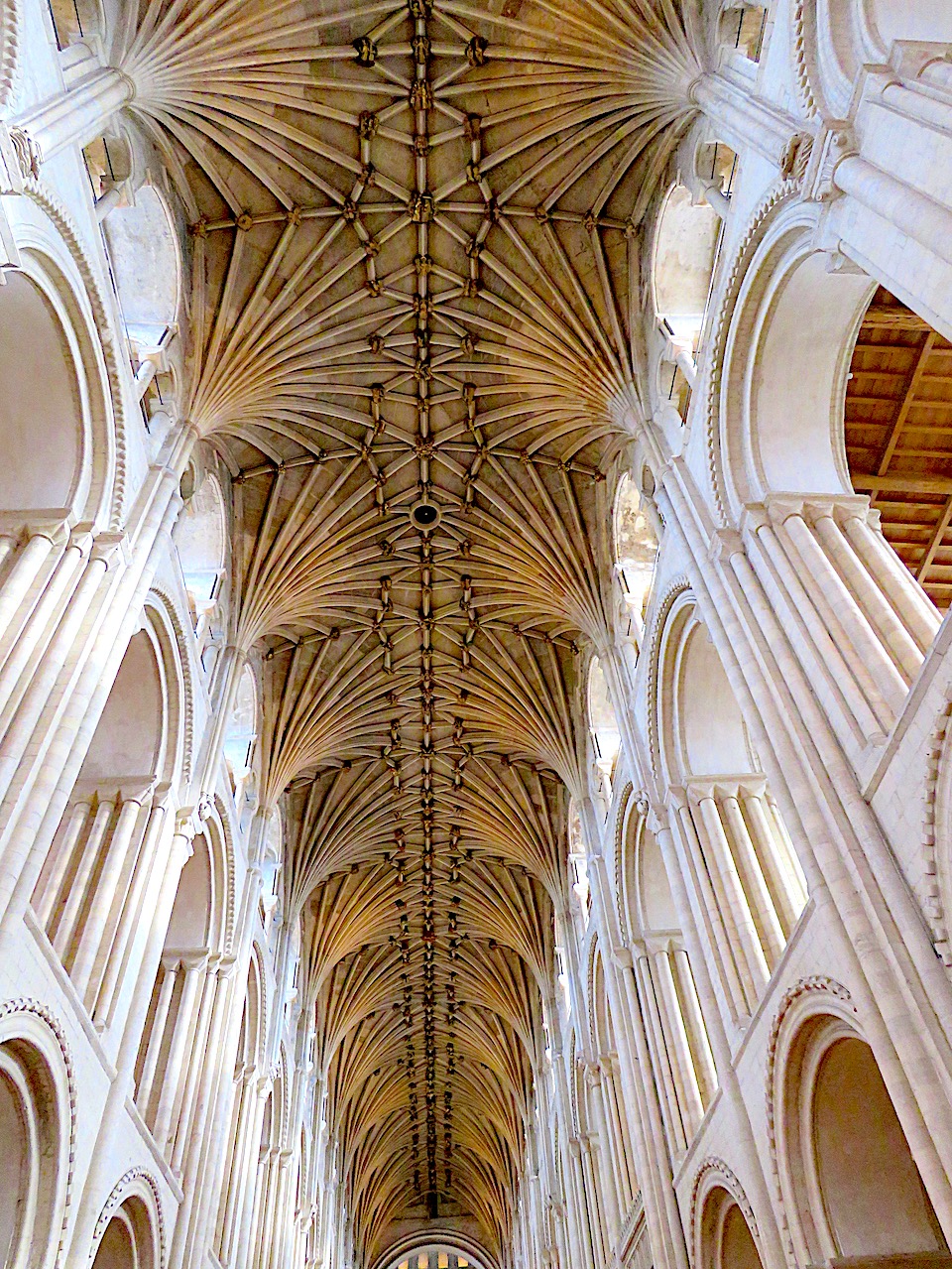
To lose one spire may be regarded as a misfortune but to lose two looks like carelessness. In 1362, the wooden spire of Norwich Cathedral was blown down in a gale; in 1463, its replacement was struck by lightning. The ferocity of the resulting fire destroyed the wooden roof of the nave and turned the Caen stone pillars pink. Bishop Walter Lyhart – whose rebus of a hart lying on water is dotted around the nave – replaced the roof with a stone vault decorated with short lierne ribs. Completed in 1472, the result was a remarkable 14-bay-long vault designed by Reginald Ely not long after he had finished working on King’s College Chapel. Where ribs intersected he placed 255 stone bosses depicting biblical scenes, from the Creation to Doomsday [11].

IMG_9955.jpeg

The lierne vault of the nave. Beneath it, the massive Norman piers had been turned a pinkish colour by the fire

IMG_3038.jpg

Norwich Cathedral from the cloisters

©2020 Reggie Unthank

Sources

  1. https://colonelunthanksnorwich.com/tag/norwich-pantheon/
  2. John Harvey (1988). Cathedrals of England and Wales. Pub: Batsford
  3. EC Wade and J Heyman (1985). The timber octagon of Ely Cathedral. Proc. Instn. Civ. Engrs, vol 8, part 1: 1421-1436.
  4. https://www.architectural-review.com/the-romantic-and-pragmatic-history-of-the-fan-vault-has-lessons-for-contemporary-structures/8609423.article
  5. Rosemary Hannah (2012). The Grand Designer: Third Marquess of Bute. Pub: Birlinn Ltd.
  6. James Macaulay (1993). Glasgow School of Art: Charles Rennie Mackintosh. Pub: Phaidon Press Ltd.
  7. Jackie Cooper (ed) (1984). Mackintosh Architecture. Academy Editions, London.
  8. Nikolaus Pevsner and Bill Wilson (1999). The Buildings of England. Norfolk 2: North-West and South. Pub: Yale University Press.
  9. https://colonelunthanksnorwich.com/2016/03/25/art-nouveau-in-great-yarmouth/
  10. Nikolaus Pevsner and Bill Wilson (1999). The Buildings of England. Norfolk 1: Norwich and North-East. Pub: Yale University Press.
  11. Paul Hurst (2013). Norwich Cathedral Nave Bosses. Pub: Medieval Media, Norwich

Share this:

  • Click to share on Facebook (Opens in new window) Facebook
  • Click to share on X (Opens in new window) X
  • Click to share on Pinterest (Opens in new window) Pinterest
  • Click to email a link to a friend (Opens in new window) Email
  • Click to print (Opens in new window) Print
Like Loading...

The Norwich Banking Circle

15 Saturday Feb 2020

Posted by reggie unthank in Norwich Banking, Norwich buildings, Norwich history

≈ 25 Comments

Tags

Catton Hall Norwich, Earlham Hall, Gurneys Bank, Harveys Bank, Keswick Hall Norwich, Whitlingham Hall

From the C16 onwards, when an influx of religious refugees from the Low Countries swelled the population by up to third, Norwich became a crowded city and those who had grown rich on the worsted industry began to move out. By moving to their grand houses in the country the wealthy not only marked their new social status but also escaped the epidemics of cholera, smallpox and typhoid that swept the city. They left behind urban space that became colonised by the poor who lived in hundreds of speculative shanties. These insanitary ‘yards’ or ‘courts’, accessed down an alleyway, were a defining feature of this city that lasted until the slum clearances of the C20 [1].

Colegate Burrell's Yard view south [2030] 1937-10-09.jpg

In the heart of the former textile industry, Burrell’s Yard, off Colegate, 1937. ©georgeplunkett.co.uk

To see where the rich had fled I drew a circle around the city with a radius of a comfortable 30-minute carriage ride. In doing this I found I was merely following David Clarke who, in his third volume of The Country Houses of Norfolk, catalogued the mansions ringing Norwich, most of which are now being subsumed by the urban sprawl [2]. I had expected to see a greater diversity of trades but what we will see is a circle of wealth maintained by families who had become rich from weaving. ‘Master weavers’ managing dozens of looms made money directly from the woollen trade but the more successful made money by handling funds and extending credit to their fellow weavers. The most successful – like the Gurney and Harvey families – formed ‘country banks’ [3].

Old Catton was convenient for those who had business north of the river in Norwich-over-the-Water and what was once an agricultural village had, by the early C20, become ‘the best residential suburb adjoining Norwich’ [4]. This gentrification had begun in the mid-1700s when wool merchant Robert Rogers (Sheriff 1743, Mayor 1758) built Catton Place [4]. In 1816 this was to become the home of Samuel Bignold, son of the founder of Norwich Union. 

Catton Catton Place [0610] 1935-08-05.jpg

‘The Firs’, formerly Catton Place, in 1935. ©georgeplunkett.co.uk

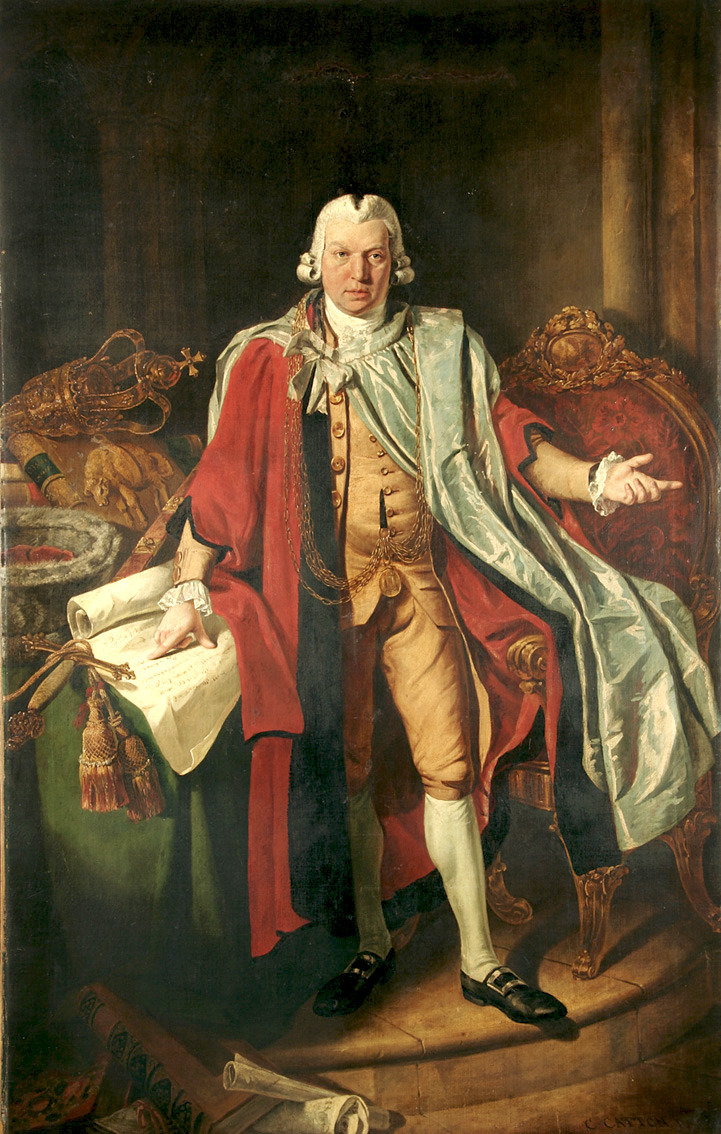
Probably the most important house in the village was Catton Hall, built on a rise that afforded a view of Norwich Cathedral now challenged by the Anglia Square development. The wealthy worsted weaver Jeremiah Ives, moved here from No.1 Colegate [5]. In the city he had lived within hailing distance of his relatives, the Harveys, and he joined them in Catton as a fellow landowner. Here is Ives, portrayed by an artist with the improbably apt name of Catton. 

ives.jpg

Portrait of Jeremiah Ives, Mayor of Norwich 1769, 1795, by Charles Catton. Presented by the yarn-makers of Norwich in gratitude for his opposition to an Act allowing the export of English wool [5].

Catton Hall was inherited by Ives’ wife from her father. This was significantly more than just ‘a house in the country’ for in 1778 Ives gave Humphry Repton his first paid commission to transform the surrounding 45 hectares into Catton Park [2,6].

Catton Park.jpg

‘Park Scene – View of Norwich – View in Catton Park’ by Humphry Repton (1752-1818). The cathedral spire can be seen between the trees. Courtesy Norfolk Museums Collections NWHCM : 1936.32.2

The Harveys had a considerable presence in Old Catton: Thomas Harvey built Catton House but there was also Robert Harvey at The Grange and Jeremiah Ives Harvey at Eastwood [4].

Screenshot 2020-01-17 at 15.17.06.png

To the north of Norwich on Faden’s map of 1797 ©Andrew Macnair. The land of J Ives Esquire is underlined in yellow. Mr T Harvey’s house in parkland is starred while Mr R Harvey and Mr Harvey owned land to the east (underlined). 

But the Harvey who built Catton House was the one who married Ann Twiss – daughter of an English merchant from Rotterdam – and whose collection of Dutch paintings had a formative influence on the co-founder of the Norwich Society of Artists, John Crome (see recent post [7]). 

Catton House poss post-war.jpeg

Catton House post-1945. Courtesy of the Old Catton Society

The Gurneys also had a presence in Catton: in 1854 Catton Hall was bought by the seriously rich John Henry Gurney Snr who had inherited the bulk of the fortune accumulated by Hudson Gurney (1775-1864) of Keswick Hall (see below). The Gurneys were Quaker weavers who, through an ‘extended cousinhood’ of alliances and partnerships, formed the country’s largest banking network outside London [3,8]. 

Financial intermediaries in the Norwich woollen trade, John and Henry Gurney established Gurney’s Norwich Bank in 1770. In 1778, Henry’s son Bartlett inherited the bank that he ran with the help of  two cousins, Richard and Joseph Gurney. Their premises were in a former wine merchant’s whose cellars proved useful for housing the safes, protected by a mastiff and a blunderbuss. Gurneys Bank was near the red well on Redwell Plain, which was renamed Bank Plain. 

lampost duo3.001.jpeg

Gurneys, Birkbeck, Barclay and Buxton Bank on Bank Plain Norwich in the 1920s, here re-badged as Barclays Bank. ©Barclays Group Archives. Astonishingly, the same ornate lamp-post on the left still stands in the same spot  (see right). 

In 1896 the bank became amalgamated under the Barclays name and the present grand banking hall was built on the site in 1927 [8]. In the C19, their London branch became ‘the world’s greatest bill-discounting house’, allowing a character in a Gilbert and Sullivan operetta to sing, ‘I became as rich as the Gurneys‘. Nevertheless, in 1866 they went bust with £11,000,000 liabilities. Although this ruined several Gurneys the Norwich branch escaped significant damage [3,8].

IMG_1900.jpg

The ‘new’ Barclays Bank built 1927, now housing ‘Open’ Youth Trust

Influenced by the Great Exhibition’s Crystal Palace, Gurney extended Catton Hall with a cast-iron Camellia House designed by local architect Edward Boardman and manufactured in Boulton & Paul’s Norwich factory. The fine cupola was removed in WWII to prevent enemy planes using it as a landmark on the way to RAF St Faith’s (now Norwich Airport) [2,4].

CattonDuo.001.jpeg

Catton Hall. The original cupola on the Camellia House is illustrated in the old postcard below, courtesy of the Old Catton Society.

John Henry Gurney Snr was married to Mary Jary who ran off with one of the grooms.

Screenshot 2020-01-21 at 15.18.08.png

Courtesy of ‘Hethersett Heritage’ by the Hethersett Society

… and, to compound JH Gurney’s woes, the bank in which he was a major shareholder (Overend, Gurney & Co.) went bust in May 1866. This triggered ‘Black Friday’ in the City and led to him selling the Hall to his cousin, Samuel Gurney Buxton, a banker at Barclays [3,4]. In 1896, Gurneys Bank was to join 10 other private banks controlled by Quakers, to form Barclays Bank. 

Mary Jary Gurney had come from Thickthorn Hall, a few miles south of Norwich at Hethersett. She had lived in this early C19 house that passed to Richard Hanbury Gurney when the owner defaulted on his mortgage. It stayed in the Gurney family until the 1930s when Alan Rees Colman, director of Colmans and second son of Russell Colman of Crown Point, bought the hall.

thickthorn hall.jpg

Thickthorn Hall. Courtesy of Cathie Piccolo

In addition to Catton and Thickthorn the wider Gurney family also had country houses ringing the city – at Colney, Earlham, Easton, Keswick Hall and Sprowston.

Map3.jpg

Clockwise from Catton Hall (Gurney) at 12 o’clock, banking families were associated with: Sprowston Hall (Gurney), Whitlingham Hall, Crown Point (Harvey), Keswick Hall (Gurney), Eaton Hall (mistakenly labelled Easton Hall by Faden; Easton Lodge was briefly owned by a Gurney but is actually a few miles west), Earlham Hall (Gurney) and Colney Hall (Barclay). From Faden’s Map of 1797 ©Andrew Macnair.

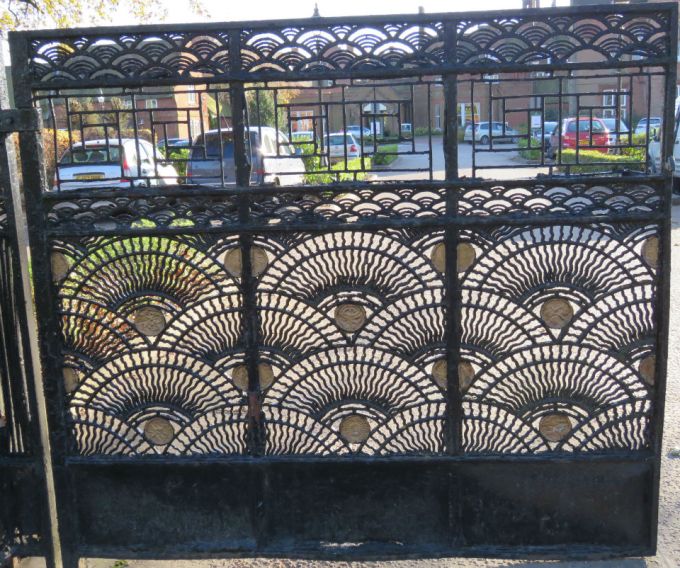
The mid-C16 Sprowston Hall was acquired by the Gurneys in 1869 – bought by John Gurney, the eldest son of John Gurney of Earlham Hall (see below) [2]. Gurney employed Wymondham architect Thomas Jeckyll to re-design it in an Elizabethan Revival style. Jeckyll, however, could not resist inserting an of-the-moment gate in the Aesthetic Style that he helped champion.

gates sprowston manor.jpg

Jeckyll’s ‘japonaise’ gate at Sprowston Manor. See previous post.

But if we’re following the money it’s impossible to avoid the gravitational pull of Keswick, south of Norwich. The worsted weaver Joseph Gurney came to Keswick Old Hall in 1747 but when the fabulously wealthy Hudson Gurney (who inherited brewing as well as banking money) took over the estate in 1811 he built a new Keswick Hall in the Regency style [2].

Hudson Gurney.jpg

The ‘dashing smart’ Hudson Gurney in an etching by Mrs Dawson Turner from a painting by John Opie RA. Courtesy of Norfolk Museums Collections NWHCM: 1832.39.1

Keswick Hall south front [6606] 1990-04-30.jpg

Keswick Hall, south front in 1990. ©georgeplunkett.co.uk

When Hudson Gurney died in 1864 his estate passed to his nephew John Henry Gurney of Earlham who had been tainted by the collapse of Overend, Gurney & Co Ltd. Much later, Keswick Hall was to become the new home of trainee teachers who had been displaced from their training college in Norwich’s College Road when it was bombed in the Baedeker Raids of 1942.

IMG_6766.jpg

The 1892 Diocesan training college for school mistresses on College Road, Norwich, was bombed in WWII and the students moved to Keswick Hall

Earlham Hall, just west of the city,  is another Gurney residence now associated with education [2]. For over a century the house was rented from the Bacon family during which time it was occupied by the banker John Gurney (1749-1809) and his family. Not all of his 13 children survived but Samuel, Daniel and Joseph John lived on to become bankers. Joseph John Gurney was also a Quaker minister and, like his sister Elizabeth Fry (née Gurney), was active in social and prison reform.

earlham-hall-1819-2.png

Earlham Hall as it was in the early C19. Now, much changed, it houses the UEA Law School. Courtesy landscape.uea

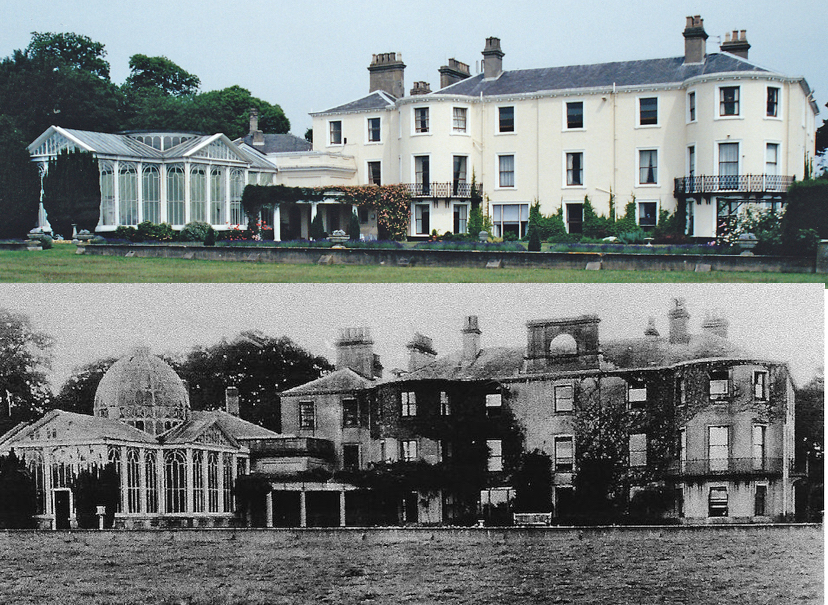
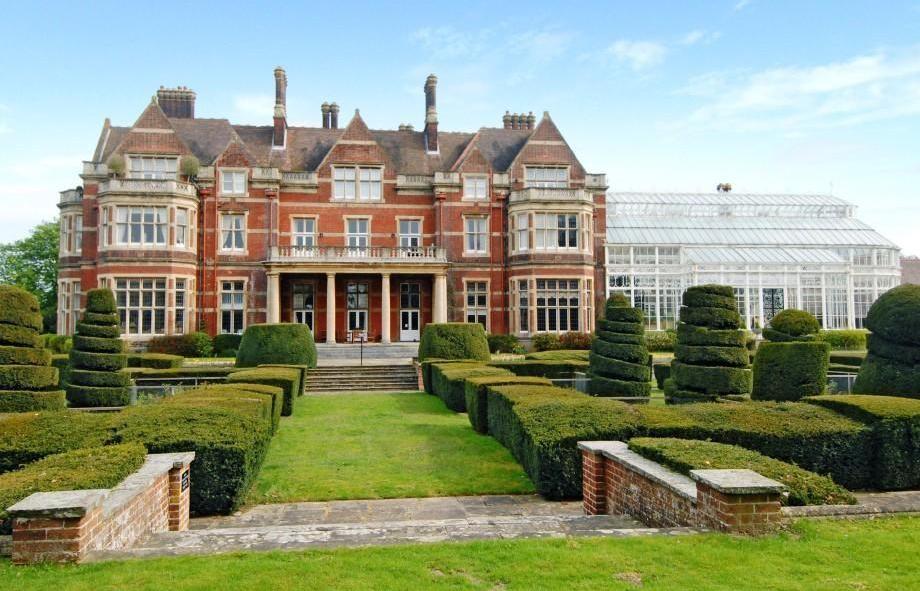
The easternmost house I underlined on Faden’s map is Whitlingham (Old) Hall, adjacent to but separate from, ‘Crown Point (Money Esq)’ where Whitlingham (New) Hall now stands. It was built from 1865 for Sir Robert Harvey Harvey 1st Baronet by architect H E Coe, a pupil of Sir George Gilbert Scott. The local practice of Edward Boardman and Son supervised the building of this large Elizabethan-Revival mansion with its spectacular ornamental conservatory [9]. 

WhitlinghamHall.jpg

Whitlingham Hall, which superseded  Crown Point Hall. ©Rightmove

Five years later, as one of the proprietors of what began as Hudson and Hatfield’s Bank, Harvey was to build the grand Classically-styled Norwich Crown Bank; this was on Agricultural Hall Plain, within sight of Gurneys (later, Barclays) Bank on Bank Plain [10]. Unfortunately, Sir Robert had been speculating on the stock exchange and tried to disguise his heavy losses as debts owed by fictitious customers. When the scandal broke in 1870 Harvey shot himself. Somewhat ironically, in view of their own recent financial uncertainty, Gurneys Bank bought the goodwill of the Crown Bank in order to quell local panic [3]. The Crown Point Estate was sold to JJ Colman and in 1955 it became Whitlingham Hospital, now private apartments.

crown bank.jpg

Norwich Crown Bank

The name ‘crown’ associated with this building is sometimes thought to be associated with its later use as the city’s Head Post Office (until 1969).  IMG_1918.jpg

The name, however, can be traced to the Money family who bought the Whitlingham estate as far back as the late 1600s. It was here, in 1784, that Major John Money built a house in the Neo-Gothic style. This was Crown Point Hall, named in commemoration of his military exploits in the North American Campaign when he was based at Fort Crown Point, New York State  –  “the greatest British military installation ever raised in North America.” [11]. You may remember Major Money from a previous post [12] that describes his perilous balloon flight of 1785 when he took off from Quantrell’s Pleasure Garden (near Sainsbury’s on Queens Road); he landed in the sea off Yarmouth from which he was rescued several hours later. Money’s new house did not, however, survive for after his death and the estate was sold, Sir Robert John Harvey tore it down and replaced it with the Victorian iteration of Whitlingham Hall that stands today as private apartments[2]. 1024px-Major_Mony's_Perilous_Situation_When_he_fell_into_the_Sea_July,_23,_1785,_off_the_Coast_of_Yarmouth_NASM-745A8AFD32D22_001.jpg

Bonus track: The Harvey family portrait [13]

You know that dream where you meet all your ancestors in some celestial picnic spot; you know, grandparents, distant aunts and uncles and a posse of strangely familiar faces? Well, here it is, several blog posts rolled into one. There’s Robert Harvey who founded the family bank (#3 in the portrait). And there’s John Harvey (#5) from the Street Names post [14] who gave his name to Harvey Lane; he also appeared in the Norwich School of Painters post in Stannard’s painting, Thorpe Water Frolic [7]. There’s even Charles Harvey MP (#6) who took the surname of his uncle Savill Onley in order to secure an inheritance, as we saw in Street Names [14], together with his son Onley Savill Onley. (#7) And don’t forget that Onley became an Unthank name (hence, Onley Street off Unthank Road) through marriage [15]. These are just some of the unspoken connections in the portrait by Norwich School artist Joseph Clover – a friend of Amelia Opie’s husband John who we encountered  in the previous post, Behind Mrs Opie’s Medallion [16].

Harveys numbered.001.jpg

The Harvey Family of Norwich, by Joseph Clover c 1821. Courtesy of Norwich Castle Museum and At Gallery  NWHCM: 1985.435. 1= Robert Harvey ‘Father of the City’ (1679-1773); 2= Sir Robert Harvey Harvey; 3=Genl Sir Robert Harvey b.1785, founder of Harvey’s Bank; 4=Robert Harvey of Catton and St Clements ?1730-1816;  5= John Harvey of Thorpe Lodge 1775-1842; 6= Charles Harvey who took the name of Savill Onley 1756-1843; 7= Onley Savill Onley d.1890; 8= Roger Kerrison of Brooke House, Norfolk. Father-in-law of John Harvey (#5) and bank owner 1740-1808.

©Reggie Unthank 2020

Sources

  1. Frances and Michael Holmes (2015). The Old Courts and Yards of Norwich. Pub: Norwich Heritage Projects.
  2. David Clarke (2011). The Country Houses of Norfolk. Part Three: The City and Suburbs. Pub: Geo R Reeve Ltd, Wymondham.
  3. Roger Ryan (2004). Banking and Insurance. In, ‘Norwich Since 1550’ by Carol Rawcliffe and Richard Wilson. Pub: Hambledon and London.
  4. Old Catton Society (2010). Historic Houses of Old Catton. Pub: Catton Print, Norwich.
  5. http://www.norwich-heritage.co.uk/monuments/Jeremiah%20Ives%201729%20-%201805/Jeremiah%20Ives%20younger%201729.shtm
  6. http://www.cattonpark.com/about/park-history.html
  7. https://colonelunthanksnorwich.com/2019/09/15/the-norwich-school-of-painters/
  8. https://en.wikipedia.org/wiki/Gurney%27s_Bank
  9. https://historicengland.org.uk/listing/the-list/list-entry/1001480
  10. AD Bayne (1869). A Comprehensive History of Norwich. Pub: Jarrolds, Norwich. Now available online:https://www.gutenberg.org/files/44568/44568-h/44568-h.htm
  11. https://en.wikipedia.org/wiki/Fort_Crown_Point
  12. https://colonelunthanksnorwich.com/2019/01/15/pleasure-gardens/
  13. Andrew Moore and Charlotte Crawley (1992). Family and Friends: A Regional Survey of British Portraiture. Pub: London: HMSO and Norwich: Norfolk Museums Service.
  14. https://colonelunthanksnorwich.com/2019/10/15/street-names/
  15. https://colonelunthanksnorwich.com/2016/01/30/colonel-unthank-and-the-golden-triangle/
  16. https://colonelunthanksnorwich.com/2020/01/15/behind-mrs-opies-medallion/

Thanks to David Clarke of City Bookshop, Norwich, for his advice; his Country Houses of Norfolk is the standard work. I am grateful to Dr Giorgia Bottinelli and Jo Warr of Norwich Castle Museum and Art Gallery for providing the information on the Harvey portrait. Thanks also to Ray Jones, archivist to the Old Catton Society for providing images and to Cathy Piccolo for information on, and the photo of, Thickthorn Hall.

Share this:

  • Click to share on Facebook (Opens in new window) Facebook
  • Click to share on X (Opens in new window) X
  • Click to share on Pinterest (Opens in new window) Pinterest
  • Click to email a link to a friend (Opens in new window) Email
  • Click to print (Opens in new window) Print
Like Loading...

Norwich: shaped by fire

15 Sunday Dec 2019

Posted by reggie unthank in Norwich buildings, Norwich history

≈ 16 Comments

Tags

Norwich fires, Norwich libraries, Norwich thatched buildings

Fire has been a potent force in shaping where we live – a lick here, a conflagration there – especially when buildings were made of timber and thatch. In the period before the Conquest, near a low river crossing, a defended Anglo-Scandinavian settlement evolved on the north bank of the River Wensum. This was the North Wic whose name is recorded on coins minted there during the reign of the first English king, Athelstan (925-939). But in 1004 the Danish king, Sweyn Forkbeard, took vengeance for the death of his sister during the St Brice’s Day Massacre by burning the northern settlement [1].

“This year came Sweyne with his fleet to Norwich, plundering and burning the whole town.”  (The Anglo-Saxon Chronicles).

vikings.jpg

From the bronze doors of Norwich City Hall. James Woodford 1938

Two ‘lost’ churches on the north bank, in the Magdalen Street area of Norwich, had suffixes referring to fire: St Mary’s Unbrent (unburnt) and St Margaret’s in Combusto or, in Combusto Loco. The qualifier, ‘in combusto loco’, identifies them as survivors of a conflagration but by the Reformation both had disappeared. The local historian Blomefield [1] avoided blaming the Danes for this fire; instead he suggested it was ‘in the time of the Conqueror’, although it is hard to get a definitive answer. Whether the north wic was too devastated to be rebuilt as a regional capital or whether they preferred to be inside the protective loop of the Wensum, the Normans radically transformed the topography by re-settling Northwic on the south of the river. Here, they built their cathedral, castle and marketplace from which the new French Borough pushed westward.

IMG_7837.jpg

Sr Mary Unbrent (red star) and St Margaret In Combusto (yellow) were in the part of Norwich-over-the-Water ravaged by fire. The new French Borough changed the city’s north-south axis by expanding westwards from the new Castle. Map: ‘How the city of Norwich grew into shape’ by Wm Hudson 1896. Courtesy Norfolk Museums NWHCM:1997.550.50:M

In August 1272 a quarrel erupted at the annual Tombland Fair over whether stall-holders should pay fees to the city or the priory. The prior’s armed men claimed that the old Anglo-Scandinavian marketplace outside the cathedral gates was under their jurisdiction, not the city’s, and in the ensuing fight a citizen was killed with a crossbow [1]. The belligerent prior, William de Brunham, fled to Yarmouth and returned with barges of armed men who ‘fell upon citizens with fire and sword’ [1]. While the priory men  barred the monastery gates and fired crossbows at passing citizens, citizens on the tower of St George Tombland shot slings of fire that set the monastery ablaze, destroying much, including the library.

IMG_1976.jpg

The tower of St George Tombland, in Princes Street, from which the townsmen hurled fire towards the cathedral spire.

Thirteen priory men were killed [2]. When he heard about this, King Henry III – who was attending his parliament at Bury St Edmunds – condemned 34 young townsmen to be drawn by horses around the city until dead. Others were hanged, drawn and quartered and their bodies burned, according to the old Anglo-Saxon penalty for arson. The woman who set fire to the gates was burned alive. Though the prior was acknowledged to have instigated the riot he got off lightly: he was committed to the bishop’s prison and the priory’s manors were seized by the Crown. 

Ethellred Gate.jpg

For burning the old Saxon church of St Ethelbert the king ordered the citizens to build the Ethelbert Gate (restored in the C19) to the cathedral precinct. While the presence of St George in the left-hand spandrel could be fulfilling a traditional protective (apotropaic) role it can’t help reminding us of the Tombland Riot.

A century and a half before the Great Fire of London, much of Norwich was to be devastated by its own Great Fires. First,  in 1505, “was grete part of the cyte of Norwich brent” [1]. Two years later, two more fires consumed the city centre, helping to explain why so few timber-framed and thatched medieval buildings survived into the modern period [2]. The first of the 1507 fires started on Easter Tuesday and, over four days, 718 buildings burned: Norwich was ‘almost utterly defaced’ [1].  

fire map.001.jpeg

The 1507 fire map. Redrawn from ©BS Veriod 1986 [3]


The fire is said to have started at The Popinjay Inn on Tombland, home to the Popinjay or Papingay family (popinjay = parrot) [1, 4]. 

Tombland 29 site of Popinjay Inn [4659] 1962-03-28.jpg

Site of the Popinjay Inn 1962, Number 27 on the SE corner of Tombland. The corner building was demolished to make way for an unsympathetic modern structure now occupied by All-Bar-One.  ©www.georgeplunkett.co.uk


On Ascension Day – the fourth of June 1507 – a second fire started in the house of a French surgeon in the Colegate area; it raged for two days and a night, destroying a further 360 houses. Stone-built churches survived but very few timber-framed and thatched houses did (the city’s remaining thatched buildings are shown at the end). Almost half the city’s houses were destroyed. In Elm Hill, the Britons Arms stood alone [2]. IMG_1995.jpg

Britons Arms of 1347 [5] was originally a beguinage that housed lay sisters associated with St Peter Hungate (in the background). Now it is a coffee house and restaurant.

After the fires, Augustine Steward – sheriff, mayor and wealthy wool merchant, whose wonky house is around the corner in Tombland – rebuilt much of Elm Hill. This included Paston House, now home to the Strangers’ Club (see previous post [6]). 

Paston House Norwich.JPG

Paston House in Elm Hill, rebuilt by Augustine Steward after the 1507 fires. Blackfriars’ Hall is glimpsed at the end of the street.

Blackfriars’ Hall itself had been ravaged by fire in 1413 and was rebuilt over a 30 year period (1440-70) [7]. The family of Sir Thomas Erpingham – whose kneeling effigy still supervises entry through the cathedral’s Erpingham Gate – paid generously towards the restoration of the Blackfriars’ buildings while the Paston family paid for the hammer-beam roof in the nave now known as St Andrew’s Hall [6]. After the Reformation, Augustine Steward bought St Andrew’s Hall on behalf of the city and it comes down to us as ‘the most complete English friars’ church’ [7].

In 1509 the city authorities eventually decreed that all new buildings should have roofs of thaktyle (tile) and not thakke (thatch) [3,2]. Curiously, this ordinance was repealed in 1532, allowing houses to be roofed in ‘slatte, tyle or reeyd’ but sense prevailed and in 1570 Norfolk-reed thatch was again forbidden, changing the roofscape of Norwich at the stroke of a pen [3]. In The Netherlands and Flanders, thatch had already been banned in favour of pantiles that were now being imported all along the east coast of England and Scotland [8].

‘Pan’ is Dutch  for ’tile’ but it also refers to the pan you put on the stove, so ‘roof tile’ in Dutch is ‘dakpan’.

Another survivor of the 1507 fires was the C14 Suckling House, named after the mayor of 1564. In 1923 it was bought by Ethel and Caroline Colman. They added Stuart Hall as a cinema (to the left) and presented a renovated Suckling House to the City of Norwich, “for the advancement of education … in its widest sense” [9]. Cinema City is now an arts cinema with bar and restaurant.

Suckling House2.jpg

The pantiled great hall of Suckling House is at centre. Stuart Hall (left) was given to the city by the Colman sisters in memory of their sister Laura Elizabeth Stuart (see previous post). 

Decades later, the city still hadn’t risen from the ashes. To hasten the resurrection an Act of Parliament in 1534 declared that if the properties were not rebuilt or at least enclosed within two years: ‘the chief lords of the fees (or ‘the mayor &c’) may enter upon them, and rebuild or enclose them in one year’s time’ [1]. In 1578, in readiness for the visit of Queen Elizabeth, the mayor repaired and beautified the streets although this didn’t stop the monarch from commenting on the number of derelict properties.

The city ordinance of 1570 that specified tiled roofs represented an important turning point for it also outlined steps to fight fires. For instance, every carrier and brewer had to be prepared to convey vessels of water until a fire had been extinguished. 

For a fire alert the carriers and brewers were to be called by a peal of bells rung ‘auk’ or ‘auker’ [4].  ‘Auker’ is an elusive word (awkward?) but an inscription on the 7th bell at St Ives, Cambs provides an explanation: ” When backwards rung we tell of fire/Think how the world shall thus expire” [11]. That is, the call to action was a peal rung backwards.

There was also an inspection regime to ensure that church wardens and aldermen maintained sufficient buckets and tall ladders, or else be fined [4]. The thatched St Augustine’s church had to have six buckets and a ladder, while St Peter Mancroft was a 30-bucketer [10]. 

In 1577 the city had its first supply of pumped water, from New Mills, although it took until 1742 for the entire city to have access to water from cisterns. In 1720 a mechanism was installed that raised water into a cistern known as ‘The Tombland Waterhouse’ [3].

IMG_8278.jpg

The Tombland Obelisk (and water fountain), erected in 1860 by JH Gurney on the site of the water cistern.

In 1668, just two years after the Great Fire of London, Norwich had its first fire engine, kept in St Andrew’s Hall; by 1750 the other city parishes had these manual appliances [3]. After the Great Fire, insurance companies sprang up as a hedge against financial loss but it wasn’t until 1797 that Thomas Bignold was to set up the ‘Norwich Union Society for the Insurance of Houses, Stock and Merchandise from Fire’, later the ‘Norwich Union Fire Insurance Company’.

Screenshot 2019-11-27 at 13.44.01.png

Norwich Union fire mark of the early 1800s. Such plaques marked which houses were to be rescued by the company’s own fire brigade

At that time, the insurance companies’ own trained fire brigades probably offered better fire-fighting than the parish.

Screenshot 2019-11-24 at 14.19.01.png

Note the fire engine and the Norwich City arms. Norwich Union header of the late 1700s. Courtesy: Aviva

The ‘fire timeline’ [3] for Norwich in the C19 presents a catalogue of fires in commercial premises: Hubbard’s the cabinet makers (1815); Neal’s coachmakers (1820); St James factory (later Jarrolds’ print works, 1846); the Steam Flour Mills (1855); Tilyard and Howlett’s Shoe Factory (1862); JJ Colman’s Carrow Works (1881) etc etc. In 1829, there was a major fire at Squire & Hills Vinegar Brewery on the Wensum – a large factory of 125,000 square feet (11,600 sq metres).

OS 1905:1908 VinegarWorks.png

The Vinegar Works. Ordnance Survey map 1905/8

The presence of a gin distillery made for an explosive mixture and this was captured in a sketch by John Sell Cotman.

Cotman.jpg

Fire at the Vinegar Works on the River Wensum by John Sell Cotman. Courtesy of The British Museum 1905,0520.2

Where Norwich goes, London follows: five years later JMW Turner had his own Vinegar Works.

JMW Turner.jpg

The Burning of the Houses of Parliament by JMW Turner ca 1834-5. Tate Britain, Creative Commons

In 1835 Norwich City Council was allowed to levy a rate to pay for combatting fire, and in 1840 they formed their own fire brigade. Norwich Union’s fire brigade disbanded in 1858 and passed on their equipment to the city [3]. 

But large companies still maintained their own fire brigades. In 1876, by the time the City Fire Brigade arrived at a fire in Albion Mills (now apartments) in King Street, JJ Colman’s fire brigade were already in attendance. Later that year they were again first attenders when a large fire devastated Boulton & Paul’s factory, further upriver at Rose Lane [3]. 

30129065933450.jpg

Colman’s Carrow Works Fire Brigade at work on the Wensum. Jets of water from the steam engine could be used to propel the fire team along the river. Courtesy Norfolk County Council at Picture Norfolk 

IMG_2040.jpg

A horse-drawn steam engine of ca 1881 used by Colman’s Carrow Works Fire Brigade until 1945. Now in The Museum of Norwich at The Bridewell

The city’s fire station had originally been in the medieval Guildhall but in September 1898 a new station was opened in Pottergate. It may have been financially favourable to convert council-owned property but it meant that horse-drawn (and later, motor) fire engines had to negotiate their way through narrow medieval lanes. 

OS 1905:7. FireEnginePtrgte.png

The 1898 fire station in a yard off Pottergate. The Old Norfolk and Norwich Library is marked with a star. Ordnance Survey map 1905/7

The new fire station yard was accessed through an archway.

Pottergate 12 to 16 fire station entrance [B504] 1933-03-26.jpg

The fire station sign marks the archway into the yard of 12-16 Pottergate. The firemen’s quarters were in a fine Georgian-fronted building opposite (No 17). The shop at the end of the street was a fish restaurant in 1933 and remains as such today – the Grosvenor Fish Bar. The near left side of the street was rebuilt after WWII. ©georgeplunkett.co.uk


One month before the Pottergate station was opened, a fire broke out in the premises of Hurn the rope and sail maker in nearby Dove Street (see map above). The municipal fire brigade was assisted by brigades maintained by two of the city’s big four breweries (Bullards and Steward & Patteson) but they were unable to prevent the spread of fire to the warehouse of Chamberlin’s the drapers, which occupied most of the block, nor to the Norwich Public Library. (For the history of Norwich libraries, and their fires, see [12]).

guildhall-hill-subscription-library-4368-1955-08-24.jpg

The Norfolk and Norwich Public Library in 1955. It was rebuilt following the major fire of 1898 and was until recently The Library restaurant. ©georgeplunkett.co.uk

In 1935 the fire station moved to Bethel Street, in purpose-built premises designed by Stanley Livock of London Street. Its style is akin to the ‘Post-Office Georgian’ employed on public buildings of the inter-war years. Its subdued decoration complements the Scandinavian-influenced City Hall, designed in 1931 but not completed until 1938.  

1934-05 construction almost complete [0093] 1934-05-10.jpg

The new fire station in Bethel Street, six months before the official opening. The chimney pots to the left are in Lacey & Lincoln’s builders’ yard, once the Old Skating Rink, and now Country & Eastern. Far right are houses at the corner of Bethel and St Peter’s Street that were soon to be demolished to make way for the City Hall, opened in 1938. ©georgeplunkett.co.uk


Other cities may have had separate fire brigades but in Norwich, the Chief Constable remained in charge of ‘police/firemen’ until the late 1940s [3]. This explains the presence of both police and fire helmets carved above the original entrance to the police station in Norwich City Hall. 

helmets.001.jpeg

A fireman’s and a policeman’s helmet mark the old entrance to the police station in City Hall (1938) before it was moved to the SW corner. Designer: H Wilson Parker.

In 1994, with a horrible symmetry that recalled the 1892 library fire, the new Central Library (1960-2) burned down, one hundred yards from the fire station [see 13].

30129032932833.jpg

St Peter Mancroft (far left) separated by a car park from the Central Library – a part of which is glimpsed extreme right. Circa 1969. Courtesy Norfolk County Council at Picture Norfolk.

Housed in The Forum the new Millennium Library (2001), designed by Sir Michael Hopkins, is claimed to be the most visited in the country. This building relates to St Peter Mancroft, across a piazza, far more successfully than its predecessor did across that cheerless car park.

IMG_2070.jpeg

The piazza forms a successful pedestrian space, shared between St Peter Mancroft and The Forum.

In 2013 the fire station became Sir Isaac Newton Sixth Form and the city was served by three stations, not in the historic centre but on the perimeter at Carrow, Sprowston and North Earlham.

Bonus track: the six remaining thatched buildings

Thatched 6.001.jpg

Top row: Pykerell’s House C15, rebuilt after WWII, St Mary’s Plain; Thatched cottage C17, formerly the Hampshire Hog, St Swithin’s Alley off St Benedict’s Street; The Hermitage, 52-54 Bishopgate, dating from the C15. Bottom row:  Britons Arms C14, Elm Hill; 2-4 Lion and Castle Yard, C17, Timberhill; Waring’s Lifestore, late C16, formerly The Barking Dickey (Braying Donkey) Inn, Westlegate. Read more about these thatched buildings on the web page by Evelyn Simak, assiduous photographer of Norwich and Norfolk [13].


©2019 Reggie Unthank

A suggestion for the Christmas stocking: some copies of the fourth – and probably final – printing of the Unthank book remain. They can be bought from Jarrolds Book Department or the City Bookshop in Davey Place.  (“An ideal companion for the fireside”. The Norwich Mardler).

Sources

  1. Francis Blomefield (1806). An Essay Towards A Topographical History of the County of Norfolk: Volume 3, the History of the City and County of Norwich, Part I. Originally published by W Miller, London. Online: https://www.british-history.ac.uk/topographical-hist-norfolk/.
  2. Frank Meeres(2011). The Story of Norwich. Pub: Phillimore.
  3. Bryan S Veriod (1986). A History of the Norwich City Fire Brigade. Pub: BS Veriod, Norwich
  4. http://www.norfolkpubs.co.uk/norwich/pnorwich/ncpjy.htm
  5. http://www.britonsarms.co.uk/history.html
  6. https://colonelunthanksnorwich.com/2017/12/15/the-pastons-in-norwich/
  7. Nikolaus Pevsner and Bill Wilson (1997). The Buildings of England. Norfolk 1: Norwich and the North-East. Pub: Yale University Press.
  8. https://flemish.wp.st-andrews.ac.uk/2013/12/13/crowsteps-in-fife-the-flemish-connection-part-2/
  9. Ethel M Colman and Helen C Colman (1961). Suckling House and Stuart Hall Norwich. Pub: Trustees of the Laura Elizabeth Stuart Memorial Trust, Suckling House.
  10. http://www.staugustinesnorwich.org.uk/Church_3.html
  11. Thomas North (1878). The Church Bells of Northamptonshire. Online: https://babel.hathitrust.org/cgi/pt?id=nyp.33433075903801&view=1up&seq=9
  12. https://colonelunthanksnorwich.com/2018/06/15/norwich-knowledge-libraries/
  13. https://www.geograph.org.uk/article/Thatched-buildings-in-the-city-of-Norwich

Thanks: to Eva Kleiweg for correcting my Dutch for ‘pantile’; Jim Mearing for the booklet on Suckling House; Clare Everitt of Picture Norfolk (https://www.norfolk.gov.uk/libraries-local-history-and-archives/photo-collections/picture-norfolk) and Jonathan Plunkett (https://www.georgeplunkett.co.uk) for permissions.


Share this:

  • Click to share on Facebook (Opens in new window) Facebook
  • Click to share on X (Opens in new window) X
  • Click to share on Pinterest (Opens in new window) Pinterest
  • Click to email a link to a friend (Opens in new window) Email
  • Click to print (Opens in new window) Print
Like Loading...

Street Names #2

15 Friday Nov 2019

Posted by reggie unthank in Norwich buildings, Norwich history, Norwich streets

≈ 17 Comments

Tags

Edward Valpy, George Borrow, James Stuart MP, Laurence Binyon, Southwell Road, The Colman family, Trafford Road Norwich, Waldeck Road

Valpy Avenue NR3

The founders of the Norwich Society of Artists, John Crome and Robert Ladbrooke, both sent sons to Norwich Grammar School (now Norwich School, in the Cathedral Close). Crome’s son, John Berney Crome, was a distinguished pupil; he was School Captain and, as a classicist, was selected to be the ‘Speech Boy’  to deliver a Latin oration to the Mayor of Norwich on Guild Day. Unfortunately, during a bitterly fought election, the school and the corporation found themselves on opposite sides and the Mayor never turned up to hear young Crome’s Latin composition. [1]

speech-boy.jpg

From [2]

This was during the headship of Reverend Edward Valpy, author of a Latin text book, who oversaw a rapid rise in pupil numbers from four or five until ‘he got nearly 300‘ [3]. The unusual name ‘Valpy’ is said to trace back to a family named Vulpi who emigrated to Jersey from Lucca in the C16 – ‘Vulpi’ deriving from the Italian word for fox.

italy2_2476927a.jpg

In the absence of a portrait of Reverend Valpy, an Italian fox. Courtesy The Telegraph

George Borrow Road NR4

The novelist and traveller George Borrow (1803-1881) was also a student at Norwich Grammar School during Valpy’s headship. As a sixteen-year-old he would go to the Romani encampment on Mousehold Heath, visit fairs and Tombland Market with them and he even learned the Romani language. In recognition of his linguistic skills the gypsies called him Lav-engro, or Word Master. They also called him Cooro-mengro for his pugilistic skills learned from a fighter, John Thurtell, who was hanged for murder [4].

800px-George_Borrow_by_Henry_Wyndham_Phillips.jpg

Portrait of George Borrow, 1843, by Henry Wyndham Phillips. Courtesy, National Portrait Gallery.

Perhaps as a result of his disaffection with school and immersion in Romani life, Borrow is said to have stained his face to darken it, prompting Reverend Valpy to ask, “Is that jaundice or only dirt, Borrow?”[4]. George Borrow’s fame derived from novels based on his wide travels through Europe. Evidently, Borrow was not a star pupil (no prize orations for him) yet he went on to gain a working knowledge of 100 languages, including a passion for Welsh [5]. Despite his rackety life, Borrow’s name is included on a school memorial naming Valpy’s pupils who made good [3].

30129063097126George Borrow.jpg

An early photographic portrait of George Borrow by Henry Pulley, Norwich 1848. Courtesy of Norfolk County Council at Picture Norfolk

Binyon Gardens NR8

Laurence_Binyon_by_William_Strang.jpg

Laurence Binyon by William Strang 1901

Binyon is a surprising name to be found in the luminous company of Shakespeare, Byron, Keats and Dryden on a late C20 estate in the Norwich suburb of Taverham. Laurence Binyon (1869-1943) wrote a poem about The Blitz during WWII, The Burning of the Leaves, but it is for the war (or, rather, peace) poem he wrote in World War I that he is best known: he wrote For the Fallen in response to the high number of casualties already apparent in 1914 [6]. For the Fallen was one of three of Binyon’s poems on which Edward Elgar based his choral work, The Spirit of England. The fourth stanza is read on Remembrance Sunday:

They shall grow not old, as we that are left grow old,
Age shall not weary them, nor the years condemn.
At the going down of the sun and in the morning
We will remember them. 

But we previously came across Binyon – then unnamed – in September’s post on the Norwich School of Painters when he was cited as the Keeper of Prints at the British Museum who thought John Sell Cotman’s Yorkshire paintings, ‘the most perfect examples of pure watercolour ever made in Europe’ [7].

castle.jpg

‘Castle in Yorkshire’ by John Sell Cotman. Norwich Castle Museum and Art Gallery NWHCM : 1951.235.138

Waldeck Road NR4

Unthank Road, like the rest of England, is divided in two: the city end, from Tesco Express to the ring road, and the posh end from the ring road down to Waitrose. Waldeck Road is off the second half, although it looks much like the terraces nearer the city. Robert Webb contacted me about the derivation of ‘Waldeck’ and between us we came up with an explanation. Pim Waldeck – a recent Dutch Ambassador to Great Britain, who visited Norwich – arrived a century too late to receive the accolade but the Germanic-sounding name does provide a clue. Princess Helena of Waldeck (a German principality) was married to Prince Leopold, Duke of Albany, the youngest son of Queen Victoria [8].

Princess_Helena_at_her_wedding,_1882.png

Princess Helena on her wedding day in 1882. Courtesy of Wikipedia

Leopold inherited his mother’s gene for haemophilia and died of a fall two years after his marriage, ensuring that ‘Waldeck’, ‘Leopold’ and ‘Albany’ would linger in the minds of those distributing patriotic street-names. However, an 1898 edition of the Norfolk Chronicle contains a record of a council meeting in which over-zealous street-naming had to be corrected.

Screenshot 2019-10-17 at 21.43.35.png

Norfolk Chronicle 28-5-1898

It appears that the road originally named Avenue Road was changed to Waldeck Road because it clashed with Avenue Road off Park Lane. The names of Albany Road and Leopold Road also appear in this piece, clearly grouping the street names with Queen Victoria’s unfortunate son and his wife. Royalty provided a favourite riff for naming streets: another of Queen Victoria’s sons (Prince Arthur, Duke of Connaught who was stationed in Norwich with his regiment, the 7th Hussars) was commemorated in Connaught Road, off Dereham Road, next door to Helena Road named after his German sister-in-law.  

An interesting postscript is that Harry Barnes, who developed most of Waldeck Road, lived in Brunswick Road [9] named after the German Duchy. Barnes applied to build his own house on Brunswick Road in 1906, not long before WWI when the Royal Family changed its own name from Saxe-Coburg Gotha to Windsor. 

Trafford Road NR1 (and several others)

Next time The Canaries play Manchester United at Old Trafford, remember the connection with a Norwich street name, based on the estate developed by the Trafford family.

shoes.jpg

Spotted in the window of Bowhill & Elliott in London Street, Canary Yellow co-respondent shoes – a must for all Norwich City supporters (called The Canaries after the birds kept in the windows by immigrant Dutch weavers).

The Trafford family can be traced back to Anglo-Saxon landowners and are said to have taken their name from the village of Trafford, now part of Greater Manchester [10]. The great Norwich historian, Walter Rye [11], suggests that the real name of the family is Boehm after a male Boehm married a female Trafford in the C17. In the C18, however, the marriage of Sir Clement Boehm Trafford of Dunton Hall in Tydd St Mary, Lincolnshire and his wife Jane Southwell did not last and they separated in 1764. In 1790 Jane re-took the name of Southwell when she inherited from her brother Edward. Jane’s son Sigismund adopted the name of Trafford Southwell and it is he who bought the estate at Wroxham where the family still live. Sigismund died in 1827 and his splendid Gothic Revival mausoleum can be seen in the churchyard of St Mary’s Wroxham.Mausoleum.jpg

The Trafford Mausoleum, designed by Anthony Savin

The family lived in Wroxham Hall. It was erected in 1781 re-using stairs from the Great Tower at Caister Castle, built by Sir John Fastolf, the inspiration for Shakespeare’s Falstaff [11]. Wroxham Hall was demolished in the 1960s. 

30129028249317WrxmHse.jpg

Wroxham House (not Hall) ca 1890. Courtesy Norfolk County Council at Picture Norfolk

The Trafford family owned land in the parish of Lakenham, to the east of Ipswich Road. In the mid-1890s the surveyor George Fitt drew up plans on behalf of Edward Southwell Trafford for laying out roads on the Trafford building estate. In 1919 his son, Major William Joseph Trafford, continued development by extending Trafford and Eleanor Roads.

Trafford 2.jpg

‘The Trafford Building Estate’ of Edward Southwell Trafford with the suggested road layout of 1893, updated (red) in 1906. Newmarket Rd (dotted black line); Ipswich Rd (dotted yellow); Cecil Rd (dotted blue). The star marks Southwell Lodge. Courtesy Norfolk Record Office N/EN/24/62

Edward Southwell Trafford and his wife the Honourable Eleanor Mary Petre had 12 children, one of whom was Cecil Edward Trafford; another was Sigismund who married Lady Elizabeth Constance Mary Bertie, known as Betty; another was Eleanor Mary Josephine Southwell Trafford. And there, in addition to Trafford Road, we have Southwell Road,  Sigismund Road, Lady Betty Road and Cecil Road. As for the origin of Lady Mary Road, Mary was a common name in Catholic families like the Traffords, except there was no Lady Mary. Local historian Andrea Smith suggested to me that Lady Mary Road might have been named after the daughter of builder/developer, Albert Frost. Consistent with this, Frost did name streets off Trafford Road after his children (Brian, Patricia, Christopher, Josephine) . 

A diversion around Southwell Lodge

On the map above, Southwell Lodge appears at the corner of Ipswich and Cecil Roads, now subsumed under City College.

30129034687948Southwell Lodge.jpg

Demolition of Southwell Lodge (date unknown). This was to give way to City College’s Southwell Building, itself demolished in 1972 to make way for student accommodation, also known as Southwell Lodge. Photo George Swain, courtesy of Norfolk County Council at Picture Norfolk.

Southwell Lodge became the home of John Willis JP. In 1870 he married Mary Esther Colman whose brother was Jeremiah James Colman, manufacturer of English mustard, philanthropist and the man whose art collection forms the basis of the Norwich School galleries in the Castle Museum.

In the next generation the Colman women were active in campaigning for women to get the vote: in 1909 John Willis’ daughter Edith was Honorary Secretary  of the Norwich Women’s Suffrage Society while her cousin Laura Elizabeth – JJ Colman’s eldest daughter – was President [12]. And as Mayor of Norwich, JJ Colman’s second daughter, Ethel Mary, became the first woman to hold such a post in this country.

Screenshot 2019-10-23 at 18.09.59.png

Edith Willis of Southwell Lodge. Courtesy of Norfolk County Council

Screenshot 2019-10-23 at 18.38.42.png

Campaigners for female emancipation on Prince of Wales Road

Stuart Road NR1

The Colmans were an influential family whose presence is still strong around the city (despite the recent closure of their mustard factory, Carrow Works). Laura Colman married James Stuart (1843-1913) whose name is commemorated in a row of workers’ cottages a few hundred yards from Carrow Works.

Screenshot 2019-10-29 at 13.34.31.png

Between Carrow Hill (green) and King Street (blue) lie the cul-de-sacs, Stuart Road (underlined in red) and Alan Road (purple). Colman’s Carrow Works are starred. OS map of Norwich 1905/1907. Courtesy National Library of Scotland

Stuart was the first Professor of Mechanism and Applied Mechanics (now Engineering) at Cambridge. His support of extension courses for adults, especially women, did not find favour with the university and he left to become  Liberal MP for Hackney and then Hoxton in London. But when his father-in-law died in 1898 Stuart became a director of Colman’s. Like JJ Colman, Stuart was an enlightened employer; in addition to adult education he supported female suffrage and established a pension scheme for Colman’s employees.
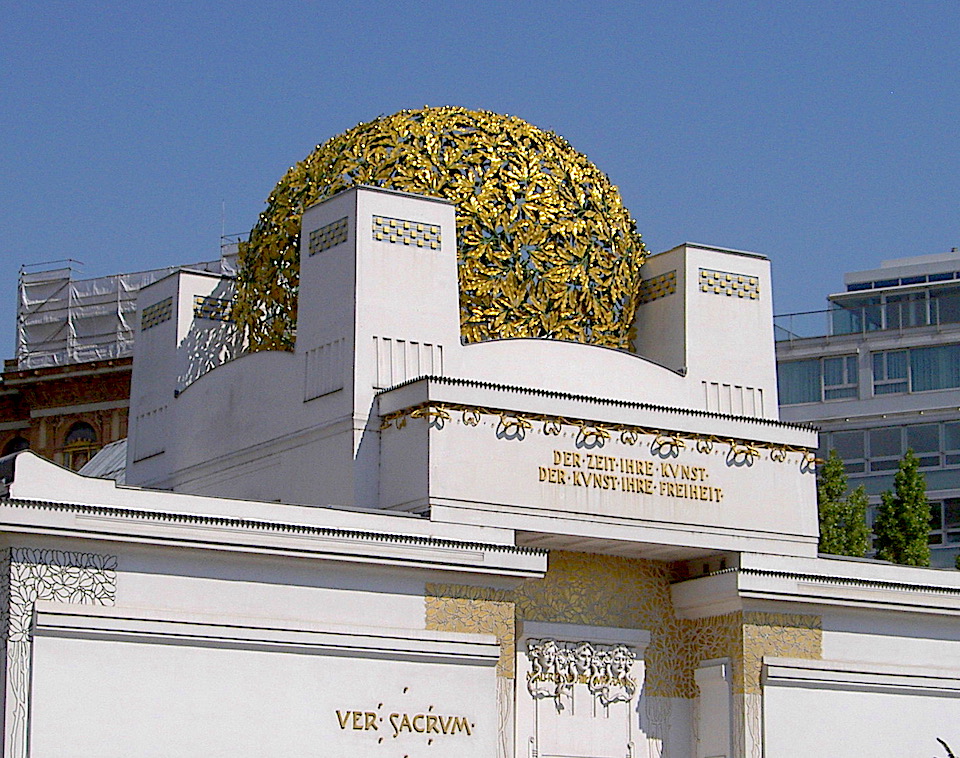
james stuart.png

James Stuart MP drawn by Harold Wright for Vanity Fair 1899

James Stuart and Laura Colman married at the Princes’ Street Congregational Chapel designed by one of its deacons, the Norwich architect Edward Boardman. It was in this Nonconformist chapel that Boardman’s son, Edward Thomas Boardman (also an architect) was to marry Laura’s sister, Florence Esther Colman [14].
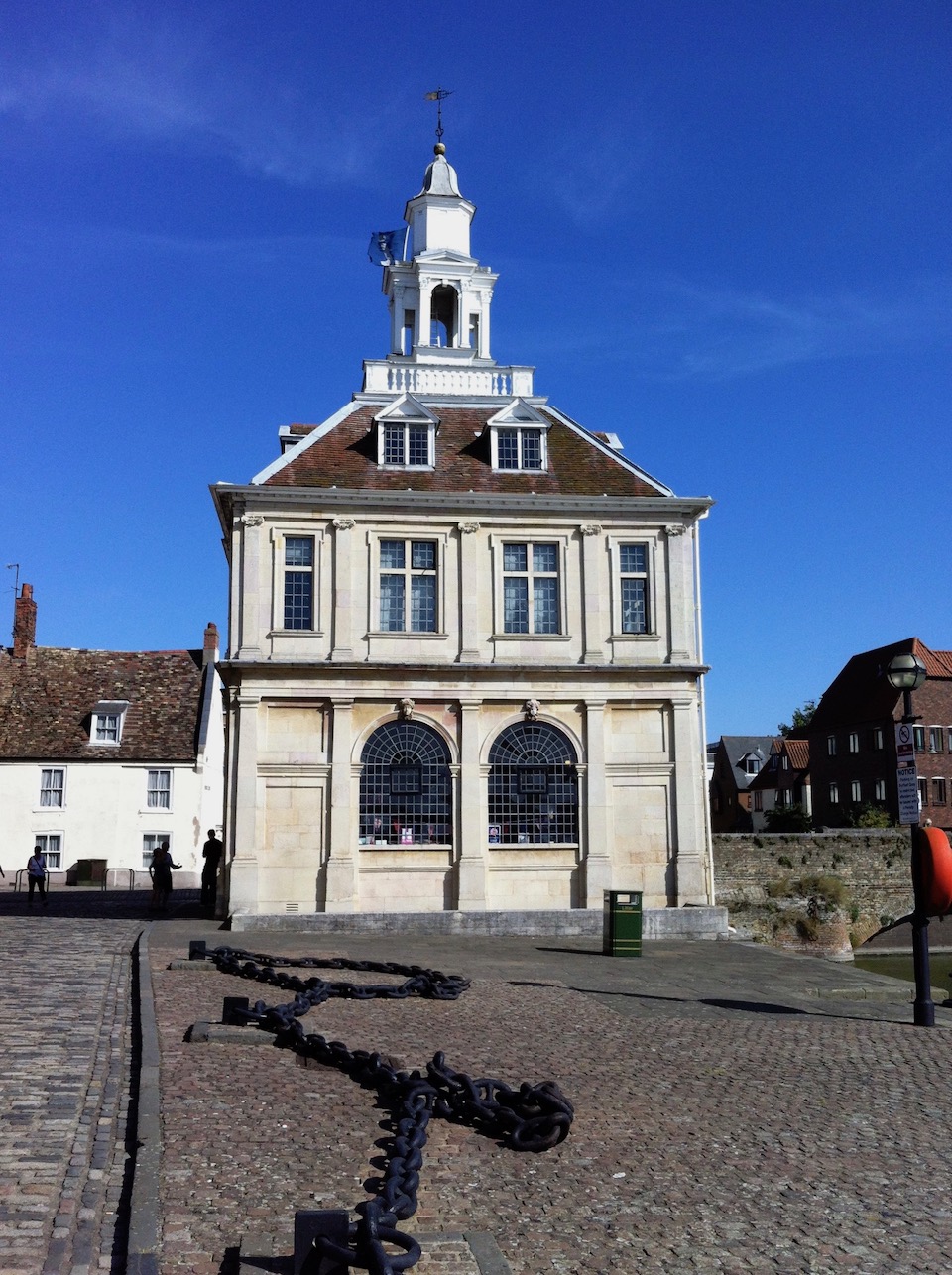
Fig1 Wedding.jpg

The marriage of Edward Thomas Boardman to Florence Esther Colman in 1898. Courtesy of ludhamarchive.org.uk

The Colman family burial plot is in The Rosary, the country’s first non-denominational cemetery [15]. In 1915, the Colman family commissioned Boardman and Son architects to design the Stuart Court apartments on Recorder Road in remembrance of Stuart. James Stuart had been concerned about the quality of housing for the elderly and this, according to Pevsner and Wilson [16], explains the almshouse feel of the apartments. They thought the Dutch-style gables slightly outdated but although late in terms of Arts & Crafts style (e.g., the ‘Pont Street Dutch’ of the 1880s) these features are entirely consistent with the Dutch gables brought to this city from the C16 onwards by religious refugees from the Low Countries [17]. See examples in nearby Cathedral Close.

IMG_6009.jpg

Stuart Court almshouses in Recorder Road. They were built around reinforced concrete, one of the first such examples in the city.

IMG_6013.jpg

The initials EMC and HCC recognise Ethel Mary and Helen Caroline Colman’s initiative in this project

IMG_1945.jpeg

Opening of the James Stuart Garden (1922) on Recorder Road was delayed by the Great War

Alan Road NR1

JJ Colman’s wife Caroline was born a Cozens-Hardy and she passed these names on to their son Alan. Sadly, Alan Cozens-Hardy Colman (1867-1897) was to die young on a Nile boat near Luxor while convalescing from TB. Eight years on, Ethel and Helen Colman arranged for Daniel Hall of Reedham, on the Norfolk Broads, to build the pleasure wherry ‘Hathor’ in memory of the boat on which their brother had died. It is still available for hire [18].

Hathor Trio2.jpg

The interior of Hathor, decorated in an Egyptian style designed by ET Boardman. ©2018 http://www.broadsnet.co.uk. Courtesy of Peter Cox.

© 2019 Reggie Unthank

Sources

  1. William Frederick Dickes (1905). The Norwich School of Painting; Being a Full Account of the Norwich Exhibitions, the Lives of the Painters, the Lists of their Respective Exhibits and Descriptions of the Pictures. Pub: Jarrold & Sons, London.
  2. Richard Harries, Paul Cattermole and Peter Mackintosh (1991). A History of Norwich School. Pub: Friends of Norwich School.
  3. HW Saunders (1932). A History of the Norwich Grammar School. Pub: Jarrold & Sons Ltd., Norwich.
  4. Edward Thomas (1912). George Borrow: the Man and his Books. From: http://www.gutenberg.org/files/18588/18588-h/18588-h.htm
  5. https://www.georgeborrowtrust.org.uk/Georgeborrow.php
  6. https://en.wikipedia.org/wiki/Laurence_Binyon
  7. https://colonelunthanksnorwich.com/2019/09/15/the-norwich-school-of-painters/
  8. https://en.wikipedia.org/wiki/Princess_Helena_of_Waldeck_and_Pyrmont
  9. Norfolk Record Office  NROCAT N/EN 12/1/6223
  10. The Trafford Family in, EA Handbook (1808). Norfolk Millennium Library CTRA 048.
  11. http://www.heritage.norfolk.gov.uk/record-details?MNF8068-Site-and-remains-of-Wroxham-Hall&Index=7550&RecordCount=56881&SessionID=7f476775-83b1-42ed-acd3-903e5e32df18
  12. https://ww1norfolk.co.uk/wwi-women-of-norfolk/test-page/suffragettes-suffragists/
  13. https://en.wikipedia.org/wiki/James_Stuart_(scientist)
  14. James Stuart Reminiscences (1911). Privately printed by the Chiswick Press, London.
  15. https://colonelunthanksnorwich.com/2018/10/15/the-norwich-way-of-death/
  16. Nikolaus Pevsner and Bill Wilson (2002). The Buildings of England. Norfolk I: Norwich and the North-East. Pub: Yale University Press.
  17. https://colonelunthanksnorwich.com/2019/08/15/going-dutch-the-norwich-strangers/
  18. https://www.wherryyachtcharter.org/hathor.php

Thanks 

I am grateful to Robert Webb for providing information on Waldeck Road. For permissions, I thank Clare Everitt of Picture Norfolk, Nigel Pope of the Ludham Community Archive Group and Peter Cox of Broadsnet. Andrea Smith, local historian, provided useful background to the street names on the Trafford estate. Paul Clarke provided information about John Berney Crome’s Latin oration.

Share this:

  • Click to share on Facebook (Opens in new window) Facebook
  • Click to share on X (Opens in new window) X
  • Click to share on Pinterest (Opens in new window) Pinterest
  • Click to email a link to a friend (Opens in new window) Email
  • Click to print (Opens in new window) Print
Like Loading...

Street names

15 Tuesday Oct 2019

Posted by reggie unthank in Norwich buildings, Norwich history

≈ 28 Comments

Tags

Norwich street names

In a city as old as Norwich some of the more interesting glimpses into its past are to be found in the historically significant names given to streets.

Hotblack Road NR2  (off Dereham Road)

The uncommon name, Hotblack, which conjures up images for me of road-laying, tar, and snooker on the telly, commemorates the family of John Hotblack who was a boot and shoe manufacturer in the C19 when Norwich was still one of the country’s major shoe producers. Hotblack’s factory was in Mountergate, off Rose Lane, not far from the large Co-op shoe factory.

IMG_8638.jpg

At top, one of the very few weavers’ windows remaining in the city

The Hotblack family lived next door in St Faith’s House. 

Mountergate St Faith's House [1168] 1936-07-27.jpg

St Faith’s House in Mountergate 1936, home to the Hotblacks around the 1890s ©georgeplunkett.co.uk

John Hotblack’s son, Major-General Frederick Elliott ‘Boots’ Hotblack was decorated six times in the First World War and mentioned in despatches five times. ‘Boots’ was in charge of the Reconnaissance Department of the Tank Corps and had laid a trail of tape for the tanks to follow the next day. However, the trail was obscured by overnight snow so, under fire, he walked across the battlefield, showing the tanks the way [1]. Since Hotblack Road is given on the 1907 OS map it would appear that the street was named for the shoe-making family rather than the war-hero son.

Frederick_Hotblack.jpg

‘Boots’ by Sir William Orpen 1917. Courtesy of the Imperial War Museum

Lyhart Road NR4

In 1463, lightning struck the central tower of Norwich Cathedral, setting fire to the roof in the crossing, causing the spire to crash down into the nave. In the 1470s the Bishop of Norwich, Walter Lyhart, replaced the wooden roof with a vaulted roof of stone, using some of his own money to employ stonemason Reginald Ely, who had worked on King’s College Chapel, Cambridge [2]. Lyhart’s contribution is commemorated in his rebus of a hart lying on wa(l)ter.

IMG_6447.jpg

Another lying hart can be seen amongst the wonderful collection of roof bosses in the cloisters. The cloisters were damaged in the riots of 1272 and the restoration, which was halted by the Black Death, stretched over the fourteenth and fifteenth centuries. lyhart cloisters.jpeg

Bishop Lyhart also oversaw the installation in the nave of 255 stone bosses that mark the intersection of short lierne ribs with the main ribs of the vault. The bosses represent biblical scenes, from the Creation to the Last Judgement. A favourite of mine is the overthrow of the Pharaoh in the Red Sea; it shows the Pharaoh’s chariot – looking more like a farm cart – in a literally red sea.IMG_6445.jpg

There was a time when Lyhart’s rebus could be seen in the tower screen at Yaxley, Suffolk [3]. In the same screen was another piece of stained glass depicting the head of a bishop. Could this have been Walter Lyhart himself?

Screenshot 2019-09-17 at 14.11.55.png

From ref [3]. 1932

Lound Road NR4

Major figures of the Norwich School of Painters (see previous post [4]) are well represented on road signs – for example, Cotman Road NR1, Crome Road NR3, Ladbrooke Place NR1 – but each time I travel clockwise around the ring road I am reminded of a less-well-known artist, Thomas Lound.

Thomas_Lound2.jpg

Early collodion positive of Thomas Lound 1850s

Lound (1802-1861) was a painter and etcher of local landscape but instead of scrabbling for a living, as many members of the Norwich Society of Artists did, he worked as a manager in the family brewing business and actually died with money in the bank. He was employed by the brewery of Tompson, Stackhouse & Co on King Street [5]. In 1844, Tompson’s was sold to the Morgan brothers, one of whom, Walter, drowned in a brewery vat [6]. Morgan’s was one of the ‘Big Four’ Norwich breweries in the first half of the C20.

Lound was taught by John Sell Cotman, whose influence can be seen in Lound’s paintings, though he probably followed more in the footsteps of Thirtle, whose work he collected avidly [7]. 

1850-view-from-old-barge-yard-by-thomas-lound-c-1850.jpg

View from Old Barge Yard by Thomas Lound (1850) shows the back of  what is now called Dragon Hall, near his home in King Street. The open door (centre) is part of the original C14 doorway within the larger C15 ‘blind’ door-surround installed by Robert Toppes when the building was used as his wool-trading hall.

In 1839, six years after the demise of the Norwich Society of Artists, Lound became  co-founding President of the Norwich Art Union [8] that – if it was anything like the Art Union of London – used subscriptions to buy works of art to be distributed amongst members by lottery. Lound was also involved in the Norwich School of Design (1846), a predecessor of the Norwich Technical Institute (1899) on St George’s Street, which is now part of the Norwich University of the Arts (NUA). In its first year the Art Union held an exhibition in its gallery at The Bazaar near the corner of Bridewell Alley and St Andrew’s Street [8].

Politechnic exhibiton Norwich copy.jpg

The Great Hall of the Polytechnic Institution, The Bazaar, Norwich. Courtesy of Norfolk County Council at Picture Norfolk

(Added 5/10/2019) The Classical façade of The Bazaar is highlighted on this mid-Victorian  photograph.

30129075885310StAndrewsSt.jpg

St Andrew’s Street with The Bazaar, arrowed. The tombstones are in the churchyard of St Andrew’s. Courtesy of Norfolk County Council at Picture Norfolk.

The Bazaar is long gone but by one of those pleasing circularities its former site on the corner of Bridewell Alley and St Andrew’s Street is now occupied by NUA’s East Gallery.

NUA gallery.jpg

East Gallery, site of former Royal Bazaar. Courtesy of NUA

Thomas Lound was also on the committee of the Norwich Photographic Society. In 1856 he exhibited five of his own photographs including one of Norwich Fish Market [8].

30129028232750.jpg

The Fish Market, Norwich by Thomas Lound, reissued as a postcard by AE Coe Opticians and Photographers. Courtesy of Norfolk County Council at Picture Norfolk

Bathhurst Road NR2 

Bathurst Road at the city end of Unthank Road was built on the Heigham Lodge Estate that once belonged to Timothy Steward of Steward & Patteson’s Brewery. In 1877 architect Edward Boardman divided Steward’s former land into lots for sale. Three roads were laid around the estate, one of which – temporarily named Grove Street North – was renamed Bathurst Road after Bishop of Norwich, Henry Bathurst (1744-1837).

OS MapStewardsAreaNew.jpg

Bathurst Road (red) runs parallel to Unthank Road (yellow). Ordnance Survey 1883

As described in Colonel Unthank and the Golden Triangle [9], Heigham Lodge was mistakenly thought to have been the home of William Unthank, who had bought 60 or so acres in Heigham to establish the Unthank Estate. William Unthank and Bishop Bathurst both died in 1837.

IMG_1669.jpg

Memorial statue to Bishop Bathurst in north transept of Norwich Cathedral

After the Reformation, Dissenters were banned by the Church of England from burial in their parish church. But in 1821, Bathhurst licensed Norwich’s Rosary Cemetery as the first non-denominational burial ground in the country (see [10] for The Norwich Way of Death). This chimes with Henry Bathurst’s reputation as the only liberal bishop in the House of Lords and as someone who supported Catholic Emancipation.

Since their Oxford days, Henry Bathurst had been friends with Parson James Woodforde (1740-1803) of Weston Longville, about seven miles north-west of Norwich. When Bathurst was non-resident Rector of nearby Great Witchingham, Woodforde would collect surprisingly large tithes on his behalf. In his absorbing Diary of a Country Parson, Woodforde wrote:

About noon took a ride to Norwich … and dined, supped and slept at the King’s Head. As soon as I got to Norwich I went to Kerrison’s Bank and there recd. for cash etc a Note of £137 (about £8,000 today) which I immediately inclosed in a letter to Dr Bathurst, Oxford. I walked to the Post Office, and put the letter into the Post which sets for London this evening at 10 o’clock. I then went to the King’s Head and eat a Mutton Chop and before I had quite dined Mr Hall came to me, and we smoked a pipe and drank a Bottle of Wine [11].

Harvey Lane NR7

… named after Colonel John Harvey (1755-1842) who moved from the city centre to Thorpe, a few miles east of the city [12]. Harvey came from a long line of wealthy Norwich textile merchants who had turned to banking: he himself was a leading partner of Harvey & Hudson’s Bank. Like nine of his relatives, Harvey became Mayor of Norwich (1792) but in his mayoral portrait he chose to be portrayed as colonel of the local militia.

John Harvey.jpg

Colonel John Harvey 1792, painted by John Opie RA, fashionable portrait artist and husband of  Norwich abolitionist, Amelia Opie. Presented by the Norwich Light-Horse Volunteers. Courtesy Norfolk Museums Collections NWHCM: Civic Portrait 33

We encountered Colonel Harvey last month in the large oil painting he commissioned from Joseph Stannard: ‘Thorpe Water Frolic, Afternoon’ (1825) [4]. Harvey instigated The Frolic in 1821, largely as a sporting event for the gentry, but opened it up to the working population two years later when city weavers were given a day’s holiday. 10,000 are said to have attended: polite society on the Thorpe side, workers on the opposite bank [12]. Last time, I focussed in on Stannard on the right bank, peering across to the gentry but here we see Harvey peering back from the left. 

IMG_1694.jpg

A fragment of ‘Thorpe Water Frolic, Afternoon’ by Joseph Stannard, showing the white-haired colonel in his Venetian gondola. Courtesy Norwich Castle Museum and Art Gallery

Harvey did not live on the riverside in Old Thorpe Hall – only parts of which remain – but at Thorpe Lodge, a five-bayed house that he built on the other side of the highway, re-routing the Yarmouth Road in the process [12]. In the 1930s the central third storey was removed and the east wing demolished; it now houses the Broadland District Council.

Thorpe St Andrew Thorpe Lodge [5423] 1974-09-14.jpg

Thorpe Lodge 1974 ©georgeplunkett.co.uk. In the 1930s the curved east wing was removed along with the third storey of the central bay.

Colonel Harvey is thought to have brought old doors from family properties in Norwich to install in the garden wall of Thorpe Lodge [12]. Two plaques – one dedicated to Robert Harvey (1696-1773) the other to Thomas Harvey (1710-1772) – mark fine Georgian houses in Colegate, in the heart of the Norwich weaving quarter, but the Tudor door below comes from neither of these. The garden-wall doors at Thorpe seem to have disappeared in the 1970s but, fortunately, Arnold Kent photographed this door at Thorpe Lodge in 1948 [13]. The flat-arched Tudor oak door came from Mayor George Cocke’s home (1613) at Bacon’s House in Colegate.

IMG_1688.jpg

Photographed in the garden wall of Thorpe Lodge 1948, a Tudor door from the home of Mayor George Cocke (1613) at Bacon’s House, Colegate.  The left-hand spandrel contains the Grocers’ arms, the right contains Cocke’s initials as part of his merchant mark. From [13].

Towards the end of the C18 a downturn in the  Norwich textile trade brought increasing unemployment [14]. But business took an upturn when Harvey started making highly patterned silk ‘fillover’ shawls that could now be woven-in instead of having to be filled-in/embroidered by hand. These expensive items (12-20 guineas each) were the height of fashion and a counterpane shawl, twelve feet square and woven on Harvey’s looms, was presented to George III and his wife Queen Charlotte [14].

In 1792 the Royal Mint was unable to obtain sufficient silver for coinage. Harvey responded by minting Norwich trade tokens from base metal, their value no doubt backed by the Harvey & Hudson bank. This can be seen as a philanthropic way of keeping the city’s trade flowing although the loom on the reverse of the coin would also have served to advertise Colonel Harvey’s role in the local economy during his mayoral year [15].

harvey token.jpg

The reverse of a Harvey token shows a hand-loom, the obverse shows the Norwich City coat of arms, the rim is impressed with Harvey’s name. Norfolk Museums Collection NWHCM : 2006.79.1

Onley Street NR2

The Harveys were related to the Unthanks but to understand the origins of this street name we have to untwist the limbs of the Harvey family tree.

Colonel Harvey’s brother Charles (1757-1843) dropped the surname Harvey when he inherited Stisted Hall in Essex from his uncle, the Reverend Onley. The Reverend had himself adopted his wife’s family name, Savill, making him a Savill-Onley. Double-barrelled names were often adopted to preserve a family name that would otherwise have died out due to lack of male heirs or, in the case of Reverend Savill-Onley, ‘in appreciation of the fortune (£33,000) his wife had brought with her’ [16].

Charles Harvey.jpg

Charles Harvey, MP for Norwich, later Savill-Onley. Courtesy Norfolk Museums Collections THEHM:DS.25

When Charles Savill-Onley died his son adopted the name of Onley Savill-Onley [17].

IMG_1718.jpeg

Onley Savill-Onley Esq 1795-1890. From [16].

Onley Savill-Onley had a daughter, Judith Sarah, and it is she who connects us with the Unthanks by marrying Colonel Clement William Joseph Unthank of Intwood Hall [9]. Their eldest son was Clement William Onley Unthank (1874-1900). Sadly, when only in his twenties, he died of a polo accident while serving in India.

IMG_5635.jpg

Clement William Onley Unthank ca 1900. From [9].

When Colonel CWJ Unthank and his wife moved to her family house at Intwood Hall, CWJ started selling off the Unthank estate in what is now Norwich’s Golden Triangle. Over the years the estate was developed from Trinity Street down to Mount Pleasant and, in memory of their son, one of the later side-roads off Unthank Road was named Onley Street [9].

To be continued …

©Reggie Unthank 2019

–––––––––––––––––––––––––––––––––––––––––––––––––

‘An excellent Christmas-stocking filler’. The book Colonel Unthank and the Golden Triangle, which contains more about the Unthank family and describes the development of the the streets either side of Unthank Road, is still available from: Jarrolds’ Book Department (https://www.jarrold.co.uk/departments/books); or City Bookshop in Davey Place (http://www.citybookshopnorwich.co.uk/); or direct from me via the contact form (https://colonelunthanksnorwich.com/contact/).

Sources

  1. https://www.edp24.co.uk/features/norfolk-war-hero-who-was-too-brave-1-4801801
  2. Paul Hurst (2013). Norwich Cathedral Nave Bosses. Pub: Medieval Media, Norwich.
  3. Christopher Woodforde (1932). The Medieval Glass in Yaxley Church. Suffolk Institute of Archaeology and Natural History vol XXI pt 2.
  4. https://colonelunthanksnorwich.com/2019/09/15/the-norwich-school-of-painters/
  5. https://suffolkartists.co.uk/index.cgi?choice=painter&pid=4128
  6. https://www.norridge.me.uk/pubs/names_/brewers/morgan.htm
  7. Josephine Walpole (1997). Art and Artists of the Norwich School. Pub: Antique Collectors’ Club.
  8. http://www.earlynorfolkphotographs.co.uk/Norwich%20Photographic%20Societies/Norwich_Photographic_Societies.html
  9. Clive Lloyd (2017). Colonel Unthank and the Golden Triangle. ISBN 978-1-5272-1576-4
  10. https://colonelunthanksnorwich.com/2018/10/15/the-norwich-way-of-death/
  11. https://archive.org/stream/in.ernet.dli.2015.227134/2015.227134.The-Diary_djvu.txt
  12. Trevor Nuthall (2014). Thorpe St Andrew: A Revised History. Pub: Trevor Nuthall ISBN 978-0-9543359-1-5.
  13. Arnold Kent and Andrew Stephenson (1948). Norwich Inheritance. Pub: Jarrolds and Sons Ltd.
  14. Walter R Rudd (1923). The Norfolk and Norwich Silk Industry. Norfolk Archaeology vol XXI, pp245-282.
  15. Katy Barrett. Eighteenth Century ‘Hand-Loom’ Token. Analysing the English Collections at the Pitt Rivers Museum. https://england.prm.ox.ac.uk/englishness-token.html
  16. Reverend A J Nixseaman (1972). The Intwood Story. Printed in Norwich by RR Robertson.
  17. https://www.jjhc.info/harveyjohn1842

Thanks. I am grateful to Clare Everitt of Picture Norfolk, Ken Skipper of Cork Brick Gallery Bungay and the George Plunkett archive (www.georgeplunkett.co.uk). 

Share this:

  • Click to share on Facebook (Opens in new window) Facebook
  • Click to share on X (Opens in new window) X
  • Click to share on Pinterest (Opens in new window) Pinterest
  • Click to email a link to a friend (Opens in new window) Email
  • Click to print (Opens in new window) Print
Like Loading...

Catherine Maude Nichols

15 Wednesday May 2019

Posted by reggie unthank in Norwich buildings, Norwich history

≈ 20 Comments

Tags

catherine maude nichols, Norfolk and Norwich Art Circle, Norwich School of Artists, The Woodpecker Club

I first came across Catherine Maude Nichols in a book published in 1910 called ‘Citizens of No Mean City’, a Jarrolds trade book containing over 360 potted biographies with accompanying photographs of ‘Norwich Citizens of To-day’ [1], some of whom probably paid for advertising their business on the facing page. I was attracted by the fact that Kate Nichols was one of only three women … and by the flamboyant hat.CM Nichols.jpg

Although she herself was not a major figure her artistic life is fascinating for spanning the last days of Crome and Cotman’s Norwich School of Artists and the emergence of English Impressionism.

IMG_0663.jpeg

From [1]

Kate was born in 1847 behind this fine Georgian doorway at 32 Surrey Street, Norwich, where she was looked after by a nanny and a nurse.

Surrey St 32 Regency Georgian doorway [0468] 1935-04-19.jpg

The Regency doorway at 32 Surrey Street ©georgeplunkett.co.uk

This was on the opposite side of the street to the tall terrace, built in 1761 by Thomas Ivory (Assembly House, Octagon Chapel), where Sir James Edward Smith of Linnean Society fame lived from 1796 to 1828 [see previous blog post 2]. Unfortunately, this fashionable Georgian street was bombed in WWII and the even-numbered houses on the east side no longer exist. Fortunately, George Plunkett recorded No 32 in 1935.

Surrey St 30 to 34 [1028] 1936-06-14AA.jpg

30-34 Surrey Street 1935. ©georgeplunkett.co.uk

Kate Nichols’ father was born into a wealthy Norfolk farming and landowning family who lived at Alpington Hall, a few miles south of Norwich [3].

Alpington Hall.jpg

Alpington Hall. ©Evelyn Simak. Creative Commons

Her father, William Peter Nichols, was related to the Musketts. Regular readers may recall that when Colonel C. W. Unthank married Mary Anne Muskett and moved into her family home at Intwood Hall, a few miles south of the city, he started selling off his own land on which much of Norwich’s present-day Golden Triangle was built [4].

Kate’s father trained in London as a surgeon and returned to Norwich in the 1820s. In the 1850s he was appointed one of the four surgeons at the Norfolk and Norwich Hospital where he specialised in removing bladder stones – something once common in Norfolk.

N&N Hospital.jpg

The north-east wing of N&N Hospital, built by Thomas Ivory’s son William in the 1770s. Most of Ivory’s hospital was rebuilt by Edward Boardman 1879-1884 [5]. 

At various times William Peter Nichols was to be mayor and local magistrate as well as surgeon to the police, to the prison and to the Bethel Hospital. The latter was opened in 1713 by Mary Chapman as an asylum for the curable mentally ill and may well have been the first purpose-built asylum in the country. In 1836 Nichols bought Heigham Hall as a ‘private lunatic asylum’ for ladies and gentlemen. We previously encountered this mansion at the junction of Old Palace Road and Heigham Street when trying to discover which of several Heigham Houses/Halls was home to the Unthank family [6]. This mental asylum was in competition with the genteel Heigham Retreat whose tree-lined avenue is commemorated by Avenue Road.

The Retreat.jpg

Etching of Heigham Retreat by Henry Ninham ©Norfolk Record Office MC279/6. Avenue Junior School now occupies part of this site. 

Nichols and two other doctors bought out Heigham Retreat but closed it in 1859. This was after Heigham Hall had been mired in scandal. In 1852 a curate from Hethersett, Reverend Edmund Holmes, was accused of raping a young girl but, because of his family’s standing in the county, Holmes was promptly admitted to Heigham Hall by Dr Nichols in order to evade arrest. Nichols then appointed Holmes as chaplain to the asylum [7] and boasted that he had rescued one of his class from the clutches of the law [3].

In 1870, Sir Robert John Harvey, senior partner in Norwich Crown Bank on Agricultural Hall Plain, shot himself after bankrupting the business. Hard to believe but in a letter to the Eastern Daily Press dated 1960 the correspondent recalls tales of a suicide being buried with a stake through the heart at a crossroads in Heigham [8]. Although such roadside burial was repealed in 1823 those who committed self-murder whilst still in control of their faculties could only be buried in cemeteries between 9pm and midnight, and without ceremony. William Nichols was the Harvey family’s doctor and it was his diagnosis of hereditary ‘excitement’ (i.e., whilst the balance of his mind was temporarily disturbed) that allowed Sir Robert a Christian burial.

Crown Bank Norwich.jpg

Norwich Crown Bank on Agricultural Hall Plain. After the Harvey affair the goodwill and building were bought by Gurneys Bank, the forerunner of Barclays.

It was into this wealthy and politically involved family that Kate was born. And when, in Dr Nichols’ mayoral year (1866), the Prince and Princess of Wales visited Norwich together with the Queen of Denmark it was Kate who presented the princess a book of Norwich photographs on behalf of the women of the city [7].

30129028230671.jpg

The royal party at the music festival held at St Andrew’s Hall in aid of the Norfolk and Norwich Hospital ©Norfolk County Council at Picture Norfolk

That evening Kate accompanied her parents to a ball held at Costessey Hall where the royal party stayed for three days with the Jerninghams in their never-completed Gothic fantasy.

Costessey Hall.jpg

 Costessey Hall. A C19 Neo-Gothic fantasy made of Gunton Bros ‘fancy bricks’ from the nearby Costessey Brickworks [9].

Costessey Hall was made of ‘Cossey’ brick, baked from Jerningham clay by the Gunton family who went on to supply decorative and carved bricks that can still be seen around the city [see previous post 9].

Guntons chimneys Norwich.jpg

Guntons’ Tudorbethan chimneys on a house in Chapelfield North

There seems to have been something Walter Mitty-like about Kate Nichols. She was to describe herself as a spinster with no close relatives but in so doing she ignored two brothers, three nieces, two nephews and a dozen cousins [3]. She would also tell others that she was a self-taught artist despite: having a drawing mistress at school; studying with David Hall McEwan, a member of the Royal Society of Watercolour Artists; and at age 27 studying for two terms at the Norwich School of Art where she probably learned etching and won a prize in the Advanced Division. Indeed, the Head of the NSA stated that Kate Nichols and George Skipper were the two best students during his 25-year tenure [3].

George Skipper.jpg

Not recorded as such but this is an excellent likeness of George Skipper, Norwich’s flamboyant architect, sitting on top of his Commercial Chambers in Red Lion Street [see 10].

There was an artistic strand in the Nichols family for her four aunts had been taught at Alpington Hall by co-founder of the Norwich School of Artists, John Crome, some of whose landscape paintings hung in Kate’s home in Surrey Street [3].

Almost always described as ‘etchings’ most of Kate’s output was actually dry point engraving. Unlike etching, which involves ‘eating’ into a copper plate with acid, dry point engraving involves incising lines directly onto a copper sheet with a sharp tool; this raises a ‘burr’ that – when inked – is pressed onto paper to create an impression. Because printing produces a mirror image the original scene should be drawn in reverse but for some reason Kate did not do this for ‘Tombland’.

Tombland duo.001.jpg

Left: Tombland Alley with the house of Augustine Steward, which was used by Royalist troops during Kett’s Rebellion of 1549. Right: ‘Tombland’ drypoint by CM Nichols courtesy of Norfolk County Council at Picture Norfolk

Kate’s first dry point engraving for which there is a record, ‘College’, was made in 1875 when she was 28. There was something about this linear technique that suited Kate’s fondness for landscape for she seems to have been less accomplished with the rounded forms of the human body [3].

College.jpg

‘College’ (which appears to be St John’s Cambridge) 1875. Courtesy Norfolk Museums Collections NWHCM : 1969.557.63

Here we see the gardens of the Bethel Hospital, where her father was surgeon.

Bethel Duo.001.jpg

Dry point and oil painting of the Bethel Hospital. Undated but after 1882. Courtesy Norfolk Museums Collections. NWHCM : 1940.75.19 and NWHCM : 1940.75.8

Kate Nichols was single and adventurous, dropping in – apparently – on artists she admired, such as Lord Leighton and John Everett Millais [3]. She travelled alone to France and from 1876-8 visited Barbizon, south of Paris, to join others painting there. This was a generation after the original founders of the Barbizon school, such as Corot and Millet, had painted landscape from nature in the manner of East Anglian John Constable. Future Impressionists like Monet, Renoir and Sisley also went to Barbizon and although Kate may not have met them she at least mixed with ‘hundreds of artists’ who were also paying their dues [3]. In 1879, she stayed in Newlyn – the Cornish counterpart to Barbizon – and this time she was not too late to catch the wave: now  she was amongst painters out of whom the ‘Newlyn Group’ of artists would emerge with their impressionistic style.

Cornish scene AN01231428_001_l Crop.jpg

Old Houses, Cornwall 18979 ©The Trustees of the British Museum

Back home, Kate was to draw from the countryside around Norwich as well as the urban landscape of the city itself. She exhibited widely and between 1877-1908 some of her engravings were shown at the Royal Academy. The first was of Ber Street, Norwich, which illustrates animals being driven towards the livestock market around the castle.

Ber stNorwich.jpg

Ber Street 1878 ©Norfolk County Council at Picture Norfolk

Perhaps unsurprisingly, Kate was influenced by the Norwich School painters whose work had hung in her family home [3]. In 1907 she was to produce a folder of prints entitled ‘After Crome’.

Oak Duo.001.jpg

Left: ‘The Poringland Oak’ (1880-1820) by John Crome. The Tate, Creative Commons Licence. Right:  ‘Poringland Oak (After Old Crome)’ by CM Nichols. Courtesy of Norfolk County Council at Picture Norfolk

NchMusCllctns.jpg

Oil painting ‘Old Norwich River’ by CM Nichols (her drypoint of this scene is labelled ‘Widdow’s Ferry’. Could this be Pull’s Ferry since Pull married Widow Sandling and took over Sandling’s Ferry?). Courtesy of Norfolk Museums Collections NWHCM 1952:125 

She was obviously fond of the area around Cow Hill.

CowHillDuo.001.jpg

Left: Drypoint of Cow Hill 1883, exhibited at The Royal Academy and reproduced in The Studio; courtesy of Norfolk County Council at Picture Norfolk. This looks up to great St Giles with the morning sun spilling down from Willow Lane. 

The houses in Willow Lane, off Cow Hill, are largely as Kate must have seen them, though not all of the houses on Cow Hill survive.

WillowLane Duo.001.jpg

Left: Willow Lane by CM Nichols. Courtesy of Norfolk County Council at Picture Norfolk

She drew George Borrow’s House half way up the hill between Pottergate and Willow Lane. 

BorrowDuo.jpg

Left: The C17 George Borrow’s House, Willow Lane by CM Nichols. Courtesy of Norfolk County Council at Picture Norfolk. Right: the house today, viewed through a modern archway. 

George Borrow (1803-1881) was a larger-than-life character: a boxer, a spinner of tales, a gipsy traveller and a linguist who taught himself Old Norse and Welsh. He was born in Dereham but his family lived for a while in Norwich where George was taught at Norwich Grammar School alongside Kate’s father and uncle [3]. In 1913 Kate was to provide engravings of the interior of the Borrow house for a souvenir booklet produced a decade late for Borrow’s centenary. 

Borrow booklet.jpg

The George Borrow centenary souvenir booklet with cover by Alfred Munnings, who painted scenes of gypsy life. Courtesy of [11].

The Society (later the Royal Society) of Painter-Etchers was formed in 1880; two years later Kate submitted a diploma piece, Scotch Firs, for which she was elected the first female fellow.

ScotchFirsDiploma Work.jpg

Scotch Firs 1882. Courtesy of Norfolk Museums Collections NWHCM : 1965.82.1

In 1882 Kate was baptised into the Catholic faith, causing a rift with her family. In 1891 she is recorded as living a few doors away at 12 Surrey Street and by 1900 she had ventured further along the road to Carlton Terrace.

Surrey St 47 to 79 Carlton Terrace [6461] 1987-05-19.jpg

Carlton Terrace at the south end of Surrey Street. George Plunkett’s photograph was taken in 1987, eight years after Edward Skipper and Associates restored the 1881 terrace for Broadland Housing Association. Kate Nichols lived at the far end. ©georgeplunkett.co.uk

Before St John’s Catholic Church (later Cathedral) was completed in 1910 Kate worshipped at the Old St John’s Chapel (1794), which is now the Maddermarket Theatre.

maddermarket Duo.001.jpg

Left: Off St John’s Alley, The Old St John’s Catholic Chapel pre-1900 (from [12]). Right: Converted to the Tudor style Maddermarket Theatre in 1921. 

For the frontispiece of a book celebrating Catholicism in Norwich Kate painted the new Catholic church from Chapelfield North [12].

IMG_0703.jpeg

Frontispiece of ‘A Great Gothic Fane’ by CM Nichols. From [12].

In this book Kate appears on a photographic plate of notable Catholic women.

IMG_0713.jpeg

Kate age 66. From [12].

Kate Nichols’ closest friend was the wealthy Mary Radford Pym who lived in an exotic Tudor Revival house in Chapelfield (once home to my dentist’s practice).

St Marys Croft Norwich.jpg

St Mary’s Croft (1881) in Chapelfield North

Mrs Pym was philanthropic. She funded the clocktower in Sheringham and gave land on Earlham Road to be used as a park. She also gave money to the Norfolk and Norwich Hospital for a nurses’ home; this funded Pym House on the corner of Unthank and Christchurch Roads [3].

IMG_0720.jpg

Pym House, purchased in 1927. A plaque records that this was for the use of the Jenny Lind Children’s Hospital on the opposite side of Unthank Road, now the site of the Colman Hospital and prior to this the Priscilla Bacon Lodge.

In 1889, Mrs Radford Pym arranged for her good friend Kate to be installed as President of the newly-founded Woodpecker Art Club, a title she held  until her death 34 years later. The Woodpeckers  – who included Alfred Munnings among their members – were so named because they chipped away at wooden engraving blocks, unlike Kate who inscribed metal. In addition to outings the club held an annual meeting upstairs in ‘Princes’ high-class confectioners in Castle Street, owned by Margaret Pillow a friend of Mrs Pym.

IMG_0803.jpg

From [1]

Kate died in 1923 and in her memory Mrs Pym arranged for a portrait, painted 20 years earlier by neighbour Edward Elliot, to be bought and donated to the Castle Museum. It was presented by Prince Frederick Duleep Singh, who succeeded Kate as President of The Woodpeckers (Frederick was son of the last Maharaja of the Sikh Empire, Maharaja Sir Duleep Singh, a favourite of Queen Victoria who lived in exile at Elveden Hall, near Thetford).

NchMusCllctnsMissNichols.jpg

Miss Nichols by Edward Elliot. Courtesy Norfolk Museums Collections NWHCM : 1923.75. This captures Kate  around the late 1890s when overblown leg-of-mutton sleeves were fashionable.

In 1927 the Woodpeckers merged with the Norwich Art Circle (est. 1885), which continues as the Norfolk and Norwich Art Circle[13]. 

Jarrolds.jpg

The colophon of Jarrolds of Norwich who printed Kate Nichols’ later drypoints

© 2019 Reggie Unthank

Sources

  1. Citizens of No Mean City (1910). Pub: Jarrold, Norwich.
  2. https://colonelunthanksnorwich.com/2017/01/15/when-norwich-was-the-centre-of-the-world/
  3. Pamela Inder and Marion Aldis (2015). ‘A Forgotten Norwich Artist: Catherine Maude Nichols’. Pub: Poppyland Publishing, Cromer.
  4. https://colonelunthanksnorwich.com/2017/07/15/the-end-of-the-unthank-mystery/
  5. Nikolaus Pevsner and Bill Wilson (1997). The Buildings of England: Norfolk I.Norwich and North-East. Pub: Yale University Press.
  6. https://colonelunthanksnorwich.com/2017/04/15/colonel-unthank-rides-again/
  7. http://www.hellenicaworld.com/UK/Literature/CharlesMackie/en/NorfolkAnnals2.html
  8. Letter by CC Lanchester to the Eastern Daily Press 20.9.1960.
  9. https://colonelunthanksnorwich.com/2016/05/05/fancy-bricks/
  10. https://colonelunthanksnorwich.com/2017/02/15/the-flamboyant-mr-skipper/
  11. https://www.gutenberg.org/files/21538/21538-h/21538-h.htm
  12. A Great Gothic Fane: The Catholic Church of St John the Baptist, Norwich (1913). Pub: WT Pike and Co., Brighton.
  13. https://www.nnartcircle.com/about.html

Thanks

I have relied for background on ‘A Forgotten Norwich Artist: Catherine Maude Nichols’ by Pamela Inder and Marion Aldis – a model of local historical research (and still available).  I also thank Clare Everitt of Picture Norfolk for permission to reproduce photographs (try the site: https://norfolk.spydus.co.uk/cgi-bin/spydus.exe/MSGTRN/PICNOR/HOME). Thanks, too, to Jonathan Plunkett for allowing access to his father’s invaluable collection of Norwich photographs: http://www.georgeplunkett.co.uk/Website/.

Share this:

  • Click to share on Facebook (Opens in new window) Facebook
  • Click to share on X (Opens in new window) X
  • Click to share on Pinterest (Opens in new window) Pinterest
  • Click to email a link to a friend (Opens in new window) Email
  • Click to print (Opens in new window) Print
Like Loading...

City Hall Doors # 2

15 Friday Mar 2019

Posted by reggie unthank in Norwich buildings, Norwich history

≈ 16 Comments

Tags

James Woodford, Norwich City Hall doors, Public art

The Normans left Norwich a magnificently tangible legacy of Castle and Cathedral but traces of their Scandinavian cousins – the Vikings – are harder to find.

Roundel 4A: The Vikingsvikings.jpg

For the first roundel in this ‘second half’ of his plaques on the City Hall doors (1936-8), James Woodford acknowledged the significance of the Viking invasion to the development of proto-Norwich. The Great Heathen Army first invaded East Anglia in 865AD but there is little physical evidence that Scandinavians settled in Norwich until the C10 [1]. Then, there is evidence of an Anglo-Scandinavian settlement – a North wic on the northern side of the Wensum, centred along modern-day Magdalen Street, defended by a looping, 13-foot-deep ditch and probably topped by bank and fence. This may have been constructed in response to Anglo-Saxon pressure from Edward the Elder of Wessex who overcame the East Anglian Danelaw in 9 I 7.

Map2.001.jpg

Anglo-Scandinavian Norwich outlined in red. Dotted lines mark the known defensive ditch. Blue triangle = St Clement Colegate; yellow diamond = Tombland marketplace. Map courtesy of Norfolk Museums Service, redrawn from Philip Judge’s map in [1].


This protected settlement was sufficiently important and stable in the C10 to have its own mint making Anglo-Saxon ‘Nordwic’ coins. 

Coins2.jpg

Æthelstan, Anglo-Saxon King of Wessex. Penny minted in Nordwic ca 930AD.  © CNG 2019 

Scandinavian influence can be detected in the naming of churches: St Clement – the patron saint of sailors – was much favoured by the Scandinavians and his churches occur at rivers or portals as here, at St Clement’s on the corner of Fye Bridge Street and Colegate. Norwich also had two churches named after St Olave or Olaf, the Norwegian king canonised in 1030.IMG_0357.jpg

St Clement’s Fye Bridge/Colegate, perhaps pre-Conquest, now mostly C15/16 

The Anglo-Scandinavian settlement was not confined to the northern bank for it extended southwards to form a double burh joined across the river by a wooden causeway where Fye Bridge now stands [1]. A few hundred yards south of the river was the marketplace in Tombland, from the Danish word täm for open space and it is from their word ‘gata’ meaning street that we have inherited Finkelgate, Fishergate, Pottergate, Colegate, Mountergate etc. What may have caused Nordwic to abscond to the south bank was the raid in 1004 when Sweyn Forkbeard – whose sister Gunhilde had been amongst the hundreds of  Vikings killed in the so-called St Brice’s Day Massacre – laid waste to Norwich. When the French descendants of the Vikings – the Christianised Normans – arrived a few decades later they established their presence on the south side with their cathedral of stone and a castle overlooking a re-sited marketplace. 

Roundel 4B: Textiles and agriculture

Doors3&4A.jpg

The middle roundels 3B and 4B on the central pair of doors

On roundel 4B Woodford presents us with much the same layout he used on the facing roundel (3B, see previous post): the wool comb could be a mirror image of the comb on the left-hand roundel, there is another yarn winder and, again, a stand – this time a candle holder seemingly warming a tool clamped above (anyone?). Again, an object at the bottom breaks the weaving sequence but here it is not specifically related to Norwich industry but to Norfolk in general. The wheels on this plough reduce friction so that one ox could draw it through the light Norfolk soil and as such the image refers to Thomas Coke, 1st Earl of Leicester (1754-1842), who was first to have harnessed rather than yoked oxen. From his Holkham estate on  the North Norfolk coast Coke is credited with sparking the British Agricultural Revolution [2].

Screenshot 2019-02-04 at 11.22.03.png

The Leicester Monument (1845) at Holkham Hall, in memory of the 1st Earl. Between the wheeled plough and the ox are sheep, referring to the ‘English Leicester’ – an improved breed promoted by Lord Leicester. © racns [3]

Roundel 4C: Kett’s Rebellion

Here hangs Robert Kett from the walls of Norwich Castle. IMG_0270.jpg

The success of the Norwich weaving trade, and the rising price of wool, led to rich landlords enclosing common land in order to graze their own sheep. In 1549 Robert Kett, a tanner from Wymondham, sided with those uprooting hedges and fences. Under his leadership the uprising swelled to about 15,000 ‘rebels’ encamped on Mousehold Heath. Kett’s men defeated forces led by the Marquess of Northampton but were finally overcome at the Battle of Dussindale. Robert Kett was hanged from a gibbet erected on the battlements of Norwich Castle and “left hanging, in remembrance of his villany, till his body being consumed, at last fell down”. His brother was left hanging by chains from the steeple at Wymondham [4]. The C18 historian Francis Blomefield wrote that Kett’s army contained the ‘scum of Norwich’ but, of course, one man’s rebel is another man’s freedom fighter and a plaque on the castle walls expresses a more enlightened view:

In 1549 AD Robert Kett yeoman farmer of Wymondham was executed by hanging in this castle after the defeat of the Norfolk Rebellion of which he was the leader.
In 1949 AD – four hundred years later – this memorial was placed here by the citizens of Norwich in reparation and honour to a notable and courageous leader in the long struggle of the common people of England to escape from a servile life into the freedom of just conditions.

Roundel 5A: Chocolate and crackers

IMG_0272.jpg

We know this represents Caley’s, rather than other confectioners, because of the combination of chocolate-making and Christmas crackers that we see arranged around the perimeter of this roundel. Twelve years before James Woodford drew this design Caley’s installed 44 chocolate-piping machines [5] so the worker is piping chocolate in their Fleur-de-Lys Factory in Chapelfield.

Caley's TM2.jpg

Registration of Caley’s trade mark ‘The Prentices Christmas in the Snow’ (1899). Note ‘Ye Sign of ye Fleur de Lys’. Courtesy Norfolk Record Office BR266/119/2

Between the 1864 and the 1883 editions of Kelly’s Directory, chemist and druggist Albert Jarman Caley – ‘manufacturer of aerated & mineral waters, & ginger ale’ – had moved from London Street to Chapelfield (1883), presumably to take advantage of a nearby deep well with the purest water in the city [7]. His sodas were bottled in an old factory in Chapelfield that had made cloth for glove-making but this was just the beginning of Caley’s expansion.

Caley's Lined latest.001.jpeg

Caley’s Fleur de Lys works 1928 now the site of Chapelfield shopping mall. Chapelfield Gardens are to left and, below, is the triangle of The Crescent where Alfred Caley lived

In order to provide year-round employment for his summer workforce, Caley started to make drinking chocolate in 1883 and three years later began to make chocolate confectionery using milk from a farm in nearby Whitlingham [6]. In 1932 Caley’s was sold to Mackintosh’s, the toffee-makers from Halifax, who modernised the factory and produced new lines, like the chocolate-toffee combos ‘Rolo’ and ‘Quality Street’ assortment. The factory was rebuilt after being badly damaged in the 1942 Baedeker Raids. In 1969 the business was acquired by Rowntree’s and then by Nestlé (1988) who sold the site to be redeveloped as intu Chapelfield shopping mall (2005). Have I mentioned the aroma of chocolate over the city, usually – it seemed – on Sunday mornings?

Round thing.jpg

This stone roller once used for grinding cocoa beans is now used as a seat at the Chapelfield Road entrance to the intu Chapelfield mall where Caley’s once stood

In 1899 the Caley’s fancy box department expanded into making Christmas crackers – some of the boxes decorated by a young Alfred Munnings who had recently graduated from the Norwich School of Art. Tom Smith, inventor of the Christmas cracker [8], opened his factory on Salhouse Road in 1953, too late to be considered an influence on Woodford’s roundel.

caleys5.001.jpeg

Caley’s Christmas cracker boxes ca 1900. Some, such as the first two, bear Munnings’ signature. Courtesy Norfolk Museums Collections


Roundel 5B: Livestock marketsAnimals.jpg

Norwich was the trading centre for a major agricultural county and, since at least the time of James II, livestock was brought to the Castle Ditches or Dykes for sale [9]. The ‘Market for Horses Cows Sheep & Swine’ is clearly marked on King’s C18 map. Also marked are Old Horse Fair, Haymarket, Hog Hill (Orford Hill near the Bell Hotel), Horse Market (now Rampant Horse Street) and the Old Swine Market on All Saints’ Green – all contributing to a sense of the city as a hub for the county’s agriculture.

Annotated Kings 2.001.jpeg

Samuel King’s New Plan of Norwich 1766. Courtesy of Norfolk Museums Service

After the coming of the railways, cattle would be driven from Norwich Thorpe Station, up the new, wide Prince of Wales Road to various sites around the castle commemorated in the street names: Cattlemarket Street, Market Avenue, Farmer’s Avenue.

Cattle Market view NE from Market Avenue [4541] 1960-03-12.jpg

Norwich Cattlemarket from Market Avenue, 1960. This is to the rear of the Agricultural Hall with the cathedral spire just visible, right of centre. Courtesy of http://www.georgeplunkett.co.uk


Here we see the Cattlemarket in 1877. Today, this is the site for the garden and glazed roof of subterranean Castle Mall. In 1960 the Cattlemarket was taken out of town to Hall Road.

30129065940745Cattlemarket1877.jpg

Sheep sale at the Cattlemarket at a time when the castle was Norwich Prison. Courtesy of Norfolk County Council at Picture Norfolk

Roundel 5C: Shoe-making

The City Hall stands on the site of a former Start-rite shoe factory and it is shoe-making that is celebrated in this roundel.

Shoemaking.jpg

Preparing soles

By the 1840s the city’s textile trade was in decline but the same pattern of work – production by outworkers controlled by garret-masters – was inherited by the city’s rapidly expanding boot and shoe manufacturing trade. Soon, this piecemeal form of production was overtaken by large-scale manufacture in factories. Numerous small businesses became consolidated into the Big Five companies that dominated Norwich’s boot and shoe trade: Edwards & Holmes; Howlett & White (later the Norvic Shoe Co.); Haldinstein’s (later the Bally Shoe Co.); James Southall (later Start-rite); and H. Sexton & Sons (later Sexton, Son & Everard). About the time that Woodford was designing this roundel the Norwich boot and shoe trade was employing about 10,000 workers, although none of the major factories are operating now [10, 6].

Norvic.jpg

The former Norvic Shoe Co at the corner of St George’s Street and Colegate was once the biggest shoe factory in the country

Roundel 6A: Soldering mustard tins

Here, the worker is soldering tins with what appears to be a pool of molten lead; a soldering iron is highlighted on the left. He would have been working on a production line at Colman’s of Carrow, famous worldwide for producing mustard. This company’s yellow tins of mustard powder were emblematic of the city and it is a great sadness that the factory will close in 2019 after over 150 years at the old Carrow Abbey site.Roundel 6A.jpg

Roundel 6B: More livestock

Roundel 6B.jpg

This image is paired with the ‘livestock’ roundel on the facing door (5B above).

The hill at Norwich on Market Day.jpeg

The Hill at Norwich on Market Day, by Frederick Bacon Barnwell (1871). Looking down Cattlemarket Street at the ‘back’ of the Castle, separating into Market Avenue to the left and, to the right, down Rose Lane to a distant Thorpe Hamlet  

Roundel 6C: Silk weaving

6C Silk weaving.jpg

This plaque almost certainly refers to the firm of Francis Hinde & Hardy who employed several hundred people in St Mary’s Works on Oak Street [6].

30129032942345SilkWeavingHindeB.jpg

Silk weaving at Hinde’s St Mary’s Mill at Oak Street. Courtesy of Norfolk County Council at Picture Norfolk

In the 1550s and 60s Dutch and Belgians Protestants fleeing from religious persecution settled in Norwich, eventually comprising a third of the city’s population. These ‘Strangers’ revived our flagging textile trade and helped develop New Draperies that included silk. Even in the C19, when the textile trade was in serious decline, Norwich silk shawls and ‘Mourning Crape’ kept business alive [11]. In the 1920s Hindes expanded, taking over other Norwich silk weavers and building a silk-weaving mill at Mile Cross; they also owned another silk mill at Oulton Broad. In the 1920s and 30s Hindes were experimenting with nylon and an artificial silk (Rayon) so the roundel may depict the weaving of artificial yarn [12]. Later, Hindes’ produced parachute fabric in WWII.

Im1949BIF-Hinde.jpg

1949 advertisement. Courtesy [13]


In 1964 Hindes was bought by the giant Courtaulds; the factory closed in 1982, ending 700 years of textile manufacture in the city [6].

The 19th roundel 

For the final – the 18th – roundel, Woodford chose to illustrate silk weaving but  his designs indicate that his original intention was to show tubes being filled with toothpaste [3]. I did read that the toothpaste was ‘Odells’ but it turns out to have been ‘Odol’ by Cranbux Ltd of 103 Westwick Street – a firm owned by Coleman & Co Ltd [14]. Remember Coleman’s (with an ‘e’), the wine-bottling company from Westwick Street that we saw on roundel 1A?

Odol1.jpg

When Norwich had its own toothpaste. ‘Odol’ marketed by Cranbux, owned by Coleman & Co Ltd, Norwich.  Photo courtesy of atlasrepropaperwork.com [14]


We have to ask whether these roundels gave a fair reflection of the city. Well, it’s rather puzzling why Woodford even considered the filling of toothpaste tubes when he could have chosen the famous home-grown insurance business, Norwich Union (now Aviva). Woodford’s vision was decidedly backward-looking but who in 1936 anticipated the war and could imagine what post-war life would be like in a post-industrial Britain? Now, Norwich is a city of literature and science, amongst many other things, but it would take a brave person to commission another set of roundels to fix this moment in time.

(That was to have been my ending but, serendipitously, I came across someone who did have the courage to predict the city’s future. In 1935 an Art Master at CNS School, Walter Watling, drew ‘Norwich in AD 2035’. In his prophetic dream he was introduced to someone over the “televisophone” who “promised to send along the glasses and in another minute they arrived by the pneumatic tube delivery service [15].” Quite a good stab at the smartphone and Amazon, no?)

Norwich2035 copy.jpg

‘Norwich in AD 2035’ by WT Watling [15, 16]. 


©2019 Reggie Unthank

Sources

  1. Brian Ayers (2004). The Urban Landscape. In, Medieval Norwich (Eds Carole Rawcliffe and Richard Wilson. Pub: Hambledon and London.
  2. https://en.wikipedia.org/wiki/Thomas_Coke,_1st_Earl_of_Leicester_(seventh_creation)
  3. http://racns.co.uk/sculptures.asp?action=getsurvey&id=6
  4. Francis Blomefield (1806).  ‘The City of Norwich’ Ch 25, online at: https://www.british-history.ac.uk/topographical-hist-norfolk/vol3/pp220-265
  5. Norfolk Record Office BR266/93.
  6. Nick Williams (2013). Norwich: City of Industries. Pub: Norwich Heritage Economic and Regeneration Trust.
  7. Barry Pardue (2005). Norwich Streets. Pub: Tempus.
  8. https://en.wikipedia.org/wiki/Christmas_cracker
  9. http://www.georgeplunkett.co.uk/Norwich/markets.htm
  10. Frances and Michael Holmes (2013). The Story of the Norwich Boot and Shoe Trade. Pub: Norwich Heritage Projects.
  11. Gillian Holman (2015). Made in East Anglia: A History of the Region’s Textile & Menswear Industries. Pub: The Pasold Research Fund http://www.pasold.co.uk/download/%7BA14AC35B-4095-46E1-BBB9-F54A05D5DA92%7D/made-in-east-anglia
  12. Communication from Cathy Terry, Senior Curator at Strangers’ Hall Museum, Norwich.
  13. https://www.gracesguide.co.uk/Francis_Hinde_and_Sons
  14. https://www.atlas-repropaperwork.com/odol-toothpaste/#comment-22921
  15. Walter T Watling (1935). ‘Norwich AD 2035: A Prophetic Fantasy’. In, The Norwich Annual 1935.
  16. https://www.edp24.co.uk/features/remembering-scatty-an-art-master-with-a-future-vision-1-5894702

Thanks: to Cathy Terry of the Strangers’ Hall Museum for information on silk weaving; Cathy acknowledges the research of Thelma and Alan Morris. I am grateful, as ever, to Clare Everitt of Picture Norfolk for permission to reproduce images. I also thank Derek James of the Eastern Daily Press for kindly sending me the Watling illustration. See his article on Walter Watling in [16].


Share this:

  • Click to share on Facebook (Opens in new window) Facebook
  • Click to share on X (Opens in new window) X
  • Click to share on Pinterest (Opens in new window) Pinterest
  • Click to email a link to a friend (Opens in new window) Email
  • Click to print (Opens in new window) Print
Like Loading...
← Older posts
Newer posts →

Enter your email address to follow this blog and receive notifications of new posts by email.

Recent Posts

  • Gothick Norwich
  • The Sons of Flora
  • The United Friars: Charity and Enquiry in the Age of Reason
  • Plans for a Fine City
  • Three Unthank books in print

Recent Comments

Jonathan Dutton's avatarJonathan Dutton on The Nursery Fields of Eat…
Jacqui edgar's avatarJacqui edgar on Two Bs or not two Bs? Norfolk…
Unknown's avatarJapan goes on show |… on Jeckyll and the sunflower…
reggie unthank's avatarreggie unthank on Gothick Norwich
huroncityradio's avatarhuroncityradio on Gothick Norwich

Archives

  • December 2023
  • October 2023
  • April 2023
  • January 2023
  • November 2022
  • October 2022
  • July 2022
  • March 2022
  • February 2022
  • January 2022
  • December 2021
  • November 2021
  • October 2021
  • September 2021
  • August 2021
  • July 2021
  • June 2021
  • May 2021
  • April 2021
  • March 2021
  • February 2021
  • January 2021
  • December 2020
  • November 2020
  • October 2020
  • September 2020
  • August 2020
  • July 2020
  • June 2020
  • May 2020
  • April 2020
  • March 2020
  • February 2020
  • January 2020
  • December 2019
  • November 2019
  • October 2019
  • September 2019
  • August 2019
  • July 2019
  • June 2019
  • May 2019
  • April 2019
  • March 2019
  • February 2019
  • January 2019
  • December 2018
  • November 2018
  • October 2018
  • September 2018
  • August 2018
  • July 2018
  • June 2018
  • May 2018
  • April 2018
  • March 2018
  • February 2018
  • January 2018
  • December 2017
  • November 2017
  • October 2017
  • September 2017
  • August 2017
  • July 2017
  • June 2017
  • May 2017
  • April 2017
  • March 2017
  • February 2017
  • January 2017
  • December 2016
  • November 2016
  • October 2016
  • September 2016
  • August 2016
  • July 2016
  • June 2016
  • May 2016
  • April 2016
  • March 2016
  • February 2016
  • January 2016
  • December 2015

Categories

  • Aesthetic Movement
  • Amelia Opie
  • Art
  • Art Nouveau
  • Arts and Crafts
  • Decorative Arts
  • James Minns carver
  • Linnean Society
  • Norwich architect
  • Norwich Banking
  • Norwich buildings
  • Norwich Department Stores
  • Norwich history
  • Norwich libraries
  • Norwich maps
  • Norwich parks
  • Norwich School of Painters
  • Norwich streets
  • Paston Letters
  • River Wensum history
  • Shutter Telegraph
  • Sir Thomas Browne
  • Stained Glass
  • The Royal Society
  • Uncategorized

Meta

  • Create account
  • Log in
  • Entries feed
  • Comments feed
  • WordPress.com

Recent Posts

  • Gothick Norwich
  • The Sons of Flora
  • The United Friars: Charity and Enquiry in the Age of Reason
  • Plans for a Fine City
  • Three Unthank books in print

Recent Comments

Jonathan Dutton's avatarJonathan Dutton on The Nursery Fields of Eat…
Jacqui edgar's avatarJacqui edgar on Two Bs or not two Bs? Norfolk…
Unknown's avatarJapan goes on show |… on Jeckyll and the sunflower…
reggie unthank's avatarreggie unthank on Gothick Norwich
huroncityradio's avatarhuroncityradio on Gothick Norwich

Archives

  • December 2023
  • October 2023
  • April 2023
  • January 2023
  • November 2022
  • October 2022
  • July 2022
  • March 2022
  • February 2022
  • January 2022
  • December 2021
  • November 2021
  • October 2021
  • September 2021
  • August 2021
  • July 2021
  • June 2021
  • May 2021
  • April 2021
  • March 2021
  • February 2021
  • January 2021
  • December 2020
  • November 2020
  • October 2020
  • September 2020
  • August 2020
  • July 2020
  • June 2020
  • May 2020
  • April 2020
  • March 2020
  • February 2020
  • January 2020
  • December 2019
  • November 2019
  • October 2019
  • September 2019
  • August 2019
  • July 2019
  • June 2019
  • May 2019
  • April 2019
  • March 2019
  • February 2019
  • January 2019
  • December 2018
  • November 2018
  • October 2018
  • September 2018
  • August 2018
  • July 2018
  • June 2018
  • May 2018
  • April 2018
  • March 2018
  • February 2018
  • January 2018
  • December 2017
  • November 2017
  • October 2017
  • September 2017
  • August 2017
  • July 2017
  • June 2017
  • May 2017
  • April 2017
  • March 2017
  • February 2017
  • January 2017
  • December 2016
  • November 2016
  • October 2016
  • September 2016
  • August 2016
  • July 2016
  • June 2016
  • May 2016
  • April 2016
  • March 2016
  • February 2016
  • January 2016
  • December 2015

Categories

  • Aesthetic Movement
  • Amelia Opie
  • Art
  • Art Nouveau
  • Arts and Crafts
  • Decorative Arts
  • James Minns carver
  • Linnean Society
  • Norwich architect
  • Norwich Banking
  • Norwich buildings
  • Norwich Department Stores
  • Norwich history
  • Norwich libraries
  • Norwich maps
  • Norwich parks
  • Norwich School of Painters
  • Norwich streets
  • Paston Letters
  • River Wensum history
  • Shutter Telegraph
  • Sir Thomas Browne
  • Stained Glass
  • The Royal Society
  • Uncategorized

Meta

  • Create account
  • Log in
  • Entries feed
  • Comments feed
  • WordPress.com

Recent Posts

  • Gothick Norwich
  • The Sons of Flora
  • The United Friars: Charity and Enquiry in the Age of Reason
  • Plans for a Fine City
  • Three Unthank books in print

Recent Comments

Jonathan Dutton's avatarJonathan Dutton on The Nursery Fields of Eat…
Jacqui edgar's avatarJacqui edgar on Two Bs or not two Bs? Norfolk…
Unknown's avatarJapan goes on show |… on Jeckyll and the sunflower…
reggie unthank's avatarreggie unthank on Gothick Norwich
huroncityradio's avatarhuroncityradio on Gothick Norwich

Archives

  • December 2023
  • October 2023
  • April 2023
  • January 2023
  • November 2022
  • October 2022
  • July 2022
  • March 2022
  • February 2022
  • January 2022
  • December 2021
  • November 2021
  • October 2021
  • September 2021
  • August 2021
  • July 2021
  • June 2021
  • May 2021
  • April 2021
  • March 2021
  • February 2021
  • January 2021
  • December 2020
  • November 2020
  • October 2020
  • September 2020
  • August 2020
  • July 2020
  • June 2020
  • May 2020
  • April 2020
  • March 2020
  • February 2020
  • January 2020
  • December 2019
  • November 2019
  • October 2019
  • September 2019
  • August 2019
  • July 2019
  • June 2019
  • May 2019
  • April 2019
  • March 2019
  • February 2019
  • January 2019
  • December 2018
  • November 2018
  • October 2018
  • September 2018
  • August 2018
  • July 2018
  • June 2018
  • May 2018
  • April 2018
  • March 2018
  • February 2018
  • January 2018
  • December 2017
  • November 2017
  • October 2017
  • September 2017
  • August 2017
  • July 2017
  • June 2017
  • May 2017
  • April 2017
  • March 2017
  • February 2017
  • January 2017
  • December 2016
  • November 2016
  • October 2016
  • September 2016
  • August 2016
  • July 2016
  • June 2016
  • May 2016
  • April 2016
  • March 2016
  • February 2016
  • January 2016
  • December 2015

Categories

  • Aesthetic Movement
  • Amelia Opie
  • Art
  • Art Nouveau
  • Arts and Crafts
  • Decorative Arts
  • James Minns carver
  • Linnean Society
  • Norwich architect
  • Norwich Banking
  • Norwich buildings
  • Norwich Department Stores
  • Norwich history
  • Norwich libraries
  • Norwich maps
  • Norwich parks
  • Norwich School of Painters
  • Norwich streets
  • Paston Letters
  • River Wensum history
  • Shutter Telegraph
  • Sir Thomas Browne
  • Stained Glass
  • The Royal Society
  • Uncategorized

Meta

  • Create account
  • Log in
  • Entries feed
  • Comments feed
  • WordPress.com

Enter your email address to follow this blog and receive notifications of new posts by email. It's free, no junk.

Join 722 other subscribers

Recent Posts

  • Gothick Norwich
  • The Sons of Flora
  • The United Friars: Charity and Enquiry in the Age of Reason
  • Plans for a Fine City
  • Three Unthank books in print
  • The new Colonel Unthank’s Norwich book #3
  • Female Suffrage in Norwich
  • Norfolk Rood Screens
  • Norwich Guides: Ancient and Modern
  • Chapel in the Fields
  • Noël Spencer’s Norwich
  • Georgian Norwich
  • Cecil Upcher: soldier and architect
  • Sculptured Monuments #2
  • Sculptured Monuments
  • Madness
  • New Book: Colonel Unthank’s Norwich
  • AF Scott, Architect:conservative or pioneer?
  • Norwich Department Stores
  • Revolutionary Norwich
  • Parson Woodforde and the Learned Pig
  • A postscript on Eaton Nurseries
  • The Nursery Fields of Eaton
  • Vanishing Plains
  • Parson Woodforde goes to market
  • Norwich, City of the Plains
  • The Plains of Norwich
  • Twentieth Century Norwich Buildings
  • Thomas Browne’s World
  • The angel’s bonnet
  • After the Norwich School
  • A few of my favourite buildings
  • James Minns, carver
  • The Norwich Banking Circle
  • Behind Mrs Opie’s medallion
  • Norwich: shaped by fire
  • Street Names #2
  • Street names
  • The Norwich School of Painters
  • Going Dutch: The Norwich Strangers
  • The Captain’s Parks
  • Norfolk’s Napoleonic Telegraph
  • Catherine Maude Nichols
  • The Norfolk Botanical Network
  • City Hall Doors # 2
  • City Hall Doors # 1
  • Late Extra: The Norwich Pantheon
  • Pleasure Gardens
  • The absent Dukes of Norfolk
  • Nairn on Norwich
  • The Norwich Way of Death
  • Norwich: City of Trees
  • The Bridges of Norwich Part 2: Around the bend
  • The Bridges of Norwich 1: The blood red river
  • Norwich knowledge (libraries)
  • Street furniture: palimpsests
  • Putting Norwich on the map
  • Clocks
  • Faces
  • The Norwich coat of arms
  • New book: Colonel Unthank and the Golden Triangle
  • The Pastons in Norwich
  • Reggie through the underpass
  • Gildencroft and Psychogeography
  • Bullards’ Brewery
  • Post-medieval Norwich churches
  • The end of the Unthank mystery?
  • Barnard Bishop and Barnards
  • Public art, private meanings
  • Colonel Unthank rides again

Archives

  • December 2023
  • October 2023
  • April 2023
  • January 2023
  • November 2022
  • October 2022
  • July 2022
  • March 2022
  • February 2022
  • January 2022
  • December 2021
  • November 2021
  • October 2021
  • September 2021
  • August 2021
  • July 2021
  • June 2021
  • May 2021
  • April 2021
  • March 2021
  • February 2021
  • January 2021
  • December 2020
  • November 2020
  • October 2020
  • September 2020
  • August 2020
  • July 2020
  • June 2020
  • May 2020
  • April 2020
  • March 2020
  • February 2020
  • January 2020
  • December 2019
  • November 2019
  • October 2019
  • September 2019
  • August 2019
  • July 2019
  • June 2019
  • May 2019
  • April 2019
  • March 2019
  • February 2019
  • January 2019
  • December 2018
  • November 2018
  • October 2018
  • September 2018
  • August 2018
  • July 2018
  • June 2018
  • May 2018
  • April 2018
  • March 2018
  • February 2018
  • January 2018
  • December 2017
  • November 2017
  • October 2017
  • September 2017
  • August 2017
  • July 2017
  • June 2017
  • May 2017
  • April 2017
  • March 2017
  • February 2017
  • January 2017
  • December 2016
  • November 2016
  • October 2016
  • September 2016
  • August 2016
  • July 2016
  • June 2016
  • May 2016
  • April 2016
  • March 2016
  • February 2016
  • January 2016
  • December 2015

Follow me on Twitter

My Tweets

previous posts

  • About
  • Colonel Unthank and the Golden Triangle (Unthank #1)
  • Colonel Unthank’s Norwich #2
  • Contact
  • Latest Colonel Unthank’s Norwich Book #3
  • Posts

Blog at WordPress.com.

  • Subscribe Subscribed
    • COLONEL UNTHANK'S NORWICH
    • Join 722 other subscribers
    • Already have a WordPress.com account? Log in now.
    • COLONEL UNTHANK'S NORWICH
    • Subscribe Subscribed
    • Sign up
    • Log in
    • Report this content
    • View site in Reader
    • Manage subscriptions
    • Collapse this bar
 

Loading Comments...
 

    %d