• About
  • Colonel Unthank and the Golden Triangle (Unthank #1)
  • Colonel Unthank’s Norwich #2
  • Contact
  • Latest Colonel Unthank’s Norwich Book #3
  • Posts

COLONEL UNTHANK'S NORWICH

~ History, Decorative Arts, Buildings

COLONEL UNTHANK'S NORWICH

Category Archives: Decorative Arts

Pizza dough and lampshades

20 Wednesday Jan 2016

Posted by reggie unthank in Decorative Arts

≈ 4 Comments

Tags

Norfolk Heritage Centre, Norwich buildings, Paul Nurse, Pizza Express Norwich, The Forum Norwich

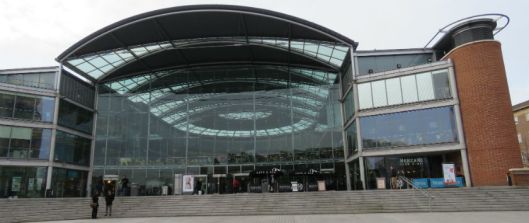
This week I was doing research on Colonel Unthank in Norwich Library’s Heritage Centre in The Forum – what a resource. And I came across something that I thought would make a quick post  before tackling my namesake.

The Forum Norwich.jpg

The Forum, Norwich

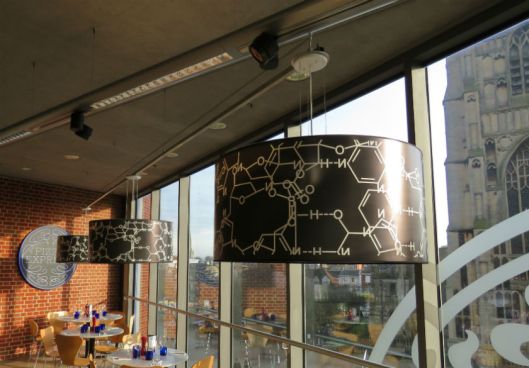
While eating a restorative pizza on the mezzanine I noticed the molecular models decorating the lampshades in Pizza Express  (other pizza outlets are available).
Pizza Express Pixlr.jpg

These molecular models represent the four DNA bases that make up the genetic code

Then, at the opposite end of the mezzanine I saw a photograph that explains the molecular theme.

Paul Nurse Pixlr.jpg

Sir Paul Nurse, Norwich-born Nobel Laureate

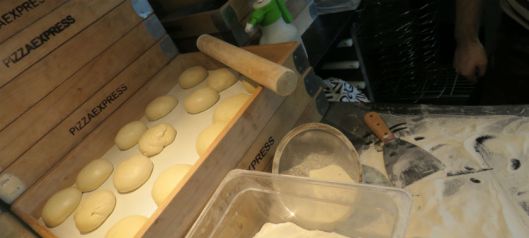
Apart from Norwich being Paul’s birthplace the connection must be about yeast and pizza dough, no?

Pizza dough.jpg

Baker’s yeast in action

The yeast used in pizza, and baking in general, is baker’s yeast. But Paul Nurse worked on a different kind of yeast, fission yeast, that divides in a slightly different way.

yeast4.jpg

Baker’s yeast grows by protruding a bud

Normally, a freshly-divided cell must grow to (at least) double its birthweight before an internal regulator allows it to divide again (double-up/halve/double-up/halve etc etc). Otherwise the result would be smaller and smaller cells that eventually disappear down their own navels. Paul was working on a mutant fission yeast that did produce abnormally small cells. In the Scottish lab’ in which he worked these small cells were called wee (wee2).

S pombe

Fission yeast divide in the middle instead of budding

Paul identified the gene responsible for the premature division in fission yeast. It turned out to be synonymous with a gene that Leland Hartwell in the USA had shown to control cell division in baker’s yeast. So, the two sorts of yeast may divide differently but they share the same mechanism for initiating division.

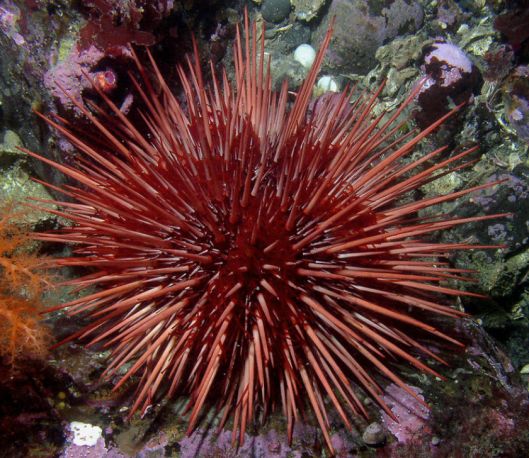
The third character in this story is Tim Hunt. Working on sea urchin eggs he saw that one particular protein accumulated steadily during the build-up to division but suddenly disappeared when all the cells divided. This cyclic protein – unsurprisingly called cyclin – turned out to bind to the regulatory protein identified by Nurse and Hartwell.

Strongylocentrotus_franciscanus Kirt L Onthank.jpg

Sea urchin (Photo: Kirt L Onthank)

These two proteins form part of the complex that ‘tells’ a cell when it is ready to divide. This complex is found in all living things from yeast to man and when faulty plays a part in cancer.

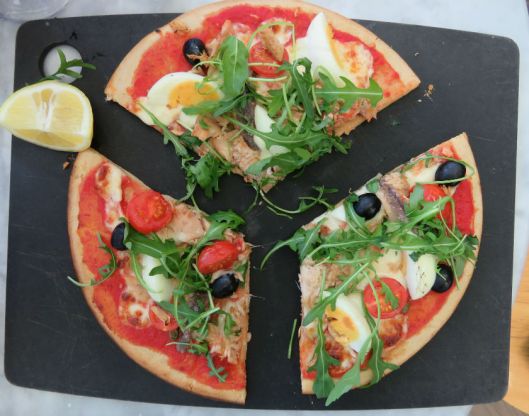
Pizza.jpg

Niçoise pizza on a gluten-free base

The 2001 Nobel Prize for Physiology or Medicine was shared three ways by Paul Nurse, Leland Hartwell and Tim Hunt.

Respect to Pizza Express for choosing such a brave theme

Share this:

  • Click to share on Facebook (Opens in new window) Facebook
  • Click to share on X (Opens in new window) X
  • Click to share on Pinterest (Opens in new window) Pinterest
  • Click to email a link to a friend (Opens in new window) Email
  • Click to print (Opens in new window) Print
Like Loading...

Twinned towers

14 Thursday Jan 2016

Posted by reggie unthank in Decorative Arts

≈ 4 Comments

Tags

Arts and Crafts, Cardiff Castle, Castell Coch, Gothic revival, Norwich buildings, The Artichoke pub Norwich, The Gatehouse pub Norwich, William Burges

When I first came to Norwich I was delighted to find two pubs in the Arts and Crafts  style whose conical roofs reminded me of a castle I used to see regularly throughout my childhood in Wales.

The first public house was The Artichoke at the top of Magdalen Street. Built in local materials (red brick and flint) with tapering chimney and mullioned windows it is very much in the Arts and Crafts tradition. But perhaps its most distinctive features are the conical roofs capping two-storey semi-circular bays.

ArtichokePH_Pixlr.jpg

The Artichoke, Magdalen Street Norwich

In view of these Arts and Crafts signifiers it was surprising to find that The Artichoke was built well after the First World War. The pub was built in 1932 by local builder R G Carter [1] for the brewers Youngs, Crawshay and Youngs. The photograph below was taken by George Plunkett that year and it has not changed substantially since then.

Magdalen Rd Artichoke PH1932PlunkettPixlr.jpg

The Artichoke in 1932 (georgeplunkett.co.uk)

The other pub is The Gatehouse on Dereham Road built in 1934, again by R G Carter and although Carter’s archives show no record of the architect(s) it is highly likely the two pubs were designed by the same hand(s).

Gatehouse PH Pixlr.jpg

The Gatehouse, Norwich 2016

The Artichoke resembles its sister building in having a two-storey bay under a conical roof, a dominant tapering chimney and the use of local materials – although the flint, here, is restricted to a panel in which it alternates with concrete blocks.  There have been minor structural changes since George Plunkett captured  it in 1939 (e.g., loss of one of the  chimneys to the right). This photograph also illustrates the use of the cat-slide roof, sweeping down from ridgeline to groundfloor. This was a feature of some of Edwin Lutyens’ domestic architecture of the earlier Arts and Crafts period and underlines the mixture of styles employed here.

Gate House PH1939Plunkett Pixlr.jpg

The Gatehouse (georgeplunkett.co.uk)

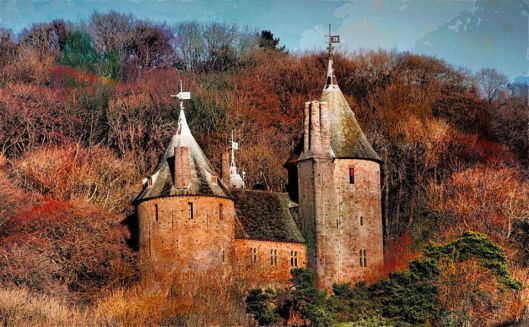
The Welsh castle in question – Castell Coch –  is, however, very much a product of the Victorian era and an outstanding example of the Gothic Revival. It was designed by the King of the Goths, William Burges, for the Third Marquess of Bute, John Crichton-Stuart [2].

castell coch rob carney Pixlr.jpg

Castell Coch (courtesy Rob Carney)

Built high on the side of a valley a few miles north of Cardiff, it was this castle that my sister and I craned our necks to see whenever we were driven to the city along the road below. We knew it as The Fairy Tale Castle – a description used by locals long before they’d seen the towers and turrets of Disney World.

Castle_Coch_from_A470Pixlr.jpg

Castell Coch from the A470 (Wikimedia Commons/RJMorgan)

In 1875 Burges built the red castle – Castell Coch – on the remains of a thirteenth century fort for Bute. Bute’s father had almost bankrupted the family in developing Cardiff docks but by the time John was born he  was referred to as ‘the richest baby in the world’, due to the wealth extracted from the family’s South Wales coal fields. Burges was a romantic, a dreamer who found his ideal client in Bute. Both men shared a deep passion for the medieval period and in Castell Coch Burges delivered Bute a Gothic fantasy, as he had done with the more extensive restoration of Cardiff Castle.  However, Bute never slept a night at Castell Coch.

Cardiff Castle Pixlr.jpg

Banqueting Room Cardiff Castle (cardiffcastle.com [3])

“a great brain has made this place. I don’t see how anyone can fail to be impressed by its weird beauty … awed into silence from the force of this Victorian dream of the Middle Ages.” (John Betjeman, 1952).

In designing Castell Coch, William Burges seems to have deliberately favoured the picturesque over historical accuracy: his towers were capped by conical roofs that were more typical of continental castles than of the 400 or so medieval castles dotted around Wales.

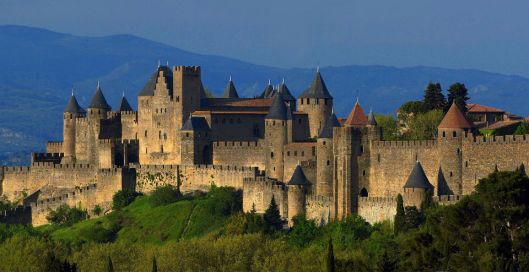
In doing this, Burges was following his passion for thirteenth century Gothic. In particular, he admired the French Gothic Revival and the works of a near contemporary Eugene Viollet-le-Duc [4], perhaps most widely known for his restoration of the medieval city of Carcassonne.

carcassonne Pixlr.jpg

Carcassonne (www.renfe-sncf.com)

Viollet-le-Duc was a controversial figure in that his works were imaginative recreations rather than faithful restorations but it was exactly this vein of medieval romanticism that Burges admired. “Billy” Burges’ own home, The Tower House (1875-81), in London’s Holland Park was a hymn to medievalism [5]. Like Castell Coch and Cardiff Castle it was furnished in medieval style, from the door-furniture to the  circular stair tower capped with a conical roof.

Over the years The Tower House has been home to Poet Laureate John Betjeman, actor Richard Harris (and singer of the strange but lovely ‘MacArthur Park’) and Jimmy Page of Led Zeppelin and ‘Circular Staircase to Heaven’ fame.

TowerHouse_RIBA_Pixlr.jpg

Burges’ Tower House, London (courtesy RIBA [6])

As a solution to capping circular towers it’s not surprising that conical roofs can be traced back to early medieval castle-building (not forgetting the defensive tower houses built in the Scottish Baronial style). The Gothic Revival brought back the conical tower at a time of anti-industrial romanticism but perhaps only the wealthy few could afford such architect-designed structures. CFA Voysey’s more domestic Arts and Crafts houses  allowed elements of these style to filter down to the middle classes into the beginning of the twentieth century but by the end of World War I the style had gone out of fashion. Hence the surprise at seeing such strong echoes in The Artichoke and The Gatehouse in the 1930s.

Stained Glass The Gatehouse Norwich.jpg

Norman influence in The Gatehouse PH, Norwich

Sources

  1. http://www.rgcarter-construction.co.uk/about/ [and RG Carter archives].
  2. Rosemary Hannah (2012).”The Grand Designer”. Pub Birlinn.
  3. A visit to the fabulous interior of Cardiff Castle is highly recommended (www.cardiffcastle.com) as is Castell Coch only five miles away (http://cadw.gov.wales/daysout/castell-coch/?lang=en).
  4. https://en.wikipedia.org/wiki/Eugène_Viollet-le-Duc
  5. https://en.wikipedia.org/wiki/The_Tower_House
  6. RIBApix at https://www.architecture.com/image-library/customers/login.html

I thank Jonathan Plunkett for access to the essential Norwich website:  www.georgeplunkett.co.uk. I am grateful to Mark Wilson and Alan Theobald for information on these two public houses.


Share this:

  • Click to share on Facebook (Opens in new window) Facebook
  • Click to share on X (Opens in new window) X
  • Click to share on Pinterest (Opens in new window) Pinterest
  • Click to email a link to a friend (Opens in new window) Email
  • Click to print (Opens in new window) Print
Like Loading...

Jeckyll and the sunflower motif

06 Wednesday Jan 2016

Posted by reggie unthank in Aesthetic Movement, Decorative Arts

≈ 13 Comments

Tags

Chapelfield Pagoda, sunflower motif, Thomas Jeckyll

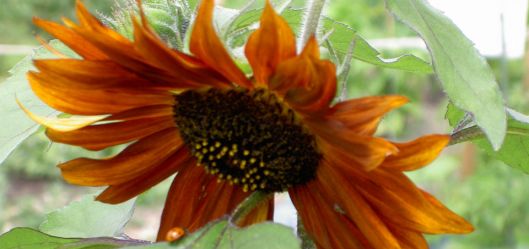
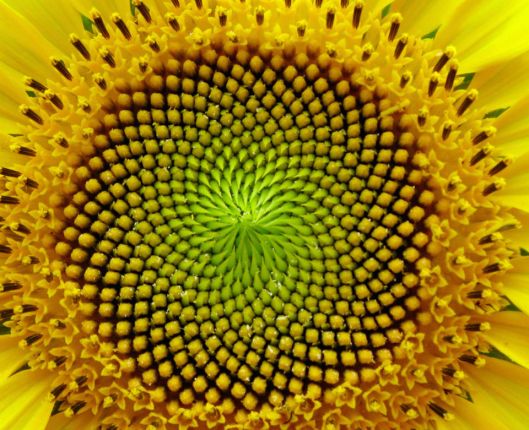
sunflower_2pixlr.jpg

Martin Battersby wrote that the sunflower has no special association with Japanese art (1) yet, during the second half of the nineteenth century, it became the symbol of the Anglo-Japanese Aesthetic Movement.

Norfolk’s Thomas Jeckyll played a part in its popularization – his Japonaise designs  for fireplaces, produced by the Norwich foundry of Barnard Bishop and Barnards, helped connect the sunflower motif with other more recognisably Japanese emblems like cherry blossom, fan shapes and cranes. The sunflower crops up on illustrations, paintings, metalwork, china. One explanation for its popularity was “… the ease with which its simple flat shape could be wrought into a formal pattern…” (1).

SunflowerSpirals_pixlr.jpg

Clockwise and anti-clockwise spirals

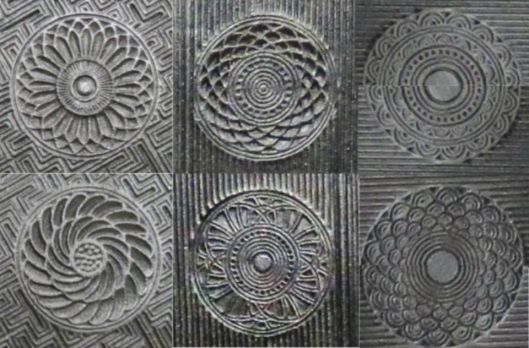
It may be beautiful but the sunflower’s flat shape is anything but simple. The pattern of seeds on the flower head is mathematically complex, comprised of clockwise and anti-clockwise spirals. The numbers of right-handed and left-handed spirals, which change as the flower grows, are adjacent numbers in the Fibonacci series; for example 55 and 89, or 8 and 13. Described by Leonardo Fibonacci in the thirteenth century, this series is  0, 1, 1, 2, 3, 5, 8, 13, 21 etc, where the next number is the sum of the previous two. Jeckyll, like all other artists (such as van Gogh in his later  series of sunflower paintings [1888]) had to devise a shorthand for representing such complexity. Fortunately, in working for Barnards, Jeckyll was able to exploit their fine casting in his experiments to translate the Fibonacci series into a visually pleasing effect.

Difft SunflowersPixlr.jpg

Abstracted flower designs in which the contrary spirals of the sunflower are represented with varying degrees of success. On a single cast-iron fireplace Jeckyll used six different sunflower designs (the two motifs at right were semicircles that I mirror-imaged  to form whole circles). A Barnards fireplace at Norfolk Museums Service, Gressenhall.

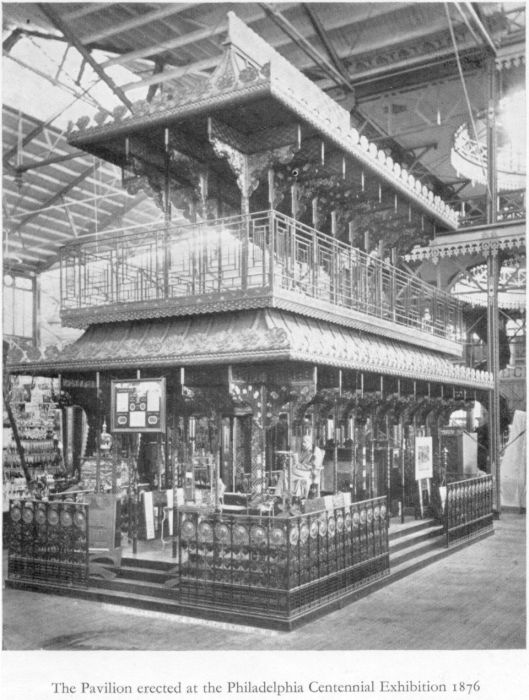
Jeckyll was certainly not the only one to use the sunflower motif in an Arts and Crafts context – William Morris had popularised it a generation earlier – but as a member of a London-based circle of connoisseurs of oriental art he was one of the first to apply it within the Anglo-Japanese Aesthetic Movement. One of his most famous designs was for Barnard Bishop and Barnards’ cast-iron Pavilion or Pagoda for the Philadelphia Centennial Exhibition, 1876. Seventy two sunflowers, three-foot-six inches high, formed the railings around the Pagoda (2).

PhiladelphiaPagodaPixlr.jpg

Jeckyll’s Pagoda exhibited in Philadelphia, surrounded by the golden sunflower railings (Courtesy Jonathan Plunkett [3])

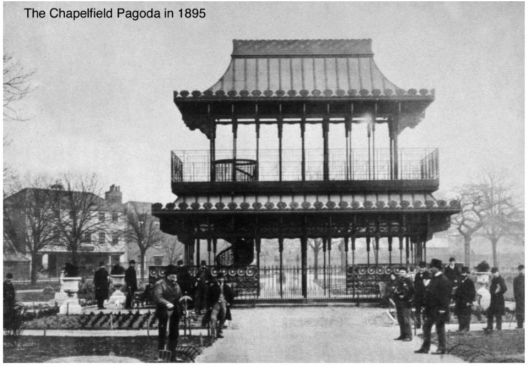
The Pagoda was bought ca. 1880 by the Norwich Corporation for £500 and erected in Chapelfield Gardens.

Chapelfield pagodaPixlr.jpg

The sunflower railings can just be seen at the base of the Pagoda installed in Chapelfield Gardens, Norwich. (Courtesy http://www.racns.co.uk [4])

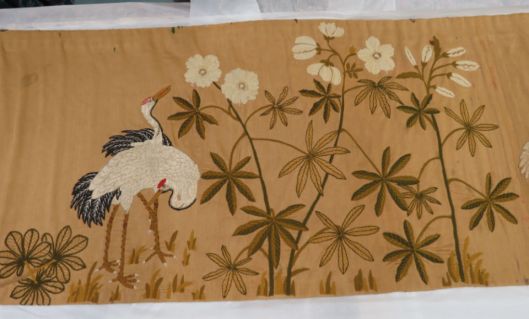
When exhibited, the ceilings and upper parts of the walls of the Pagoda were decorated with embroidered textiles in the Japanese style. But when the pagoda was dismantled some 70 years later these seem to have been cut for curtains; fortunately large fragments are conserved in the Costume and Textile Department at Norwich Castle Museum & Art Gallery (5).

JeckyllTextilePixlr.jpg

For the Pagoda, Jeckyll designed textile hangings embroidered with cranes and Japanese flowers (1876). (Accession number, NWHCM: 1968.240)

Below, an early colour photograph from the essential George Plunkett photographic archive of Norwich (3) shows the Pagoda in 1935, left of the bandstand.

Chapel Field bandstand and pagoda COLOUR [0738] 1935-08-21.jpg

The Chinese Pagoda (left) in 1935, apparently painted Corporation Green.(Courtesy of georgeplunkett.co.uk)

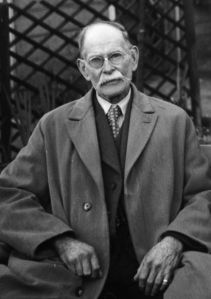
The photographer George Plunkett’s great-uncle, the wonderfully named Aquila Eke, was a son of a blacksmith. He also became a blacksmith at Barnard Bishop and Barnards’ Norfolk Iron Works and is said to have made much of the bas-relief work for the Pagoda (3).

aquila eke 21 June 1937reduced

Aquila Eke 1937.(Courtesy Jonathan Plunkett)

“At about the age of 10 [Aquila] ran away from home, finding his way to Norwich. (On arrival, he thought he had reached London!). He found his way into the blacksmith’s shop in the yard of the Royal Oak public house in St Augustine’s Street, where he was recognised, and promptly driven back to Drayton. However, he eventually came to Norwich to work, and joined the Norfolk Ironworks of Messrs Barnard, Bishop and Barnard, where [twelve years after running away] he assisted in the manufacture of the handsome wrought-iron pavilion which for so many years graced Chapel Field Gardens.”(From the Plunkett family archive, courtesy of Jonathan Plunkett).

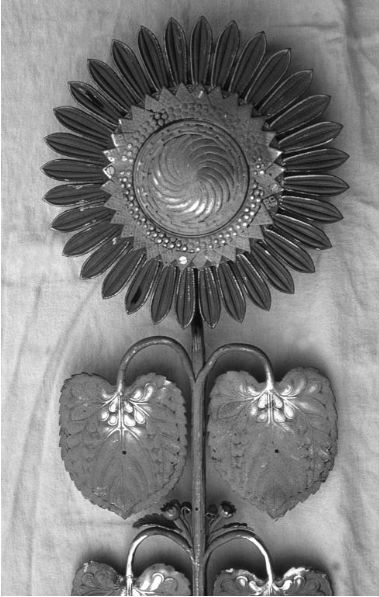
In 1942 the Pagoda was damaged during the ‘Baedeker’ raids that bombed cities judged by the German travel guide to be of cultural and historic importance. Blast damage and general corrosion led to the dismantling of the structure in 1949. Some panels of the sunflower railings were salvaged and, after being used at the tennis courts of Heigham Park, Norwich, were refurbished in 2004 as the park’s entrance gates. During restoration, Sarah Cocke (4) remembers a mixture of old and new sunflowers mixed in cardboard boxes at Norwich City Works. Presumably, Sarah’s photograph below shows a new sunflower since it has a simplified single row of petals instead of a double row as in the original pieces.

SunflowerHeighamPark_racns.jpg

A ‘Heigham Park’ sunflower during restoration. Note that the highly complex double spirals are now reduced to one. (Courtesy Sarah Cocke)

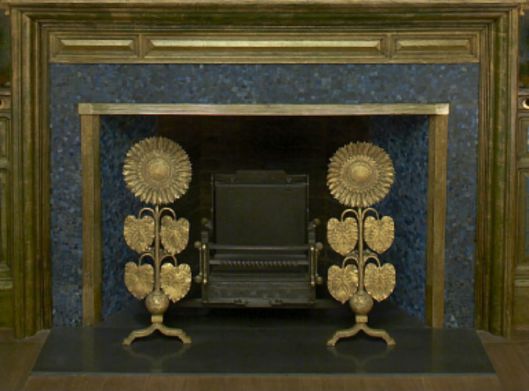
This was the same design that Jeckyll used for the andirons in the fireplace of the Peacock Room, one of Jeckyll’s few remaining vestiges after Whistler’s makeover (see previous post).

Freer Sunflowers closeup.jpg

Jeckyll’s sunflower andirons and grate – some of his few untouched contributions to the Peacock Room. (Courtesy Freer and Sackler Galleries, Washington, USA [6])

Sunflowers Freer galleryPixlr.jpg

Whistler’s painting above, Jeckyll’s sunflowers below (Freer and Sackler Galleries [6])


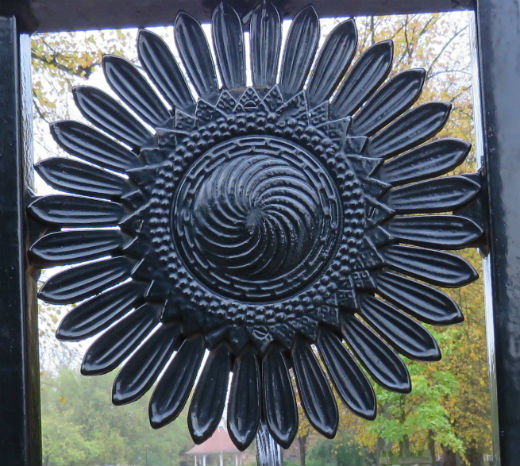
The most recent manifestation of Jeckyll’s sunflower design is in the newly-made gates to Chapelfield Gardens, where the originals had surrounded the Pagoda over 125 years ago.

chapelfield_sunflowersPixlr.jpg

Twenty-first century sunflower gates at the entrance to Chapelfield Gardens, Norwich

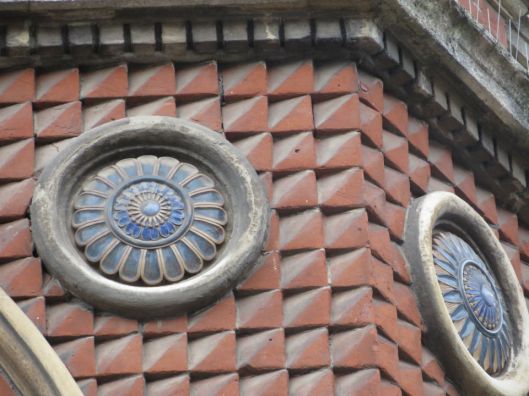
The flower motif is ubiquitous and can be found elsewhere in Norwich. The flatiron-shaped red brick and terracotta building (1880) at the junction of London and Castle streets was part of Edward Boardman’s London Street Improvement Scheme. On this building, around the top of the second storey, Boardman added a series of white terracotta roundels containing flowers with blue-glazed petals. Admittedly, these flowers are more daisy-like than sunflowers but so were some of Jeckyll’s own variations as he worked out ways of representing the sunflower – see, for example, one of his fireplaces in the third figure from top. Boardman would have been well aware of Jeckyll’s work for Barnards, whose showroom was just around the corner in Gentleman’s Walk.

BlueSunflower.jpg

Blue-glazed roundels.

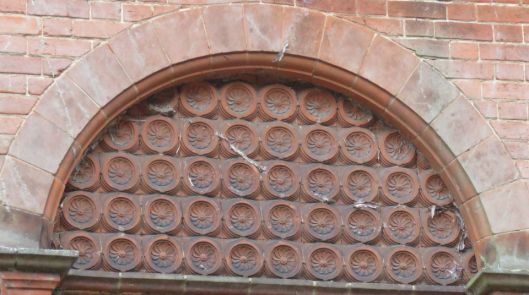
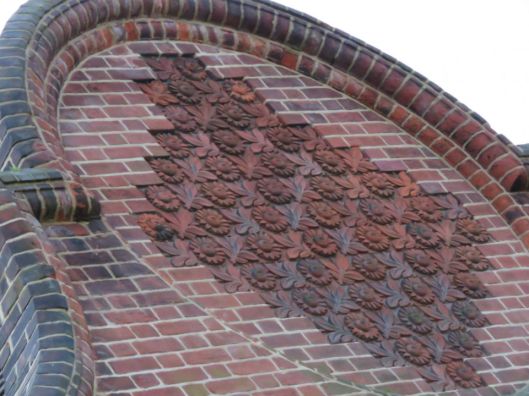
At some point, perhaps for ease of manufacture in materials incapable of showing such fine detail as iron, what might once have been an Aesthetic sunflower becomes a generic daisy. The house at number 19 Ipswich Road is profusely decorated with diapered panels of Aesthetic-influenced flowers above windows and on a gable.

19 ipswich rdPixlr.jpg

Repeated Aesthetic flower motifs in Ipswich Road, Norwich

At 50 All Saints Green is a restored (2015) former coach house and stables. It is highly decorative with two panels of terracotta flowers; one in the east end’s Dutch gable… 50AllSaintsGreenPixlr.jpg

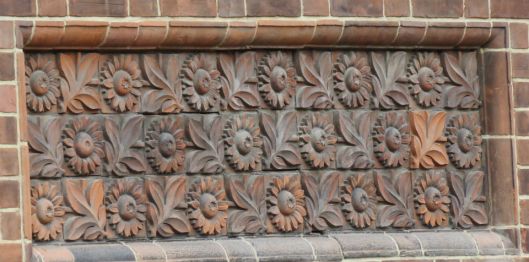
… and the other above the front door (below).

sunflower panel.jpg

Although described as sunflowers the central apple-like structure sidesteps the complexity of Fibonacci spirals that Jeckyll had managed to convey in iron.


Sunflower_Chapelfield.jpg

Jeckyll sunflower, ‘new’ gates at Chapelfield Gardens, Norwich

Sources

1. Martin Battersby (1973). Essay on ‘Aesthetic Design’. pp 18-24 In, The Aesthetic Movement, Ed Charles Spencer. Academy Editions .

2. Susan Weber Soros and Catherine Arbuthnott (2003). Thomas Jeckyll, Architect and Designer, 1827-1881. The Bard Graduate Center for Studies in the Decorative Arts, Design, and Culture, New York. Pub, Yale University Press.

3. George Plunkett’s Photographs of Old Norwich http://www.georgeplunkett.co.uk/Website/ 

4. Recording Archive for Public Sculpture in Norfolk and Suffolk. http://www.racns.co.uk

5. The Costume and Textile Department at the Castle Study Centre, Norfolk Museums Service.  http://www.museums.norfolk.gov.uk/Visit_Us/Norwich_Castle_Study_Centre/index.htm

6. The Freer and Sackler Galleries, The Smithsonian’s Museums of Asian Art. Washington D.C., USA. http://www.asia.si.edu/exhibitions/current/peacockRoom/pano.asp

Thanks to Sarah Cocke of racns; Jonathan Plunkett of the Plunkett photographic site; Lisa Little, Samantha Johns and Shaz Hussain of the Norfolk Museums Service.


Share this:

  • Click to share on Facebook (Opens in new window) Facebook
  • Click to share on X (Opens in new window) X
  • Click to share on Pinterest (Opens in new window) Pinterest
  • Click to email a link to a friend (Opens in new window) Email
  • Click to print (Opens in new window) Print
Like Loading...

Two Bs or not two Bs? Norfolk’s Thomas Jeckyll

26 Saturday Dec 2015

Posted by reggie unthank in Aesthetic Movement, Decorative Arts, Uncategorized

≈ 13 Comments

Tags

Barnard Bishop and Barnards, Butterfly signature, James McNeill Whistler, Japonisme, Thomas Jeckyll

THE AESTHETIC MOVEMENT IN NORFOLK

Norfolk’s Thomas Jeckyll was a largely unsung hero of the nineteenth century Aesthetic Movement whose popularization had its roots in Norwich.

I first came across Thomas Jeckyll’s work when I bought the catalogue to a 1973 exhibition that had done much to bring together the work of this diffuse group: The Aesthetic Movement 1869-1890 (1).

aesthetic movement catalogue.jpg

Catalogue of 1973 exhibition, The Aesthetic Movement, edited by Charles Spencer

In the 1980s, my first house in Norwich had a wrought-iron gate bearing a small roundel embossed with two butterflies. I was told this was how Jeckyll stamped his designs for the Norwich foundry of Barnard and Bishop. These insects have been described as moths  but butterflies make more sense to me and tie Jeckyll in to the wider art movement. [A correspondent later suggested that the roundels on the wings signified peacock butterflies. This makes sense in the context of the Aesthetic Movement and even has resonances in Whistler’s later Peacock Room].

Jeckyll insignia.jpg

Jeckyll’s two-insect motif on a cast-iron fireplace..

Jeckyll was born in 1827 in Wymondham, a market town a few miles south of Norwich. His father was curate of the Abbey Church, Wymondham and church restoration was an important part of Jeckyll’s early work. He established an office in Norwich and his entire family moved to the city’s Unthank Road in 1854 (2). [I hope to write a post on the Unthank Estate].

The opening up of Japan for trade to the west in the early 1850s had an enormous impact on European art: collectors fought over porcelain and James Whistler even tussled over a Japanese fan. There was great competition for the wood-block prints included in shipments of imported goods. Largely free of the western preoccupation with linear perspective these Japanese images came to inspire the ‘flattened’ poster art of western artists such as Toulouse Lautrec and Alphonse Mucha, while Gustav Klimt’s decorative effects can be traced to the coloured patterns and motifs on Japanese fabric.
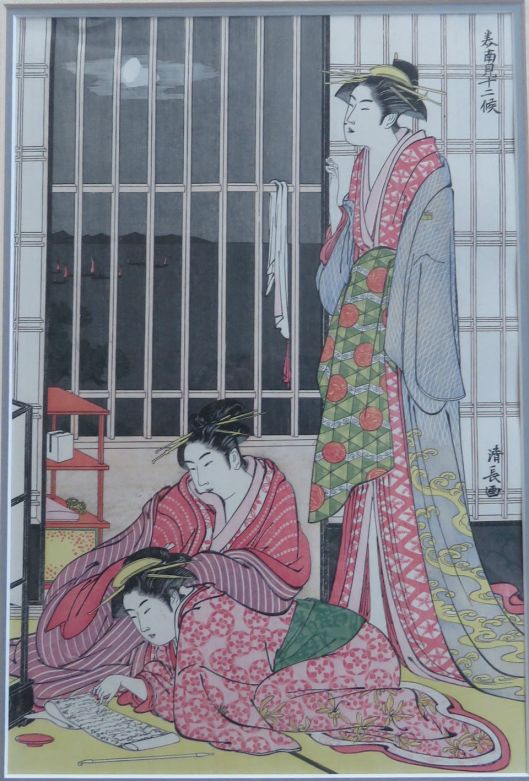
kiyonaga.jpg

On Japanese fabrics the roundel was a key motif superimposed upon geometric backgrounds. Torii Kiyonaga 1752-1815.

This avant-garde passion for things oriental filtered into popular culture as the Anglo-Japanese Aesthetic Movement. While The Arts and Crafts Movement had become, under William Morris’ influence, an exclusive enterprise based on handmade goods and opposition to mechanization, The Aesthetic Movement became an expression of middle-class taste for Japonaise objects produced on an industrial scale. Household objects, such as china and pottery, were embellished with roundels, cherry blossom, cranes, fan shapes and other geometric patterns of the kind seen on Japanese fabrics and prints

Aesthetic Jug Pixlr4.jpg

A travelling salesman’s ‘flat’, showing Aesthetic Movement decoration of cherry blossom, fan shapes and roundels

Aesthetic bowl Pixlr.jpg

Victorian soup dish (actually, my porridge bowl) decorated with ‘Aesthetic’ motifs of sunflowers and cherry blossom.

One of Jeckyll’s first successes for Barnard Bishop and Barnards was his design for the Norwich Gates, shown in the International Exhibition, London 1862. The gates were then presented by the people of Norwich and Norfolk to the Prince of Wales (later, King Edward VII) as a wedding present and can still be seen at the queen’s country estate at Sandringham.

Smaller but more dramatically Aesthetic gates – showing repeated use of the fan shape – were designed for Sprowston Hall (now Sprowston Manor Hotel) just north of Norwich.

gates sprowston manor.jpg

The gates for Sprowston Manor are one of Jeckyll’s best realised Japanese designs. Some of the gold-painted roundels contain Jeckyll’s insignia (below).

jeckyll emblem sprowston gates_2.jpg

In addition to such individual pieces, Jeckyll’s designs reached the mass market in the form of cast-iron fireplaces in the Japanese style. Again, roundels are the predominant motif, the piece below showing various depictions of the sunflower’s mathematically-complex seed heads.

Jeckyll fireplace.jpg

Barnard Bishop and Barnards fireplace designed by Thomas Jeckyll. Note his symbol in the roundel top left. Courtesy of Norfolk Museums Service.

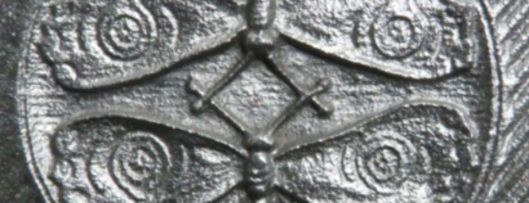
The insects imprinted within Jeckyll’s roundels are sometimes described as moths but they clearly have bulbs at the ends of their antennae as butterflies do but which moths – with feathery antennae – do not. The two initials B of the butterflies would have celebrated Jeckyll’s role as designer for Barnard and Bishop, as the firm was known when he was first associated with them.
butterfly antennae.jpg

The bulbs at the ends of these insects’ antennae are characteristic of butterflies.

Jeckyll worked with Charles Barnard of Barnard and Bishop from 1850 but when Barnard’s two sons joined the company in 1859 the firm used a four-bee motif as seen in the roundel on the fireplace below. The firm became Barnard Bishop and Barnards – note the ‘Barnards’, plural.

Jeckyll fireplace2.jpg

Jekyll-designed fireplace marked with the four-bee motif used by Barnard Bishop and Barnards. Courtesy of Norfolk Museums Service.

Barnards 4 bee emblem.jpg

Close-up of the four-bee emblem from the fireplace above

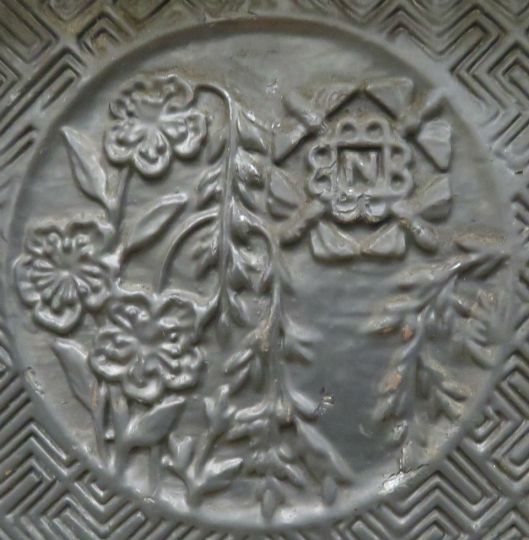
On a recent visit to the Costume and Textile Study Centre, Shirehall, Norwich (3), I was shown a working fireplace that had one time been boarded up in a store room. Its top left roundel contains four bees in a square, inside that are four letter Bs and at the centre a capital N, possibly for Norwich.
Barnards 4B symbol.jpg

A variation on the four-bee motif for Barnard Bishop and Barnards:  four insects, four capital Bs and a letter N.

Barnard fireplace.jpg

Registered design for a Jeckyll fireplace. The close-up of the four-bee symbol in the preceding image can just be seen in the top left roundel.

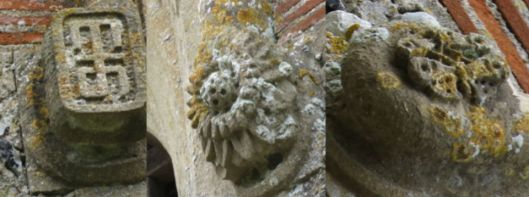
Although the four-bee motif relates to the enlarged ‘Barnards’ group, the two-butterfly symbol does not seem to have been appropriated by the earlier pairing of Barnard and Bishop and was clearly reserved for Jeckyll himself. Recently, I visited Saint Peter’s church Ketteringham, a few miles south of Norwich. Jeckyll is known to have restored the upper part of the tower in the early 1870s for the Boileau family of Ketteringham Hall. The churchwarden pointed out Jeckyll’s oriental-style monogram carved on one of the stone bosses terminating the eyebrows over the towers’ Gothic arches (below left). This monogram was also used in terracotta panels on the Lodge of Framingham Manor for which Jeckyll was the architect (2).The central image shows another defining symbol of The Aesthetic Movement – the sunflower – while the right-hand image shows his symbol of two-butterflies with interlocking antennae.
3 Jeckyll motifs.jpg

Three of Jeckyll’s symbols on stone bosses decorating the tower of Ketteringham Church, Norfolk: his initials, a sunflower and two butterflies

This demonstrates that Jeckyll used his two-butterfly motif independently of his metalwork with the Barnards; it also shows that he was using it more than ten years after Barnard and Bishop had expanded to four Bs.

Jeckyll’s family were Jeckells and Thomas changed his name, perhaps as an affectation, much as his Norfolk-born friend Frederick Sandys had elevated himself from Sands (2). Sandys’ paintings in the Pre-Raphaelite style can be seen in Norwich Castle Museum (4). It was Sandys who introduced Jeckyll to  a group of London aesthetes including George du Maurier (author of Trilby), the poet Algernon Swinburne, the artists Whistler and the Pre-Raphaelite, Dante Gabriel Rosetti.

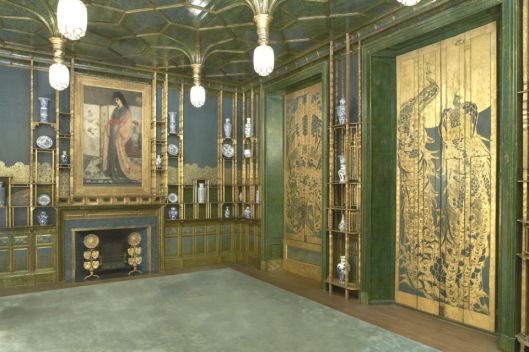
Jeckyll was employed by wealthy collector Frederick Leyland to design a room with extensive shelving  to display his collection of Chinese porcelain. Jeckyll re-fashioned the dining room in an eclectic style in keeping with the current Aesthetic  manner (2). It was lined with embossed leather thought to have come from Catton Hall, in Old Catton just outside Norwich. Another of Jeckyll’s signature motifs, the sunflower, was present in the form of two gilded andirons in the fireplace above which hung  Whistler’s appropriately entitled painting,  The Princess from the Land of Porcelain (5, 6).
Peacock Room 2.jpg

The Peacock Room painted by Whistler with Jeckyll’s sunflower andirons in the fireplace. The Freer Gallery of Art, Washington, USA.

Since his early interactions with the Boileau family at Ketteringham Hall, Jeckyll had shown signs of unreliability. While decorating Leyland’s rooms his behaviour became increasingly erratic (7, 2) due to what is now recognised as severe manic-depression. In his absence Whistler took over the decoration. To achieve one of the high points of the Aesthetic Movement, ‘Harmony in Blue and Gold: the Peacock Room’, Whistler  overpainted Jeckyll’s leather-clad walls, shelving and even his sideboard. While the  result was undoubtedly splendid it effectively overwrote Jeckyll’s contribution to art history.

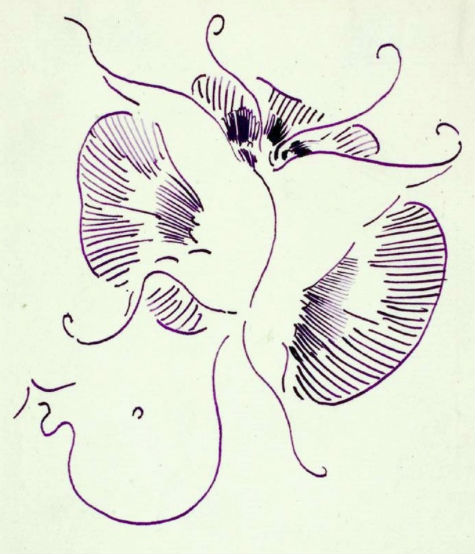
The press referred to this as Whistler’s room, a half-truth that Whistler himself seems to have been slow to correct, causing Jeckyll’s loyal friend Sandys to confront the American artist.  Whistler did, however, appear to have a begrudging admiration for Jeckyll’s work and his own famous, more ethereal, butterfly signature has been traced to the influence of Jeckyll’s earlier motif (6).
Whistler's butterfly signature.jpg

Whistler’s butterfly signature

Towards the end of his life Jeckyll spent time in Heigham Hall, a private asylum. heigham hall asylum.jpg

He returned to the family home in Park Lane, Norwich,  but Jeckyll’s father was also exhibiting extreme mania at this time so the family transferred Thomas to the Bethel Hospital, Norwich, where he eventually died in 1881.

Victorian attitudes to mental illness may have contributed to the lack of recognition due to Jeckyll but later scholarship helped to right this wrong (1, 2, 7). What is clear is that the Anglo-Japanese designs for Barnard Bishop and Barnards are indisputably Jeckyll’s and that the widespread sale of goods bearing his butterflies, roundels and sunflowers did much to bring the Aesthetic Movement to a broader public.

Sources

This post has relied heavily on the scholarship of Susan Weber Soros and Catherine Arbuthnott (2). I thank Shaz Hussain of the Norfolk Museums Service, Gressenhall, Norfolk for showing me the Jeckyll fireplaces in storage at Gressenhall, and Lisa Little for pointing out another Jeckyll fireplace in situ at the Costume and Textile Study Centre, Shirehall, Norwich. I am grateful to churchwarden Mary Parker for teaching me so much about Jeckyll’s work at Ketteringham.

Sources

1. The Aesthetic Movement (1973). Ed, Charles Spencer. Academy Editions London.

2. Soros, Susan Weber and Arbuthnott, Catherine. Thomas Jeckyll: Architect and Designer, 1827-1881. The Bard Graduate Centre for Studies in the Decorative Arts, Design and Culture, New York in association with Yale University Press, 2003.

3.The Costume and Textile Department, Castle Study Centre, Norfolk Museums Service.  http://www.museums.norfolk.gov.uk/Visit_Us/Norwich_Castle_Study_Centre/index.htm

4.http://www.museums.norfolk.gov.uk/Whats_On/Virtual_Exhibitions/Frederick_Sandys_and_the_Pre-Raphaelites/Sandys_and_the_Pre-Raphaelites/NCC081281

5. http://www.asia.si.edu/exhibitions/online/peacock/2.htm.

6. For a highly-recommended interactive tour of The Peacock Room download this free app for iPad and iPhone: http://www.asia.si.edu/apps/

7. Merrill, Linda. The Peacock Room: A Cultural Biography. Washington, D.C.: Freer Gallery of Art in association with Yale University Press, 1998.

Also, do visit Norfolk Museums Service Collections website: http://norfolkmuseumscollections.org


Share this:

  • Click to share on Facebook (Opens in new window) Facebook
  • Click to share on X (Opens in new window) X
  • Click to share on Pinterest (Opens in new window) Pinterest
  • Click to email a link to a friend (Opens in new window) Email
  • Click to print (Opens in new window) Print
Like Loading...

Norfolk’s stained glass angels

19 Saturday Dec 2015

Posted by reggie unthank in Decorative Arts, Stained Glass, Uncategorized

≈ 16 Comments

Tags

Stained glass angels

Angels’ Ears

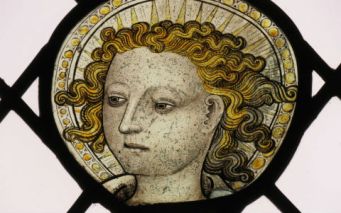
The first exhibition I saw in The Sainsbury Centre for Visual Arts, in the 1980s, was Treasures of Norfolk Churches. The most beautiful piece was a head of an angel painted on glass and I had the poster of this fifteenth century angel on my office wall for many years.

Later, my wife and I were paying homage to Robert Marsham who recorded how nature changes over the seasons and so started the science of phenology in the eighteenth century. We traced him to St Margaret’s church in Stratton Strawless (poor soil, poor wheat, little straw) (1) where there was a small display of his work alongside the imposing memorials to his ancestors. Most of the remaining medieval glass was in the upper traceries of the windows but there, in the otherwise clear main light of the north aisle window, was the angel from the poster (visit the excellent: norfolkstainedglass.co.uk (2)).

SSangelPixlr.jpg

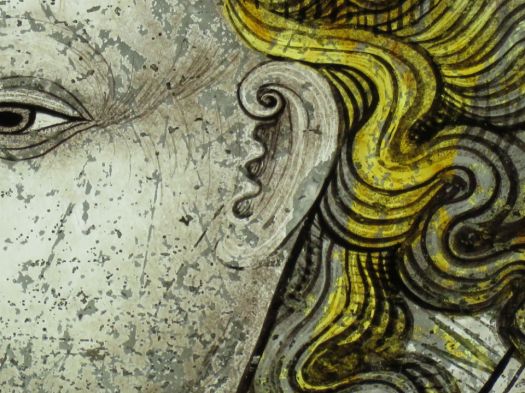
Over many years of staring at this poster on a daily basis I had noted some peculiarities. First was the angel’s curly hair with a distinctive double S curl in the centre of the hairline; the second was the peculiar double tragus – the flap in front of the ear. Normally, this is a single-pointed prominence covering the opening to the ear. Abnormally, an accessory tragus can form as a smaller tag  but the ear of the Stratton Strawless angel shows a more equal bi-lobing giving it a pie-crust appearance. A friend who spent time as a paediatric dermatologist never encountered a double tragus, indicative of it rarity.

Ear_PixlrA.jpg

In another chance encounter I visited The Burrell Collection in Glasgow (3) and saw a very similar head in a 15th century stained glass panel attributed to The Norwich School (see also ref 4). Comparison with the Stratton Strawless angel shows they share the double tragus, the double S curl and evidently visited the same hair stylist. The noses are drawn with identical strokes of the brush, as are the philtrums (the double-lined channel between nose and mouth). But there is an overall cartoon-like quality to the Burrell saint that is missing from the softer Strawless angel. Whereas the Burrell saint has expression lines drawn at the corner of the mouth the more wistful appeal of the Strawless angel derives from the smoky shading at the edge of the mouth, giving the face a quizzical look somewhat reminiscent of the Mona Lisa.

BurrellPixlrHalf.jpg

Head of St John. St Peter Mancroft glass from The Burrell Collection Glasgow. Image reversed for comparison. Reproduced courtesy  of Glasgow Museums.

SSangelPixlrHalf.jpg

Stratton Strawless angel. Note the double tragus in the ears of this and the figure above.

From the same family then but not identical twins. At this distance it is not easy to identify the artist but there are clues.

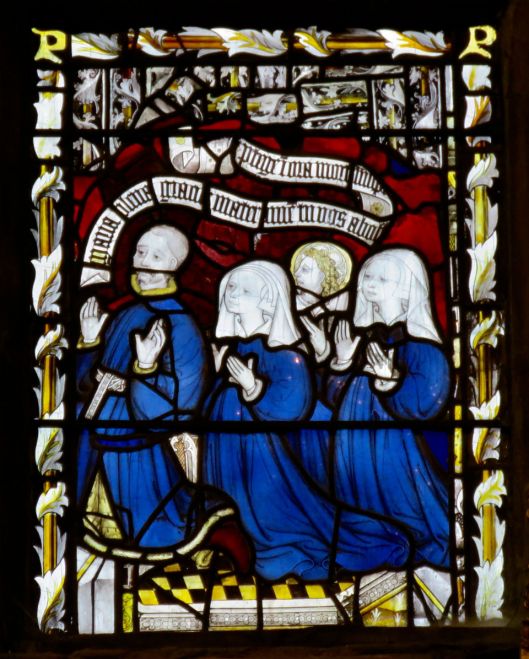
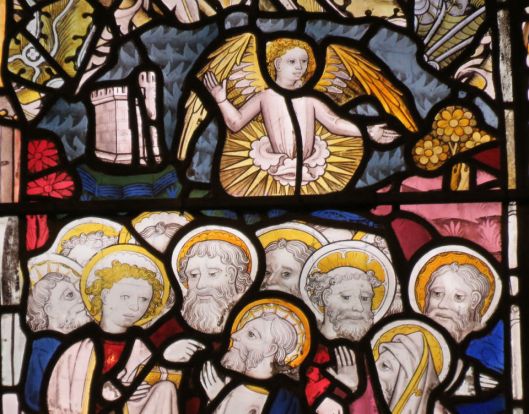
The Burrell glass (3) is attributed to the St Peter Mancroft church, Norwich. In 1450-55 Robert Toppes, a rich wool merchant, donated painted glass panels to this, Norwich’s ‘most prestigious’ parish church (4). An unknown proportion of the glass must have been destroyed by  iconoclasts during the mid sixteenth and seventeenth centuries and the explosion of 90 barrels of gunpowder at the Royalist Committee House in nearby Bethel Street didn’t help. In 1647, during the Civil War, this ‘Great Blow’  killed or injured a hundred people (4,5). Apart from the panel now in The Burrell Collection, Glasgow, and two in Norfolk’s Felbrigg Hall (one of which is on loan in the Mancroft treasury) the rest of the surviving glass was gathered together in the east window in an apparently random fashion (4,6). Robert Toppes himself is depicted in the donor panel (below) along with female members of his family. The head of a curly-haired saint or angel replaces a lost third female head.

ToppesPixlr.jpg

Robert Toppes and family in the donor panel of the east window of St Peter Mancroft, Norwich. The head of a blond saint/angel replaces one family member. Close inspection shows that Toppes’ ear is also painted with a double tragus.

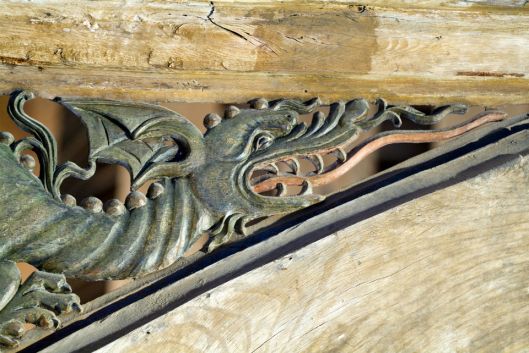
Toppes (1405-1467) was probably Norwich’s wealthiest tradesman at the height of the city’s trading power, demonstrating the rise of the merchant class. He became mayor and was member of parliament four times. He built his own trading hall in King Street, adjacent to the River Wensum that was used to transport his fine cloths and wool for trade with the continent. This hall, then called Splytts, is now known as Dragon Hall after the carved dragon exposed amongst the roof timbers during restoration.

DragonPixlrFinal.jpg

Dragon discovered in the roof timbers of Dragon Hall, King Street, Norwich. Courtesy of The Writers’ Centre

Records show that Norwich had been a regional centre for glass painting since at least the thirteenth century (7). The Toppes window was made by the prominent workshop of John Wighton (6,8) who was alderman when Toppes was mayor and whose workshop is likely to have been close to Toppes’ trading hall, Splytts. During his mayoralty Toppes paid for the windows of the Guildhall’s council chamber to be glazed by Wighton and on a tour of the Guildhall (highly recommended) it is possible to see generic similarities between figures in this and the Toppes window in St Peter Mancroft.

GuildhallPixlr.jpg

Stained glass window in Norwich Guildhall, painted by the Wighton workshop and funded by the mayor, Robert Toppes. Note Toppes’ coat of arms between the two angels.

For the Toppes window, David King in a magisterial book devoted to just this one window, identifies the styles of at least three painters (6, 7). In addition to Wighton himself, he suggests that the Master of the Passion window may have been his apprentice William Moundford who came from Moontfort in Utrecht, underlining the close links between Norfolk and the Low Countries.  William’s wife Helen was – perhaps surprisingly considering the date – also a glazier in Wighton’s studio and she is thought to have made a contribution to the Toppes window. Their son John was also apprenticed to Wighton in 1446 and became head of the workshop in 1458.

St Peter Mancroft GlassPixlr.jpg

Panels from St Peter Mancroft’s ‘Toppes’ window. All visible ears display the double tragus.

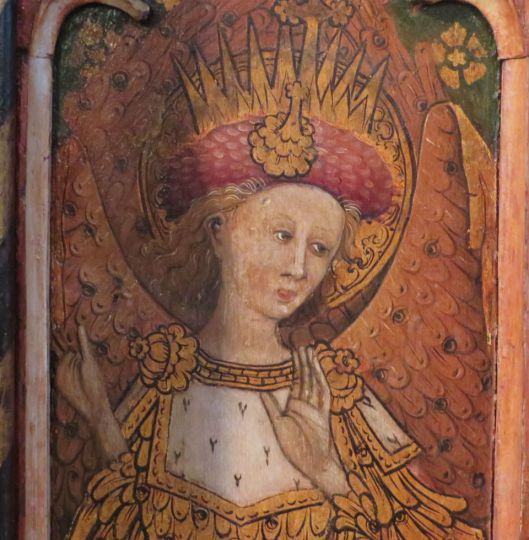
On a recent visit to The Metropolitan Museum, New York, I saw fifteenth century stained glass attributed to Gloucestershire (9), in which the apostles also had the double tragus, although this bunch of ruffians  looked nothing like the angelic Stratton Strawless head. So by itself this facial feature cannot be considered diagnostic of a particular artist or school. Indeed, angels painted on the wooden panels of the beautiful rood screen of St Michael, Barton Turf, Norfolk have the double tragus, showing that this trait was not confined to glass painting.

Barton Turf angel Pixlr.jpg

Angel painted on rood screen of St Michael Barton Turf. The angel’s ear shows the double tragus.

By comparing more than one facial trait it should be possible to further define the Strawless glass painter. A tour around Norfolk, based on the brilliant Hungate glass trails (10), reveals other saints and angels by the Wighton workshop and by using imaging software it was possible to overlay their images onto the Strawless angel. Below, these reunited fragments of an angel’s head from Warham St Mary share the double tragus and double-S curl with the Stratton Strawless angel.

warham angel pixlr.jpg

Head of angel, Warham St Mary’s Norfolk

The transparency of this image was increased and the face overlaid onto the Strawless angel.

Warham Strawless overlay pixlr.jpg

Overlaying the heads of the Strawless and Warham angels

The positions of the nose, ear and mouth of the two angels coincide  pretty well as do the eyes, despite the lead strip across the Warham figure.  Only the Warham angel’s more prominent jaw is significantly out.

Another angel with an enigmatic smile, and which rivals the beauty of the Strawless head, can be seen at All Saints Church, East Barsham, Norfolk. This musician wears ‘feather tights’ as worn in medieval mystery plays.

east barsham angel Pixlr.jpg

Angel, All Saints East Barsham, Norfolk

Below, overlaying the semi-transparent heads of the Strawless and East Barsham angels reveals an exact coincidence between the alignment of ears (with double tragus), the angle of the nose, position of the pupils, size and shape of the mouth as well as the overall shape of the face, even the scratched shading inside the upturned collar.

E Barsham Strawless angels Pixlr.jpg

Overlay of the East Barsham and Stratton Strawless angels

The exactness of this coalignment strongly suggests that the two heads originated from the same workshop. However, different members of the shop may have used the same template or cartoon at different times yet produced identifiably different results, as with the various artists of John Wighton’s workshop thought to have painted the Toppes window. And remember that not all those figures by the Wighton workshop had the double tragus. It seems probable, therefore, that the Strawless and East Barsham (and Bale) heads are by the same artist.

So who was that artist? After more than 500 years there is little to go on (see 8). David King,  the eminent authority on Norfolk stained glass mentions  that in 1473 John Marsham left a bequest in his will for the glazing of Stratton Strawless north window (11). There is no guarantee that the Strawless angel was part of the bequest but if it were this would date the angel to the 1470s. In this case John Wighton died too early to have painted the angel’s head (1458). There is record of William Mundford’s will in 1457 so he, too, may have preceded the painting of the angel. However, his son John, who became head of the Wighton workshop, died in 1481 and could have painted the piece. What does seem clear is that the cartoon on which the Stratton Strawless angel was based originated in Norwich’s Wighton workshop and was adapted by its various artists over several decades.

©2015 Reggie Unthank

Sources 

  1. norfolkchurches.co.uk
  2. norfolkstainedglass.co.uk
  3. The Burrell Collection, Glasgow. Asset number 45.92_01
  4. Matthew, R. (2013) Robert Toppes: Medieval Mercer of Norwich. Pub, The Norfolk and Norwich Heritage Trust.
  5. http://www.heritagecity.org/research-centre/social-innovation/norwich-in-the-civil-war.html
  6. King, D. J. (2006) The Stained Glass of St Peter Mancroft, Norwich, CVMA (GB), V, Oxford.
  7. Woodforde, C. (1950) The Norwich School of Glass-Painting in the Fifteenth Century. Pub, Oxford University Press.
  8. King, D. (2004). Glass Painting. In, Medieval Norwich eds C. Rawcliffe and R.Wilson. Pub, Hambledon and London. pp121-136.
  9. http://www.metmuseum.org/collection/the-collection-online/search/463580?rpp=30&pg=2&ft=gloucestershire&pos=53
  10. http://www.hungate.org.uk
  11. King, D.J. (1974)Stained Glass Tours Around Norfolk Churches. Pub, The Norfolk Society.


Share this:

  • Click to share on Facebook (Opens in new window) Facebook
  • Click to share on X (Opens in new window) X
  • Click to share on Pinterest (Opens in new window) Pinterest
  • Click to email a link to a friend (Opens in new window) Email
  • Click to print (Opens in new window) Print
Like Loading...
Newer posts →

Enter your email address to follow this blog and receive notifications of new posts by email.

Recent Posts

  • Gothick Norwich
  • The Sons of Flora
  • The United Friars: Charity and Enquiry in the Age of Reason
  • Plans for a Fine City
  • Three Unthank books in print

Recent Comments

Jonathan Dutton's avatarJonathan Dutton on The Nursery Fields of Eat…
Jacqui edgar's avatarJacqui edgar on Two Bs or not two Bs? Norfolk…
Unknown's avatarJapan goes on show |… on Jeckyll and the sunflower…
reggie unthank's avatarreggie unthank on Gothick Norwich
huroncityradio's avatarhuroncityradio on Gothick Norwich

Archives

  • December 2023
  • October 2023
  • April 2023
  • January 2023
  • November 2022
  • October 2022
  • July 2022
  • March 2022
  • February 2022
  • January 2022
  • December 2021
  • November 2021
  • October 2021
  • September 2021
  • August 2021
  • July 2021
  • June 2021
  • May 2021
  • April 2021
  • March 2021
  • February 2021
  • January 2021
  • December 2020
  • November 2020
  • October 2020
  • September 2020
  • August 2020
  • July 2020
  • June 2020
  • May 2020
  • April 2020
  • March 2020
  • February 2020
  • January 2020
  • December 2019
  • November 2019
  • October 2019
  • September 2019
  • August 2019
  • July 2019
  • June 2019
  • May 2019
  • April 2019
  • March 2019
  • February 2019
  • January 2019
  • December 2018
  • November 2018
  • October 2018
  • September 2018
  • August 2018
  • July 2018
  • June 2018
  • May 2018
  • April 2018
  • March 2018
  • February 2018
  • January 2018
  • December 2017
  • November 2017
  • October 2017
  • September 2017
  • August 2017
  • July 2017
  • June 2017
  • May 2017
  • April 2017
  • March 2017
  • February 2017
  • January 2017
  • December 2016
  • November 2016
  • October 2016
  • September 2016
  • August 2016
  • July 2016
  • June 2016
  • May 2016
  • April 2016
  • March 2016
  • February 2016
  • January 2016
  • December 2015

Categories

  • Aesthetic Movement
  • Amelia Opie
  • Art
  • Art Nouveau
  • Arts and Crafts
  • Decorative Arts
  • James Minns carver
  • Linnean Society
  • Norwich architect
  • Norwich Banking
  • Norwich buildings
  • Norwich Department Stores
  • Norwich history
  • Norwich libraries
  • Norwich maps
  • Norwich parks
  • Norwich School of Painters
  • Norwich streets
  • Paston Letters
  • River Wensum history
  • Shutter Telegraph
  • Sir Thomas Browne
  • Stained Glass
  • The Royal Society
  • Uncategorized

Meta

  • Create account
  • Log in
  • Entries feed
  • Comments feed
  • WordPress.com

Recent Posts

  • Gothick Norwich
  • The Sons of Flora
  • The United Friars: Charity and Enquiry in the Age of Reason
  • Plans for a Fine City
  • Three Unthank books in print

Recent Comments

Jonathan Dutton's avatarJonathan Dutton on The Nursery Fields of Eat…
Jacqui edgar's avatarJacqui edgar on Two Bs or not two Bs? Norfolk…
Unknown's avatarJapan goes on show |… on Jeckyll and the sunflower…
reggie unthank's avatarreggie unthank on Gothick Norwich
huroncityradio's avatarhuroncityradio on Gothick Norwich

Archives

  • December 2023
  • October 2023
  • April 2023
  • January 2023
  • November 2022
  • October 2022
  • July 2022
  • March 2022
  • February 2022
  • January 2022
  • December 2021
  • November 2021
  • October 2021
  • September 2021
  • August 2021
  • July 2021
  • June 2021
  • May 2021
  • April 2021
  • March 2021
  • February 2021
  • January 2021
  • December 2020
  • November 2020
  • October 2020
  • September 2020
  • August 2020
  • July 2020
  • June 2020
  • May 2020
  • April 2020
  • March 2020
  • February 2020
  • January 2020
  • December 2019
  • November 2019
  • October 2019
  • September 2019
  • August 2019
  • July 2019
  • June 2019
  • May 2019
  • April 2019
  • March 2019
  • February 2019
  • January 2019
  • December 2018
  • November 2018
  • October 2018
  • September 2018
  • August 2018
  • July 2018
  • June 2018
  • May 2018
  • April 2018
  • March 2018
  • February 2018
  • January 2018
  • December 2017
  • November 2017
  • October 2017
  • September 2017
  • August 2017
  • July 2017
  • June 2017
  • May 2017
  • April 2017
  • March 2017
  • February 2017
  • January 2017
  • December 2016
  • November 2016
  • October 2016
  • September 2016
  • August 2016
  • July 2016
  • June 2016
  • May 2016
  • April 2016
  • March 2016
  • February 2016
  • January 2016
  • December 2015

Categories

  • Aesthetic Movement
  • Amelia Opie
  • Art
  • Art Nouveau
  • Arts and Crafts
  • Decorative Arts
  • James Minns carver
  • Linnean Society
  • Norwich architect
  • Norwich Banking
  • Norwich buildings
  • Norwich Department Stores
  • Norwich history
  • Norwich libraries
  • Norwich maps
  • Norwich parks
  • Norwich School of Painters
  • Norwich streets
  • Paston Letters
  • River Wensum history
  • Shutter Telegraph
  • Sir Thomas Browne
  • Stained Glass
  • The Royal Society
  • Uncategorized

Meta

  • Create account
  • Log in
  • Entries feed
  • Comments feed
  • WordPress.com

Recent Posts

  • Gothick Norwich
  • The Sons of Flora
  • The United Friars: Charity and Enquiry in the Age of Reason
  • Plans for a Fine City
  • Three Unthank books in print

Recent Comments

Jonathan Dutton's avatarJonathan Dutton on The Nursery Fields of Eat…
Jacqui edgar's avatarJacqui edgar on Two Bs or not two Bs? Norfolk…
Unknown's avatarJapan goes on show |… on Jeckyll and the sunflower…
reggie unthank's avatarreggie unthank on Gothick Norwich
huroncityradio's avatarhuroncityradio on Gothick Norwich

Archives

  • December 2023
  • October 2023
  • April 2023
  • January 2023
  • November 2022
  • October 2022
  • July 2022
  • March 2022
  • February 2022
  • January 2022
  • December 2021
  • November 2021
  • October 2021
  • September 2021
  • August 2021
  • July 2021
  • June 2021
  • May 2021
  • April 2021
  • March 2021
  • February 2021
  • January 2021
  • December 2020
  • November 2020
  • October 2020
  • September 2020
  • August 2020
  • July 2020
  • June 2020
  • May 2020
  • April 2020
  • March 2020
  • February 2020
  • January 2020
  • December 2019
  • November 2019
  • October 2019
  • September 2019
  • August 2019
  • July 2019
  • June 2019
  • May 2019
  • April 2019
  • March 2019
  • February 2019
  • January 2019
  • December 2018
  • November 2018
  • October 2018
  • September 2018
  • August 2018
  • July 2018
  • June 2018
  • May 2018
  • April 2018
  • March 2018
  • February 2018
  • January 2018
  • December 2017
  • November 2017
  • October 2017
  • September 2017
  • August 2017
  • July 2017
  • June 2017
  • May 2017
  • April 2017
  • March 2017
  • February 2017
  • January 2017
  • December 2016
  • November 2016
  • October 2016
  • September 2016
  • August 2016
  • July 2016
  • June 2016
  • May 2016
  • April 2016
  • March 2016
  • February 2016
  • January 2016
  • December 2015

Categories

  • Aesthetic Movement
  • Amelia Opie
  • Art
  • Art Nouveau
  • Arts and Crafts
  • Decorative Arts
  • James Minns carver
  • Linnean Society
  • Norwich architect
  • Norwich Banking
  • Norwich buildings
  • Norwich Department Stores
  • Norwich history
  • Norwich libraries
  • Norwich maps
  • Norwich parks
  • Norwich School of Painters
  • Norwich streets
  • Paston Letters
  • River Wensum history
  • Shutter Telegraph
  • Sir Thomas Browne
  • Stained Glass
  • The Royal Society
  • Uncategorized

Meta

  • Create account
  • Log in
  • Entries feed
  • Comments feed
  • WordPress.com

Enter your email address to follow this blog and receive notifications of new posts by email. It's free, no junk.

Join 722 other subscribers

Recent Posts

  • Gothick Norwich
  • The Sons of Flora
  • The United Friars: Charity and Enquiry in the Age of Reason
  • Plans for a Fine City
  • Three Unthank books in print
  • The new Colonel Unthank’s Norwich book #3
  • Female Suffrage in Norwich
  • Norfolk Rood Screens
  • Norwich Guides: Ancient and Modern
  • Chapel in the Fields
  • Noël Spencer’s Norwich
  • Georgian Norwich
  • Cecil Upcher: soldier and architect
  • Sculptured Monuments #2
  • Sculptured Monuments
  • Madness
  • New Book: Colonel Unthank’s Norwich
  • AF Scott, Architect:conservative or pioneer?
  • Norwich Department Stores
  • Revolutionary Norwich
  • Parson Woodforde and the Learned Pig
  • A postscript on Eaton Nurseries
  • The Nursery Fields of Eaton
  • Vanishing Plains
  • Parson Woodforde goes to market
  • Norwich, City of the Plains
  • The Plains of Norwich
  • Twentieth Century Norwich Buildings
  • Thomas Browne’s World
  • The angel’s bonnet
  • After the Norwich School
  • A few of my favourite buildings
  • James Minns, carver
  • The Norwich Banking Circle
  • Behind Mrs Opie’s medallion
  • Norwich: shaped by fire
  • Street Names #2
  • Street names
  • The Norwich School of Painters
  • Going Dutch: The Norwich Strangers
  • The Captain’s Parks
  • Norfolk’s Napoleonic Telegraph
  • Catherine Maude Nichols
  • The Norfolk Botanical Network
  • City Hall Doors # 2
  • City Hall Doors # 1
  • Late Extra: The Norwich Pantheon
  • Pleasure Gardens
  • The absent Dukes of Norfolk
  • Nairn on Norwich
  • The Norwich Way of Death
  • Norwich: City of Trees
  • The Bridges of Norwich Part 2: Around the bend
  • The Bridges of Norwich 1: The blood red river
  • Norwich knowledge (libraries)
  • Street furniture: palimpsests
  • Putting Norwich on the map
  • Clocks
  • Faces
  • The Norwich coat of arms
  • New book: Colonel Unthank and the Golden Triangle
  • The Pastons in Norwich
  • Reggie through the underpass
  • Gildencroft and Psychogeography
  • Bullards’ Brewery
  • Post-medieval Norwich churches
  • The end of the Unthank mystery?
  • Barnard Bishop and Barnards
  • Public art, private meanings
  • Colonel Unthank rides again

Archives

  • December 2023
  • October 2023
  • April 2023
  • January 2023
  • November 2022
  • October 2022
  • July 2022
  • March 2022
  • February 2022
  • January 2022
  • December 2021
  • November 2021
  • October 2021
  • September 2021
  • August 2021
  • July 2021
  • June 2021
  • May 2021
  • April 2021
  • March 2021
  • February 2021
  • January 2021
  • December 2020
  • November 2020
  • October 2020
  • September 2020
  • August 2020
  • July 2020
  • June 2020
  • May 2020
  • April 2020
  • March 2020
  • February 2020
  • January 2020
  • December 2019
  • November 2019
  • October 2019
  • September 2019
  • August 2019
  • July 2019
  • June 2019
  • May 2019
  • April 2019
  • March 2019
  • February 2019
  • January 2019
  • December 2018
  • November 2018
  • October 2018
  • September 2018
  • August 2018
  • July 2018
  • June 2018
  • May 2018
  • April 2018
  • March 2018
  • February 2018
  • January 2018
  • December 2017
  • November 2017
  • October 2017
  • September 2017
  • August 2017
  • July 2017
  • June 2017
  • May 2017
  • April 2017
  • March 2017
  • February 2017
  • January 2017
  • December 2016
  • November 2016
  • October 2016
  • September 2016
  • August 2016
  • July 2016
  • June 2016
  • May 2016
  • April 2016
  • March 2016
  • February 2016
  • January 2016
  • December 2015

Follow me on Twitter

My Tweets

previous posts

  • About
  • Colonel Unthank and the Golden Triangle (Unthank #1)
  • Colonel Unthank’s Norwich #2
  • Contact
  • Latest Colonel Unthank’s Norwich Book #3
  • Posts

Blog at WordPress.com.

  • Subscribe Subscribed
    • COLONEL UNTHANK'S NORWICH
    • Join 722 other subscribers
    • Already have a WordPress.com account? Log in now.
    • COLONEL UNTHANK'S NORWICH
    • Subscribe Subscribed
    • Sign up
    • Log in
    • Report this content
    • View site in Reader
    • Manage subscriptions
    • Collapse this bar
 

Loading Comments...
 

    %d