• About
  • Colonel Unthank and the Golden Triangle (Unthank #1)
  • Colonel Unthank’s Norwich #2
  • Contact
  • Latest Colonel Unthank’s Norwich Book #3
  • Posts

COLONEL UNTHANK'S NORWICH

~ History, Decorative Arts, Buildings

COLONEL UNTHANK'S NORWICH

Category Archives: Norwich buildings

Colonel Unthank rides again

15 Saturday Apr 2017

Posted by reggie unthank in Norwich buildings, Norwich history

≈ 20 Comments

Tags

Colonel Unthank, the golden triangle, Unthank Road Norwich

One man’s tireless search for his namesake.unthank2.jpg
The story so far … one year ago I wrote about the Unthank Road – the backbone of Norwich’s Golden Triangle of Victorian Housing – and about the family who gave name to it [1]. Of course, I am not an Unthank, I simply lived on the road for many years and became fascinated by an isolated piece of high wall said to have been the last remnant of William Unthank’s estate. He was not ‘Colonel Unthank’, unlike his grandson and great-grandson, but his business acumen propelled his descendants into the local gentry. What follows is an account of my further searches into Unthank’s house, full of dead ends and false leads but bear with me, I do reach a conclusion – sort of.

The father of William Unthank (b1760 d 1837), William Senior,  was a barber who made perukes or periwigs of the kind worn by William Wiggett, Norwich Mayor.

Wiggett2.jpg

An example of tonsorial determinism: William Wiggett, Mayor of Norwich 1742 [2]

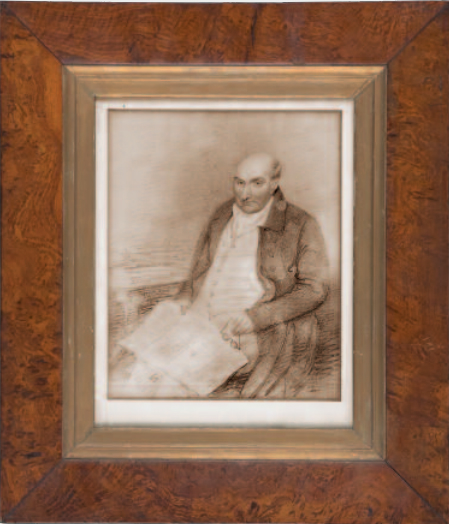
William Unthank Junior was an ‘Attorney’ in Foster and Unthank. Fosters Solicitors on Bank Plain is still one of the city’s major law firms.
William Unthank Fosters Solicitors1.jpg

William Unthank. Courtesy of Fosters Solicitors Norwich [1a]
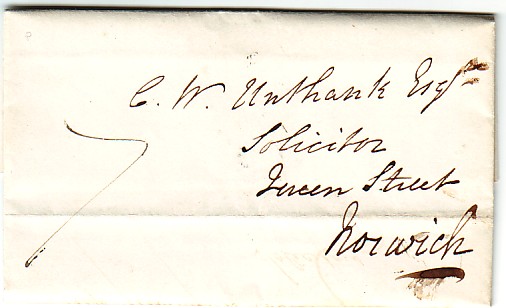
William Unthank’s son Clement William was also to become a partner in the firm.

unthank letter.jpg

Letter to CW Unthank, solicitor at Foster and Unthank’s offices, then at Queen St, Norwich 1835 [3]

William Jr accumulated 2416 acres of land, including the land between St Giles’ Gate (at the top of Upper St Giles Street) and Intwood/Cringleford on the city’s southern edges [4]. According to Reverend Nixseaman [4] Clement William – while courting the heiress of Intwood Hall – was able to ride across his father’s land along a back lane that became known as ‘Unthank’s Road’ [4]. Later, after he moved into his wife’s home, Intwood Hall, Clement William started to sell off blocks of land to create the Unthank estate of terraced housing [see previous post, 1].

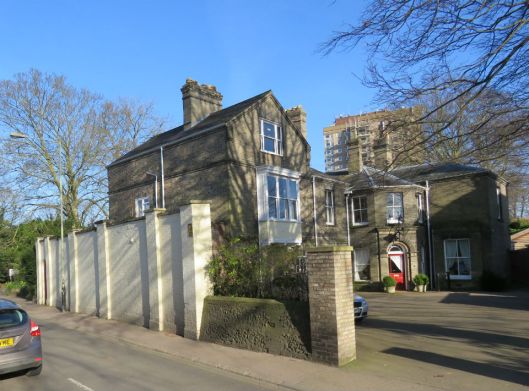
Reverend Alfred Jonathan Nixseaman, the vicar of Intwood [4], described in some detail where William Unthank Jr lived. He said it was within sight of St Giles’ Gate and where Norwich Gaol – now the site of St John’s Catholic Cathedral – was built against the entrance to Unthank’s own parkland. This clearly places Heigham House at the extreme city end of Unthank Road. Nixseaman seems to be the originator of the story that the stretch of high wall, on the opposite side of Unthank Road, formed part of the Unthank stables.
The Wall.JPG

The Wall, reputedly opposite Wm Unthank’s Heigham House

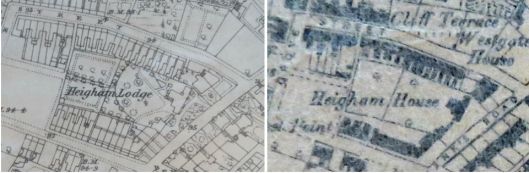
However, several of Nixseaman’s facts do not check out. He wrote that the Unthank family lived for over 100 years at Heigham House (approx 1790 to 1890) but another source says that CW, his wife and four children lived in Heigham from their marriage in 1835 until 1855 when they moved into Intwood Hall [5]. And, as we shall see, CW can be placed in a house further down Unthank Road at a time when Timothy Steward (of Norwich’s Steward and Patteson Brewery) was occupying Heigham Lodge as Heigham House was sometimes called (and as these maps show) [6].
HH Duo2.jpg

Heigham Lodge on the 1883 1:2500 OS map: Heigham House on 1887 OS 6″ map [7]. Courtesy of OrdnanceSurvey and Norwich Heritage Centre.

These maps were made about 50 years after William Unthank died (1837) but the Norfolk Record Office holds an early undated map of the house  and grounds (below) well before Edward Boardman surveyed the Heigham Lodge Estate (1887) and laid out Grosvenor, Clarendon, Bathhurst Roads and Neville Street [8].

Steward map+sig2.jpg

Stewards House on ‘Unthanks Road’. The junction at left is with extant Oxford Street. Note the estate doesn’t include land on the opposite side of the road where ‘the wall’ stands. Courtesy Norfolk Record Office

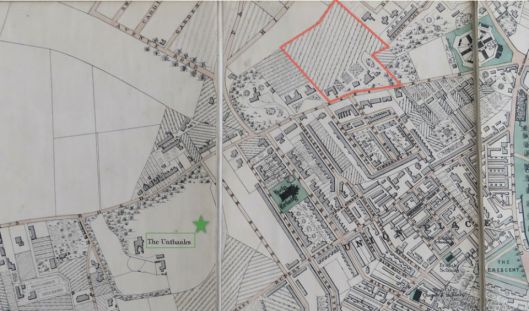
There is good evidence from poll and census records that William Unthank’s son Clement William lived several hundred yards down Unthank Road.
The Unthanks 7.jpg

Map by City Surveyor AW Morant 1873. The ‘Wm Unthank/T Steward ‘estate is outlined in red. The green star marks CW Unthank’s estate (The Unthanks) further south on ‘Unthanks Road’. Octagonal City Gaol top right. Courtesy Norfolk County Council.

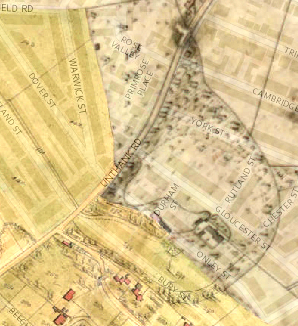
The 1842 tithe map of the parish of Heigham (Norfolk Record Office) records CW Unthank as the owner of ‘The Unthanks’, comprised of  house and gardens, lodge, lawn and a plantation. The 1851 census indicates he was living there with wife, two daughters, two sons and eight servants. Nixseaman makes no mention of this. By overlaying the circa 1840 tithe map onto a modern map, using Norfolk County Council’s invaluable Map Explorer [9], it can be seen that ‘The Unthanks’ stretched from Bury Street to the south to beyond Cambridge Street to the north. Clement William and his family moved to Intwood Hall in 1855 but as late as 1880-1884 the Ordnance Survey still records this as Unthanks House when the terraces had only encroached as far south as York Street.
MAPs overlay.jpg

© Norfolk County Council ©Crown copyright and database rights 2011 Ordnance Survey

Could one of three other large houses known as Heigham Hall/House/Lodge have been William Unthank’s House?

1. Heigham Hall was situated at the junction of Old Palace Road and Heigham Street.

Old Palace Road refers to the home of Bishop Holl who moved there after the Puritans had sacked the Cathedral and turned him out of the Bishop’s Palace. Heigham Street was once known as Hangman’s Lane. A letter refers to suicides being buried at the crossways at the bottom of the road where a stake was driven through the body [10].

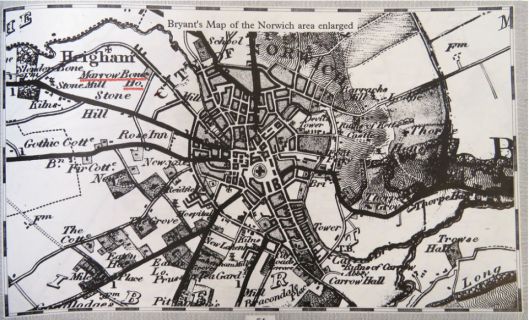
This medieval hall was partly rebuilt by a butcher, John Lowden, who had been a contractor in the Napoleonic Wars. On Bryant’s map of 1826 Heigham Hall first appears as Marrowbone House but was also known as Marrowbone Hall [11].
Marrowbone + line.jpg

Bryant’s map of Norwich 1826.  Marrowbone House/Hall underlined in red. Courtesy Norfolk County Council

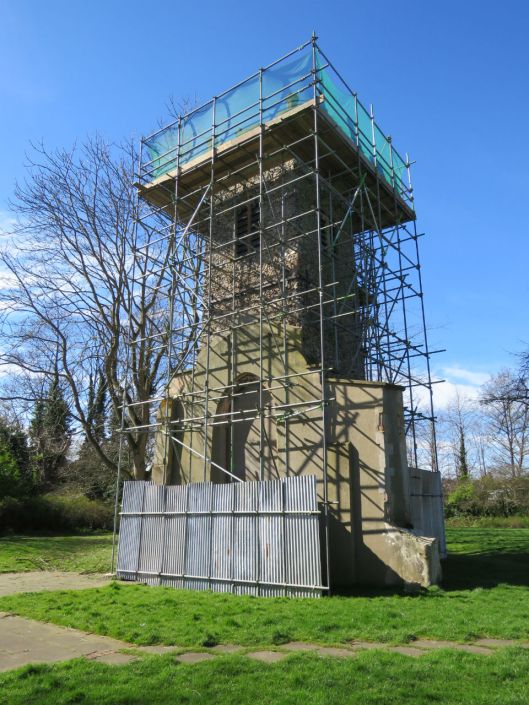
This Heigham Hall has the virtue of being very close to St Bartholomew’s church where William Unthank worshipped. In the early C19 it was the parish church of rural Heigham before the boom in terraced house building – triggered by the sale of Unthank land –necessitated the construction of other churches (e.g., Holy Trinity in Trinity Street). St Bartholomews was bombed in the war; the Saxon tower survived but the parish records didn’t nor, presumably, the family vault in which William Unthank was interred[4].
St Bartholomews.JPG

St Bartholomew Heigham, Norwich. Destroyed by enemy bombs 1942.

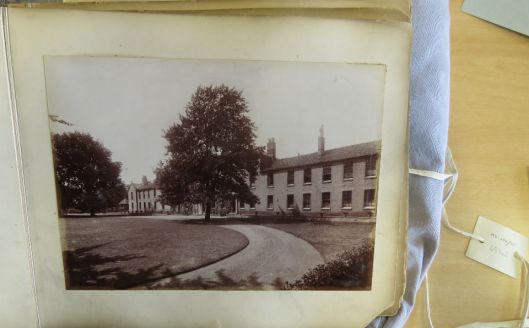
There is no evidence that William Unthank lived in this particular Heigham Hall but it provides a fascinating diversion. In 1836, Drs WP Nichols and JW Watson bought Heigham Hall and opened it as a ‘Private Lunatic Asylum’. (A letter from Dr Nichols’ granddaughter indicates Heigham Hall was first referred to as Heigham House [12]).
Heigham Hall.JPG

From, ‘Photographic Views of Heigham Hall’, Courtesy Norfolk Record Office. MC279/15

Screen Shot 2017-03-28 at 13.16.43.png

©jnnp.bmj.com

In 1852, Heigham Hall was involved in a notorious scandal. To avoid being charged with the attempted rape of a minor a magistrate declared Reverend Edmund Holmes insane. Holmes was admitted to asylum but promptly regained his sanity and remained as the hospital’s chaplain. Local outrage led to a change in the law but the incident speaks of a time when being of ‘a good county family’ was sufficient qualification for the avoidance of justice [15].

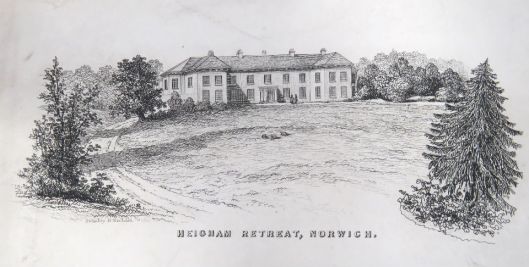
2. Heigham Retreat – another private mental hospital just off present-day Avenue Road – was in competition with Heigham Hall [13, 14] . The Retreat, as ‘private madhouses’ were often called, was opened in 1829 by a Mr Jollye of Loddon who sold it to three doctors.
The Retreat.jpg

Etching of Heigham Retreat by Henry Ninham ©Norfolk Record Office MC279/6

In 1859 The Retreat was bought out by Heigham Hall who closed it down. Heigham Hall itself was demolished to make way for the corporations social housing estate, Dolphin Grove, in the early 1960s.

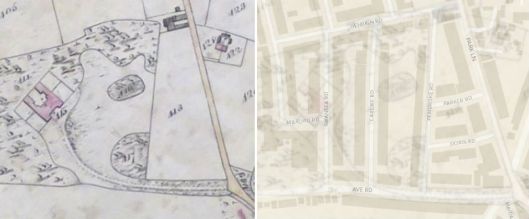
The outline of the Heigham Retreat estate is commemorated in the layout of the Victorian terraces that followed [16]. Part of the tree-lined avenue to The Retreat survives as Avenue Road as it branches off Park Lane (once known as Asylum Lane). Two of the boundaries align with Pembroke and Denbigh Roads while Cardiff, Swansea and (the top of) Caernarvon Roads run vertically down the map.
Two maps final.jpg

Left, map of the parish of Heigham 1842 © Norfolk County Council. Right, overlaid with 2011 Ordnance Survey map using Norfolk Map Explorer [9] © Crown copyright and database rights Ordnance Survey 

3. Heigham House existed on a plot of just over an acre at the junction between Heigham Road and West Pottergate Street [17]. It was adjacent to St Philip’s Church, demolished in 1977. There is, however, nothing to connect the Unthanks to this house.

Until two weeks before I made this post the most economical explanation seemed to be that William Unthank lived in the Heigham House/Lodge at the city end of Unthank Road while his son Clement William lived in Unthanks House/The Unthanks near Onley Street. William Unthank’s death certificate stated that he died (1837), not at home, but at his son-in-law’s house in Eaton, Norwich after “severe suffering for several years, in patient resignation to his affliction” [18]. Timothy Steward, recorded as living at Heigham Lodge in 1836 [6], could therefore have been merely renting the sick man’s house.

Then I came across two C20th letters promising authoritative recollections from the Unthank family. The first, dated 1983, is from Margaret Unthank, William Unthank’s great-great granddaughter, who refers to a newspaper article about ‘the wall’.

‘The wall on the left of your picture is, I am told, all that remains of the stables of Heigham House, which was demolished in 1891. I enclose for your information a photograph of a picture I have of the house and park.” M. Unthank, Intwood Hall [19].

This favours the ‘city end’ location of the wall but the second letter, dated 1934, from William Unthank’s grandson (Clement William Joseph, 1847 – 1936) contradicts that.

“My grandfather bought Heigham House and 70 acres of land between what is now Trinity Street and Mount Pleasant about 1793 … Heigham House was pulled down about forty years ago …” CWJ Unthank, Intwood Hall [20].

Clement William Joseph was about eight when his family moved out to Intwood Hall in 1855 and was surely old enough to have remembered the name and location of his first home, which he recalls as Heigham House near modern day Onley Street. Margaret Unthank, however, was writing 128 years after the move out of Heigham, qualifying her history with a hesitant, “I am told“. The photograph of the wall to which she referred is actually a series of low front-garden walls; one of them appears to belong to a house I once lived in. Miss Unthank was the owner of Intwood Hall when the Reverend Nixseaman was vicar of Intwood Church. The picture she gave to the newspaper of ‘Heigham House’ is the same that Nixseaman used as the frontispiece to his book and one wonders if it is his uncertain understanding of the location of the Unthank’s house that is being relayed here. Rather tellingly there is nothing in his book to say that the Unthanks spent any time at all in the ‘Onley Street house’ yet Clement William is placed there with some certainty by a tithe roll and two censuses. Also consistent with the ‘Onley Street’ option is an undated sale map of ‘garden ground’ – where the parade of shops on Unthank Road currently stands – stating that William Unthank owned the estate opposite, marked on other maps as ‘The Unthanks’ or ‘Unthank’s House’.
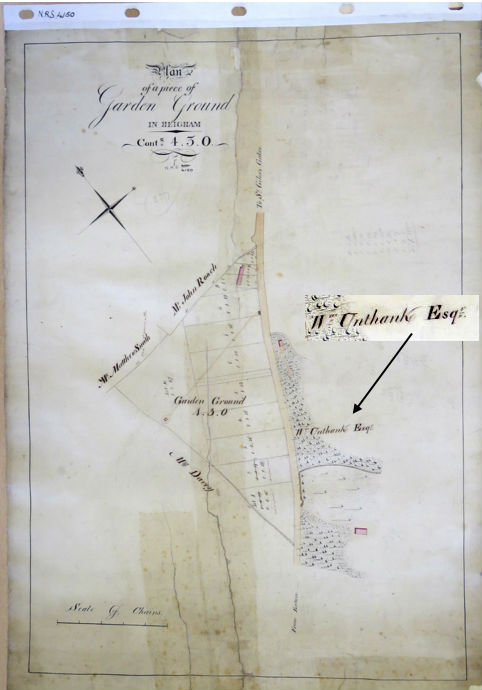
Unthank plus sig.jpg

The triangular plot on the west side of Unthank Road ends just below the junction with Park Lane. Wm Unthank owns the land opposite. Norfolk Record Office NRS4150

We still don’t have smoking-gun evidence that William Unthank lived on the estate near present day Onley Street but it is the explanation I currently favour, even if it does orphan the wall at the other end of the road. But read the next post in this Unthank series ‘The End of the Unthank Mystery’.

Postscript added 14th August 2019: I have just come across Joseph Manning’s Plan of Norwich; it clearly shows that William Unthank owned the ‘Onley Street site’ (as it became) in 1834. Below, the name ‘Wm Unthank Esqr’ is underlined in red, Timothy Steward’s house is starred and ‘the wall’ opposite is lined in pale blue.

Plan of the City and County of Norwich 1834 by Joseph Manning. Courtesy of Norfolk County Council, Heritage Centre, Norwich Millennium Library

©ReggieUnthank 2017. This work is licensed under a Creative Commons Attribution-NonCommercial-NoDerivatives 4.0 International License   Creative Commons License

Thanks: We are fortunate in Norfolk to have the Norfolk Record Office and The Heritage Centre in Norwich Millennium Library – tremendous resources for historical research. The staff are unfailingly helpful and I couldn’t have written this article without them. I thank Eunice and Ron Shanahan for access to the CW Unthank letter and Fosters Solicitors for the portrait of William Unthank. I am indebted to Pamela Summers – a great great great great granddaughter of William Unthank – for alerting me to Manning’s 1834 map.

The Norwich Society helps people enjoy and appreciate the history and character of Norwich.   Visit: www.thenorwichsociety.org.uk

NorwichSocLogo.jpg

Sources

  1. See my previous post on the Unthanks: http://wp.me/p71GjT-zh Ref 1a: http://www.fosters-solicitors.co.uk/downloads/fosters-history.pdf
  2. Portrait of William Wiggett, Mayor of Norwich 1742, by John Theodore Heins Snr (1697-1756). Norwich Civic Portrait Collection  https://artuk.org/discover/artworks/search/collection:norwich-civic-portrait-collection-931/page/4
  3. http://www.earsathome.com/letters/Previctorian/unthank.html
  4. Nixseaman, A.J. (1972) The Intwood Story. Pub: R Robertson, Norwich.
  5. A History of Intwood and Keswick by the Cringleford Historical Society (1998).
  6. The 1832 Norfolk Poll Book (The Heritage Centre, Norwich Library) lists William Unthank of Unthank’s Road as a Freeman while Timothy Steward is an ‘Occupier’ on Unthank’s Road. White’s Gazetteer (1836) page 172, places the brewer Timothy Steward in Heigham Lodge.
  7. Ordnance Survey maps Sheet LXIII and LXIII.15.1 in The Heritage Centre, Norwich Millennium Library .
  8. https://www.norwich.gov.uk/downloads/file/3010/heigham_grove_conservation_area_appraisal
  9. Using Norfolk County Council’s excellent interactive map explorer:  http://www.historic-maps.norfolk.gov.uk/mapexplorer/
  10. Letter by CC Lanchester to the Eastern Daily Press 20.9.1960.
  11. Walter Rye’s History of the Parish of Heigham in the City of Norwich (1917).  http://welbank.net/norwich/hist.html#hhall
  12. Norfolk Record Office MC 279/6. Letter by Miss M. Nichols of Dawlish.
  13. http://www.heritagecity.org/research-centre/social-innovation/heigham-hall.htm
  14. Mackie, Charles (1901). Norfolk Annals vol 1, 1801-1850. [Feb 14 1829, the opening of Mr Jollye’s Heigham House, aka Retreat].
  15. https://www.psychologytoday.com/blog/lunacy-and-mad-doctors/201505/did-the-victorian-asylum-allow-the-rich-evade-justice. The Heigham Hall referred to here is actually Heigham Retreat.
  16. http://www.heritagecity.org/research-centre/social-innovation/heigham-retreat.htm
  17. Sale catalogue of Heigham House 1934. NRO BR241/4/1067.
  18. Death notice in Bell’s Weekly Messenger Sunday 19 Nov 1837.
  19. Letter in the Norfolk Advertiser 30th June 1983
  20. Letter in the Eastern Daily Press 25th May 1934
Share this:

  • Click to share on Facebook (Opens in new window) Facebook
  • Click to share on X (Opens in new window) X
  • Click to share on Pinterest (Opens in new window) Pinterest
  • Click to email a link to a friend (Opens in new window) Email
  • Click to print (Opens in new window) Print
Like Loading...

The flamboyant Mr Skipper

15 Wednesday Feb 2017

Posted by reggie unthank in Art Nouveau, Norwich buildings, Norwich history

≈ 27 Comments

Tags

Cosseyware, George Skipper, Hotel de Paris Cromer, James Minns, Jarrolds Norwich, Poppyland

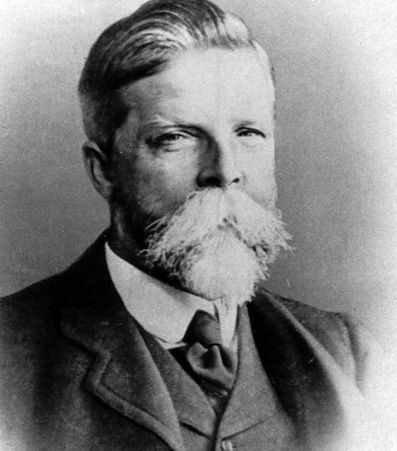
Two architects changed the face of Victorian Norwich: Edward Boardman and George Skipper. Boardman sketched out the quiet fabric of a post-medieval city but it was Skipper who provided the firecrackers.skipper3.jpg

The son of a Dereham builder, Skipper (1856-1948), spent a year at Norwich School of Art studying art and – probably at his father’s insistence – architecture [1]. He did, of course, follow the architectural path but – as the Norwich Mercury wrote in 1906 – he was known for his ‘artistic temperament’ and he expressed this side of his personality in the exuberance of his buildings. He is reputed to have said, you “need an artist for a first rate building” [1a]. However, one of his early buildings (1890), for which he and his brother Frederick won the commission, was the “modestly ‘Queen Anne’ town hall” of Cromer [2] that gave little idea of the fireworks to come.

CromerTown Hall.JPG This project is important, though, for introducing the association between Skipper and the ‘carver’ James Minns, who was responsible for the decorative brickwork from Gunton Bros’ Brickyard at Costessey [3].
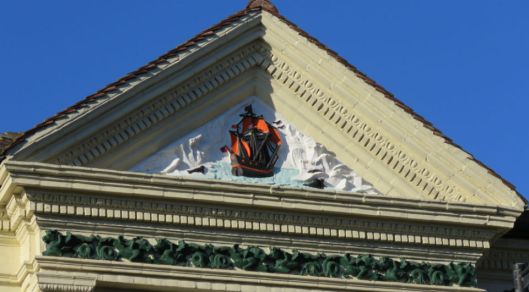
CromerPediment.JPG

In addition to the decorative shields, James Minns sculpted the tableau in the pediment depicting the discovery of Iceland by local sailor Robert Bacon [4]

In the late 1880s Clement Scott’s column ‘Poppyland‘ in the Daily Telegraph extolled the virtues of the North Norfolk coast, particularly around Overstrand [5,6]. The book based on these articles, The Poppyland Papers, proved very popular and this, combined with the arrival of the Great Eastern Railway in 1887, transformed nearby Cromer from a quiet fishing village to a fashionable watering place for the wealthy.

Not everyone succumbed to the bracing pleasures of Cromer, including the young and homesick Winston Churchill who wrote to his mother: “I am not enjoying myself very much”.

The comfortable middle and upper middle classes came to see the coastal attractions and they needed suitable accommodation [5].  This triggered a wave of hotel building and Skipper was engaged by a consortium of Norwich businessmen to design several of them [6]. After The Grand Hotel he built The Metropole, which is said to have shown signs of Skipper’s flair and exuberance [1] but both hotels were demolished.

HotelMetropole.JPG

The last vestige of the Hotel Metropole

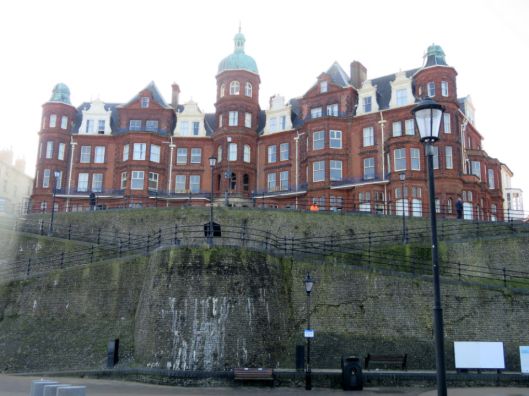
A survivor was Skipper’s best known project, the Hotel de Paris (1896). Its frontage, which borrows features from the late medieval palace at Chambord, disguised the previous Regency buildings. Marc Girouard thought the result was cruder but jollier than Skipper’s other hotels [2].

HoteldeParis.JPG

The hotel demonstrates one of Skipper’s  favourite tropes of using turrets and cupolas to provide interest at the skyline [6]. He used the same device to disguise an ugly lift heading at Sandringham [7].

SandringhamHouseT.jpg

Sandringham House. Skipper’s is the taller of the two cupolas. http://www.tournorfolk.co.uk/sandringham

Further along the clifftop at Cromer is another of Skipper’s hotels – The Cliftonville – with decorative ‘Cosseyware’ (fancy brickware) by Guntons of Costessey near Norwich [8].  Skipper was responsible for modifying the hotel originally designed by another Norwich architect, AF Scott [6]. The Cliftonville was transformed into an example of the Arts and Crafts style showing the influence of the French Renaissance as well as the C19th Queen Anne Revival.

Trevor Page & Co of Norwich provided the soft furnishings [6]. The company was a partnership between Henry Trevor (who made great use of Cosseyware seconds in creating the Plantation Garden in Norwich) and his stepson John Page. Much of the ‘hard’ interior decoration survives.

cliftonville montage1.jpg

Clockwise from top left: Turret with octagonal cupola; stained glass peacock panel; Guntons terracotta panel; dining room doors referencing ‘Poppyland’; fireplace in the dining room.

Skipper designed several private houses in Cromer. St Bennet’s at 37 Vicarage Road, built in 1893, is one of the most impressive. Freely decorated in red brick panels it is said to have been carved by James Minns [6].

Montage2.jpg

St Bennets, Cromer, designed by Skipper 1893; brick carving attributed to Minns

Skipper’s first offices (1880) in Norwich were in Opie Street but by 1891 he was employing about 50 people and in 1896 he moved to 7 London Street. At that time, architects were not allowed to advertise their services but, flying close to the regulatory wind, he commissioned Guntons to sculpt terracotta plaques depicting Skipper, on site, examining the work of sculptors and as the architect discussing plans with a client.

skipper pair2.jpg

Carved brick tableaux at No 7 London Street. Upper centre: Skipper, with family to the left, inspecting sculpted work. Lower centre: Skipper showing work to clients.

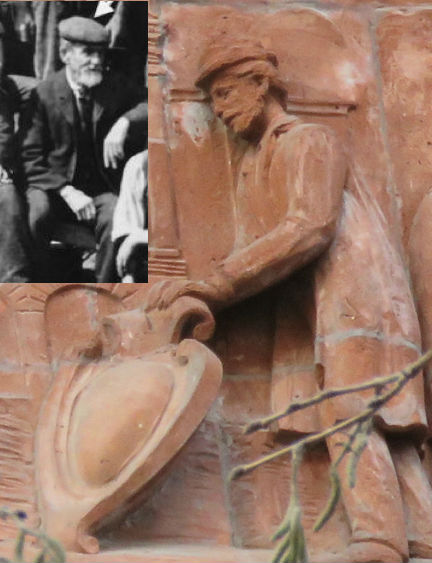
I suspect the figure presenting Skipper the plaque in the upper panel could be James Minns himself – the ‘carver’ for Guntons. Although about 68 at the time Minns was still sculpting to a high standard for one year later he successfully submitted a carved wooden panel to the Summer Exhibition of the Royal Academy [9].

Minns Duo.jpg

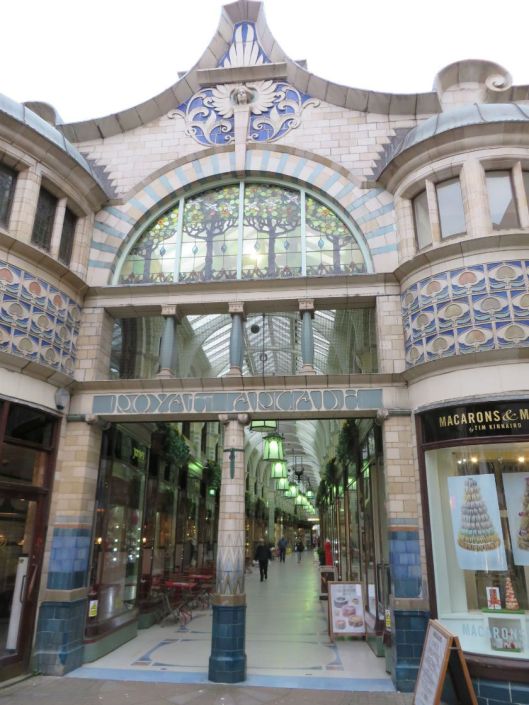
Skipper’s designs draw on a variety of sources. The French Renaissance style of his early years (enriched by Flemish influences from his visit to Belgium as a student) were to give way to the more weighty Neo-Classical Palladian buildings – buildings such as the Norfolk and Norwich Savings Bank (now Barclays Bank) in Red Lion St, the Norwich and London Accident Assurance Association (now the St Giles House Hotel in St Giles’ St) and his most expensive and sumptuous project, Surrey House for Norwich Union Life Insurance Society. But around the turn of the century he still found time for more playful ventures, embarking on ‘the mildest flirtation with British Art Nouveau'[7]. The Royal Arcade – covered in a previous blog [10] – is one such ‘transitional adventure’ although the credit for this Art Nouveau gem must surely go to the head of Doulton Pottery’s Architectural Department,WJ Neatby, who designed the jewel-like surfaces.

neatbynorwicharcade_1.jpg

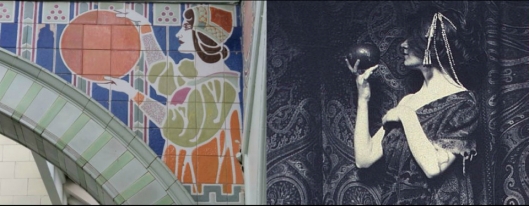
In a post on decorative tiles [11], I noted the close similarity between Neatby’s design for the young woman holding a disc in the spandrels of the arcade’s central crossing and a self-portrait by the Brooklyn photographer Zaida Ben-Yusuf. But, drawing various threads together, it seems likely that both artists were borrowing from the work of Alphonse Mucha  whose well-known posters illustrate young women holding very similar poses [see 10 for a fuller discussion].

zodiac_pair960pxl.jpg

Left: Zodiac figure by WJ Neatby (1899); right ‘The Odor of Pomegranates’ (ca 1899) by Zaida Ben-Yusuf

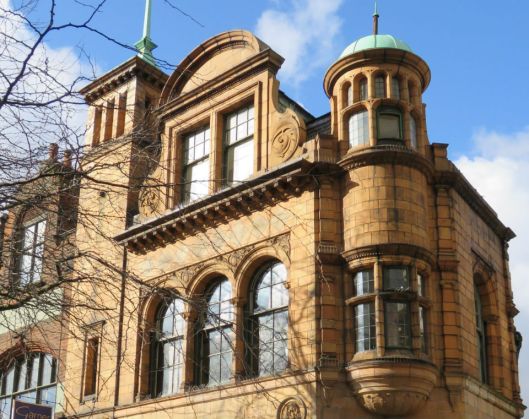
Hints of Art Nouveau were also to be seen in the turrets and domes of the Norfolk Daily Standard offices (1899-1900) on St Giles Street. This riotously decorated building survived the bombing of the adjacent building in the Blitz (1942) but later lost some of its features during a conversion to a Wimpy Bar.

Daily Standard1.jpg

Art nouveau touches can be seen on the spandrels above the first floor windows and on the Dutch/Flemish gables. The copper-domed turret is a familiar Skipper motif.

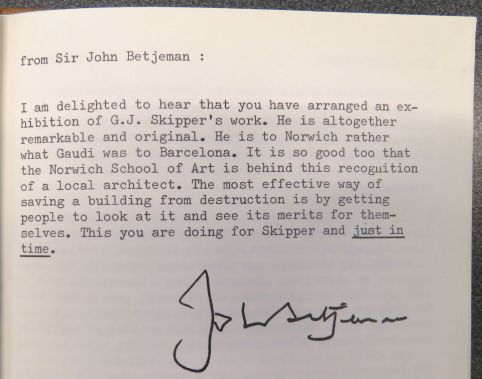
It was to ‘exuberant’ buildings such as these that Poet Laureate John Betjeman was referring when he made his well-known quotation comparing Skipper to Antonio Gaudi of Barcelona [7, 12].

IMG_4001.JPG

Frontispiece to the catalogue of the Norwich School of Art’s exhibition on Skipper, 1975  [12]

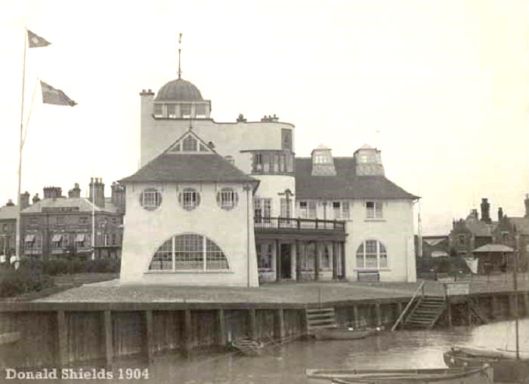
A more convincing Art Nouveau building is the Royal Norfolk and Suffolk Yacht Club at Lowestoft. Skipper’s competition-winning design from 1902 is stripped of the decoration and frenetic eclecticism of his other projects to produce a building using “the vocabulary of British Art Nouveau … with more than a sidelong look at CFA Voysey” [7]. The plain stucco walls – one of Voysey’s signatures – and sloped buttresses are relieved by circular and semi-circular windows and topped by a copper dome. This puritanical excursion was a one-off for Skipper.

shieldsd04_lowest05 Yacht Club.jpg

broadlandmemories.co.uk

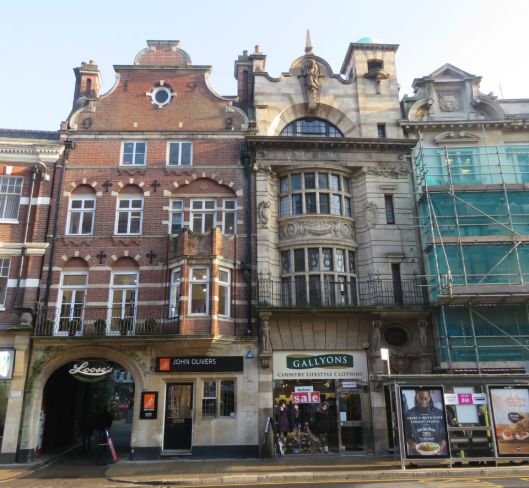
Back in Norwich Skipper designed Commercial Chambers in Red Lion Street (1901-3), wedged into a narrow site between another of his projects (the Norfolk and Norwich Savings Bank 1900-3) and John Pollock’s veterinary premises designed by his great competitor, Edward Boardman (1901-2). Even on a such a narrow building Skipper manages to create interest at the skyline by using moulded cornice, statuary, a finial and a campanile that just sneaks above Boardman’s adjacent Dutch gable by the height of its copper dome.

Commrcl chambrs.JPG

Left, Boardman’s building for Pollock; centre, Skipper’s Commercial Chambers; right, Skipper’s Norfolk and Norwich Savings Bank.

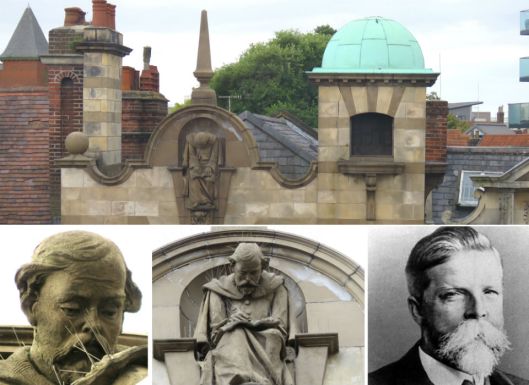
Because Commercial Chambers was built for the accountant Charles Larking [7] you would be forgiven for thinking that the robed figure at the top of the building, making entries into a ledger, was Larking himself but it is clearly the self-publicist Skipper.

skipper montage.jpg

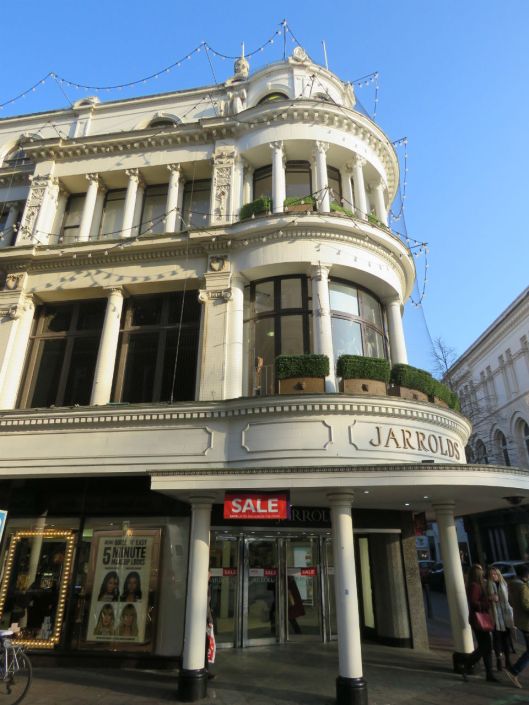
Between 1896 and 1925 [6] Skipper remodelled, in stages, the frontage of his neighbour’s department store on London and Exchange Streets. Original plans show that Skipper had also planned a dome to surmount the semi-circular bay – “rather like a tiered wedding cake” [1] – at the corner of Jarrolds department store.  But at the end of this long project no copper-clad dome materialised [1].

jarrolds.JPG

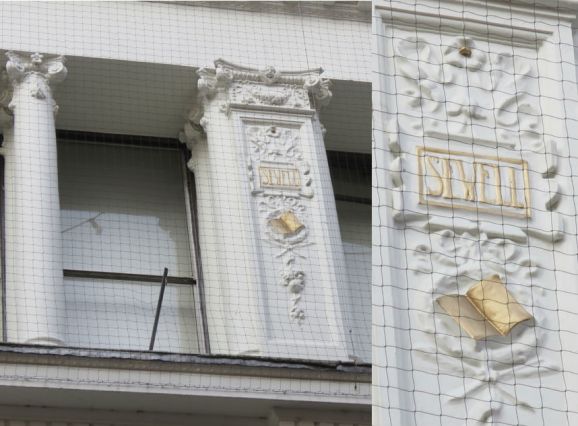
Work began first on the London Street side whose second floor facade is punctuated by a series of Royal Doulton plaques bearing the names of authors first published by Jarrold Printing [7]. The one shown below commemorates Anna Sewell who wrote Black Beauty while she lived in Old Catton just outside Norwich.

sewell.jpg

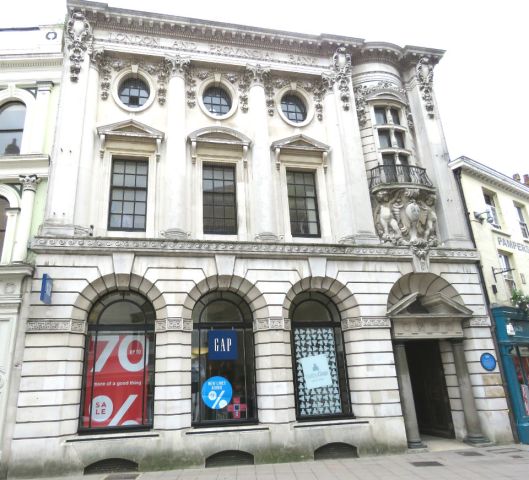
On another project, Skipper’s plans for a dome were again frustrated. In 1907 Skipper completed the London and Provincial Bank (now GAP {and now The Ivy brasserie, 2018}) a little further along London Street. Architectural interest was created by breaking the flat symmetry of the classical facade with a fourth bay containing a curved two-storey bay window [7]: the deeply recessed cylinder even broaches the massive cornice that caps the building. This is explained by the fact that Skipper originally planned to top the fourth bay with a trademark cupola whose circular section would have echoed the curved segment of the cornice. In the event, the cupola was abandoned because it would have infringed a neighbouring property’s ‘right of light’ [7].

GAP.jpg

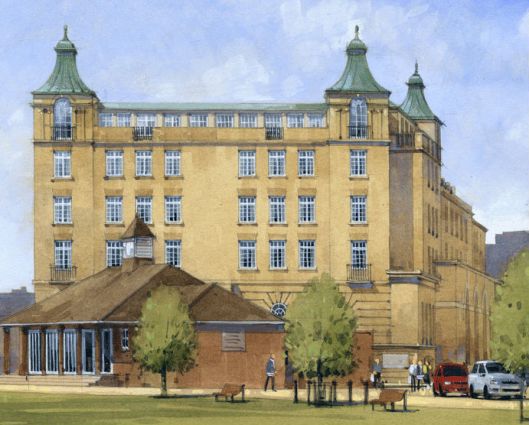
Just before the First World War, Skipper had planned to retire but the loss of his savings in the East Kent Coal Board meant he had to keep working. After the war his work in Norwich seems largely confined to humble plans for roads and sewerage required to open up that part of the Golden Triangle around Heigham Park and College Road (he also designed neo-Georgian buildings in that road) [13]. Further afield, he designed various buildings in Norfolk, Kent and London and in 1926 built a second extension to the University Arms Hotel in Cambridge. Here – perhaps harking back to his heyday – he did successfully add two cupolas: it was, “an unmistakable Skipper gesture, but in this case somewhat incongruous” [7].

University-Arms-Hotel.jpg

University Arms Hotel as proposed after the fire in 2013. Painting by Chris Draper. johnsimpsonarchitects.com

During the Second World War Skipper had kept his London Street offices open while his son Edward, a fellow architect, was on active service [7]. Edward could not, however, afford to keep the offices open and in 1946 sold the building to Jarrolds.  Skipper died in 1948 when he was nearly 92.

skipper cupolas2.jpg

Sources

  1. Summers, David  (2009). George Skipper: Norfolk Architect. In, Powerhouses of provincial  architecture 1837-1914 (Ed, Kathryn Ferry). Chapter 6 pp 75-83. Pub: The Victorian Society.   Ref1a  http://www.heritagecity.org/research-centre/whos-who/george-skipper.htm
  2. Girouard, Marc (1977). Sweetness and Light: The Queen Anne Movement 1860-1900. Pub: Yale University Press.
  3. James Minns, Carver of Norwich. http://www.thenorwichsociety.org.uk/copy-of-norwich-history. Mentioned also in previous blog [9]:
  4. http://racns.co.uk/sculptures.asp?action=getsurvey&id=1132
  5. http://jermy.org/poppy02.html
  6. Hitchings, Glenys and Branford, Christopher (2015). ‘George John Skipper, The Man Who Created Cromer’s Skyline’. Pub: Iceni Print and Products. Available from Jarrolds and from City Bookshop, Norwich.
  7. Jolly, David and Skipper, Edward (1980). Celebrating Skipper 100: 1880-1980. Booklet produced by Edward Skipper and Associates; foreword by Edward Skipper with posthumous contribution from David Jolly [see 11]. Available at Norwich Library Heritage Centre, Cat No. C720.9 [OS].
  8. https://colonelunthanksnorwich.com/2016/05/05/fancy-bricks/
  9. https://colonelunthanksnorwich.com/2016/08/18/angels-in-tights/
  10. http://wp.me/p71GjT-1C1
  11. Jolly, David (1975). Architect Exuberant: George Skipper 1856-1948. Catalogue of an Exhibition Held at The Norwich School of Art, Norwich, 24th Nov.-13th Dec., 1975
  12. https://colonelunthanksnorwich.com/2016/09/29/decorative-tiles/
  13. Clive Lloyd (2017). Colonel Unthank and the Golden Triangle. Pub: Clive Lloyd. ISBN 978-1-5272-1576-4 (Available from Jarrolds, Norwich and City Bookshop, Norwich).

Share this:

  • Click to share on Facebook (Opens in new window) Facebook
  • Click to share on X (Opens in new window) X
  • Click to share on Pinterest (Opens in new window) Pinterest
  • Click to email a link to a friend (Opens in new window) Email
  • Click to print (Opens in new window) Print
Like Loading...

Arts & Crafts pubs in the C20th

22 Thursday Dec 2016

Posted by reggie unthank in Norwich buildings, Norwich history

≈ 15 Comments

In an earlier post I mentioned two turreted pubs that reminded me of the ‘medieval’ towers by Victorian architects like the Williams, Morris and Burges – Gothic Revivalists who peddled nostalgia for a pre-industrial past. Why did these and other pubs continue to refer to the Middle Ages half a century or so after the height of Victorian medievalism?

magdalen-rd-artichoke-ph1932plunkettpixlr1.jpg

The Artichoke PH in 1932 (c) georgeplunkett.co.uk

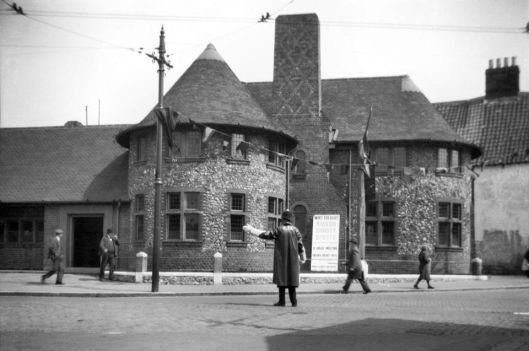
The first pub, at the end of Magdalen Street, was The Artichoke with its conical roofs so reminiscent of chateaux of the French Middle Ages. Built in 1934, The Gatehouse on Dereham Road shares a clear resemblance. Neither pub would have been out of place in 1860. William Morris’s version of the Gothic Revival in the mid C19th can be seen as a reaction to industrialisation – a symbolic retreat to sunnier times when honest craft was appreciated. However, the medieval-style pubs of the 1930s looked back at Merrie England from a different viewpoint: the intervening First World War provided a new and powerful reason for reacting against mechanisation and for settling on a style that so strongly rejected C20th Modernism.

The Gatehouse is clearly built in the revived medieval style. One of its intriguing stylistic details is the chequering produced by alternating panels of ubiquitous Norfolk flint with pressed concrete blocks substituting for the stone that is so scarce in Norfolk[1].

The Gatehouse.jpg

The Gatehouse 1939. (c) georgeplunkett.co.uk

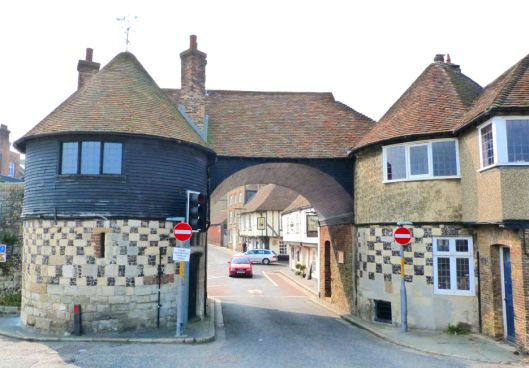
A likely model for The Gatehouse was the Barbican gatehouse (1539) to the toll bridge in Sandwich, Kent [2]. The two-storeyed bays are very similar and the names are near-enough synonymous.

sandwich-the-barbican1.jpg

The Barbican, Sandwich, Kent (c) rollingharbourlife.wordpress.com

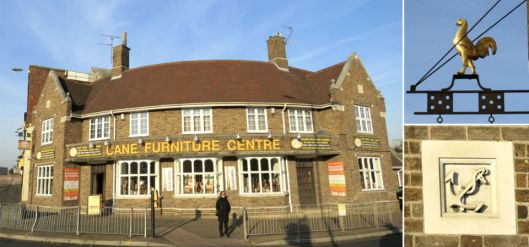
A third pub, The Barn, at the bottom of Grapes Hill shares a family resemblance to The Artichoke and The Gatehouse, perhaps not surprisingly since  all three were designed by Norwich architects Buckingham and Berry whose offices were in Prince of Wales Road. The original pub was destroyed during the bombing raids of 1942.

The Barn Trio1.jpg

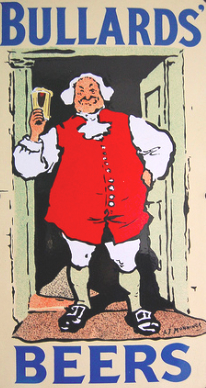
The cockerel sign on The Barn marks a takeover by Courage but the lazy anchor in the gables shows that the pub was originally built for Norwich brewers, Bullards. Their sign of the jolly landlord was designed in 1909 by one-time student of Norwich School of Art, A. J.(later Sir Alfred) Munnings.

Bullards sign.jpg

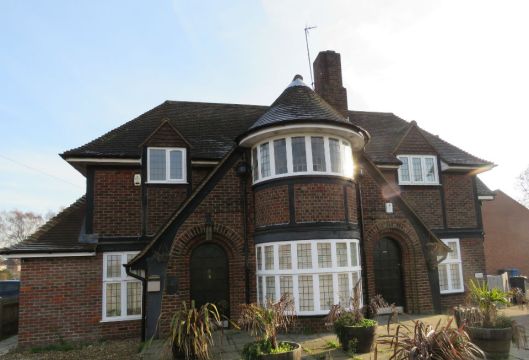
A fourth family member is the Constitution Tavern on Constitution Hill, also designed in the early 1930s by Buckingham and Berry. With its projecting double-height semi-circular bay, capped with a conical roof, The Constitution Tavern taps into the medieval style while the catslide roof over the twin doors references the Arts and Crafts houses of Charles Voysey from the beginning of the C20th.

Consti1.jpg

The former Constitution Tavern, now a private house

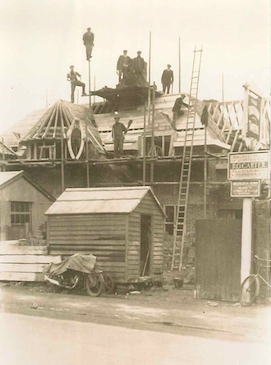
Not only were these four buildings designed by the same architects but they were all built by the same Norwich building firm of RG Carter.

image001.png

Consti2.jpg

RG Carter’s workers building The Constitution Tavern in 1933. (c) rgcarter-construction.co.uk

The Artichoke and The Barn stand just outside the city walls, at the Magdalen and St Benedict’s Gates, respectively. The Gatehouse and The Constitution Tavern are situated further out from the city: the latter on Constitution Hill on what was the old North Walsham Turnpike; the former on Dereham Road, near another circle of hell – the outer ring road.

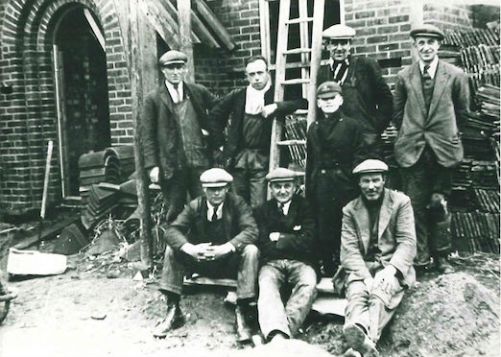
RG Carter workers.jpg

RG Carter’s son Bob (in school cap) with workmen outside The Constitution Tavern (c)rgcarter-construction.co.uk

The construction of the outer ring road in the 1930s helped relieve unemployment and established an outer boundary to the expanding city. Up until the First World War most citizens lived within the walled city, a very large number of them in the Norwich Yards – dwellings made in the gardens and courtyards of grander houses abandoned by the wealthy. As Frances and Michael Holmes have graphically shown, by the 1930s these ramshackle houses were poorly ventilated, ill-lit and very unsanitary [3].

The conditions of life in this yard must be hard indeed. An open channel runs in front of the houses containing sewage, slops and rainwater. The smell was neither imaginable nor describable. One battered pump made in 1808 supplies water to…three yards. [Norwich Mercury, see 3]. 

King St Murrell's Yard [1265] 1936-08-13_s.jpg

Murrell’s Yard, King Street, Norwich 1936 (c) georgeplunkett.co.uk

To make ‘homes fit for heroes’ the 1919 Housing and Town Planning Act required local authorities to provide houses for families. The City Council responded by starting to build the large estates that now more-or-less encircle the medieval city. The council also received government funding to build five parks (Wensum, Eaton, Heigham, Waterloo and Mile Cross Gardens) that gave pleasure to the rising population as well as providing unemployment relief  [4]. In the 1920s and 30s Captain A Sandys-Winsch supervised the laying out of these parks and planted the characteristic avenues of trees that still soften the roads beyond the old city walls.

Pr-_of_Wales_arriving_1928_350.jpg

In lock-step The Prince of Wales (centre), with Sandys-Winsch (on his right), opening Eaton Park in 1928. Courtesy  of [5]

It was against this background of civic improvement that the new public houses were designed. Morgan’s Brewery, for example, took advantage of the new estates and the increased traffic on the ring road to build The Gatehouse on the site of a former pub. The wave of pub building was not confined to Norwich for about 1000 new pubs were built countrywide in the 1920s, and 2000 in the period 1935-1939.  Most of these were part of the Improved Pub Movement that hoped to change the perception of public houses as places of drunkenness to a more respectable one with separate saloon bars, dining rooms, games rooms and gardens that would encourage women.

ct31319.jpg

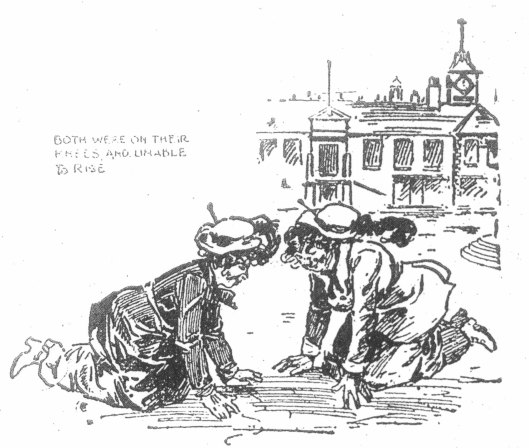
‘Both were on their knees and unable to rise’. Carlisle 1917. Courtesy www.cumbriaimagebank.org.uk

During the First World War the government became concerned by the absenteeism and poor productivity in munitions factories caused by drunkenness. In what became known as ‘The Carlisle Experiment’ the government nationalised breweries and pubs around Carlisle and parts of the Scottish Borders; they also redesigned pubs and food-providing taverns to try to control the excesses of munitions workers [6]. This experiment in public house reform had national impact and provided a model for the new public houses of the 1920s and 30s.

In 2015, Historic England awarded The Gatehouse and 20 other national pubs Grade II listing in recognition of their place in the historic Improved Pub Movement [7,8]. Virtually all are built in a backward looking Arts and Crafts style.

the-gatehouse-norwich.jpeg

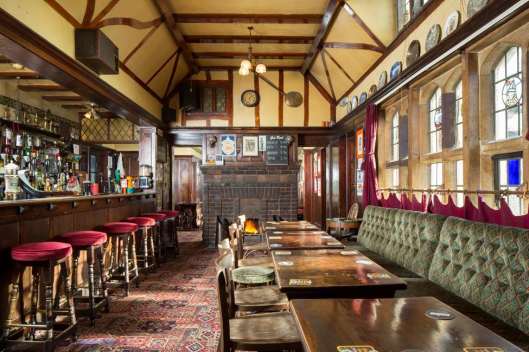
The rather baronial bar of The Gatehouse (c) Historic England/Pat Payne Ref: DP172339

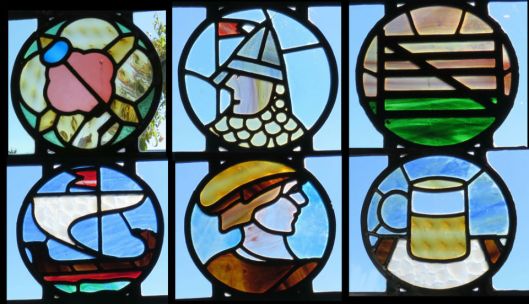
The stained glass panels, just visible in the photo above, are thought to reference the Bayeux Tapestry, underlining the diversity of sources that the Improved Pub Movement used to evoke the faux medieval style.

gatehousesix.jpg

Montage of stained glass panels in The Gatehouse

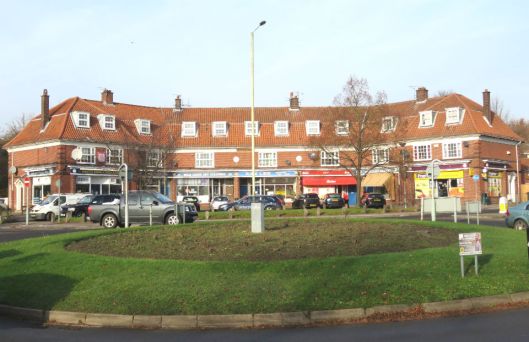
The building of roads, estates and pubs therefore took place as a more or less coherent campaign under the general banner of ‘improvement’. RG Carter’s building firm played a major part in shaping the outer city. Where the A1024 crosses the Drayton Road they built the Mile Cross Estate of 92 houses (1925) together with the shopping centre (and a similar one on the opposite side of the city where The Avenues crosses the ringroad).

IMG_3798.JPG

Carters built a mirror image to this curved shopping centre, out of shot to the right

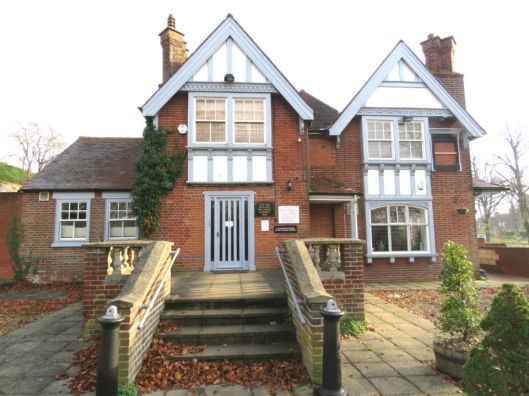
In 1929 Carter’s also built the nearby pub, The Galley Hill, in a simple Tudor Revival style. The S&P carved into the half-timbered gable end shows it was built for the Norwich brewery of Steward and Patteson.The MItre 2.jpg

Carters also built The Mitre in Earlham Road for Bullards – a solid Tudor Revival building with jettied central bay and timbered side bays infilled with herringbone brick. The local newspaper said it was a vast improvement on its Victorian predecessor and that the quality of its ‘half-timber work is not of the kind associated with speculative work and liable to be blown off by the wind.’ That is, the woodwork appeared to be a more integral part of the structure than the superficially applied beams on speculative pubs built in ‘Brewer’s Tudor’ [9]. It was presumably the cheapened form that John Betjeman referred to as ‘various bogus-Tudor bars‘ in his poem, Slough.

Earlham Rd 131 Mitre PH [B510] 1933-03-28.jpg

The Mitre 1933,  Earlham Road, now a community space for St Thomas’ church, at left  ©georgeplunkett.co.uk

It is not clear who built The Boundary Inn at the intersection of the ring road and the A140 where a Mile Cross boundary marker used to stand. However, this pub does have the usual stylistic tics of the Tudor Revival style, with its high-pitched roof, prominent chimney, a hint of half-timbering and Tudor-arched doors. It was built in 1928 for Young, Crawshay and Youngs.

boundary1.jpg

The Boundary PH, Aylsham Road, Norwich

Carters constructed the Bull Inn at Hellesdon [1935] although its historical credentials are Tudor-lite compared to The Mitre.

The Bull Inn 1.jpg

But after World War II the moment had passed, the Gothic and Tudorbethan revivals had lost their fascination and a new austerity had arrived, as can be seen from The Dial on Dereham Road, built for Bullards  by RG Carter in 1950.

THE DIAL.jpg

The Dial PH. Courtesy rgcarter-holdings.co.uk

Sources

  1. http://www.rgcarter-construction.co.uk/about/
  2. https://historicengland.org.uk/services-skills/education/educational-images/barbican-high-street-sandwich-cc56-00758
  3. Holmes, Frances and Holmes, Michael (2015). The Old Courts and Yards of Norwich: A Story of People, Poverty and Pride.  Pub: Norwich Heritage Projects.
  4. https://historicengland.org.uk/listing/the-list/list-entry/1001348
  5. http://friendsofeatonpark.co.uk/history/
  6. https://historicengland.org.uk/whats-new/first-world-war-home-front/what-we-already-know/land/state-control-of-pubs/
  7. https://historicengland.org.uk/whats-new/news/twenty-one-best-inter-war-pubs-listed.
  8. http://www.edp24.co.uk/news/find_out_why_heritage_chiefs_decided_to_protect_a_norwich_pub_1_4213510
  9. https://en.wikipedia.org/wiki/Tudor_Revival_architecture

I am indebted to the RG Carter Archive, Drayton, Norwich for supplying photos and information. I am also grateful to: Gareth Hughes for making the connection between The Gatehouse and Barbican Gate, Sandwich; Stephen White of Carlisle Library, Frances Holmes, and the invaluable Plunkett archive (www.georgeplunkett.co.uk).

The Norwich Society helps people enjoy and appreciate the history and character of Norwich.   Visit: www.thenorwichsociety.org.uk

NorwichSocLogo.jpg

Share this:

  • Click to share on Facebook (Opens in new window) Facebook
  • Click to share on X (Opens in new window) X
  • Click to share on Pinterest (Opens in new window) Pinterest
  • Click to email a link to a friend (Opens in new window) Email
  • Click to print (Opens in new window) Print
Like Loading...

Dragons

20 Thursday Oct 2016

Posted by reggie unthank in Norwich buildings, Norwich history

≈ 20 Comments

Tags

dragons, norwich cathedral, snap the dragon, St George and the dragon, Stained Glass, The Tudors

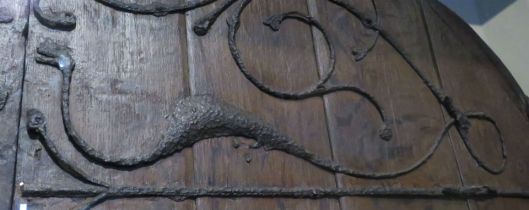
To the medieval mind dragons stood as a metaphor for the devil and all his works, the origin of pestilence and plague. The concept of a dragon could have evolved from travellers’ tales about fabulous beasts or even fossils. In one incarnation, dragons were represented as giant worms – indeed, the Old English for dragon is wyrm (or Old High German, wurm). A beautiful manifestation of the worm-like dragon is to be seen on the C13th infirmary doors from Norwich Cathedral, now in Norwich Castle.

Norwich Infirmary Doors.jpg

Norwich Castle Museum and Art Gallery

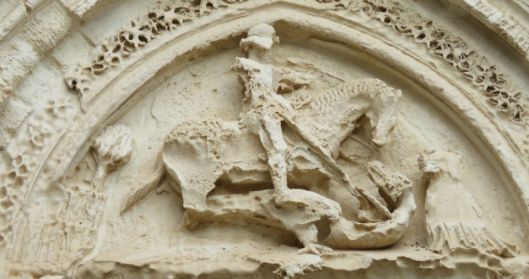
The more familiar version is of a four-legged, bat-winged creature usually seen writhing at the end of St George’s lance or St Michael’s sword. The fable of St George and the Dragon is thought to have originated in the east and brought back to this country following the crusades. St George is usually represented as a knight on horseback as can still (just about) be seen in this C14th carving from Ragusa, Sicily.

St George Ragusa.jpg

Dragons feature strongly in Norwich’s history. St George is the city’s patron and the Guild of St George, founded in 1385 [1], became a prominent social institution, celebrating the saint’s feast day and performing acts of charity for its members and the needy. In 1417 the power of the guild was greatly enhanced when it was granted a Royal Charter by Henry V, perhaps in recognition of its members who fought alongside him at Agincourt. In 1548 the guild lost its religious basis, transforming itself into the secular Company of St George that celebrated the arrival of the new mayor. However, the dragon still took part in non-religious processions; it was first mentioned as taking part in 1408, it survived Puritanism then became a civic player, performing in annual guild days when the mayor was inaugurated.

Norwich dragon.jpg

Snap the Dragon at Norwich Castle Museum and Art Gallery

Taunted by the chanting crowd the dragon would grab caps in its jaws, ransoming the headwear for a penny.

“Snap, Snap, steal a boy’s cap, give him a penny and he’ll give it back”

This C19th engraving gives a sense of the raucous nature of the guild day.

snap.jpg

In the marketplace,  outside the extant Sir Garnet (Wolseley )pub. (c) Picture Norfolk at Norfolk County Council

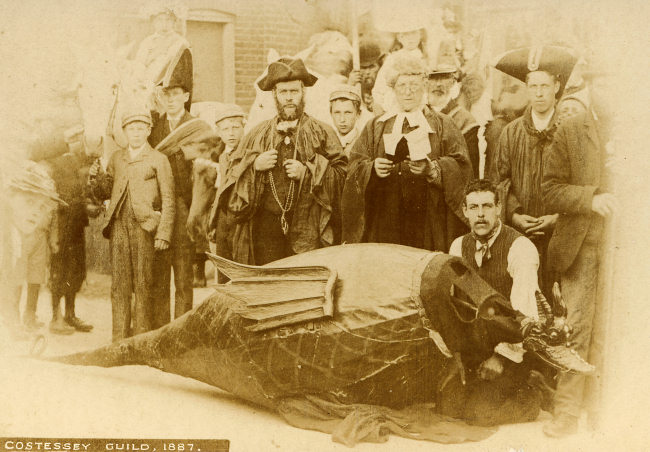
Although much of the pageantry disappeared after the passing of the Municipal Corporation Reform Act of 1835 it survived in mock pageants held in the district of Pockthorpe and in the nearby village of Costessey [1]. This 1887 photograph of the Costessey guild day nicely captures the flummery that accompanied the election of the ‘mayor’.

CostesseyGuildSnap.jpg

(c) Picture Norfolk at Norwich County Council

In 1951, Snap the Dragon was still being used in civic parades and is seen here accompanied by two whifflers (from Old English wifel for battle-axe) who, historically, carried weapons to clear the way through the crowd. The photograph is believed to be of the Pockthorpe Dragon, now stored by Norfolk Museums Service [2]

Festival procession snapdragon and whiffler [4008] 1951-06-24.jpg

(c) georgeplunkett.co.uk

Until the mid C20th another version of Snap was displayed in Back’s wine merchants in Haymarket, once known as the medieval Curat’s House [3], now landlocked behind a modern frontage (currently Fatface). During renovations the owner of a nearby shop discovered paperwork showing that Back’s used ‘Old Snap’ in their advertising.

Backs snapdragon.jpg

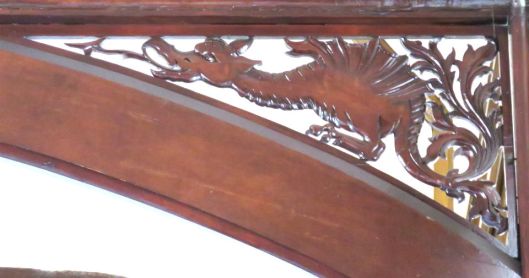
Probably the most famous Norwich dragon is to be found in Dragon Hall. In ca 1427, on the site of a previous building, wealthy textile merchant Robert Toppes [4] constructed a trading hall then known by the wonderful name, Splytts. Three-times mayor Toppes was member of the St George’s Guild, a fact celebrated in the beautifully-carved winged dragon in a roof spandrel.

dragon hall norwich3.jpg

Three pairs of dragons are to be found in the refectory roof of the Great Hospital, near the cathedral. The hospital has continuously provided for the needy since 1249, when it was built by Bishop Walter de Suffield to care for poor clergy, and is now a residential care home.

GtHospitalNorwich.jpg

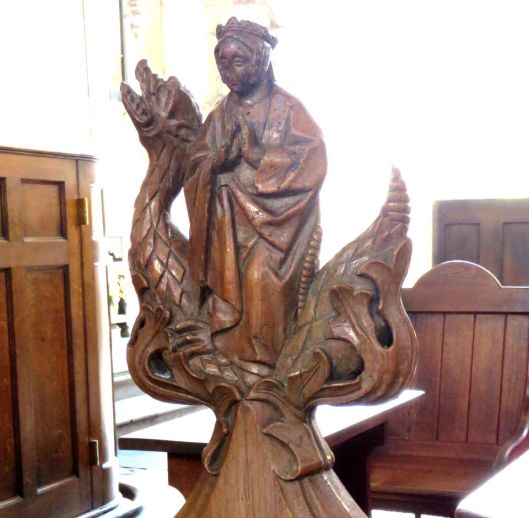
Also in the Great Hospital, in St Helen’s Church, is a fine example of the devil as the dragon. The dragon is said to have swallowed St Margaret of Antioch but her cross irritated the dragon, allowing her to break free. Here she is shown on a medieval pew end emerging from the dragon’s belly, illustrating her role as the patron saint of pregnancy and childbirth.

St Margaret.jpg

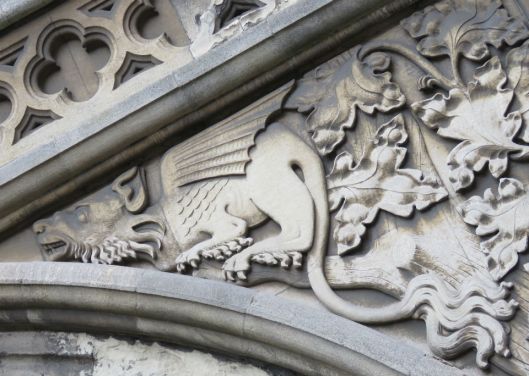
On St Ethelbert’s Gate of the nearby cathedral is another spandrel dragon, restored in the C19th. The dragon, facing an armed man/saint on the opposite side of the arch, may allude to a bloody C13th conflict between clergy and citizens for which 30 rioters were hanged [5]

spandrel St Ethelbert.jpg

Norwich Cathedral contains over 1100 roof bosses carved in stone: this boss is from the cloisters [6]. The swordsman’s nonchalant gaze could almost come from a piece-to-camera on how to kill a dragon.

norwich cathedral boss.jpg

C14th, Cloisters, Norwich Cathedral

Only yards away a rampant dragon appears amongst a series of coats of arms painted in the arches of the cloisters (restored in the 1930s). These represent the worthies who entertained Queen Elizabeth I during her progress to Norwich in 1578. The arms below belong to the queen herself and incorporate the lion of England and the dragon of Wales derived from her grandfather Henry Tudor.

Elizabeth 1 coat of arms.jpg

The city’s allegiance to the Tudors is also expressed in the first two of these exuberantly-carved bench ends in the Mayor’s Court of the Guildhall. The greyhound (lower left), with jewelled collar around its neck, represents the Beaufort line of Henry VII’s mother Margaret while the Welsh dragon (centre) refers to Henry Tudor’s Celtic father. And because of its imagination and skill  I couldn’t resist adding (right) the greedy dragon from St Agnes Cawston (although the beast would be more frightening if its head were less like a labrador’s).

2dragons1gryhnd222.jpg

Visitors to King’s College Chapel Cambridge will be familiar with the dragon and greyhound from the numerous Royal Coat of Arms that Henry Tudor displayed to impress his entitlement to the throne.

Tudor arms.jpg

St George Tombland contains more dragons than any other Norwich church with the beast rendered in  cast bronze, a C16th Germanic relief plaque, a  weather vane as a font cover, and even some Snap-the-Dragons. The stained glass window of St George and the Dragon is by CC Powell 1907.

SGeorgeTombland.jpg

Here is one of Norfolk’s treasures, St George wielding a sword to vanquish the dragon; from the rood screen at St Helen Ranworth (late C15th).

St GeorgeRanworth2.jpg

… and demonstrating that dragons are still alive in the city of dragons.

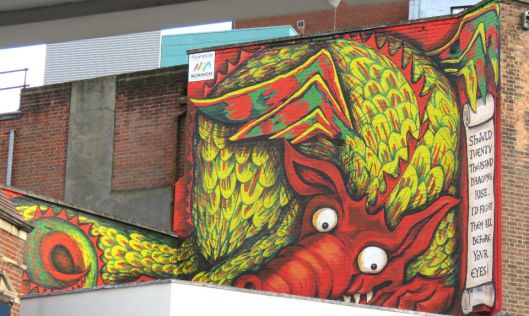
Should twenty thousand dragons rise, I’d fight them all before your eyes!

StreetDragon16.jpg

By Malca Schotten, 2016. Based on Snap, part of Norwich BID’s mural programme. Red Lion Street

Thanks to David Kingsley for the Back’s ‘Snap’ advertisement, to Clare Everitt of Picture Norfolk at Norfolk County Council for permission to use images, the staff of Norwich Castle Museum and Art Gallery for showing me their dragons, and Jumara Mulcahy of Norwich BID.

The Norwich Society helps people enjoy and appreciate the history and character of Norwich.   Visit: www.thenorwichsociety.org.uk

NorwichSocLogo.jpg

Sources

  1. http://www.dragonglow.co.uk/snap.htm
  2. http://www.nor-folk.co.uk/Norwich%20Dragon/aliens.html
  3. http://wp.me/p71GjT-3Zt
  4. http://wp.me/p71GjT-t
  5. http://wp.me/p71GjT-32e
  6. Rose, Martial and Hedgecoe, Julia (1997). Stories in Stone: The medieval roof carvings of Norwich Cathedral.  Herbert Press.

Read about Norwich’s dragons in http://www.heritagecity.org/events-festivals/norwich-dragon-festival/norwichs-dragons.htm

Share this:

  • Click to share on Facebook (Opens in new window) Facebook
  • Click to share on X (Opens in new window) X
  • Click to share on Pinterest (Opens in new window) Pinterest
  • Click to email a link to a friend (Opens in new window) Email
  • Click to print (Opens in new window) Print
Like Loading...

Norwich’s pre-loved buildings

28 Thursday Jul 2016

Posted by reggie unthank in Decorative Arts, Norwich buildings

≈ 19 Comments

Tags

Edward Boardman, George Skipper, Norwich architecture, Norwich shoe industry, Norwich textile industry, Norwich University of the Arts, Norwich weaving

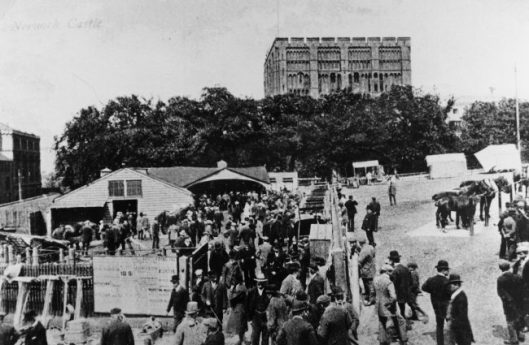
Who, at this Victorian horse market outside Norwich Castle, would have predicted that motor vehicles would displace horses from the city’s streets or that a shopping mall with space for over 1000 cars would be excavated where they once stood? This post is about once-vibrant buildings, such as stables, corn halls, weaving  sheds and leather boot and shoe manufactories, that outlived their original purpose and had to be reinvented in order to survive.

Norwich horse market (C) NCC.jpg

Norwich horse market on site of former cattle market ca 1900. (c) Norfolk County Council

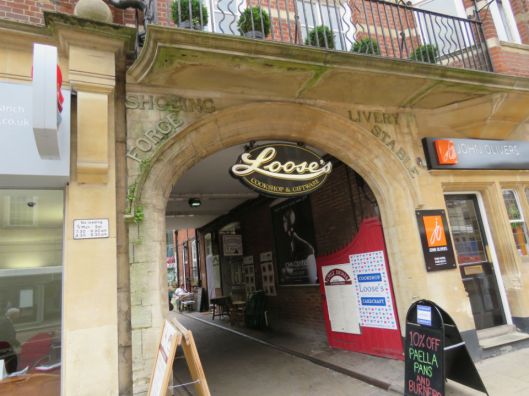
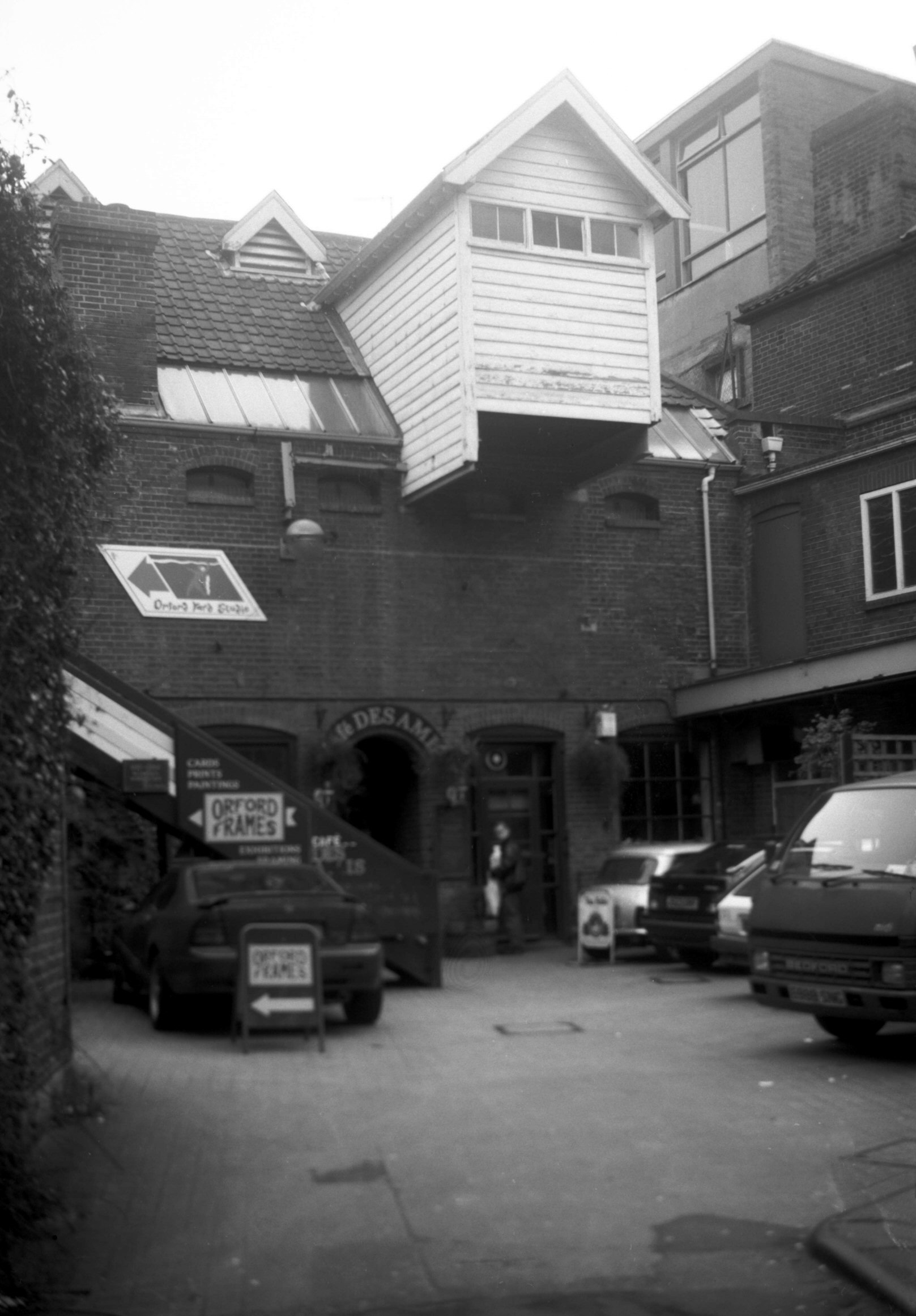
It is still possible to catch glimpses of life in the horse-drawn era.The words above this arch (shoeing, forge, livery, stable) in Orford Yard off Red Lion Street are a reminder of John Pollock’s veterinary surgery and livery stables. The date on the building’s Dutch gable gives the date of this Edward Boardman building as 1902. Boardman turns out to be a major figure in this post.Looses Norwich.jpg The yard now accommodates Loose’s Cookshop and Chez Denis cafe and brasserie. Until 1998 the owner of Chez Denis had a previous business here, Cafe des Amis, the name of which can just be made out above the central arch in the photograph below.

Red Lion St Orford Yard former stables [7536] 1998-03-10.jpg

Former stables 1998, Orford Yard (c) georgeplunkett.co.uk

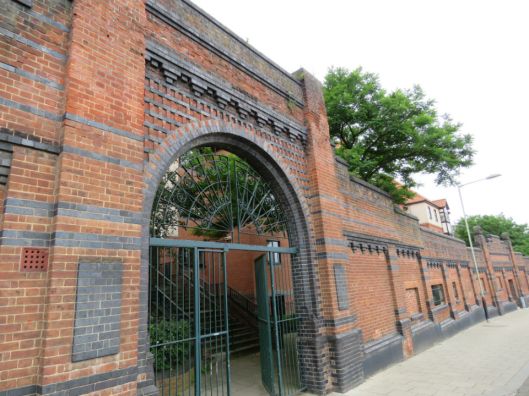
By 1840 Norwich’s weaving industry had been in decline for some years. Its hand-loom weavers were unable to compete with the steam-powered mills of the north whose better transport and production of popular cotton goods affected the sale of Norfolk’s more traditional worsteds [1]. As a consequence the shoe industry, which had been active for centuries, assumed a more dominant role. In the middle of the C20th there were about thirty boot and shoe manufacturers in Norwich that, together with allied trades, employed over 10,000 people. Now there is only one major shoe-maker, Van-Dal. This wall is all that remains of the Co-op Shoe Factory in Mountergate, and was only allowed to remain “as a baffle against traffic noise for Parmentergate Court” [2]. Coop factory.jpg

Limited.jpg

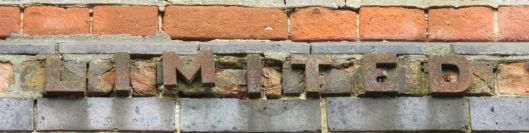
Above the gate,  the last vestige of ‘Norwich Cooperative Industrial Society Limited’?

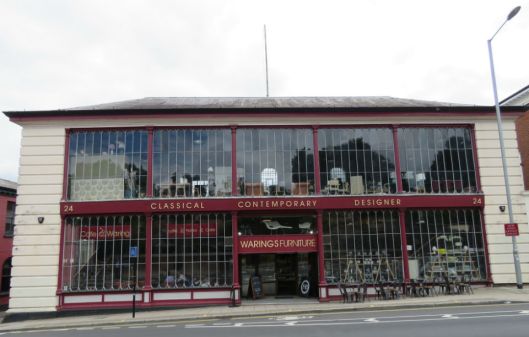
While the grander C19th public buildings tended to adhere to the binary choice between  Classical or (particularly in the north of England) Gothic styles, the popularity of Joseph Paxton’s Crystal Palace of the 1851 Great Exhibition introduced a further option. Cast-iron was cheap and strong and, being able to support large expanses of glass on thin glazing bars, opened up new possibilities in which brick and stone were no longer the major players. In 1863, Holmes and Sons – who manufactured and sold agricultural machinery – built this showroom on Rose Lane. Now it is known as Crystal House and home to Warings furniture store.

warings.jpg

The elegant facade of Crystal House (1863) – a great favourite of mine. 

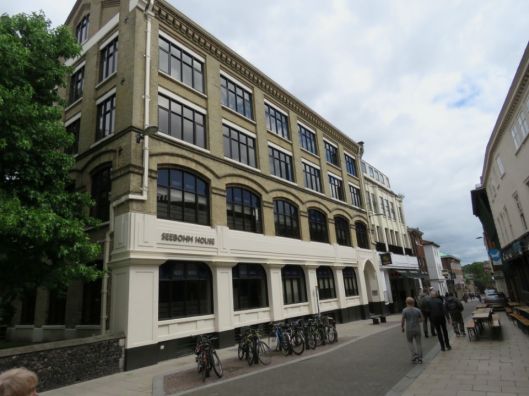
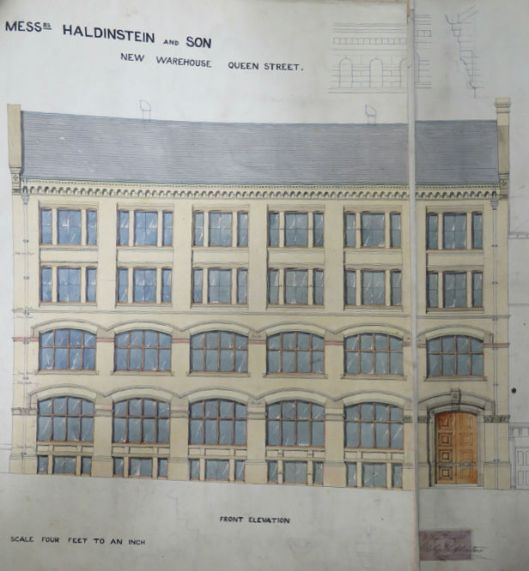
Haldinstein’s began making shoes in the early C19th and up until the early 1960s their Boot and Shoe Manufactory occupied seven blocks of buildings between Queen Street and Princes Street [1, 1a]. In the 1930s the firm went into partnership with the Swiss shoe company Bally but by the time shoe production stopped in 1999 only Bally remained [1]. The building at 2-4 Queen Street was renamed Seebohm House and now contains several businesses. The factory is dated ‘1872’ on the rain heads and, like Edward Boardman’s Colegate shoe factory of the same period (1876, see further below), is distinctly ‘modern’ and quite unlike Gothic Revival buildings of that period. However, the building does not appear to have been listed as one of Boardman’s despite his offices being only a few yards further down Queen Street in Old Bank of England Court.

Bally.jpg

The last remnant of the Haldinstein and Bally factory at 2-4 Queen Street 

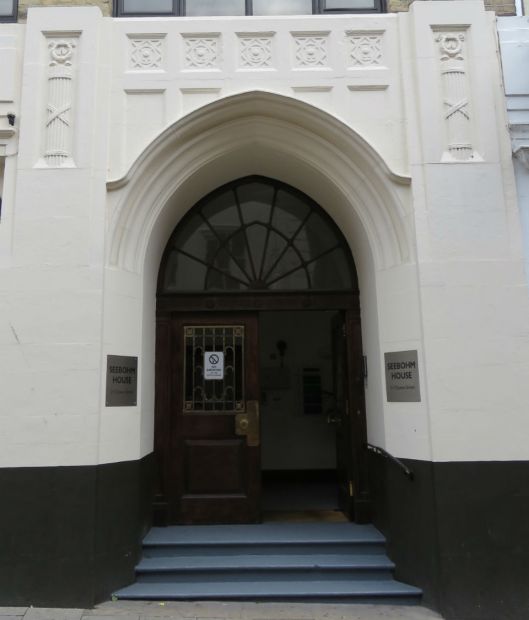
While the upper floors appear to look forward to C20th modernism – rejecting Neo-Gothic and Classical motifs – the appearance of the Gothic arch at the entrance is confusing and backward looking. The door grille, on the other hand, appears to anticipate the  Art Deco period.  Seebohm House2.jpg

Clarification lies in the Norfolk Record Office whose files reveal that Boardman did design the Haldinstein building. His original plan shows that the doorway shared the same  shallow (and decidedly non-Gothic) arch as the ground and first floor windows. The files also contain other plans by the Boardman practice, dated June 18th 1946, for “Proposed Alteration to Ground Floor”. These relate to a reorganisation of rooms but since this was the year that  George Haldinstein sold his 51% share to Bally [1] it strongly suggests that the Gothic entrance was a post-war addition as was the ground floor’s patterned stucco .

Haldinstein_Bldg3.jpg

Boardman’s plan for Haldinstein’s Queen Street factory, with Philip Haldinstein’s signature over the sixpenny stamp. Note the original door and its surround. (c) Norfolk Record Office BR35/2/23/10/1-43

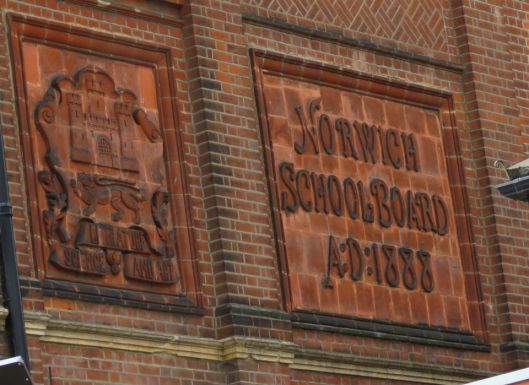
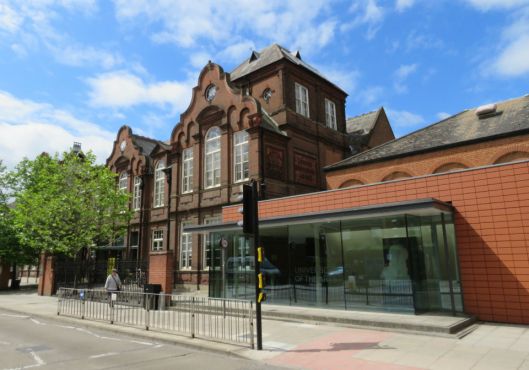
In 1870, Foster’s Elementary Education Act decreed that towns would build Board Schools in which the teaching of religion was to be strictly regulated [3]. Funded by the local rates these were amongst the first public institutions to be open to both sexes. Thousands of such schools were built throughout the country. For Norwich’s own Board School in Duke Street,  JH Brown designed a Higher Grade School that was opened in 1888. It was built by J Youngs and Sons (now a part of the RG Carter Group).

Duke St School plaque_1.jpg

The Norwich Board School in Duke Street with the city’s coat of arms to the left, surmounting “Literature, Science and Art”.

Probably following London’s influential board schools the Duke Street school was built in the contemporary and  progressive Queen Anne Revival style (see previous post). The school therefore has the Flemish, high-gabled silhouette with small-paned upper lights and tall casement windows typical of many of this country’s schools [3]. Recently, the building was extensively refurbished by the Norwich University of the Arts – not a major leap from its original purpose but a reflection of current trends in higher education.Duke St School.jpg

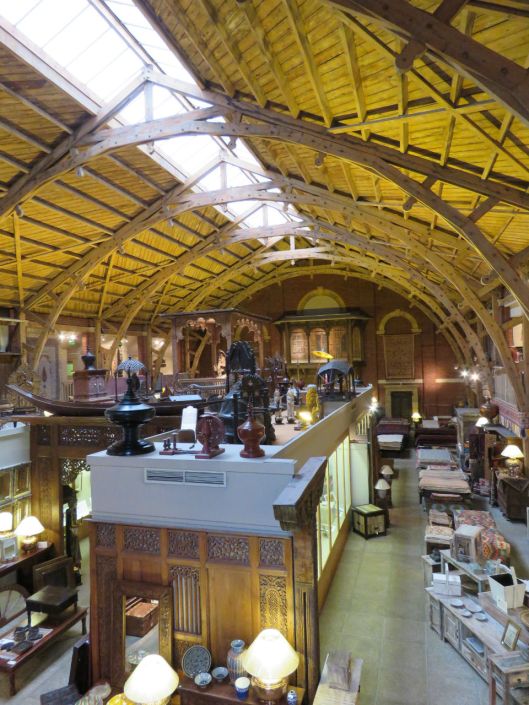
Counterbalancing the image of the Victorians’ high moral purpose is the former skating rink in Bethel Street, where fun could be had by gaslight. Built as a roller-skating rink in 1876 it was then used for ten years (1882-1892) by the Salvation Army as their Citadel (see previous blog). The Citadel was entered from St Giles Street via the iron gates adjacent to the Army’s present building that was once Mortimer’s Hotel. I remember the skating rink towards the end of its 100 year occupancy by Lacey and Lincoln, builders’ merchants, before it was refurbished by the present owners in the 1980s. Now, Country and Eastern  (below) is a spectacular eastern bazaar that – reflecting the owners’ interest in oriental culture – also contains a small museum of South Asian arts and crafts.

country and eastern.jpg

This factory-like building in St George’s Street was constructed in 1914 as premises for Guntons builders’ and plumbers’ merchants. At one time it was owned by Gunton and Havers – the latter being a relative of the actor Nigel Havers. Now the Gunton Building is another addition to the Norwich’s expanding University of the Arts.Guntons Building.jpg

c13129 nch gunton havers 1967.jpg

The Gunton & Havers building in St Georges Street, Norwich 25th March 1967 (c) Archant/EDP Library

St Giles House (41-45 St Giles Street) – one of George Skipper’s big, Baroque and slightly overblown buildings – should dominate the street but it is set parallel to the road and difficult for the passerby to see face-on. It was built in 1904-6 for the Norwich and London Accident Insurance Association just after the opening of another of Skipper’s projects, Surrey House, for rivals Norwich Union: in fact, it has been described as “the Norwich Union in miniature” [4]. Its first rebirth was as a telephone exchange and is sometimes referred to as Telephone House. George Plunkett described it as “Municipal offices until 1938. Education and Treasurer’s departments.” Now it is a luxury hotel, St Giles House.St Giles Hotel.jpg

In 1770-5, the Norfolk and Norwich Hospital was built just outside St Stephen’s Gate by the architect William Ivory. However, the facade of the old hospital that we see today was the result of Edward Boardman’s makeover a century later. His pedimented Dutch gables and rather municipal clock tower do make it look like a town hall [4]. In 2001 a new hospital was built in the suburb of Colney and the old hospital was converted to apartments.NN hospital.jpg

Another building designed by Boardman architects (father EB and son ETB) was for the Norwich Electric Light Company. In 1892 they converted the old Duke’s Palace Ironworks to a site where coal-fired boilers generated electricity that, by 1913, lit over 1750 street lamps around the city. Only 13 years later, superseded by the power station at Thorpe, the over-worked Duke Street site was converted to offices [5]. Now the offices are used by car-sharing company Liftshare.Duke St electric offices2.jpg

The offices of the electricity works are dated 1913. Norwich City’s coat of arms is above the door.

Duke St 4 Electricity works floodlit [1633] 1937-05-13.jpg

Decorations on the floodlit electricity works celebrating the coronation of George VI (1937) (c) George Plunkett

Prolific Boardman had more effect on the appearance of Norwich than perhaps any other architect. His name lives on in Boardman House – the Church Rooms he designed along with the Congregational Chapel in 1879. In 2015 this building in Princes Street was imaginatively refurbished by Norwich University of the Arts to house the School of Architecture.Church Rooms.jpg

inside church rooms.jpg

Boardman House, interior. 2016.

In the latter part of the C19th Edward Boardman spearheaded Norwich’s expansion, from church rooms to factories – the very diversity of his projects underlining “his aesthetic flexibility”[6]. Howlett and White’s shoe factory (later the Norvic Shoe Co Ltd) became the largest in Britain and between 1876 and 1909 Boardman & Son designed various additions for the expanding enterprise [1]. By the 1930s Norvic occupied virtually all of the land from the river to Colegate and from Duke Street to St George’s Street. But in 1981 the business was in receivership after being asset-stripped of its shops after a takeover in the 1970s [1]. Now the former factory contains offices, apartments, The Last Winebar (a punning reference to its previous incarnation) and, since 2014, The Jane Austen Free School.

Norvic.jpg

Part of Howlett & White’s ‘Norvic’ shoe factory. Edward Boardman designed right of the tower in 1876 and left in 1895.

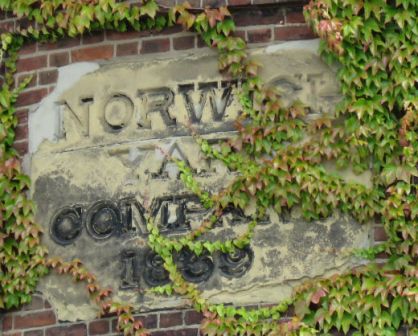
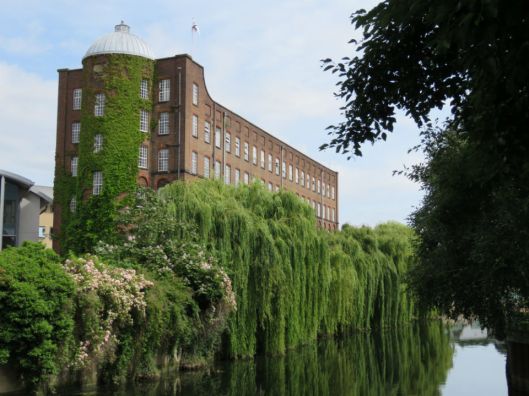
In the face of competition from mills in the north of England, the mayor Samuel Bignold (son of the founder of Norwich Union) tried to bolster Norwich’s textile trade by establishing the Norwich Yarn Company. The company’s plaque – dated 1839 – can just be seen below the dome of St James’ Mill,  built on the site of a C13th Carmelite monastery.  Norwich Yarn Co.jpg

Ian Nairn of The Observer, who could be fierce in his architectural reviews, loved this building and called it “the noblest of all English Industrial Revolution Mills” [4]. Its engine-powered looms were not, however, sufficient to avert the threat to Norwich weaving. St James’ Mill was subsequently used by the chocolate manufacturers Caley’s and, until a few years ago, as Jarrold’s Printing Works. Currently, the mill houses private offices. Visit the John Jarrold Printing Museum,which is situated in a riverside building behind St James Mill.Jarrolds Mill.jpg

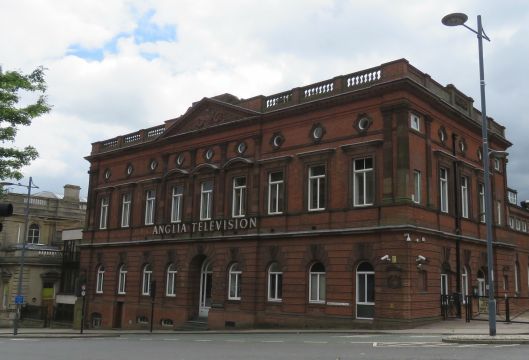
As a county town Norwich benefitted considerably from the agricultural wealth of the surrounding countryside for which it was the trading centre. In 1882 this was recognised in the inauguration of the Norfolk and Norwich Agricultural Hall, designed for once by an architect other than Edward Boardman: JB Pearce. The opening ceremony was performed by the Prince of Wales (later Edward VII) as Patron of the wonderfully named Norfolk and Norwich Fat Cattle Show Association [7]. It is not recorded what the cattlemen thought of Oscar Wilde’s lecture on “The House Beautiful”given at the Hall some two years later. The building now houses Anglia TV’s offices and studios.Agriclrl Hall.jpg

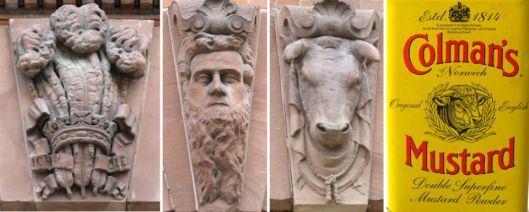
Pearce’s sombre public building is made of local red brick faced with a deep red and alien Cumberland sandstone [4]. Further decoration is provided by moulded Cosseyware (see previous post) from Guntons’  brickyard in nearby Costessey. The keystones above the ground floor doors and windows  are decorated with heads or emblems. The Prince of Wales feathers refer not only to the prince himself but to the adjoining Prince of Wales road that connects Thorpe railway station with the former cattle market on Castle Hill. One of several heads is shown below; it is evidently a portrait but the identities of these agricultural worthies are no longer known. The reference to the bull’s head seems more straightforward but since JJ Colman was Vice-Chairman of the Agricultural Hall Company might this also allude to what had been Colman’s trademark since 1855? [8].heads_use.jpg

Sources

  1. Holmes, Frances and Holmes, Michael (2013). The Story of the Norwich Boot and Shoe Trade. Pub: Norwich Heritage Projects http://www.norwich-heritage.co.uk  Ref 1a: Burgess, Edward and Wilfred (1904). Men Who Have Made Norwich. 
  2. http://www.georgeplunkett.co.uk/Norwich/Industrial%20Architecture/Mountergate%20Coop%20shoe%20factory%20wall%20[7530]%201998-03-01.jpg
  3. Girouard, Marc (1984). Sweetness and Light: “Queen Anne” Movement, 1860-1900. Yale University Press.
  4. Pevsner, Nikolaus and Wilson, Bill (1997). The Buildings of England. Norfolk 1. Yale University Press.
  5. http://www.heritage.norfolk.gov.uk/record-details?MNF61834-Duke’s-Palace-Ironworks-and-Norwich-Electric-Lighting-Company&Index=53786&RecordCount=56542&SessionID=071f84aa-3266-4621-85cc-d97a40c30c46
  6. http://hbsmrgateway2.esdm.co.uk/norfolk/DataFiles/Docs/AssocDoc6824.pdf
  7. http://www.heritagecity.org/research-centre/industrial-innovation/agricultural-hall.htm
  8. http://www.mustardshopnorwich.co.uk/history-of-colmans-pgid15.html

Thanks. For permission to reproduce images I thank Jonathan Plunkett from the Plunkett archive; to Clare Everitt of Picture Norfolk  and to Siofra Connor of the Archant/EDP Library. I am also grateful to  Frances Holmes, Philip Tolley and Diana Smith for their assistance.


Share this:

  • Click to share on Facebook (Opens in new window) Facebook
  • Click to share on X (Opens in new window) X
  • Click to share on Pinterest (Opens in new window) Pinterest
  • Click to email a link to a friend (Opens in new window) Email
  • Click to print (Opens in new window) Print
Like Loading...

Flint buildings

07 Thursday Jul 2016

Posted by reggie unthank in Decorative Arts, Norwich buildings

≈ 12 Comments

Tags

Flint buildings, Norwich architecture, Norwich buildings

“Very flat, Norfolk”. (Noel Coward. Private Lives)

“No place in England was further away from good building stone”. (Stefan Muthesius [1])

“The geology of Norfolk in eastern England largely consists of … sedimentary rocks of marine origin…” [2]

These three statements are, of course, related. Much of Norfolk is based on chalk derived from the skeletons of countless marine organisms that rained down upon the seabed some 60-95 million years ago when the sea level was much higher. In places, these layers of chalk are 300 metres (1000 feet) deep [3]. Quarry stone is therefore hard to find.

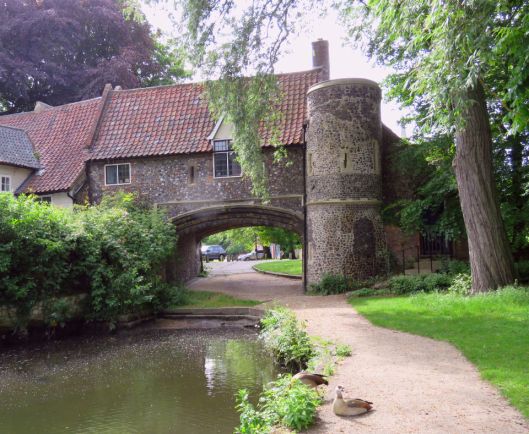
To build Norwich Cathedral the Normans brought in limestone from Caen in Normandy. Pulls Ferry (below), which was built later, is the medieval watergate that marks the route by which the stone was diverted from the River Wensum to the building site. However, despite this logistical triumph the core of the cathedral was still based on flint for the ashlar limestone is just a facing [2A].

Pulls Ferry Norwich_A.jpg

Pulls Ferry, Norwich, which marks the entrance by which building stone was shipped into the cathedral precincts

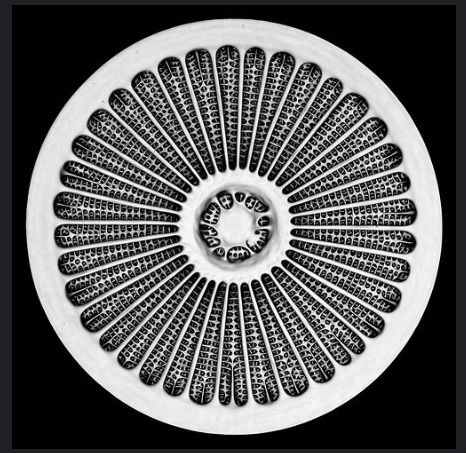
Flint and chalk are found together. Skeletons of some marine organisms provided the calcium carbonate that formed the chalk strata: others  – like this diatom – provided the silicon dioxide (silica) from which the nodules of flint were formed. I estimate this diatom to be ca. 15-20 millionths of a metre in diameter, giving some idea of the staggering number of organisms required just to make one flint nodule, let alone the blizzard of marine life needed to deposit 300 metre layers of chalk.

Arachnoidiscus Zeiss.jpg

Arachnoidiscus sp.– a diatom (c) Zeiss Microscopy

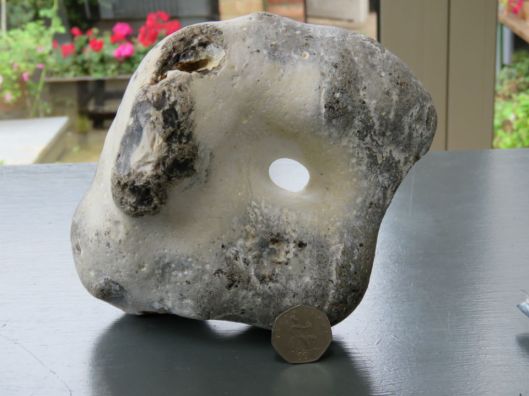
It is thought that holes formed by sea creatures burrowing through the gelatinous ooze at the bottom of the seabed provided the right sort of chemical environment for dissolved silicon – released from exoskeletons – to recrystallise, growing the irregular flint nodules around the holes [4].

flint.jpg

A hole through a flint nodule – a probable reminder of the burrow made by a Cretacean sea creature.

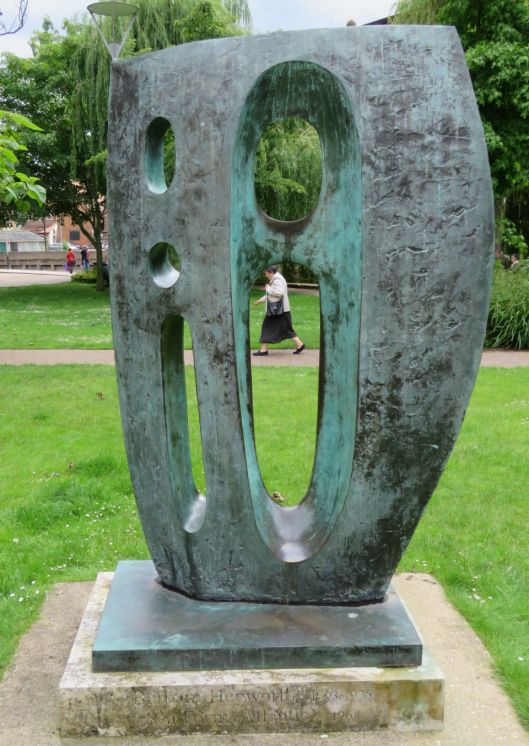
In a wonderful piece of inorganic chemistry in action, this metamorphosis of sludge on the seabed produced flint nodules. Their ‘organic’ shapes fascinated C20th artists – as did the holes. In the 1930s, Ben Nicholson, Henry Moore and Barbara Hepworth holidayed at Happisburgh on the Norfolk coast [5]. In 1931, apparently based on the Happisburgh flints, Barbara Hepworth created  one of the first sculptures with a hole through it for non-representational purposes (Pierced Form. Lost in the war). And Henry Moore’s sculptures are famously “lumpy and bumpy and sometimes have holes right through them.”

Hepworth statue Norwich.jpg

Barbara Hepworth. Sea Form (Atlantic) 1964 at St George’s Green (outside Norwich Playhouse)

One idea why there are so many round-towered flint churches in East Anglia is that the lack of stone to make the quoins or cornerstones meant it was easier (and cheaper) to build circular towers from knobbly flints set in mortar [6] . Another idea is that the Anglo-Saxons introduced round towers as protection against the Danes but this seems to have been discredited by the finding that many towers are post-Norman Conquest [7]. Geology does seem to provide the answer for while continental invaders spread far further than Norfolk only five round tower churches escaped the confines of the East Anglian chalklands compared to the 126 made in Norfolk [6].

Norwich had one church for every week of the year and one pub for every day.

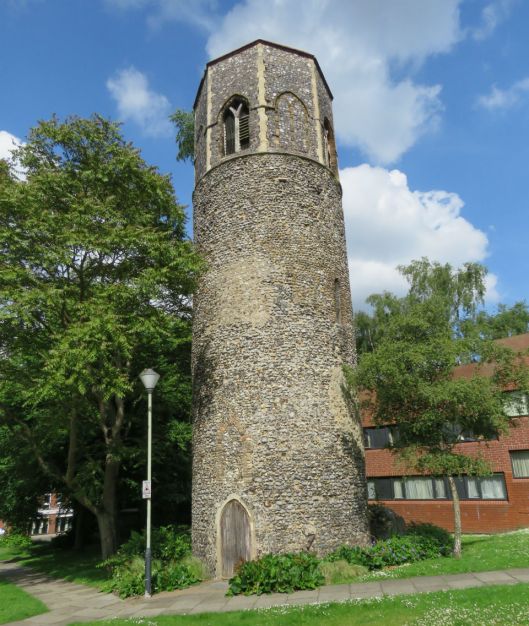
The actual number of churches appears to have been about 57, of which 31 are still in existence. I haven’t yet visited all the medieval churches but would guess that virtually all are built of flint – even the stone-clad St Peter Mancroft contains flint. However, not many of Norwich’s churches are round-towered. One was St Benedict’s church but this was bombed in the Baedecker raids of 1942 and only the tower, which is made of unknapped flint, survives.

St Benedicts Norwich.jpg

Only the tower of St Benedict’s church remained after the bombing of 1942.

St Benedict's south side from church alley [0140] 1934-06-28

St Benedict’s Church in 1934. (c) georgeplunkett.co.uk

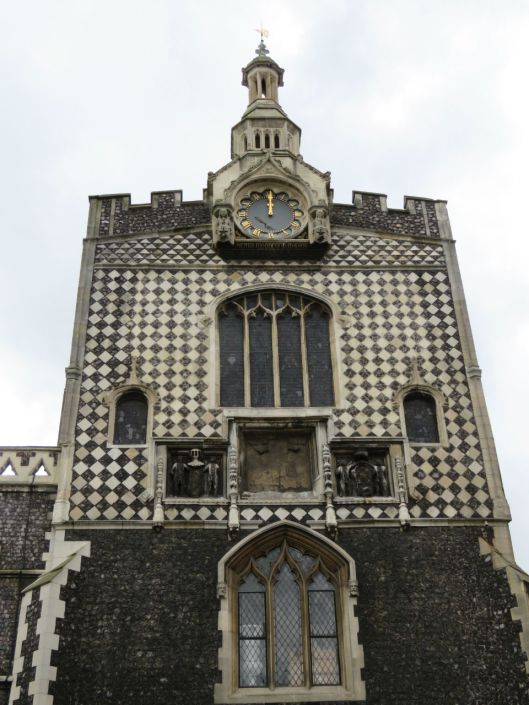
Well shaped flints occur on Norwich’s Guildhall, which is “the largest surviving medieval civic building in the country after London“[7]. It was built as a result of a royal charter of 1404 that gave the city the right of self-government. The east end (below) –  rebuilt in the C16th with a clock turret added in the C19th  – is a glorious example of diaper flushwork, where alternating diamonds of dark flint and light limestone form a smooth (i.e., ‘flush’) surface. The black and white chequerboard pattern may be a reference to the Guildhall’s use as an exchequer [8] in which a squared cloth was used for counting money.

guildhall norwich.jpg

East end of Norwich Guildhall C15th

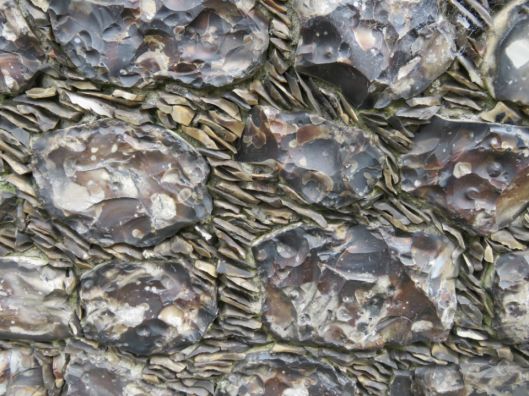
In places, the Guildhall walls contain unshaped stones surrounded by shims of flint – a byproduct of knapping. Pushing flakes into the spaces around the flints – or galetting – filled the gaps and protected the exposed mortar. The selection of flints that would leave large gaps seems to have been deliberate since it allowed swirls of galetting to become a decorative feature in its own right.

galleting flint.jpg

‘Decorative’ galetting on the Guildhall

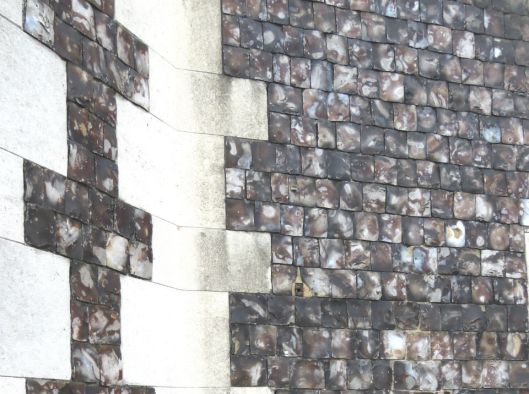
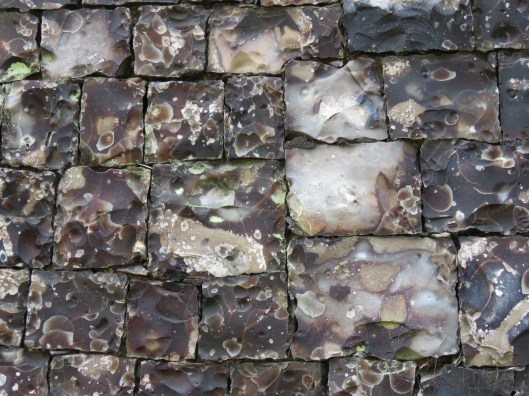
By contrast, parts of the east wall have been expertly squared up. Not only was the external face of these flints made smooth but four other sides were also square-knapped with such skill that the flints could be laid in regular courses without the need for galetting or, indeed, any visible mortar.

flint guildhall.jpg

Coursed flints on the east wall of the Guildhall

Another civic building famous for the quality of its square-knapped wall is the Bridewell, which was built about 1370 as a private house and became a prison for minor offenders  nearly 200 years later. It was named after St Bride’s Well, the first such institution in London.

Bridewell Norwich.jpg

North wall of the Bridewell, Norwich

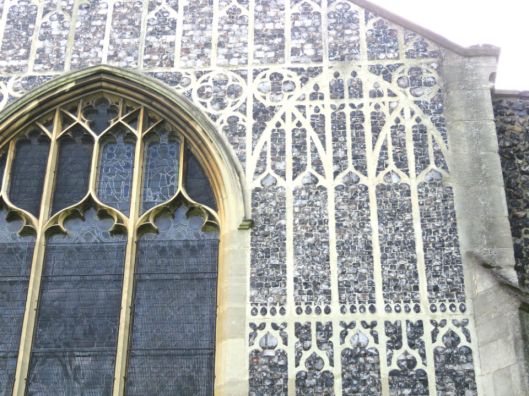
The north wall of the Norwich Bridewell has claim to being “the finest specimen of faced flint work in the country” [9]. But the knappers seem to have been less constrained here by a requirement for perfect squareness. The square-knapping is not as precise as on parts of the Guildhall and the flints are of variable size. But this honesty with which a difficult material has been handled contributes to the beauty of the wall.Bridewell 2.jpgFlushwork  was a speciality of Norfolk and Suffolk and was at its most inventive during the Perpendicular Period (1330-1530) [7, 10]. St Michael (often contracted to St Miles) Coslany is a famously exuberant example.  The artist John Sell Cotman claimed that the flushwork on the south side was “one of the finest examples of flint work in the kingdom” [11]. Parts of the church were rebuilt in the C19th. Here on the east end, restored in the 1880s, the flushwork mimics the tracery in the Perpendicular-style window next to it. This fits the general rule that representational designs were made in stone with flint in-fills while non-representational examples were in flint on a stone background [10].
St Miles Coslany.jpg

Replica window motif at St Michael (Miles) Coslany

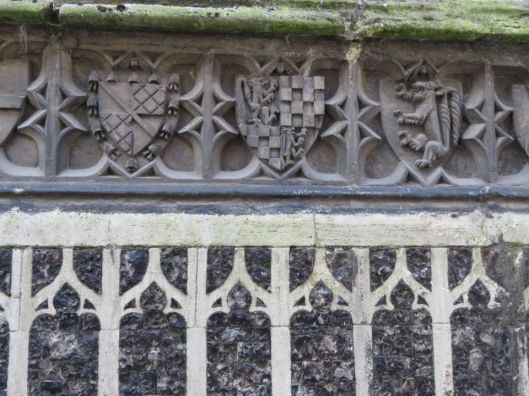
The church of St Andrew in St Andrew’s Street, Norwich, was completely rebuilt in 1506. It also has tracery flushwork but just as fascinating is the re-set frieze of shields beneath the chancel window  – the only survivor from the previous church [12].  These can be easily examined as you trudge up St Andrew’s Hill after leaving Cinema City. Kent and Stephenson [11] devoted an entire chapter to this frieze. Three of the thirteen shields (below) represent: the arms of Bishop Dispenser; Richard Fitzalan the Earl of Arundel; and possibly Thomas Mowbray who was later to become Duke of Norfolk.

st andrews flushwork.jpg

Tracery flush work beneath the chancel window of St Andrews. Above this is a frieze of shields inherited from the previous church.

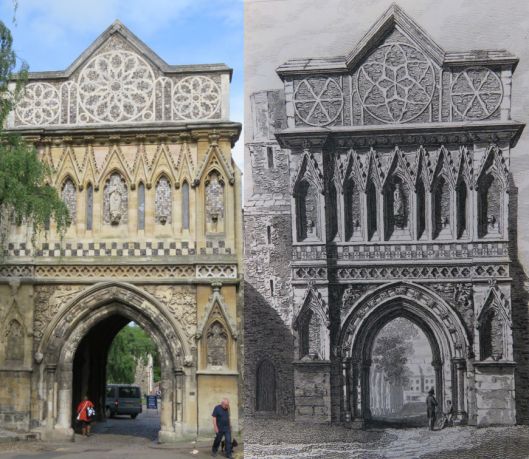
According to Stephen Hart [7] “the earliest positively datable example” of flushwork is on St Ethelbert’s gate of Norwich Cathedral (1316). The date is known with some certainty because of the events surrounding its construction. In 1272, conflicts between the cathedral and the citizens led to the torching of the Anglo-Saxon church of St Ethelbert together with the main gate to the monastery. Thirteen citizens were killed in the riots and thirty  rioters were hanged [13]. (The man fighting a dragon in the spandrels above the gate may refer to this conflict – see 13A). The king decreed that the citizens should rebuild St Ethelbert’s gate. In 1815 this C14th gateway was restored by William Wilkins  [7, 11] but although he generally followed the original pattern of three circular motifs Wilkins made significant changes to the flushwork. These circles are referred to as replica ‘rose windows’ [7] or ‘flushwork wheels’ [13A].

ethelbert old n new.jpg

R Cattermole’s engraving of St Ethelbert’s Gate to Norwich Cathedral (right) [14] shows that Wilkins’ 1815 restoration modified the pattern of the flushwork on the parapet. (Courtesy of Norfolk Heritage Centre. Norfolk County Council Library & Information Service).

Another decorative technique, proudwork, was in contrast to the flatness of flushwork [7]. St Gregory’s provides a rare example in Norwich. In this case, the ashlar in tracery design stands proud of the flint.

St Gregorys Norwich.jpg

Proudwork on the single-stage parapet of St Gregory’s church tower

It should not be surprising that Norwich, as a major centre of East Anglian flint-building, had its own brand of flushwork. In the Norwich style [7], vertical stone strips divided the flintwork beneath parapet crenellations into zones into which stone motifs were inset. This can be seen on the tower of St Clement’s Church in Colegate (near Fye Bridge), on which lozenges are decorated with blank shields indicating that God is shielding the building. The smaller lozenges appear to be recent restorations.

St Clements Norwich.jpg

St Clement’s Colegate

In serial flushwork, letters or motifs are repeated in a frieze. A good example can be found  at All Saints, East Tuddenham – a few miles west of Norwich. Above the porch is the inscription in Lombardic script (Italian lettering of the early Middle Ages): GLORIATIBITR  (Gloria Tibi Trinitas, or ‘Glory be to you Oh Trinity’ [15]). The letters are crowned when referring to god, saints and martyrs but never donors [16].

East Tuddenham.jpg

Serial flushwork at East Tuddenham made of crowned Lombardic lettering

Seen here on the porch of St Michael at Plea (below) the Norwich workshop gave St Michael a crowned M as well as a crowned sword. The crowned sword can be seen following the first M but “over-zealous pointing” seems to have obliterated subsequent swords [16].

St Michael at Plea Norwich.jpg

St Michael at Plea, Norwich. Crowned ‘M’ and (one) sword in serial flushwork above porch.

In 1671 the diarist John Evelyn wrote that Sir Thomas Browne of Norwich had told him that “they had lost the art of squaring the flints, in which they so much once excell’d, and of which the churches, best houses, and walls, are built...”[11]. The quality of the Victorian restoration at the east end of St Miles Coslany provided one example that the art of square knapping had not been lost; this  men’s lavatory of 1892 is another – an example of a different kind of flushwork.

Toilet Blackfriars.jpg

Men’s lavatory, St Andrew’s Plain, no longer in use

close-up toilet.jpg

Square-knapped flint, dated 1892

Sources

  1. Muthesius, Stefan. (1984). Norwich in the Nineteenth Century. Ed, C. Berringer. Chapter 4, pp94-117.
  2. https://en.wikipedia.org/wiki/Geology_of_Norfolk                                                              [Ref 2A. http://nhbg.org.uk/getmedia/952a6b94-eced-411a-bb63-b508d00f6220/Newsletter-No-23-web.aspx].
  3. http://www.discoveringfossils.co.uk/flint_formation_fossils.htm
  4. http://www.northfolk.org.uk/_cretaceous%20leaflet.pdf
  5. http://www.museums.norfolk.gov.uk/view/NCC081889. This links to excellent notes by Nicholas Thornton on an exhibition held in Norwich Castle Museum and Art Gallery, in 2009: Moore/Hepworth/Nicholson. A nest of gentle artists in the 1930s. 
  6. Round Tower Churches Society. http://www.roundtowers.org.uk/about-round-tower-churches/
  7. Hart, Stephen. 2000. Flint Architecture of East Anglia. Giles de la Mare Pub Ltd. 
  8. https://en.wikipedia.org/wiki/Norwich_Guildhall
  9. http://www.heritage.norfolk.gov.uk/record-details?MNF607-Norwich-Bridewell-Museum-Bridewell-Alley&Index=603&RecordCount=56881&SessionID=81a31ae1-509a-4c77-9cbe-4c9325a00b0d
  10. Talbot, Margaret. 2004. Medieval Flushwork of East Anglia and its Symbolism. Poppyland Publishing.
  11. Kent, Arnold and Stephenson, Andrew. (1948). Norwich Inheritance. Pub: Jarrold and Sons Ltd., Norwich.
  12. http://www.cvma.ac.uk/publications/digital/norfolk/sites/norwichstandrew/history.html
  13. https://norwichchurches.files.wordpress.com/2016/06/st-ethelberts-chapel-and-the-riots-of-1272.pdf.  [Ref 13A Summers, Dominic John (2011) Norfolk Church Towers of the Later Middle Ages. PhD UEA].
  14. Britton, John (1816). The History and Antiquities of the See and Cathedral of Norwich. Pub: Longman et al. London.
  15. http://www.norfolkchurches.co.uk/easttuddenham/easttuddenham.htm
  16. Blatchly, John and Northeast, Peter (2005). Decoding Flint Flushwork on Suffolk and Norfolk Churches.

Thanks to Jonathan Plunkett for permission to use an image from the George Plunkett archive http://www.georgeplunkett.co.uk. I also thank the Norfolk Heritage Centre for their help.

Share this:

  • Click to share on Facebook (Opens in new window) Facebook
  • Click to share on X (Opens in new window) X
  • Click to share on Pinterest (Opens in new window) Pinterest
  • Click to email a link to a friend (Opens in new window) Email
  • Click to print (Opens in new window) Print
Like Loading...
Newer posts →

Enter your email address to follow this blog and receive notifications of new posts by email.

Recent Posts

  • Gothick Norwich
  • The Sons of Flora
  • The United Friars: Charity and Enquiry in the Age of Reason
  • Plans for a Fine City
  • Three Unthank books in print

Recent Comments

Jonathan Dutton's avatarJonathan Dutton on The Nursery Fields of Eat…
Jacqui edgar's avatarJacqui edgar on Two Bs or not two Bs? Norfolk…
Unknown's avatarJapan goes on show |… on Jeckyll and the sunflower…
reggie unthank's avatarreggie unthank on Gothick Norwich
huroncityradio's avatarhuroncityradio on Gothick Norwich

Archives

  • December 2023
  • October 2023
  • April 2023
  • January 2023
  • November 2022
  • October 2022
  • July 2022
  • March 2022
  • February 2022
  • January 2022
  • December 2021
  • November 2021
  • October 2021
  • September 2021
  • August 2021
  • July 2021
  • June 2021
  • May 2021
  • April 2021
  • March 2021
  • February 2021
  • January 2021
  • December 2020
  • November 2020
  • October 2020
  • September 2020
  • August 2020
  • July 2020
  • June 2020
  • May 2020
  • April 2020
  • March 2020
  • February 2020
  • January 2020
  • December 2019
  • November 2019
  • October 2019
  • September 2019
  • August 2019
  • July 2019
  • June 2019
  • May 2019
  • April 2019
  • March 2019
  • February 2019
  • January 2019
  • December 2018
  • November 2018
  • October 2018
  • September 2018
  • August 2018
  • July 2018
  • June 2018
  • May 2018
  • April 2018
  • March 2018
  • February 2018
  • January 2018
  • December 2017
  • November 2017
  • October 2017
  • September 2017
  • August 2017
  • July 2017
  • June 2017
  • May 2017
  • April 2017
  • March 2017
  • February 2017
  • January 2017
  • December 2016
  • November 2016
  • October 2016
  • September 2016
  • August 2016
  • July 2016
  • June 2016
  • May 2016
  • April 2016
  • March 2016
  • February 2016
  • January 2016
  • December 2015

Categories

  • Aesthetic Movement
  • Amelia Opie
  • Art
  • Art Nouveau
  • Arts and Crafts
  • Decorative Arts
  • James Minns carver
  • Linnean Society
  • Norwich architect
  • Norwich Banking
  • Norwich buildings
  • Norwich Department Stores
  • Norwich history
  • Norwich libraries
  • Norwich maps
  • Norwich parks
  • Norwich School of Painters
  • Norwich streets
  • Paston Letters
  • River Wensum history
  • Shutter Telegraph
  • Sir Thomas Browne
  • Stained Glass
  • The Royal Society
  • Uncategorized

Meta

  • Create account
  • Log in
  • Entries feed
  • Comments feed
  • WordPress.com

Recent Posts

  • Gothick Norwich
  • The Sons of Flora
  • The United Friars: Charity and Enquiry in the Age of Reason
  • Plans for a Fine City
  • Three Unthank books in print

Recent Comments

Jonathan Dutton's avatarJonathan Dutton on The Nursery Fields of Eat…
Jacqui edgar's avatarJacqui edgar on Two Bs or not two Bs? Norfolk…
Unknown's avatarJapan goes on show |… on Jeckyll and the sunflower…
reggie unthank's avatarreggie unthank on Gothick Norwich
huroncityradio's avatarhuroncityradio on Gothick Norwich

Archives

  • December 2023
  • October 2023
  • April 2023
  • January 2023
  • November 2022
  • October 2022
  • July 2022
  • March 2022
  • February 2022
  • January 2022
  • December 2021
  • November 2021
  • October 2021
  • September 2021
  • August 2021
  • July 2021
  • June 2021
  • May 2021
  • April 2021
  • March 2021
  • February 2021
  • January 2021
  • December 2020
  • November 2020
  • October 2020
  • September 2020
  • August 2020
  • July 2020
  • June 2020
  • May 2020
  • April 2020
  • March 2020
  • February 2020
  • January 2020
  • December 2019
  • November 2019
  • October 2019
  • September 2019
  • August 2019
  • July 2019
  • June 2019
  • May 2019
  • April 2019
  • March 2019
  • February 2019
  • January 2019
  • December 2018
  • November 2018
  • October 2018
  • September 2018
  • August 2018
  • July 2018
  • June 2018
  • May 2018
  • April 2018
  • March 2018
  • February 2018
  • January 2018
  • December 2017
  • November 2017
  • October 2017
  • September 2017
  • August 2017
  • July 2017
  • June 2017
  • May 2017
  • April 2017
  • March 2017
  • February 2017
  • January 2017
  • December 2016
  • November 2016
  • October 2016
  • September 2016
  • August 2016
  • July 2016
  • June 2016
  • May 2016
  • April 2016
  • March 2016
  • February 2016
  • January 2016
  • December 2015

Categories

  • Aesthetic Movement
  • Amelia Opie
  • Art
  • Art Nouveau
  • Arts and Crafts
  • Decorative Arts
  • James Minns carver
  • Linnean Society
  • Norwich architect
  • Norwich Banking
  • Norwich buildings
  • Norwich Department Stores
  • Norwich history
  • Norwich libraries
  • Norwich maps
  • Norwich parks
  • Norwich School of Painters
  • Norwich streets
  • Paston Letters
  • River Wensum history
  • Shutter Telegraph
  • Sir Thomas Browne
  • Stained Glass
  • The Royal Society
  • Uncategorized

Meta

  • Create account
  • Log in
  • Entries feed
  • Comments feed
  • WordPress.com

Recent Posts

  • Gothick Norwich
  • The Sons of Flora
  • The United Friars: Charity and Enquiry in the Age of Reason
  • Plans for a Fine City
  • Three Unthank books in print

Recent Comments

Jonathan Dutton's avatarJonathan Dutton on The Nursery Fields of Eat…
Jacqui edgar's avatarJacqui edgar on Two Bs or not two Bs? Norfolk…
Unknown's avatarJapan goes on show |… on Jeckyll and the sunflower…
reggie unthank's avatarreggie unthank on Gothick Norwich
huroncityradio's avatarhuroncityradio on Gothick Norwich

Archives

  • December 2023
  • October 2023
  • April 2023
  • January 2023
  • November 2022
  • October 2022
  • July 2022
  • March 2022
  • February 2022
  • January 2022
  • December 2021
  • November 2021
  • October 2021
  • September 2021
  • August 2021
  • July 2021
  • June 2021
  • May 2021
  • April 2021
  • March 2021
  • February 2021
  • January 2021
  • December 2020
  • November 2020
  • October 2020
  • September 2020
  • August 2020
  • July 2020
  • June 2020
  • May 2020
  • April 2020
  • March 2020
  • February 2020
  • January 2020
  • December 2019
  • November 2019
  • October 2019
  • September 2019
  • August 2019
  • July 2019
  • June 2019
  • May 2019
  • April 2019
  • March 2019
  • February 2019
  • January 2019
  • December 2018
  • November 2018
  • October 2018
  • September 2018
  • August 2018
  • July 2018
  • June 2018
  • May 2018
  • April 2018
  • March 2018
  • February 2018
  • January 2018
  • December 2017
  • November 2017
  • October 2017
  • September 2017
  • August 2017
  • July 2017
  • June 2017
  • May 2017
  • April 2017
  • March 2017
  • February 2017
  • January 2017
  • December 2016
  • November 2016
  • October 2016
  • September 2016
  • August 2016
  • July 2016
  • June 2016
  • May 2016
  • April 2016
  • March 2016
  • February 2016
  • January 2016
  • December 2015

Categories

  • Aesthetic Movement
  • Amelia Opie
  • Art
  • Art Nouveau
  • Arts and Crafts
  • Decorative Arts
  • James Minns carver
  • Linnean Society
  • Norwich architect
  • Norwich Banking
  • Norwich buildings
  • Norwich Department Stores
  • Norwich history
  • Norwich libraries
  • Norwich maps
  • Norwich parks
  • Norwich School of Painters
  • Norwich streets
  • Paston Letters
  • River Wensum history
  • Shutter Telegraph
  • Sir Thomas Browne
  • Stained Glass
  • The Royal Society
  • Uncategorized

Meta

  • Create account
  • Log in
  • Entries feed
  • Comments feed
  • WordPress.com

Enter your email address to follow this blog and receive notifications of new posts by email. It's free, no junk.

Join 722 other subscribers

Recent Posts

  • Gothick Norwich
  • The Sons of Flora
  • The United Friars: Charity and Enquiry in the Age of Reason
  • Plans for a Fine City
  • Three Unthank books in print
  • The new Colonel Unthank’s Norwich book #3
  • Female Suffrage in Norwich
  • Norfolk Rood Screens
  • Norwich Guides: Ancient and Modern
  • Chapel in the Fields
  • Noël Spencer’s Norwich
  • Georgian Norwich
  • Cecil Upcher: soldier and architect
  • Sculptured Monuments #2
  • Sculptured Monuments
  • Madness
  • New Book: Colonel Unthank’s Norwich
  • AF Scott, Architect:conservative or pioneer?
  • Norwich Department Stores
  • Revolutionary Norwich
  • Parson Woodforde and the Learned Pig
  • A postscript on Eaton Nurseries
  • The Nursery Fields of Eaton
  • Vanishing Plains
  • Parson Woodforde goes to market
  • Norwich, City of the Plains
  • The Plains of Norwich
  • Twentieth Century Norwich Buildings
  • Thomas Browne’s World
  • The angel’s bonnet
  • After the Norwich School
  • A few of my favourite buildings
  • James Minns, carver
  • The Norwich Banking Circle
  • Behind Mrs Opie’s medallion
  • Norwich: shaped by fire
  • Street Names #2
  • Street names
  • The Norwich School of Painters
  • Going Dutch: The Norwich Strangers
  • The Captain’s Parks
  • Norfolk’s Napoleonic Telegraph
  • Catherine Maude Nichols
  • The Norfolk Botanical Network
  • City Hall Doors # 2
  • City Hall Doors # 1
  • Late Extra: The Norwich Pantheon
  • Pleasure Gardens
  • The absent Dukes of Norfolk
  • Nairn on Norwich
  • The Norwich Way of Death
  • Norwich: City of Trees
  • The Bridges of Norwich Part 2: Around the bend
  • The Bridges of Norwich 1: The blood red river
  • Norwich knowledge (libraries)
  • Street furniture: palimpsests
  • Putting Norwich on the map
  • Clocks
  • Faces
  • The Norwich coat of arms
  • New book: Colonel Unthank and the Golden Triangle
  • The Pastons in Norwich
  • Reggie through the underpass
  • Gildencroft and Psychogeography
  • Bullards’ Brewery
  • Post-medieval Norwich churches
  • The end of the Unthank mystery?
  • Barnard Bishop and Barnards
  • Public art, private meanings
  • Colonel Unthank rides again

Archives

  • December 2023
  • October 2023
  • April 2023
  • January 2023
  • November 2022
  • October 2022
  • July 2022
  • March 2022
  • February 2022
  • January 2022
  • December 2021
  • November 2021
  • October 2021
  • September 2021
  • August 2021
  • July 2021
  • June 2021
  • May 2021
  • April 2021
  • March 2021
  • February 2021
  • January 2021
  • December 2020
  • November 2020
  • October 2020
  • September 2020
  • August 2020
  • July 2020
  • June 2020
  • May 2020
  • April 2020
  • March 2020
  • February 2020
  • January 2020
  • December 2019
  • November 2019
  • October 2019
  • September 2019
  • August 2019
  • July 2019
  • June 2019
  • May 2019
  • April 2019
  • March 2019
  • February 2019
  • January 2019
  • December 2018
  • November 2018
  • October 2018
  • September 2018
  • August 2018
  • July 2018
  • June 2018
  • May 2018
  • April 2018
  • March 2018
  • February 2018
  • January 2018
  • December 2017
  • November 2017
  • October 2017
  • September 2017
  • August 2017
  • July 2017
  • June 2017
  • May 2017
  • April 2017
  • March 2017
  • February 2017
  • January 2017
  • December 2016
  • November 2016
  • October 2016
  • September 2016
  • August 2016
  • July 2016
  • June 2016
  • May 2016
  • April 2016
  • March 2016
  • February 2016
  • January 2016
  • December 2015

Follow me on Twitter

My Tweets

previous posts

  • About
  • Colonel Unthank and the Golden Triangle (Unthank #1)
  • Colonel Unthank’s Norwich #2
  • Contact
  • Latest Colonel Unthank’s Norwich Book #3
  • Posts

Blog at WordPress.com.

  • Subscribe Subscribed
    • COLONEL UNTHANK'S NORWICH
    • Join 722 other subscribers
    • Already have a WordPress.com account? Log in now.
    • COLONEL UNTHANK'S NORWICH
    • Subscribe Subscribed
    • Sign up
    • Log in
    • Report this content
    • View site in Reader
    • Manage subscriptions
    • Collapse this bar
 

Loading Comments...
 

    %d