• About
  • Colonel Unthank and the Golden Triangle (Unthank #1)
  • Colonel Unthank’s Norwich #2
  • Contact
  • Latest Colonel Unthank’s Norwich Book #3
  • Posts

COLONEL UNTHANK'S NORWICH

~ History, Decorative Arts, Buildings

COLONEL UNTHANK'S NORWICH

Category Archives: Norwich history

The flamboyant Mr Skipper

15 Wednesday Feb 2017

Posted by reggie unthank in Art Nouveau, Norwich buildings, Norwich history

≈ 27 Comments

Tags

Cosseyware, George Skipper, Hotel de Paris Cromer, James Minns, Jarrolds Norwich, Poppyland

Two architects changed the face of Victorian Norwich: Edward Boardman and George Skipper. Boardman sketched out the quiet fabric of a post-medieval city but it was Skipper who provided the firecrackers.skipper3.jpg
The son of a Dereham builder, Skipper (1856-1948), spent a year at Norwich School of Art studying art and – probably at his father’s insistence – architecture [1]. He did, of course, follow the architectural path but – as the Norwich Mercury wrote in 1906 – he was known for his ‘artistic temperament’ and he expressed this side of his personality in the exuberance of his buildings. He is reputed to have said, you “need an artist for a first rate building” [1a]. However, one of his early buildings (1890), for which he and his brother Frederick won the commission, was the “modestly ‘Queen Anne’ town hall” of Cromer [2] that gave little idea of the fireworks to come.
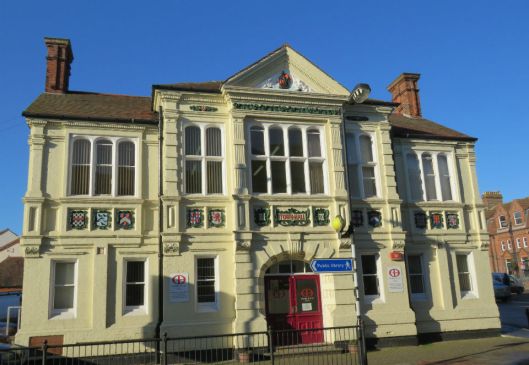
CromerTown Hall.JPG This project is important, though, for introducing the association between Skipper and the ‘carver’ James Minns, who was responsible for the decorative brickwork from Gunton Bros’ Brickyard at Costessey [3].
CromerPediment.JPG

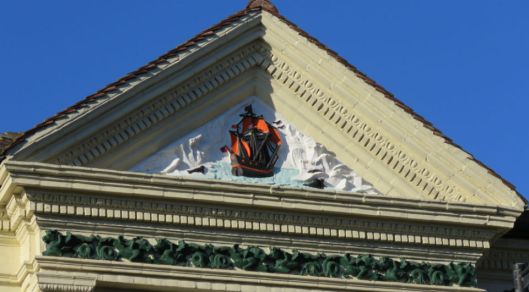
In addition to the decorative shields, James Minns sculpted the tableau in the pediment depicting the discovery of Iceland by local sailor Robert Bacon [4]

In the late 1880s Clement Scott’s column ‘Poppyland‘ in the Daily Telegraph extolled the virtues of the North Norfolk coast, particularly around Overstrand [5,6]. The book based on these articles, The Poppyland Papers, proved very popular and this, combined with the arrival of the Great Eastern Railway in 1887, transformed nearby Cromer from a quiet fishing village to a fashionable watering place for the wealthy.

Not everyone succumbed to the bracing pleasures of Cromer, including the young and homesick Winston Churchill who wrote to his mother: “I am not enjoying myself very much”.

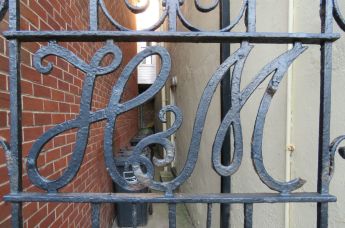
The comfortable middle and upper middle classes came to see the coastal attractions and they needed suitable accommodation [5].  This triggered a wave of hotel building and Skipper was engaged by a consortium of Norwich businessmen to design several of them [6]. After The Grand Hotel he built The Metropole, which is said to have shown signs of Skipper’s flair and exuberance [1] but both hotels were demolished.
HotelMetropole.JPG

The last vestige of the Hotel Metropole

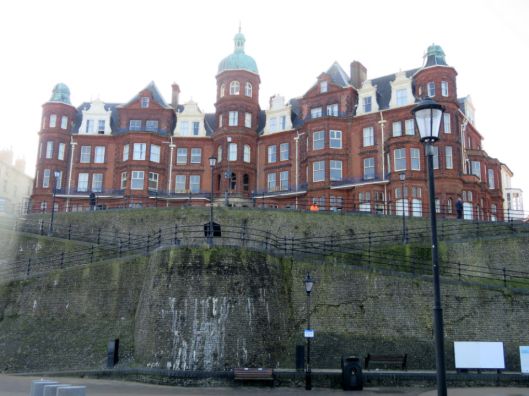
A survivor was Skipper’s best known project, the Hotel de Paris (1896). Its frontage, which borrows features from the late medieval palace at Chambord, disguised the previous Regency buildings. Marc Girouard thought the result was cruder but jollier than Skipper’s other hotels [2].
HoteldeParis.JPG

The hotel demonstrates one of Skipper’s  favourite tropes of using turrets and cupolas to provide interest at the skyline [6]. He used the same device to disguise an ugly lift heading at Sandringham [7].
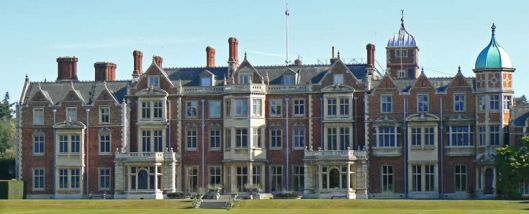
SandringhamHouseT.jpg

Sandringham House. Skipper’s is the taller of the two cupolas. http://www.tournorfolk.co.uk/sandringham

Further along the clifftop at Cromer is another of Skipper’s hotels – The Cliftonville – with decorative ‘Cosseyware’ (fancy brickware) by Guntons of Costessey near Norwich [8].  Skipper was responsible for modifying the hotel originally designed by another Norwich architect, AF Scott [6]. The Cliftonville was transformed into an example of the Arts and Crafts style showing the influence of the French Renaissance as well as the C19th Queen Anne Revival.

Trevor Page & Co of Norwich provided the soft furnishings [6]. The company was a partnership between Henry Trevor (who made great use of Cosseyware seconds in creating the Plantation Garden in Norwich) and his stepson John Page. Much of the ‘hard’ interior decoration survives.

cliftonville montage1.jpg

Clockwise from top left: Turret with octagonal cupola; stained glass peacock panel; Guntons terracotta panel; dining room doors referencing ‘Poppyland’; fireplace in the dining room.

Skipper designed several private houses in Cromer. St Bennet’s at 37 Vicarage Road, built in 1893, is one of the most impressive. Freely decorated in red brick panels it is said to have been carved by James Minns [6].
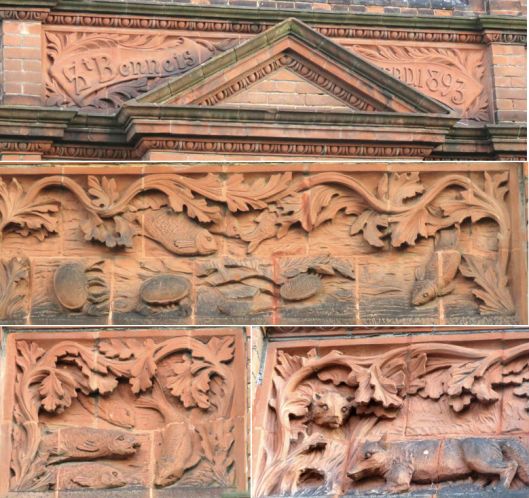
Montage2.jpg

St Bennets, Cromer, designed by Skipper 1893; brick carving attributed to Minns

Skipper’s first offices (1880) in Norwich were in Opie Street but by 1891 he was employing about 50 people and in 1896 he moved to 7 London Street. At that time, architects were not allowed to advertise their services but, flying close to the regulatory wind, he commissioned Guntons to sculpt terracotta plaques depicting Skipper, on site, examining the work of sculptors and as the architect discussing plans with a client.
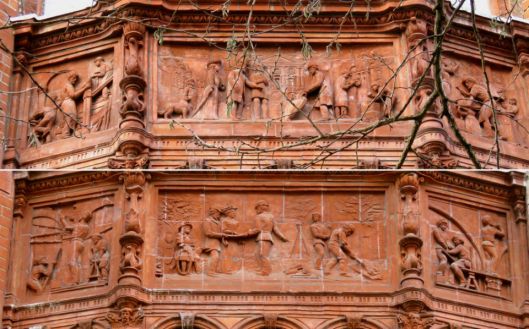
skipper pair2.jpg

Carved brick tableaux at No 7 London Street. Upper centre: Skipper, with family to the left, inspecting sculpted work. Lower centre: Skipper showing work to clients.

I suspect the figure presenting Skipper the plaque in the upper panel could be James Minns himself – the ‘carver’ for Guntons. Although about 68 at the time Minns was still sculpting to a high standard for one year later he successfully submitted a carved wooden panel to the Summer Exhibition of the Royal Academy [9].
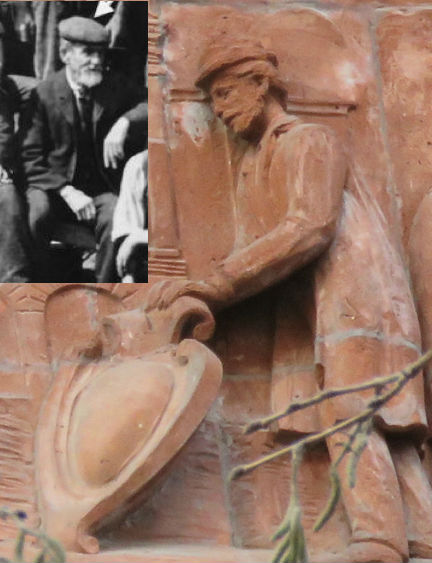
Minns Duo.jpg

Skipper’s designs draw on a variety of sources. The French Renaissance style of his early years (enriched by Flemish influences from his visit to Belgium as a student) were to give way to the more weighty Neo-Classical Palladian buildings – buildings such as the Norfolk and Norwich Savings Bank (now Barclays Bank) in Red Lion St, the Norwich and London Accident Assurance Association (now the St Giles House Hotel in St Giles’ St) and his most expensive and sumptuous project, Surrey House for Norwich Union Life Insurance Society. But around the turn of the century he still found time for more playful ventures, embarking on ‘the mildest flirtation with British Art Nouveau'[7]. The Royal Arcade – covered in a previous blog [10] – is one such ‘transitional adventure’ although the credit for this Art Nouveau gem must surely go to the head of Doulton Pottery’s Architectural Department,WJ Neatby, who designed the jewel-like surfaces.
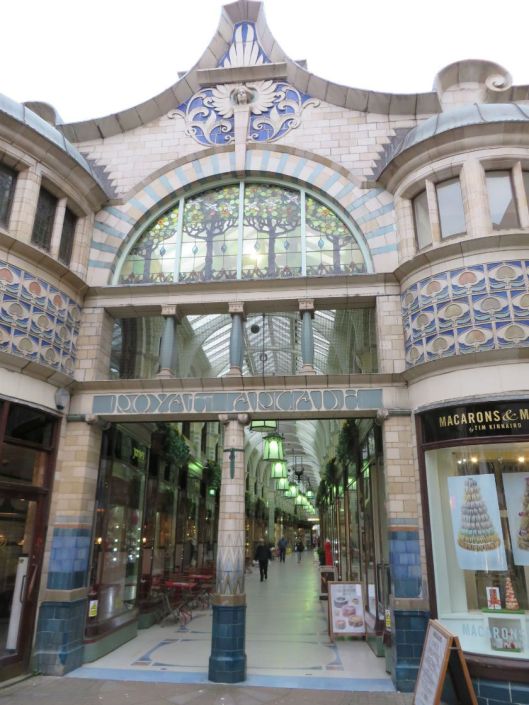
neatbynorwicharcade_1.jpg

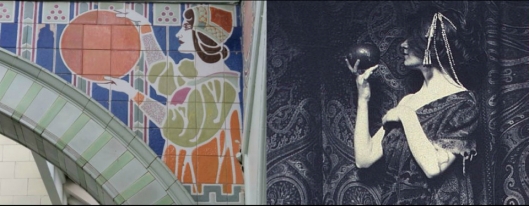
In a post on decorative tiles [11], I noted the close similarity between Neatby’s design for the young woman holding a disc in the spandrels of the arcade’s central crossing and a self-portrait by the Brooklyn photographer Zaida Ben-Yusuf. But, drawing various threads together, it seems likely that both artists were borrowing from the work of Alphonse Mucha  whose well-known posters illustrate young women holding very similar poses [see 10 for a fuller discussion].
zodiac_pair960pxl.jpg

Left: Zodiac figure by WJ Neatby (1899); right ‘The Odor of Pomegranates’ (ca 1899) by Zaida Ben-Yusuf

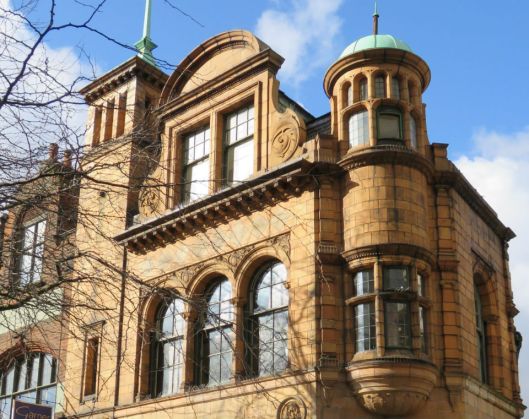
Hints of Art Nouveau were also to be seen in the turrets and domes of the Norfolk Daily Standard offices (1899-1900) on St Giles Street. This riotously decorated building survived the bombing of the adjacent building in the Blitz (1942) but later lost some of its features during a conversion to a Wimpy Bar.
Daily Standard1.jpg

Art nouveau touches can be seen on the spandrels above the first floor windows and on the Dutch/Flemish gables. The copper-domed turret is a familiar Skipper motif.

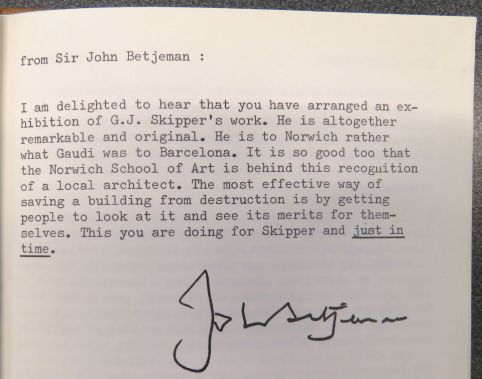
It was to ‘exuberant’ buildings such as these that Poet Laureate John Betjeman was referring when he made his well-known quotation comparing Skipper to Antonio Gaudi of Barcelona [7, 12].
IMG_4001.JPG

Frontispiece to the catalogue of the Norwich School of Art’s exhibition on Skipper, 1975  [12]

A more convincing Art Nouveau building is the Royal Norfolk and Suffolk Yacht Club at Lowestoft. Skipper’s competition-winning design from 1902 is stripped of the decoration and frenetic eclecticism of his other projects to produce a building using “the vocabulary of British Art Nouveau … with more than a sidelong look at CFA Voysey” [7]. The plain stucco walls – one of Voysey’s signatures – and sloped buttresses are relieved by circular and semi-circular windows and topped by a copper dome. This puritanical excursion was a one-off for Skipper.
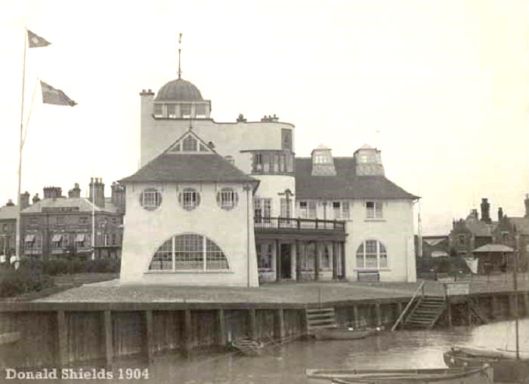
shieldsd04_lowest05 Yacht Club.jpg

broadlandmemories.co.uk

Back in Norwich Skipper designed Commercial Chambers in Red Lion Street (1901-3), wedged into a narrow site between another of his projects (the Norfolk and Norwich Savings Bank 1900-3) and John Pollock’s veterinary premises designed by his great competitor, Edward Boardman (1901-2). Even on a such a narrow building Skipper manages to create interest at the skyline by using moulded cornice, statuary, a finial and a campanile that just sneaks above Boardman’s adjacent Dutch gable by the height of its copper dome.
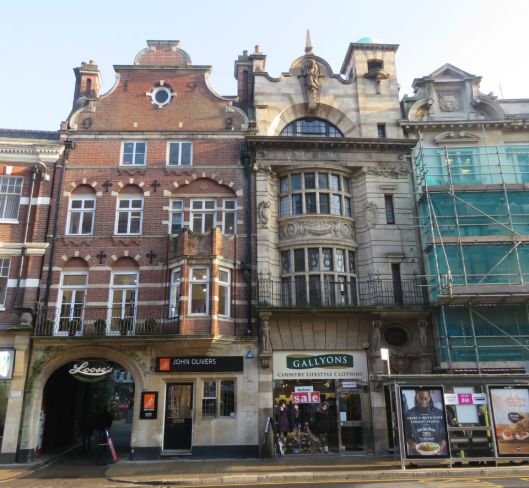
Commrcl chambrs.JPG

Left, Boardman’s building for Pollock; centre, Skipper’s Commercial Chambers; right, Skipper’s Norfolk and Norwich Savings Bank.

Because Commercial Chambers was built for the accountant Charles Larking [7] you would be forgiven for thinking that the robed figure at the top of the building, making entries into a ledger, was Larking himself but it is clearly the self-publicist Skipper.
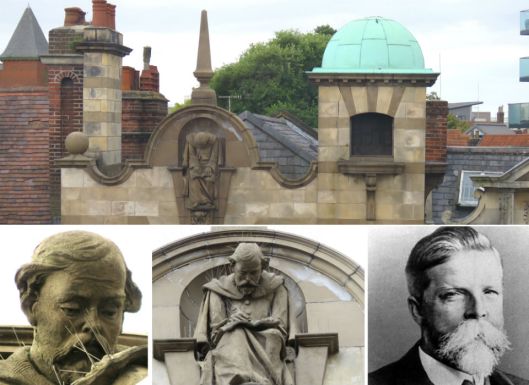
skipper montage.jpg

Between 1896 and 1925 [6] Skipper remodelled, in stages, the frontage of his neighbour’s department store on London and Exchange Streets. Original plans show that Skipper had also planned a dome to surmount the semi-circular bay – “rather like a tiered wedding cake” [1] – at the corner of Jarrolds department store.  But at the end of this long project no copper-clad dome materialised [1].
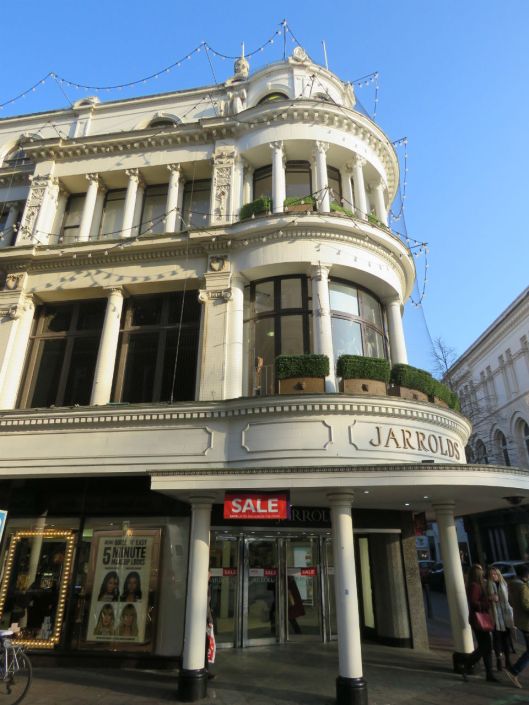
jarrolds.JPG

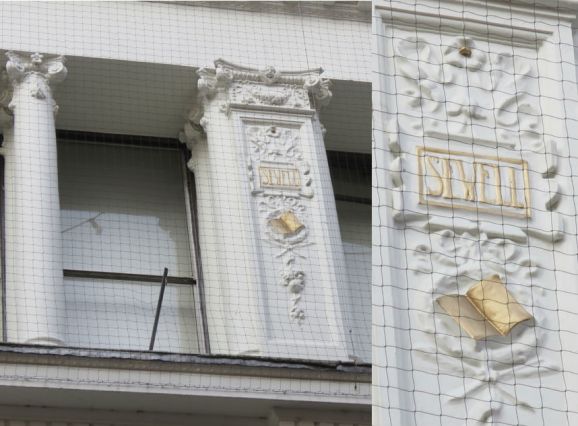
Work began first on the London Street side whose second floor facade is punctuated by a series of Royal Doulton plaques bearing the names of authors first published by Jarrold Printing [7]. The one shown below commemorates Anna Sewell who wrote Black Beauty while she lived in Old Catton just outside Norwich.
sewell.jpg

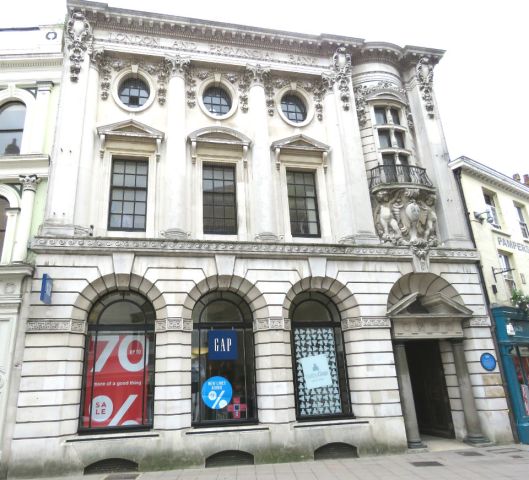
On another project, Skipper’s plans for a dome were again frustrated. In 1907 Skipper completed the London and Provincial Bank (now GAP {and now The Ivy brasserie, 2018}) a little further along London Street. Architectural interest was created by breaking the flat symmetry of the classical facade with a fourth bay containing a curved two-storey bay window [7]: the deeply recessed cylinder even broaches the massive cornice that caps the building. This is explained by the fact that Skipper originally planned to top the fourth bay with a trademark cupola whose circular section would have echoed the curved segment of the cornice. In the event, the cupola was abandoned because it would have infringed a neighbouring property’s ‘right of light’ [7].
GAP.jpg

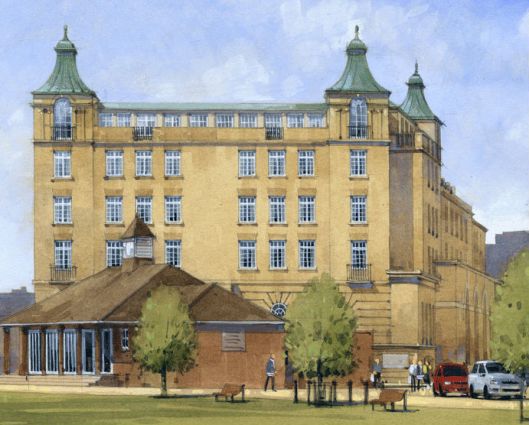
Just before the First World War, Skipper had planned to retire but the loss of his savings in the East Kent Coal Board meant he had to keep working. After the war his work in Norwich seems largely confined to humble plans for roads and sewerage required to open up that part of the Golden Triangle around Heigham Park and College Road (he also designed neo-Georgian buildings in that road) [13]. Further afield, he designed various buildings in Norfolk, Kent and London and in 1926 built a second extension to the University Arms Hotel in Cambridge. Here – perhaps harking back to his heyday – he did successfully add two cupolas: it was, “an unmistakable Skipper gesture, but in this case somewhat incongruous” [7].
University-Arms-Hotel.jpg

University Arms Hotel as proposed after the fire in 2013. Painting by Chris Draper. johnsimpsonarchitects.com

During the Second World War Skipper had kept his London Street offices open while his son Edward, a fellow architect, was on active service [7]. Edward could not, however, afford to keep the offices open and in 1946 sold the building to Jarrolds.  Skipper died in 1948 when he was nearly 92.

skipper cupolas2.jpg

Sources

  1. Summers, David  (2009). George Skipper: Norfolk Architect. In, Powerhouses of provincial  architecture 1837-1914 (Ed, Kathryn Ferry). Chapter 6 pp 75-83. Pub: The Victorian Society.   Ref1a  http://www.heritagecity.org/research-centre/whos-who/george-skipper.htm
  2. Girouard, Marc (1977). Sweetness and Light: The Queen Anne Movement 1860-1900. Pub: Yale University Press.
  3. James Minns, Carver of Norwich. http://www.thenorwichsociety.org.uk/copy-of-norwich-history. Mentioned also in previous blog [9]:
  4. http://racns.co.uk/sculptures.asp?action=getsurvey&id=1132
  5. http://jermy.org/poppy02.html
  6. Hitchings, Glenys and Branford, Christopher (2015). ‘George John Skipper, The Man Who Created Cromer’s Skyline’. Pub: Iceni Print and Products. Available from Jarrolds and from City Bookshop, Norwich.
  7. Jolly, David and Skipper, Edward (1980). Celebrating Skipper 100: 1880-1980. Booklet produced by Edward Skipper and Associates; foreword by Edward Skipper with posthumous contribution from David Jolly [see 11]. Available at Norwich Library Heritage Centre, Cat No. C720.9 [OS].
  8. https://colonelunthanksnorwich.com/2016/05/05/fancy-bricks/
  9. https://colonelunthanksnorwich.com/2016/08/18/angels-in-tights/
  10. http://wp.me/p71GjT-1C1
  11. Jolly, David (1975). Architect Exuberant: George Skipper 1856-1948. Catalogue of an Exhibition Held at The Norwich School of Art, Norwich, 24th Nov.-13th Dec., 1975
  12. https://colonelunthanksnorwich.com/2016/09/29/decorative-tiles/
  13. Clive Lloyd (2017). Colonel Unthank and the Golden Triangle. Pub: Clive Lloyd. ISBN 978-1-5272-1576-4 (Available from Jarrolds, Norwich and City Bookshop, Norwich).
Share this:

  • Share on Facebook (Opens in new window) Facebook
  • Share on X (Opens in new window) X
  • Share on Pinterest (Opens in new window) Pinterest
  • Email a link to a friend (Opens in new window) Email
  • Print (Opens in new window) Print
Like Loading...

When Norwich was the centre of the world*

15 Sunday Jan 2017

Posted by reggie unthank in Linnean Society, Norwich history

≈ 22 Comments

Tags

Carl Linnaeus, James Edward Smith, John Innes Collection, Linnean Society, Pleasance Smith, Unitarianism

*… the natural world.

This is the story of Norwich-born James Edward Smith and his involvement with the way we describe and classify the living world … but beneath this lies an important sub-text about the role of dissent in the advance of knowledge.

Father&Son2.jpg

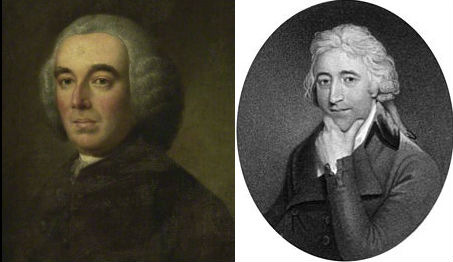
Father and son: James Smith  and James Edward Smith (c) The Ashmolean Museum of Art and Archaeology, and Wikimedia Commons

James Edward Smith (1759-1828) was son of James Smith (1727-1795), a wealthy Norwich wool merchant. This was at a time when Norwich could still claim to be one of England’s major cities, before mechanisation shifted power to the northern towns.  James Edward was a shy, delicate child who was taught at home, at 37 Gentleman’s Way. His mother’s love of plants may have stimulated his precocious love of botany [1].

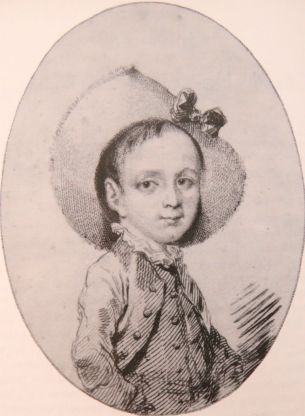
Smith at 3.jpg

James Edward Smith age 3 years 8 months, by Mrs Dawson Turner after a drawing by T Worlidge

His continuing botanical education was to be shaped, however, by the family’s religion – Unitarianism. At that time the two English universities, Oxford and Cambridge, only offered botanical studies as part of a medical course since physicians were required to prepare drugs from medicinal plants. But such studies were closed to non-conformists like Smith since only members of the Church of England were allowed to receive a degree. Against this rising tide of dissent (and by 1829 one in seven of Norwich adults were dissenters [2]) those who could afford it had to be educated elsewhere, at dissenting colleges or universities in Scotland and the Continent. So James Edward Smith went to Edinburgh and, rather prophetically, started his studies on the day that the famous Swedish naturalist, Carl Linnaeus, died [1] .

edinburgh.jpg

Old College, Edinburgh (c) ed.ac.uk

The Enlightenment of the C17th and C18th saw free-thinkers looking beyond the rigid views of the established church and embarking on a more tolerant examination of ideas through scientific enquiry and philosophical reasoning. The C18th was a period of great exploration, not only mapping the world but collecting as many examples of its flora and fauna as possible. After the gathering phase came the sifting stage in which naturalists tried to understand the underlying plan. At Edinburgh, Smith was a student of Dr John Hope, who was one of the first to teach Linnaeus’ (1707-1778) system for classifying plants and animals. Decades later, Charles Darwin (1809-1882), a fellow Unitarian, was also to study medicine at Edinburgh where he was exposed to debate about creation and whether species were God-given (i.e., fixed) or changeable.

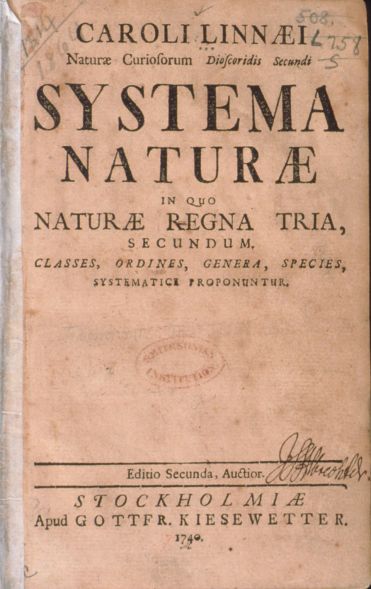
systema naturae2.jpg

(c) Smithsonian Libraries

The Linnaean system of classification placed plants into groups based on the number and arrangement of their reproductive organs.

The sexual basis of this system was not without controversy. Johann Siegesbeck called it ‘loathsome harlotry’ [3] and Linnaeus’ revenge was to give the name siegesbeckia to a small, useless weed.  (Later, Smith was cautioned not to copy Linnaeus’ foul use of “scrotiforme and genitalia”[11]).

The original system based solely on the arrangement of sexual organs was imperfect but two key parts survive in the improved version used today. The first was Linnaeus’ method of placing organisms into hierarchical groups based on shared similarities, from kingdom down through class, order, genus, species (other groups were added later). The second survival was his binomial system in which the two names – genus and species –were sufficient to identify a plant or animal. Before this, plants were referred to by long, imprecise Latin descriptions whereas the binomial system could tie down a specific plant. For example, there are many roses in the genus Rosa but addition of the specific or species name canina distinguishes the dog-rose (Rosa canina) from the red rose (Rosa rubra). Hierarchical classification and the relationship between species can be seen as an important precursor to Darwin whose Tree of Life added an extra dimension by showing that species were not fixed at the time of the Creation but mutable, evolving over time.

Linnaeus died in 1778; his son Carl inherited his father’s collections and when he died only five years later they were offered to the President of the Royal Society,  Sir Joseph Banks (1743-1820), who had befriended Smith in London. The Empress of Russia had tried to buy the collections as had the King of Sweden who is said to have sent a ship to intercept them.

Frigate.jpg

Engraving by Robert John Thornton of the apocryphal pursuit of the Linnean Collection by a Swedish frigate. (c) The Linnean Society of London

Banks could not afford the 1000 guineas himself but persuaded Smith to borrow the money from his wealthy father and so James Edward Smith became possessor of Linnaeus’ 3000 books and 26 cases of plants and insects. Smith was rewarded by being elected Fellow of the Royal Society within two years: three years later he founded the Linnean Society of London, remaining President for the rest of his life [1, 4].

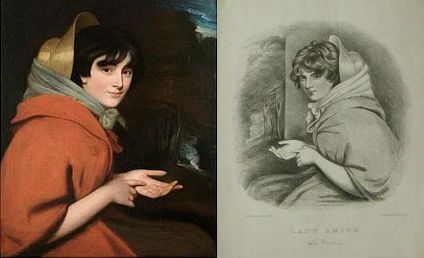
But metropolitan life did not agree with Smith so he returned to Norwich for nine months each year. Ill health is often quoted as a reason but he was known to be fed up with the “envy and backbiting” of London life [11]). In 1796 he married a Lowestoft woman, the letter writer and literary editor, Pleasance Reeve. Lady Reeve was painted as a gypsy by fashionable portraitist John Opie when she was 24: she was to live another 79 years.

Pleasance Smith x2.jpg

Left, Pleasance Smith by John Opie (Wikimedia Commons). Right, by Hannah Sarah Brightwen after Opie (c) National Trust Images, Felbrigg, Norfolk

Two unavoidable discursions:

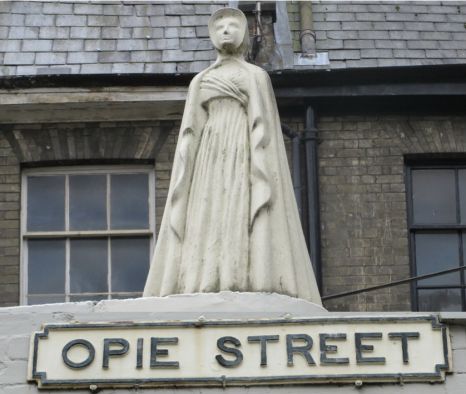
  • The wife of portraitist John Opie – Amelia Opie the novelist and abolitionist – lived at the corner of Castle Meadow, Norwich and is commemorated by a statue in nearby Opie Street [5].

Opiex2.jpg

  • Pleasance, who was childless, was evidently close to her niece Lorena Liddell (née Reeve) who gave her daughter the middle name ‘Pleasance’ after her aunt. This child, Alice Pleasance Liddell, was of course the inspiration for Alice in Wonderland. [6].
781px-Alethea,_by_Julia_Margaret_Cameron.jpg

Alice Pleasance Liddell aged 20 by Margaret Julia Cameron (Wikimedia Commons)

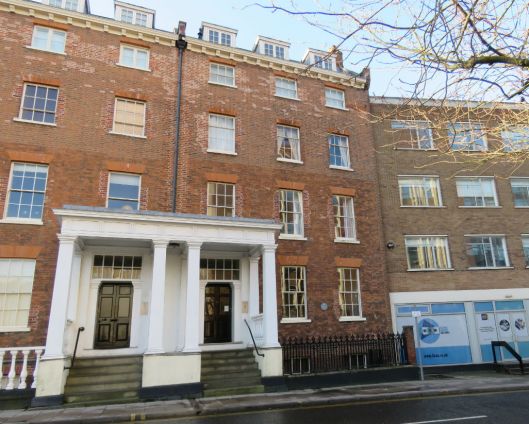
When Smith married Pleasance, her father gave them the tall Georgian town house, 29 Surrey Street, Norwich, as a wedding present. The garden that once contained Smith’s beloved plants was sold in 1939 to the Eastern Counties Bus Co [7]; No 29 itself was bomb damaged during WWII while the adjoining part of the terrace was worse hit and replaced somewhat unsympathetically after the war.

29SurreySt.jpg

29 Surrey Street, Norwich (centre). Two houses to the right were replaced after the war.

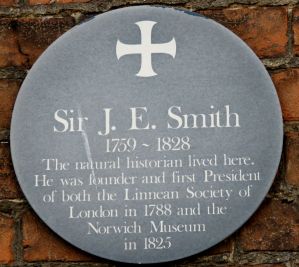
SmithPlaque.jpg

The row of houses had been designed by local architect Thomas Ivory (1709-1779), who contributed much to Georgian Norwich [6]. Not only did he design The Assembly House and the terrace in Surrey Street but he built the elegant Octagon Chapel in Colegate. Smith was deacon there when in 1820 the ownership of the chapel transferred from the Presbyterians to the Unitarians.

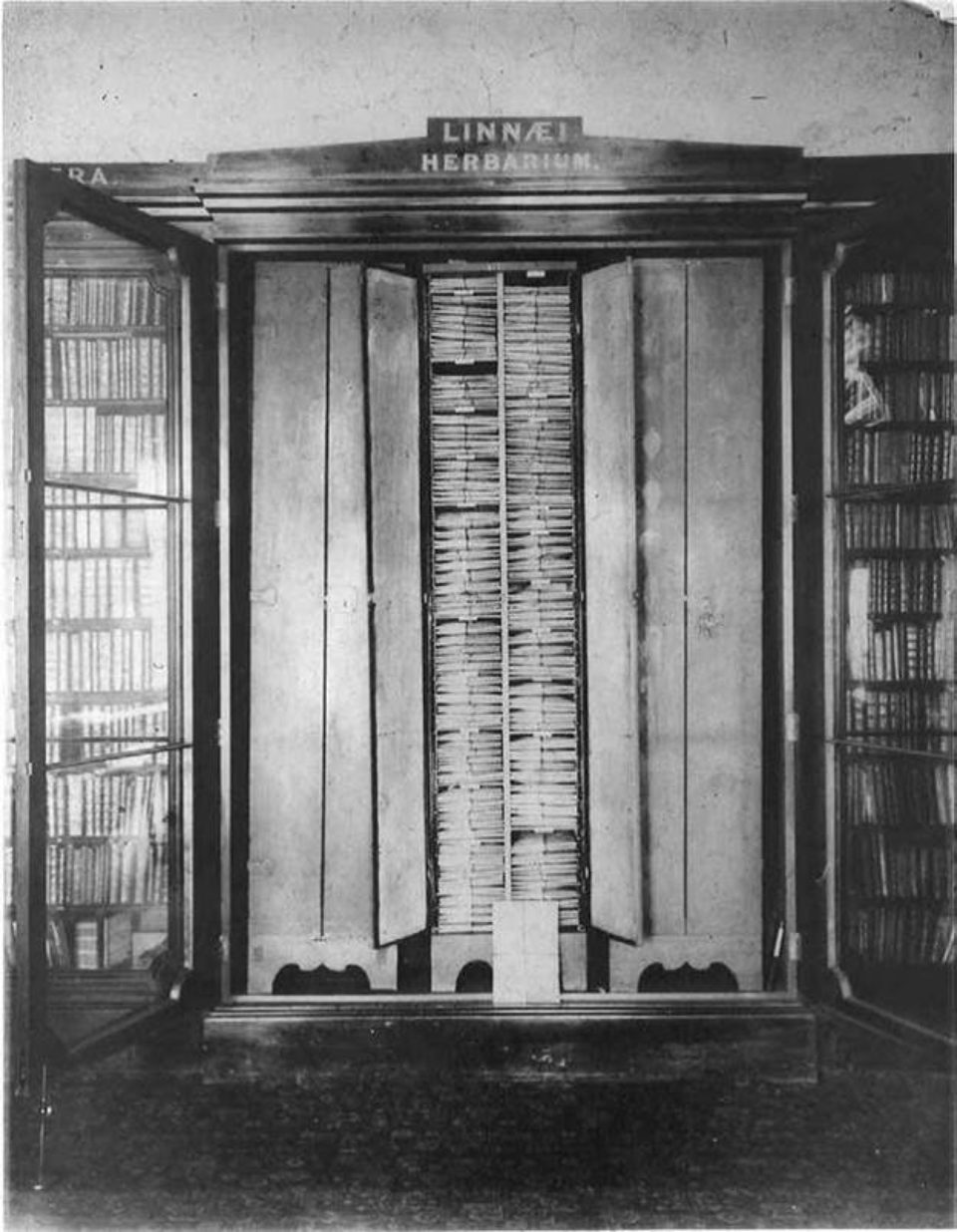
For as long as he lived in Norwich the house in Surrey Street, and not the Linnean Society, was the private museum in which Smith housed the Linnean collection. This included Linnaeus’ three herbarium cabinets arranged so that ca. 14000 specimens – plants dried on sheets of paper – could be easily referenced [1]. Attracted by Linnaeus’ own type specimens “Norwich (became) the centre of the biological and natural history study of the world” [8]. In 1938, two of the cabinets returned to Sweden but the Linnean Society retained one plus all contents.

Herbarium-CabinetLinnSoc.jpg

One of Linnaeus’ original herbarium cabinets (c) Linnean Society of London [9]

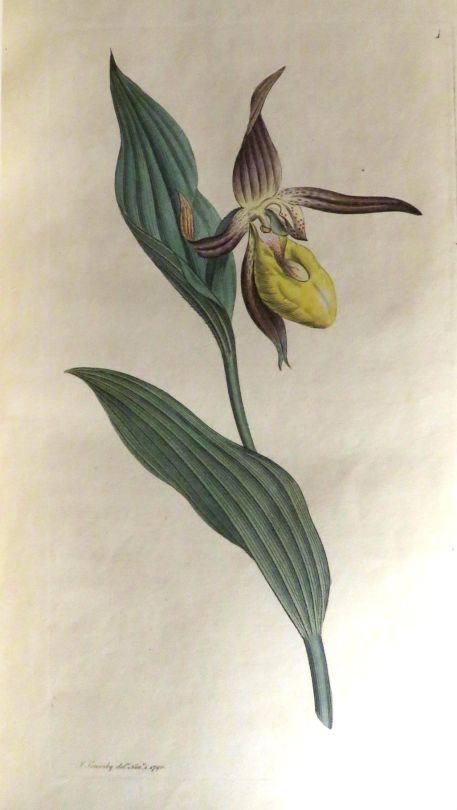
Smith maintained a prodigious output. Between 1790 and 1823 he published 36 volumes of English Botany [10]. The series, which was issued by subscription, contained over 2,500 hand-coloured plates by illustrator James Sowerby: indeed, the work was sometimes called Sowerby’s Botany because Smith – unsure about being associated with a popular illustrated work in English – left his name off the first edition [11].

ladies slipper.jpg

Lady’s-slipper orchid by James Sowerby from JE Smith’s English Flora. Courtesy John Innes Foundation Collection of Rare Botanical Books

Smith also wrote Flora Brittanica (1800-1804) and The English Flora (1824-1828). At the time of his death Smith had also edited eight and half of the 12 volumes of John Sibthorp’s survey of Greek flowers, Flora Graeca [12] – a beautiful publication, each with 100 plates illustrated by Ferdinand Bauer (the final volume by Sowerby having 66 plates).

FloraGraeca.jpg

Sibthorp’s Flora Graeca compiled by James Edward Smith. Courtesy John Innes Foundation Collection of Rare Botanical Books

At one time, Smith instructed Queen Charlotte, the wife of King George III, and her daughters; he taught the elements of Botany and Zoology but this relationship was cut short after he criticised the French court and mentioned the republican Jean-Jacques Rousseau. The dissenting mind once again confronted the establishment when Smith tried unsuccessfully to become Professor of Botany at Cambridge University – his non-conformity, support for the abolition of slavery and of Greek independence, did not help his cause [1].

Perhaps surprisingly, Smith did not bequeath his collections to the society he had founded and of which he had been President for life. Instead, he left instructions that they were to be sold as one lot to a public or corporate body, causing The Linnean Society to purchase the very reason for their existence for the vast amount of £3150 – a sum that took them over 40 years to pay off [1].

There is a memorial plaque to Sir James Edward Smith on the north side of the nave in St Peter Mancroft, Norwich, but his body was interred in his wife’s family vault in the churchyard at St Margaret’s Lowestoft.

JESmith vault.JPG

©2017 Reggie Unthank

Thanks to archivist Sarah Wilmot for providing access the rare books in the John Innes Historical Collections. Visit http://collections.jic.ac.uk/. It is an amazing resource and Sarah encourages visits and invitations to talk (sarah.wilmot@jic.ac.uk).

Sources

  1. https://www.linnean.org/library-and-archives/library-collections-of-j-e-smith/biography
  2. Rawcliffe, C., Wilson, R. and Clark, C. (2004). Norwich since 1550. Pub: A&C Black.
  3. http://www.ucmp.berkeley.edu/history/linnaeus.html
  4. Gage, A.T. (1938). A History of the Linnean Society of London. Pub: Linnean Society London.
  5. http://www.heritagecity.org/research-centre/whos-who/amelia-opie.htm
  6. Do read Joe Mason’s fascinating blog on this house, where his family had lived. https://joemasonspage.wordpress.com/2012/05/22/the-story-of-a-house-1/
  7. http://www.heritagecity.org/research-centre/whos-who/thomas-ivory.htm
  8. http://www.nnns.org.uk/sites/nnns.org.uk/files/imce/user11/publications/natterjack/NJ108.pdf Quote from Tony Irwin page 20.
  9. https://ca1-tls.edcdn.com/listing/_c960xauto/Herbarium-Cabinet.jpg?mtime=20160705144628
  10. https://en.wikipedia.org/wiki/English_Botany
  11. White, P. (1999). The purchase of knowledge: James Edward Smith and the Linnean Collections. Endeavour 23: 126-129.
  12. https://en.wikipedia.org/wiki/Flora_Graeca

The Norwich Society helps people enjoy and appreciate the history and character of Norwich.   Visit: www.thenorwichsociety.org.uk

NorwichSocLogo.jpg


Share this:

  • Share on Facebook (Opens in new window) Facebook
  • Share on X (Opens in new window) X
  • Share on Pinterest (Opens in new window) Pinterest
  • Email a link to a friend (Opens in new window) Email
  • Print (Opens in new window) Print
Like Loading...

Arts & Crafts pubs in the C20th

22 Thursday Dec 2016

Posted by reggie unthank in Norwich buildings, Norwich history

≈ 15 Comments

In an earlier post I mentioned two turreted pubs that reminded me of the ‘medieval’ towers by Victorian architects like the Williams, Morris and Burges – Gothic Revivalists who peddled nostalgia for a pre-industrial past. Why did these and other pubs continue to refer to the Middle Ages half a century or so after the height of Victorian medievalism?

magdalen-rd-artichoke-ph1932plunkettpixlr1.jpg

The Artichoke PH in 1932 (c) georgeplunkett.co.uk

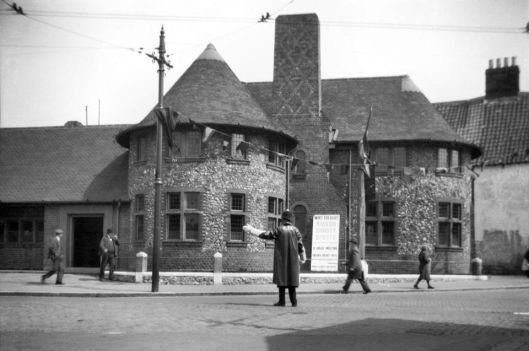
The first pub, at the end of Magdalen Street, was The Artichoke with its conical roofs so reminiscent of chateaux of the French Middle Ages. Built in 1934, The Gatehouse on Dereham Road shares a clear resemblance. Neither pub would have been out of place in 1860. William Morris’s version of the Gothic Revival in the mid C19th can be seen as a reaction to industrialisation – a symbolic retreat to sunnier times when honest craft was appreciated. However, the medieval-style pubs of the 1930s looked back at Merrie England from a different viewpoint: the intervening First World War provided a new and powerful reason for reacting against mechanisation and for settling on a style that so strongly rejected C20th Modernism.

The Gatehouse is clearly built in the revived medieval style. One of its intriguing stylistic details is the chequering produced by alternating panels of ubiquitous Norfolk flint with pressed concrete blocks substituting for the stone that is so scarce in Norfolk[1].

The Gatehouse.jpg

The Gatehouse 1939. (c) georgeplunkett.co.uk

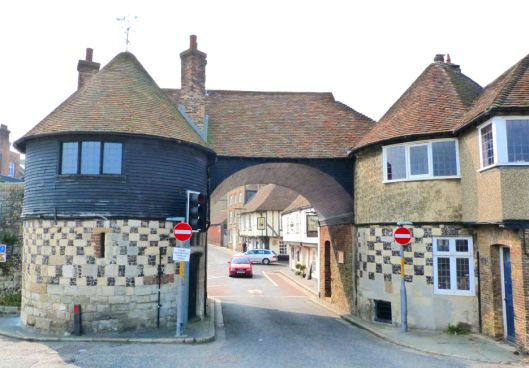
A likely model for The Gatehouse was the Barbican gatehouse (1539) to the toll bridge in Sandwich, Kent [2]. The two-storeyed bays are very similar and the names are near-enough synonymous.

sandwich-the-barbican1.jpg

The Barbican, Sandwich, Kent (c) rollingharbourlife.wordpress.com
A third pub, The Barn, at the bottom of Grapes Hill shares a family resemblance to The Artichoke and The Gatehouse, perhaps not surprisingly since  all three were designed by Norwich architects Buckingham and Berry whose offices were in Prince of Wales Road. The original pub was destroyed during the bombing raids of 1942.

The Barn Trio1.jpg

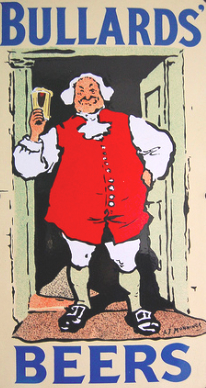
The cockerel sign on The Barn marks a takeover by Courage but the lazy anchor in the gables shows that the pub was originally built for Norwich brewers, Bullards. Their sign of the jolly landlord was designed in 1909 by one-time student of Norwich School of Art, A. J.(later Sir Alfred) Munnings.

Bullards sign.jpg

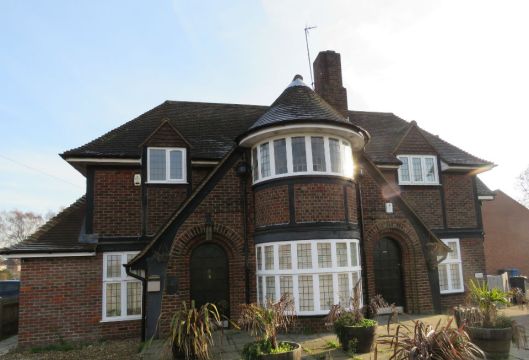
A fourth family member is the Constitution Tavern on Constitution Hill, also designed in the early 1930s by Buckingham and Berry. With its projecting double-height semi-circular bay, capped with a conical roof, The Constitution Tavern taps into the medieval style while the catslide roof over the twin doors references the Arts and Crafts houses of Charles Voysey from the beginning of the C20th.

Consti1.jpg

The former Constitution Tavern, now a private house

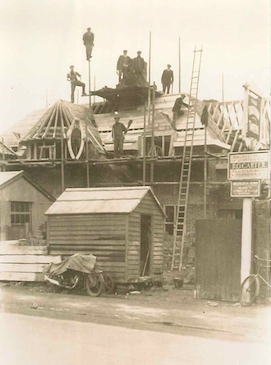
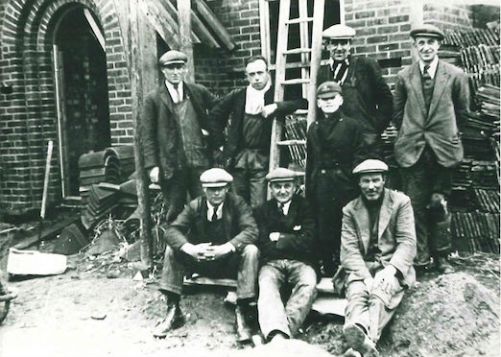
Not only were these four buildings designed by the same architects but they were all built by the same Norwich building firm of RG Carter.

image001.png

Consti2.jpg

RG Carter’s workers building The Constitution Tavern in 1933. (c) rgcarter-construction.co.uk

The Artichoke and The Barn stand just outside the city walls, at the Magdalen and St Benedict’s Gates, respectively. The Gatehouse and The Constitution Tavern are situated further out from the city: the latter on Constitution Hill on what was the old North Walsham Turnpike; the former on Dereham Road, near another circle of hell – the outer ring road.

RG Carter workers.jpg

RG Carter’s son Bob (in school cap) with workmen outside The Constitution Tavern (c)rgcarter-construction.co.uk

The construction of the outer ring road in the 1930s helped relieve unemployment and established an outer boundary to the expanding city. Up until the First World War most citizens lived within the walled city, a very large number of them in the Norwich Yards – dwellings made in the gardens and courtyards of grander houses abandoned by the wealthy. As Frances and Michael Holmes have graphically shown, by the 1930s these ramshackle houses were poorly ventilated, ill-lit and very unsanitary [3].

The conditions of life in this yard must be hard indeed. An open channel runs in front of the houses containing sewage, slops and rainwater. The smell was neither imaginable nor describable. One battered pump made in 1808 supplies water to…three yards. [Norwich Mercury, see 3]. 

King St Murrell's Yard [1265] 1936-08-13_s.jpg

Murrell’s Yard, King Street, Norwich 1936 (c) georgeplunkett.co.uk

To make ‘homes fit for heroes’ the 1919 Housing and Town Planning Act required local authorities to provide houses for families. The City Council responded by starting to build the large estates that now more-or-less encircle the medieval city. The council also received government funding to build five parks (Wensum, Eaton, Heigham, Waterloo and Mile Cross Gardens) that gave pleasure to the rising population as well as providing unemployment relief  [4]. In the 1920s and 30s Captain A Sandys-Winsch supervised the laying out of these parks and planted the characteristic avenues of trees that still soften the roads beyond the old city walls.

Pr-_of_Wales_arriving_1928_350.jpg

In lock-step The Prince of Wales (centre), with Sandys-Winsch (on his right), opening Eaton Park in 1928. Courtesy  of [5]

It was against this background of civic improvement that the new public houses were designed. Morgan’s Brewery, for example, took advantage of the new estates and the increased traffic on the ring road to build The Gatehouse on the site of a former pub. The wave of pub building was not confined to Norwich for about 1000 new pubs were built countrywide in the 1920s, and 2000 in the period 1935-1939.  Most of these were part of the Improved Pub Movement that hoped to change the perception of public houses as places of drunkenness to a more respectable one with separate saloon bars, dining rooms, games rooms and gardens that would encourage women.

ct31319.jpg

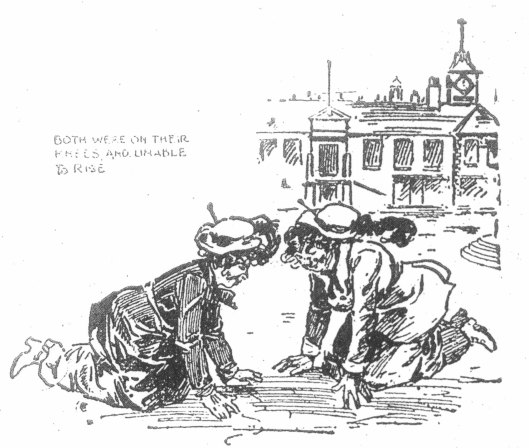
‘Both were on their knees and unable to rise’. Carlisle 1917. Courtesy www.cumbriaimagebank.org.uk

During the First World War the government became concerned by the absenteeism and poor productivity in munitions factories caused by drunkenness. In what became known as ‘The Carlisle Experiment’ the government nationalised breweries and pubs around Carlisle and parts of the Scottish Borders; they also redesigned pubs and food-providing taverns to try to control the excesses of munitions workers [6]. This experiment in public house reform had national impact and provided a model for the new public houses of the 1920s and 30s.

In 2015, Historic England awarded The Gatehouse and 20 other national pubs Grade II listing in recognition of their place in the historic Improved Pub Movement [7,8]. Virtually all are built in a backward looking Arts and Crafts style.

the-gatehouse-norwich.jpeg

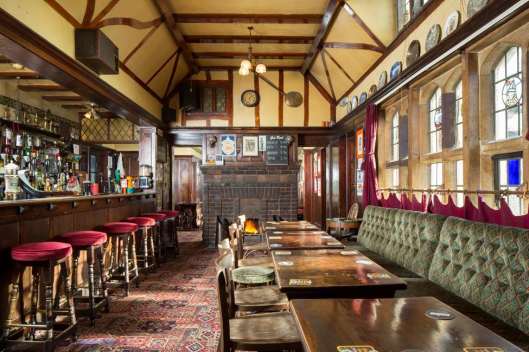
The rather baronial bar of The Gatehouse (c) Historic England/Pat Payne Ref: DP172339

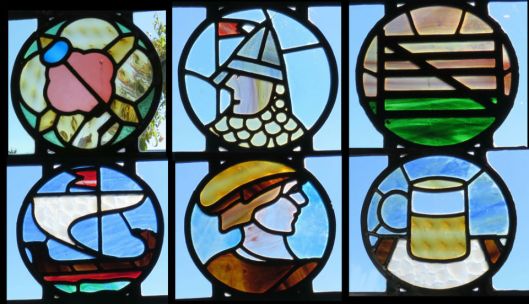
The stained glass panels, just visible in the photo above, are thought to reference the Bayeux Tapestry, underlining the diversity of sources that the Improved Pub Movement used to evoke the faux medieval style.

gatehousesix.jpg

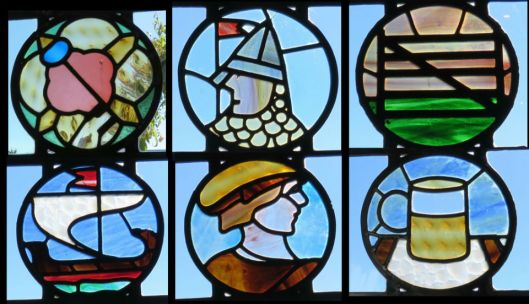
Montage of stained glass panels in The Gatehouse

The building of roads, estates and pubs therefore took place as a more or less coherent campaign under the general banner of ‘improvement’. RG Carter’s building firm played a major part in shaping the outer city. Where the A1024 crosses the Drayton Road they built the Mile Cross Estate of 92 houses (1925) together with the shopping centre (and a similar one on the opposite side of the city where The Avenues crosses the ringroad).

IMG_3798.JPG

Carters built a mirror image to this curved shopping centre, out of shot to the right

In 1929 Carter’s also built the nearby pub, The Galley Hill, in a simple Tudor Revival style. The S&P carved into the half-timbered gable end shows it was built for the Norwich brewery of Steward and Patteson.The MItre 2.jpg

Carters also built The Mitre in Earlham Road for Bullards – a solid Tudor Revival building with jettied central bay and timbered side bays infilled with herringbone brick. The local newspaper said it was a vast improvement on its Victorian predecessor and that the quality of its ‘half-timber work is not of the kind associated with speculative work and liable to be blown off by the wind.’ That is, the woodwork appeared to be a more integral part of the structure than the superficially applied beams on speculative pubs built in ‘Brewer’s Tudor’ [9]. It was presumably the cheapened form that John Betjeman referred to as ‘various bogus-Tudor bars‘ in his poem, Slough.

Earlham Rd 131 Mitre PH [B510] 1933-03-28.jpg

The Mitre 1933,  Earlham Road, now a community space for St Thomas’ church, at left  ©georgeplunkett.co.uk

It is not clear who built The Boundary Inn at the intersection of the ring road and the A140 where a Mile Cross boundary marker used to stand. However, this pub does have the usual stylistic tics of the Tudor Revival style, with its high-pitched roof, prominent chimney, a hint of half-timbering and Tudor-arched doors. It was built in 1928 for Young, Crawshay and Youngs.

boundary1.jpg

The Boundary PH, Aylsham Road, Norwich

Carters constructed the Bull Inn at Hellesdon [1935] although its historical credentials are Tudor-lite compared to The Mitre.

The Bull Inn 1.jpg

But after World War II the moment had passed, the Gothic and Tudorbethan revivals had lost their fascination and a new austerity had arrived, as can be seen from The Dial on Dereham Road, built for Bullards  by RG Carter in 1950.

THE DIAL.jpg

The Dial PH. Courtesy rgcarter-holdings.co.uk

Sources

  1. http://www.rgcarter-construction.co.uk/about/
  2. https://historicengland.org.uk/services-skills/education/educational-images/barbican-high-street-sandwich-cc56-00758
  3. Holmes, Frances and Holmes, Michael (2015). The Old Courts and Yards of Norwich: A Story of People, Poverty and Pride.  Pub: Norwich Heritage Projects.
  4. https://historicengland.org.uk/listing/the-list/list-entry/1001348
  5. http://friendsofeatonpark.co.uk/history/
  6. https://historicengland.org.uk/whats-new/first-world-war-home-front/what-we-already-know/land/state-control-of-pubs/
  7. https://historicengland.org.uk/whats-new/news/twenty-one-best-inter-war-pubs-listed.
  8. http://www.edp24.co.uk/news/find_out_why_heritage_chiefs_decided_to_protect_a_norwich_pub_1_4213510
  9. https://en.wikipedia.org/wiki/Tudor_Revival_architecture

I am indebted to the RG Carter Archive, Drayton, Norwich for supplying photos and information. I am also grateful to: Gareth Hughes for making the connection between The Gatehouse and Barbican Gate, Sandwich; Stephen White of Carlisle Library, Frances Holmes, and the invaluable Plunkett archive (www.georgeplunkett.co.uk).

The Norwich Society helps people enjoy and appreciate the history and character of Norwich.   Visit: www.thenorwichsociety.org.uk

NorwichSocLogo.jpg

Share this:

  • Share on Facebook (Opens in new window) Facebook
  • Share on X (Opens in new window) X
  • Share on Pinterest (Opens in new window) Pinterest
  • Email a link to a friend (Opens in new window) Email
  • Print (Opens in new window) Print
Like Loading...

Entertainment Victorian style

01 Thursday Dec 2016

Posted by reggie unthank in Norwich history

≈ 12 Comments

Tags

Norwich entertainment, Norwich transport, Victorian transport

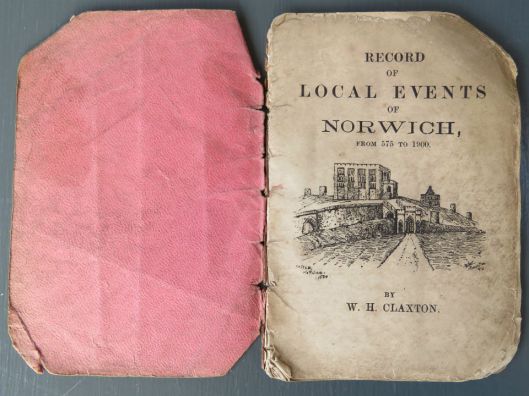
Ken Skipper of the Cork Brick Gallery, Bungay, recently lent me this small book on historical events in Norwich. It starts with the castle being built by King Uffa the First in 575AD and ends on July 30 1900 with the Electric Tram Company running their “first Cars for the Public”. All the early events are big ticket items, official record entries like, “981 The City was utterly destroyed by the Danes”. Compared to this the C19th entries seem inevitably mundane yet they are fascinating for providing insight into mass entertainment in the Victorian age. As we shall see, this is closely linked with developments in transport.

NorwichBook.jpg

“1825. September 7. Col. John Harvey, High Sheriff, ascended in a Balloon from Richmond Hill Gardens.” Before the age of mass transport, pleasure gardens at the periphery of the crowded medieval city centre were important sources of entertainment. London had its famous C18th Ranelagh and Vauxhall Gardens [1]: Norwich  had its versions too. Norwich’s Ranelagh Gardens were just outside the city walls between what is now St Stephen’s Road and Sainsbury’s supermarket. The ornamental gardens contained The Adelphi Theatre, a skittle alley and the Pantheon arena where firework displays would help depict famous British victories [2, 3].

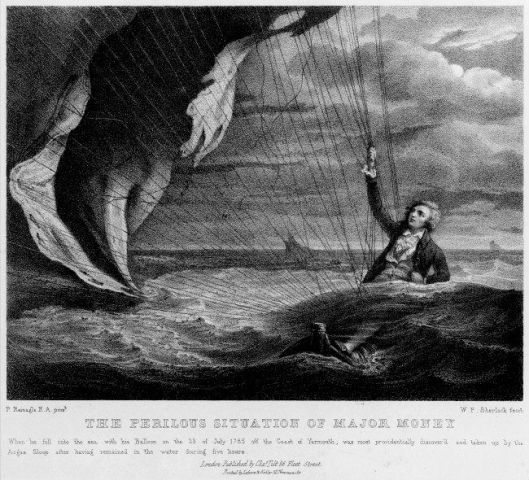
The High Sheriff’s flight from another pleasure gardens in Bracondale was evidently uneventful but in July 1785, only two years after the Mongolfier brothers’ first balloon flight, The Ranelagh Gardens had been witness to a more dramatic event when Colonel Money of the East Norfolk Regiment of Foot ascended in an ‘aerostatic globe’ [4, 5]. Unfortunately, an ‘improper current’ took him out to sea, off Yarmouth and Lowestoft. In his words:

 I ascended from this place with a balloon, and was drove out to sea, not being able to let myself down from the valve being too small. After blowing about for near two hours I dropped in the sea. My situation, you may easily conceive, was very unpleasant… [6].

ColMoneysBalloon.jpg

A Byronic Colonel Money struggling for his life off Yarmouth. Courtesy Picture Norfolk, Norfolk County Council 

“1826. Humbug on Mousehold. Signor Carlo Gram Villecrop’s ‘leap'”.  [A humbug: a trick, a deception] Mousehold Heath – the high ground overlooking the city – was another venue capable of accommodating large crowds. According to a circulated bill, Signor Villecrop the Swiss Mountain Flyer promised to appear there on the 28th of August and with his 50 foot Tyrolese pole would perform:

the most astonishing gymnastic flights never before witnessed in this country… (and) … will frequently jump forty and fifty yards at a time[4].

Screen Shot 2016-11-16 at 15.07.09.png

Not Signor Villecrop. ghost-in-the-library.tumblr.com

He would run up St James’ Hill with the pole between his teeth, lie on his back and balance the pole on his nose and on certain parts of his body, walk up and down the hill on his head balancing the pole on his foot. Twenty thousand people came to see him but it was, of course, a hoax.

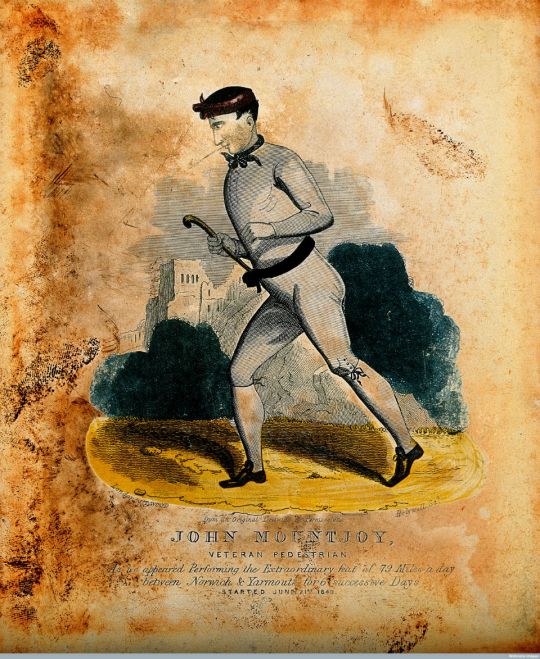
“1840. June 21. Mount Joy walked from Norwich to Yarmouth and back twice a day for six consecutive days”. John Mountjoy was referred to as ‘a veteran pedestrian’ – that is, a speed walker – and in the summer of 1840 he performed a series of remarkable feats [5].

Mountjoy1.jpg

John Mountjoy, Veteran Pedestrian. Courtesy of Wellcome Library, London

He started his twice-daily walk from the Shirehall Tavern, Norwich, to Symonds’ Gardens, Yarmouth and when, six days later, he crossed Foundry Bridge for the last time a ‘tremendous crowd bore the toll collectors before them and made a free passage’. Previously, on the 16th of June at The Ranelagh Gardens he had taken up with his mouth, without touching the ground with his knees, 100 eggs a yard apart and dropped them into a bucket of water without breaking them. Warming to his theme, on the 13th July he ran a mile, walked a mile backwards, ran a wheelbarrow half a mile, trundled a hoop a mile, hopped 200 yards, picked up with his mouth 40 hazelnuts etc etc  …

“1847. Douro and Peto were chaired, at which stones were thrown at Douro.” This economically-worded entry glosses over what others have called the Norwich election riots of 1847: an example of When Crowds Go Wrong. Samuel Morton Peto was an eminent Victorian responsible for building The Reform Club, Nelson’s Column, The Houses of Parliament, London’s brick sewers etc. [7]. Peto was a major railway contractor and was said to have been the largest employer of labour in the world [8]. He built railways around the globe but is remembered locally for building the lines that connected Yarmouth and Lowestoft to Norwich and London. The speed and capacity of trains finished the coaching trade to London [9] but allowed large numbers of Norwich citizens to spend leisure time at the growing seaside resorts, like Cromer, Yarmouth and Lowestoft. Glance up next time you visit Norwich Rail Station.

Peto.jpg

On the concourse of Norwich Station, “Sir Samuel Morton Peto 1809-1889. Baptist Contractor Politician & Philanthropist”

In the election The Marquis of Douro (The Duke of Wellington’s son) and  Peto won two of the available seats, leaving the other candidate – the Non-Conformist Serjeant Parry – well behind. Two hundred of Peto’s navvies from the Eastern Counties Railway paraded merrily through the city until they met Parry’s disgruntled supporters. Stones were thrown. The outnumbered navvies became barricaded in The Castle Inn, windows were broken and the police had to use horse buses to transport the workers to a special train waiting at the station. Peto paid £70 towards the damage. Whether or not this constituted a riot depended very much on the newspaper that reported the affair [7].

“1858. Huffman’s Humbug on the Old Cricket Ground”.  Now, you would have thought that those who had been bamboozled by Villecrop’s humbug in 1826 would have warned the next generation when Mr JW Hoffman came to town. But Hoffman had previously been to Norwich as manager of his ‘Organophonic Band’ (a full orchestra with just the human voice) so it did appear as if he could put on a show [5].

Hoffman's band.jpg

Courtesy Terry Drayton

On this occasion Hoffman had widely advertised a medieval pageant on the Old Cricket Grounds, presumably at Lakenham.

Lakenham Cricket.jpg

The Cricket Ground, Lakenham, Norwich. (c) Dereham Times

The big difference between this and the previous humbug was that the railway had in the meantime come to Norwich – the Yarmouth line in 1844 and London via Brandon in 1845. And The Ranelagh Gardens were now occupied by Victoria Station. Train companies ran excursions, crowds thronged the streets; once again the city was immobilised and business was suspended. With so much anticipation the pageant, which consisted of 30-40 people on foot following a man on a horse, was an anti-climax and was met with boos and hisses. The ‘Old English Sports’ that followed were also a failure, ending with general fighting amongst the blackguards at the ground [5]. But the long arm of the law soon caught up with Hoffman for in September 1858 The London Gazette mentioned that John William Hoffman, Professor of Music and Elocution, Exhibitor of Ventriloquism, and Caterer for Public Amusement in General, and of 16 previous addresses, was being sued in Shrewsbury County Court [10].

“1868. Aug 13. Mr Maris ascended in a Balloon from the Market-place, which was lost at Sheringham.”  Balloon flights continue to be mentioned in The Record of Local Events throughout the C19th. We do know that some balloons were filled with coal gas at the City Gas Works in Bishop Bridge then led to the launch site. It isn’t known how the balloon was filled on this occasion but hundreds of people waited all day in the market place to see the ascent. At about six o’clock, Mr Maris the fruiterer ascended with Mr Simmons the aeronaut. After two minutes they had already risen to 10,000 feet from where Mr Maris was able to point out towns as far apart as Harwich and King’s Lynn. However, the noise below of threshing machines and barking dogs very soon gave way to the sound of the sea and they had to make an emergency descent. Fortunately, they jumped out over land but the balloon, now lighter, re-ascended and was lost in the sea at Sheringham [5].

NorwichBalloon.jpg

Norwich balloon ascent, late C19. (c) Norfolk County Council. Picture Norfolk

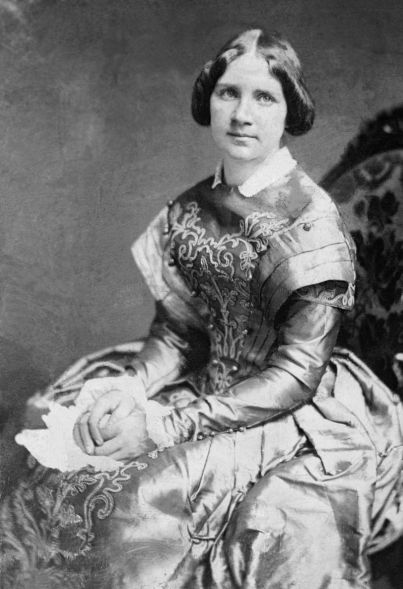
“1849. Jenny Lind sang.”  Jenny Lind, ‘The Swedish Nightingale’, was one of the most popular sopranos of the early-mid C19th and she was more deeply embedded into Norwich life than this brief note could suggest [11].

800px-Jenny_Lind_retouched.jpg

She first came to sing in St Andrew’s Hall in 1847 …

jenny lind poster reduced.jpg

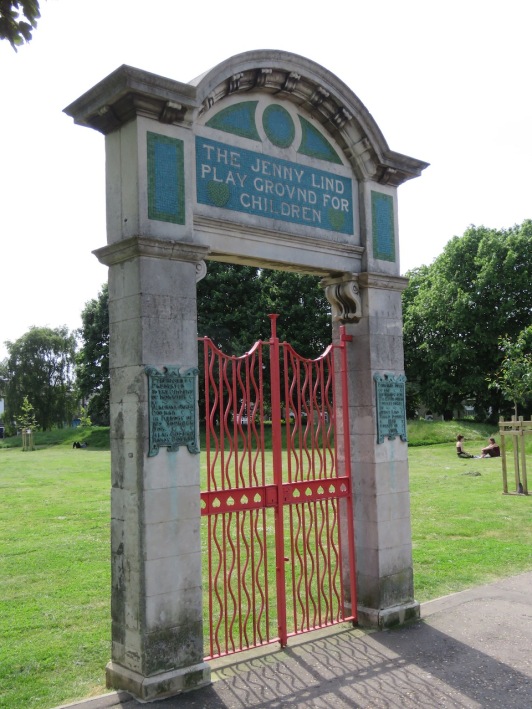
… two years later, at the age of 29, she announced her retirement from opera although she still appeared in the concert hall and even toured with showman TP Barnum in the States. She was highly philanthropic and the money she raised from concerts in 1849 and 1854 [11] funded the city’s Infirmary for Sick Children in Pottergate.  Her name lives on in the Jenny Lind Children’s Hospital at the Norfolk and Norwich University Hospital. Another reminder is provided by the memorial gate in the Jenny Lind Park off Vauxhall Street, left isolated by the Norfolk and Norwich Hospital’s move to Colney. I remember my children saying they were off to play in the Jenny Lind.

JennyLindGate reduced.jpg

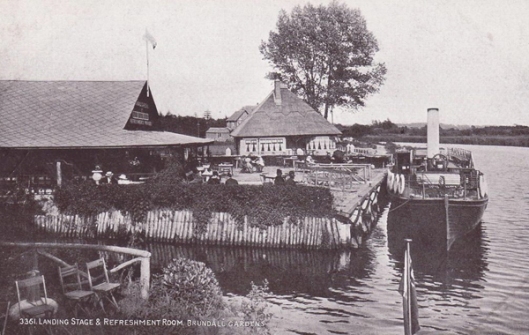
“1895. June 1. The Jenny Lind Steamboat burned”. Steam power would shape the nineteenth century. The little record book mentions the first steamboat on the Yare in 1813 but this later reference is to a serious fire that occurred  at Foundry Bridge. Launched in 1879 the Jenny Lind would run daily excursions from the quayside next to Thorpe Station and travel the few miles down to Bramerton Woods where there was an inn and a seven-acre pleasure garden [12]. The Jenny Lind would also steam down to Brundall Gardens, known as “The Switzerland of Norfolk”because of the 120 acres of wooded slopes surrounding a lake [13].

brundall10_gardensstaithe.jpg

Jenny Lind steamboat at Brundall Gardens (c) broadlandmemories.co.uk 

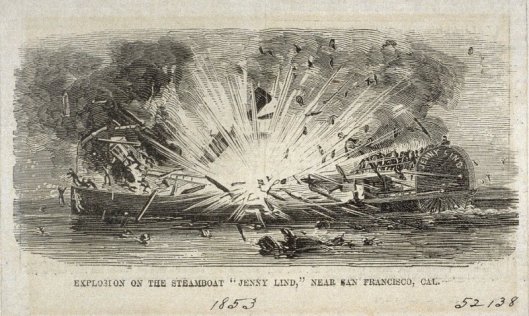
The ship apparently survived but another steamboat named ‘Jenny Lind’was not so fortunate. In 1853, the US steamboat Jenny Lind – a ferry between Alviso and San Francisco– exploded just as dinner was called [14]. Superheated steam flooded the dining room, killing 34 passengers.

jenny lind explosion.jpg

Explosion of the American ‘Jenny Lind’. (c) Fine Arts Museum of San Francisco

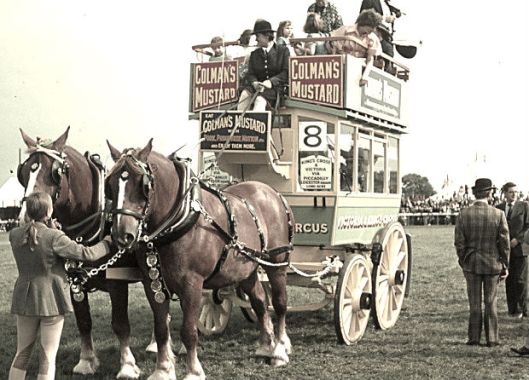
“June 23 1879 Norwich Omnibus Company started.” Increased mechanisation saw workers leave the countryside and find jobs in the city’s industries; by the end of the C19th Norwich’s population had tripled to ca 100,000. Horse-drawn omnibuses carried citizens around the city for 20 years but the company stopped business on December 17 1899 [16].

colmans-omnibus2.jpg

A horse-drawn Norwich omnibus. Photo 1977 (c) Joe Mason [15]

“July 30. 1900. The Electric Tram Company ran their first cars for the Public.” By mid-century, steam engines were carrying people long distances over land and water but within towns and cities horse-power still reigned. But, never an efficient means of mass transport, omnibuses were withdrawn in 1899 and superseded by the horseless carriages of the Norwich Electric Tramways Company [16]. Power was provided by the Norwich Electric Light Company that, from 1892, generated electricity at the old Duke’s Palace Ironworks off Duke Street [see 17].

Boileau fountain 1908.jpg

There were seven routes. The tram above, at the junctions of Newmarket and Ipswich Roads would have been on the Green route to Cavalry Barracks [16]. If Norwich’s industrial workers wanted to get away from the grime they could, in the summer, take the extension up the hill to Mousehold Heath, scene of Signor Villecrop’s humbug three quarters of a century earlier.

The Norwich Society helps people enjoy and appreciate the history and character of Norwich.   Visit: www.thenorwichsociety.org.uk

NorwichSocLogo.jpg


Thanks: to Ken Skipper, Joe Mason, Terry Drayton, broadlandmemories.co.uk, Picture Norfolk (norfolkspydus.co.uk) and Mary Parker for their assistance.

Sources

  1. https://en.wikipedia.org/wiki/Ranelagh_Gardens
  2. John Riddington Young (1975). The Inns and Taverns of Old Norwich. Pub: Wensum Books.
  3. http://www.heritagecity.org/research-centre/at-leisure-in-norwich/norwichs-pleasure-gardens.htm
  4. Carol Twinch (2012). The Norwich Book of Days. Pub: The History Press.
  5. Charles Mackie (2010). Norfolk Annals, a Chronological Record of Remarkable Events in the Nineteenth Century. http://archive.org/stream/norfolkannalsach34439gut/34439.txt
  6.  Scots Magazine June 1785
  7. Terry Coleman (1965). The Railway Navvies. Pub: Hutchinson.
  8. http://www.gracesguide.co.uk/Samuel_Morton_Peto
  9. http://www.heritagecity.org/research-centre/industrial-innovation/norwich-railway-station.htm
  10. https://www.thegazette.co.uk/London/issue/22186/page/4313/data.pdf
  11. https://norfolkwomeninhistory.com/1800-1850/jenny-lind/
  12. http://www.broadlandmemories.co.uk/pre1900gallerypage2.html
  13. http://www.brundallvillagehistory.org.uk/gardens.htm
  14. http://www.mercurynews.com/2013/04/08/herhold-ceremony-set-to-remember-1853-jenny-lind-steamboat-disaster/
  15. https://joemasonspage.wordpress.com/2012/01/22/colmans-mustard-omnibus/
  16. http://www.heritagecity.org/research-centre/social-innovation/swish-rattle-and-clang.htm
  17. https://colonelunthanksnorwich.com/2016/07/28/norwichs-pre-loved-buildings/


Share this:

  • Share on Facebook (Opens in new window) Facebook
  • Share on X (Opens in new window) X
  • Share on Pinterest (Opens in new window) Pinterest
  • Email a link to a friend (Opens in new window) Email
  • Print (Opens in new window) Print
Like Loading...

Jeckyll and the Japanese wave

10 Thursday Nov 2016

Posted by reggie unthank in Aesthetic Movement, Decorative Arts, Norwich history

≈ 13 Comments

Tags

Arts and Crafts, Barnard Bishop and Barnards, James McNeill Whistler, Japonisme, Thomas Jeckyll

Sackler sunflowers.jpg

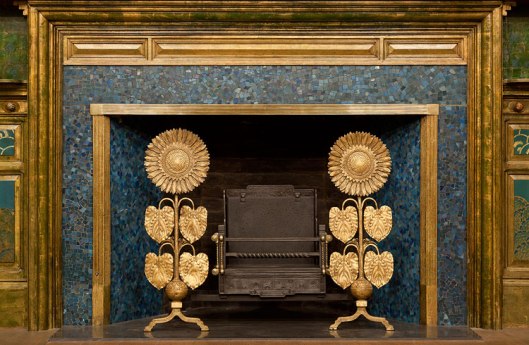
Thomas Jeckyll’s ‘Sunflower’ andirons – emblems of the Aesthetic Movement. (c) The Freer and Sackler Galleries, Washington DC USA. Photo: Neil Greentree 

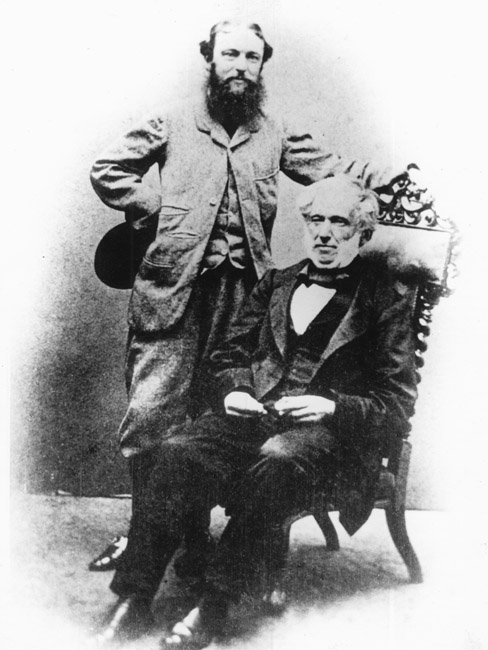
He was a key figure in the Aesthetic Movement who helped spread an esoteric fascination with japonisme to the nation, yet Thomas Jeckyll was an unsung local hero who died in a Norwich lunatic asylum. In previous posts [1,2, 3] I discussed how this son of a clergyman from Wymondham, Norfolk  joined the set of London aesthetes including Whistler, Swinburne, Rosetti and fellow Norfolkman Frederick Sandys. This influenced his work  back home in Norfolk where his designs for Barnard Bishop and Barnards’ Norwich Iron Works advertised the Anglo-Japanese Movement on an industrial scale.

Jeckyll and father.jpg

Thomas Jeckyll with his father George in the 1860s ((c) Picture Norfolk. Norfolk County Council)

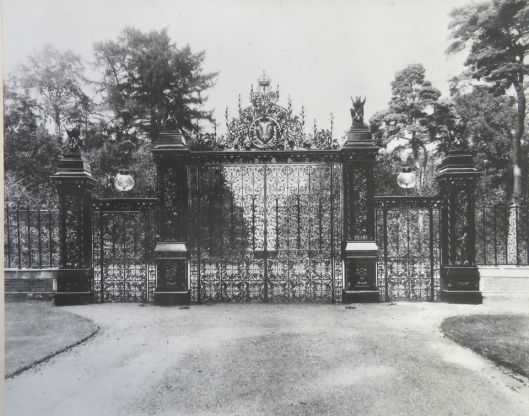
Jeckyll’s first national success was with the Norwich Gates that he designed for Barnards in 1859 [4]. They took three years to manufacture and, when exhibited in the 1862 International Exhibition in London, were awarded a medal for craftsmanship; Jeckyll – who received ecstatic critical acclaim – was elevated to national attention. The people of Norfolk and Norwich bought the gates by public subscription and presented them to the Prince and Princess of Wales on their marriage in 1863. The gates can still be seen at Sandringham.

Norwich Gates.jpg

Norwich Gates, Sandringham, Norfolk (c) Museum of Norwich, Norfolk Museums Service

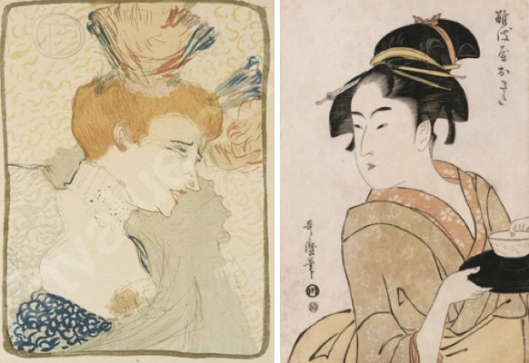
But Jeckyll’s continuing reputation was shaped by events on the other side of the world. In 1853-4 US Admiral Perry used gunboat diplomacy to force Japan out of its self-imposed isolation, opening trade with the west. The woodblock prints that emerged had an immediate impact on western art: the works of Manet, Monet, van Gogh, Vuillard, Toulouse-Lautrec, Bonnard, Cassat all showed the signs of Japanese influence, often being occidental versions of original oriental themes [5]. The unusual (to western eyes) cropping of the image, flattened shapes and planes composed of few subtle colours changed the direction of French art in the latter half of the C19th.

lautrecUtamaro.jpg

‘Mlle Marcelle Lender en buste’ by Henri de Toulouse-Lautrec (1895); bust of the waitress Okita of the Naniwaya teahouse by Kitagawa Utamaro (1753-1806)

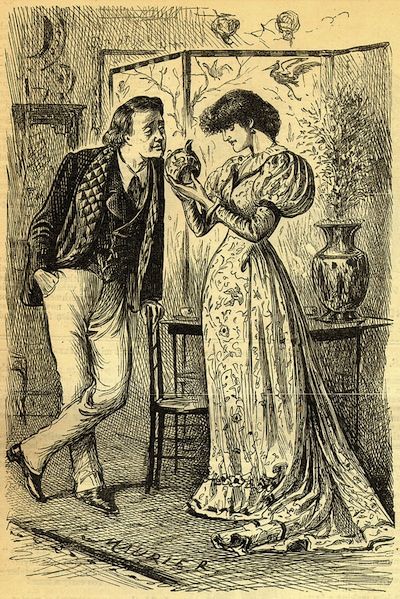
James McNeill Whistler, who was an avid collector of Japanese prints and pottery, is said to have been the first to bring back japonisme to this country after his return from Paris in 1860. The art dealer Murray Marks said that the artist had “invented blue and white in London” [5]. The mania for things Japanese could attract a certain preciousness; after Oscar Wilde said he was finding it hard to live up to his blue china, George du Maurier – one of Jeckyll’s London circle – pricked the bubble with this Punch cartoon:

the-six-mark-tea-pot-400.jpg

The Six Mark Teapot (c) Punch

Aesthetic Bridegroom: “It is quite consummate is it not?”

Intense Bride: “It is indeed! Oh, Algernon, let us live up to it!”

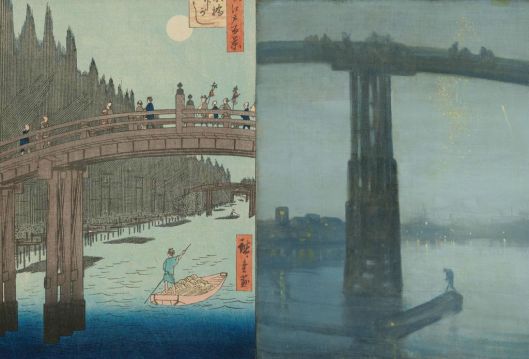
Whistler’s own painting was changed by his exposure to Japanese art. His well known nocturne of Old Battersea Bridge certainly borrowed strongly from Hiroshige’s print of Kyobashi Bridge, part of his One Hundred Famous Views of Edo (as Tokyo was called).

WhistHiro1.jpg

Utagawa Hiroshige, Kyobashi Bridge 1857: James McNeill Whistler, Old Battersea Bridge 1859

While the fashion for things oriental was originally confined to a metropolitan elite, where it developed out of their interest in the fine arts, it soon became a widespread phenomenon of the applied arts [5]. The influential decorative arts designer Lewis F Day recognised that Jeckyll’s work was amongst the first to show this Japanese influence [4]. Art dealer Gleeson White wrote that Jekyll was:

the first to design original work with Japanese principles assimilated – not imitated [6]

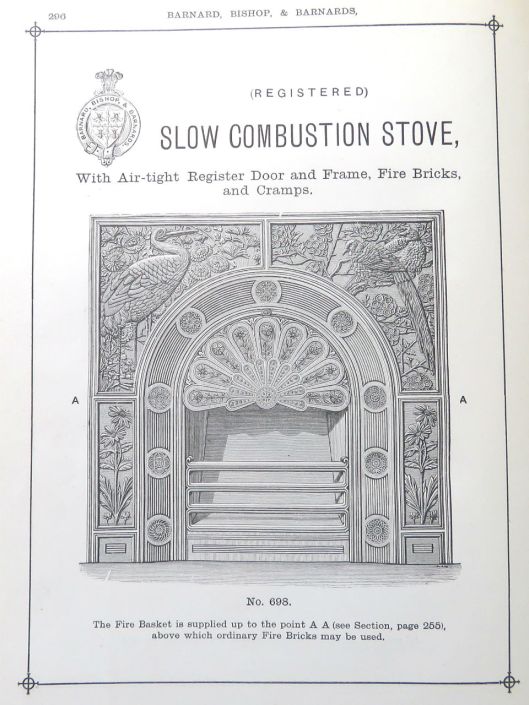
As designer for Barnards at their Norwich foundry, Jeckyll was able to spread japonisme  and he did this largely via the Great British Fireplace (coming soon to BBC1). From ca 1870 Barnard Bishop and Barnards produced numerous japonaise designs into which Jeckyll skilfully introduced cranes, cherry blossom, chrysanthemums, sunflowers etc.

Jeckyll stove.jpg

Designed by Thomas Jeckyll From Barnards’ 1884 catalogue. (c) Museum of Norwich, Norfolk Museums Service

Japanese heraldic roundels or mon also became a recurring motif in Jeckyll’s designs, providing a ready shorthand for japonisme.

Roundels Fplace.jpg

Jeckylll fireplace (c)  The Museum of Norwich, Norfolk Museums Service

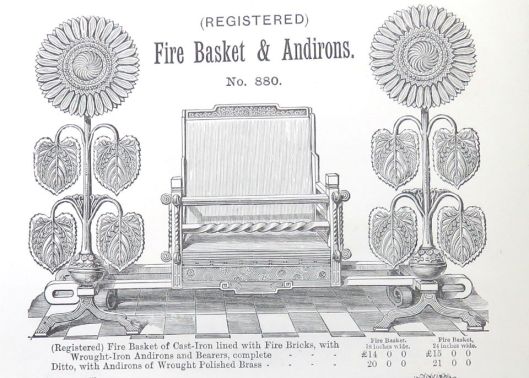
Jeckyll designed numerous pieces of metalwork for the fireside, including perhaps his best-known items: andirons or firedogs in the form of the sunflowers that were to become emblematic of The Aesthetic Movement [7,2]. These sunflowers fenced in Jeckyll’s Pagoda that once stood in Chapelfield Gardens and – in reproduction form – now decorate the gates to these Gardens and to Heigham Park (see previous post [2])

sunflower dogs.jpg

Barnard Bishop and Barnards catalogue 1884. (c) Museum of Norwich, Norfolk Museums Service

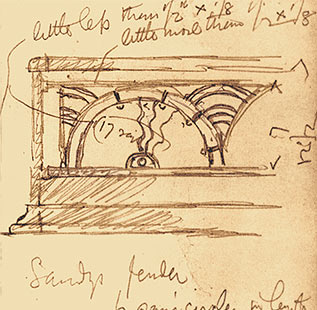
But it was this fender – seen in the apartment of Jeckyll’s friend, the Norfolk painter Frederick Sandys – that impressed a leading figure of the Anglo-Japanese Movement, E.W. Godwin. Indeed, Whistler insisted on having one of these fenders in his own apartment even though Godwin, who was refurbishing it, could have supplied fenders in his own designs [4].

Jeckyll-Brass-Fireplace-Fender_2_1.jpg

EW Godwin’s sketch of the ‘Sandys fender’ (c) Victorian and Albert Museum, London

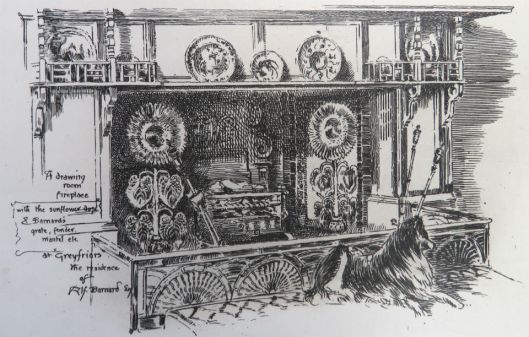
This fender can be glimpsed in part of a larger sketch made in Charles Barnard’s home ‘Greyfriars’, Norwich (demolished). Jeckyll’s sunflower andirons are also illustrated.

BarnardsFPlace.jpg

Firedogs. (c) Museum of Norwich, Norfolk Museums Service

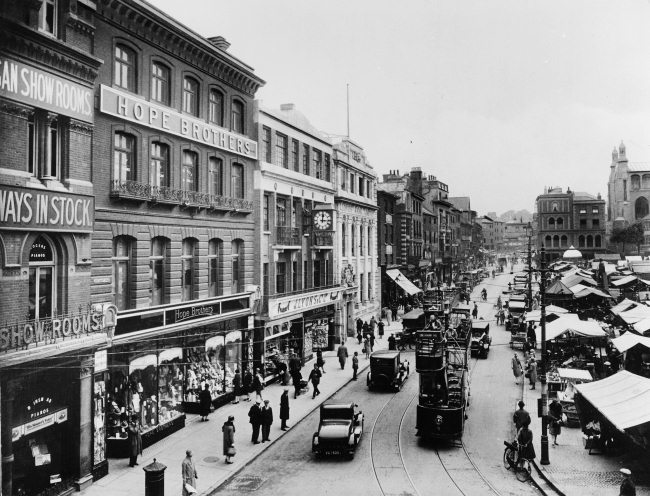
These were not prototypes made just for friends, for the fender must have been sold in fair numbers through Barnards’ catalogues and showrooms. Barnards’ Norwich showroom was on Gentleman’s Walk next to the market. By the 1930s the Hope Brothers had taken over the shop but it was still possible to see on the second floor the balcony railings that Jeckyll designed.

Hope Bros.jpg

(c) Picture Norfolk. Norfolk Museums Service

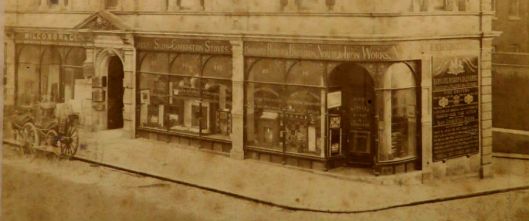
Barnards also had a showroom in Queen Victoria Street, London.

Barnards shop1.jpg

Barnards London showroom (c) Museum of Norwich, Norfolk Museums Service

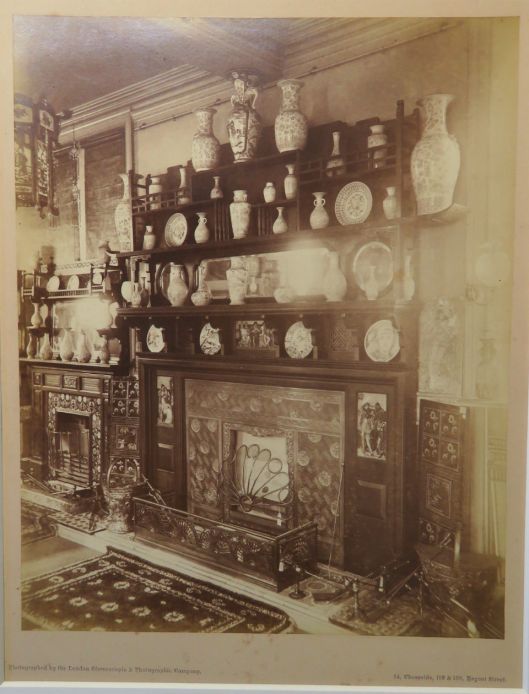
Below, we can see the fender advertised in the London showroom – the photograph providing a glimpse of the mishmash of Japanese, Chinese and even medieval influences available to the rising middle classes wanting to establish their Aesthetic credentials.

barnards showroom.jpg

Barnard, Bishop and Barnards London showroom in the latter part of the C19. (c) Museum of Norwich, Norfolk Museums Service

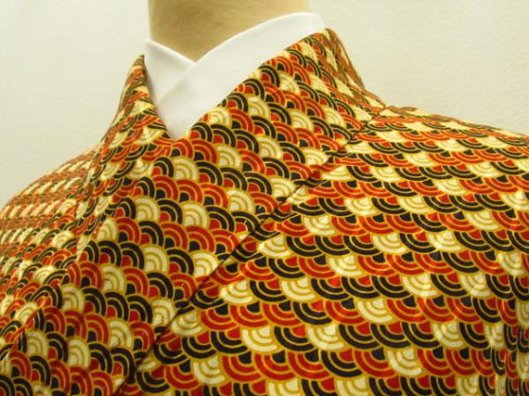
The scalloped pattern, which became one of Jeckyll’s most frequently used motifs, was based on a Japanese design. For the fender, Jeckyll had used a single layer of semi-circles as the main motif but it is clear from his other work that this had been extracted from the larger seigaiha (blue ocean wave) design.

smithjackEtsy.jpg

Seigaiha pattern on a kimono. (c) SmithjackJapan on Etsy

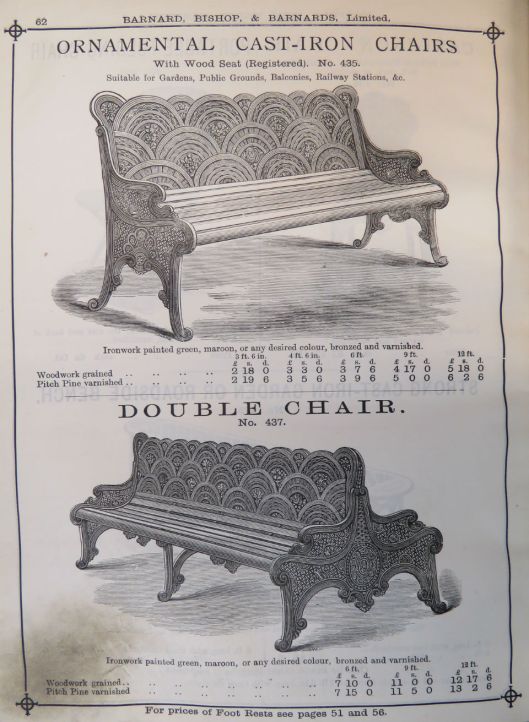
The overlapping waves were also used on cast-iron garden benches.

benches.jpg

Barnards catalogue 1884. (c) Museum of Norwich, Norfolk Museums Service

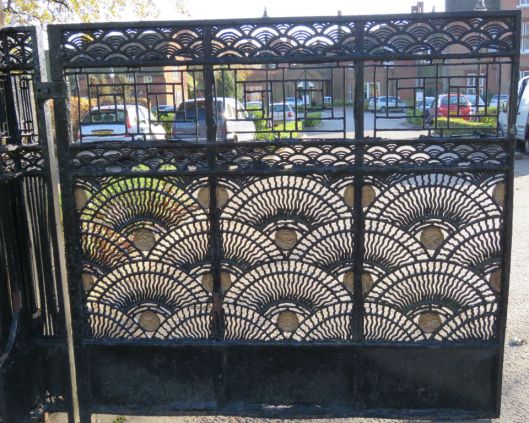
A local application of the seigaiha design can be seen on the gates at Sprowston Manor Hotel on the outskirts of Norwich.

SpowstonGates.jpg

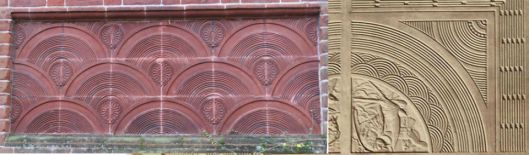
Jeckyll also used the wave design independently of the work he did with Barnards. Here it is seen in a terracotta plaque on the garden wall of High House, Thorpe St Andrew (left) and on a quadrant from the ceiling of the Boileau Memorial Fountain (right, demolished) that once stood at the junction of Newmarket and Ipswich Roads near the old Norfolk and Norwich Hospital (see previous post on the fountain [1]).

2waves3.jpg

Left, Jeckyll plaque at High House, possibly made at the Costessey Brickworks. Right, a quadrant of the ceiling from the Boileau Fountain [1]

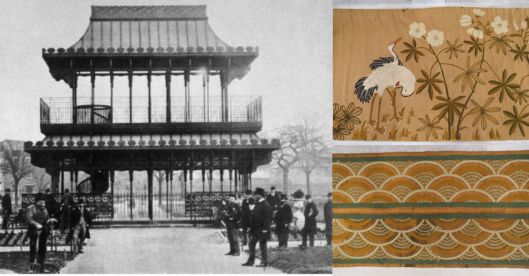
Fabric is not always durable but in this case the japonaise embroidery, made to Jeckyll’s designs, outlived the Chapelfield Pagoda that was dismantled in 1949. Fortunately, the hangings that decorated the pagoda at international exhibitions are conserved in Norwich Castle Study Centre –the seigaiha design bottom right.

Pagoda_final.jpg

Left: The Chapelfield Pagoda. Right: Jeckyll’s hangings used to decorate the structure when it was exhibited internationally. (c) Norfolk Museums Service

Jeckyll was an inventive designer who was certainly not restricted to one design or material. He had previously collaborated with the sculptor Sir J Edgar Boehm on the Boileau memorial Fountain and when Boehm sculpted the monument to Juliana, Countess of Leicester for the estate church at Holkham Hall it is highly likely that Jeckyll designed the japonaise base [4].

holkham.jpg

Base of the monument to Lady Leicester in the church of St Withburga, Holkham Estate, Norfolk, which is attributed to Thomas Jeckyll

Sources

  1.  https://colonelunthanksnorwich.com/2016/04/15/thomas-jeckyll-the-boileau-family/
  2.  https://colonelunthanksnorwich.com/2016/01/06/jeckyll-and-the-sunflower-motif/
  3.  https://colonelunthanksnorwich.com/2015/12/26/two-bs-or-not-tw…s-thomas-jeckyll/
  4. Soros, Susan Weber and Arbuthnott, Catherine (2003). Thomas Jeckyll: Architect and Designer, 1827-1881. Yale University Press.
  5. Ives, Colta Feller (1974). The Great Wave: The Influence of Japanese Woodcuts on French Prints. The Metropolitan Museum of Art.
  6. The Cult of Beauty (2011). Eds Stephen Calloway and Lynn Feder Orr. V&A Publishing
  7. The Aesthetic Movement (1973). Ed, Charles Spencer. Academy Editions, London.‎

Thanks to: Hannah Henderson, Museum of Norwich, Bridewell Alley for showing me the Jeckyll collection; to Michael Innes for allowing me to photograph the Jeckyll terracotta at his house; to Mary Parker, warden of Ketteringham Church for providing the photograph of the ceiling in the Boileau Memorial; to Lisa Little of Norwich Castle Study Centre, Norfolk Museums & Archaeology Service, Shirehall,for showing me the Jeckyll hangings and to Clare Everitt of Picture Norfolk for permissions.

Visit the display of Barnards’ work and Jeckyll’s designs in The Museum of Norwich, Bridewell Alley, Norwich

The Norwich Society helps people enjoy and appreciate the history and character of Norwich.   Visit: www.thenorwichsociety.org.uk

NorwichSocLogo.jpg

Share this:

  • Share on Facebook (Opens in new window) Facebook
  • Share on X (Opens in new window) X
  • Share on Pinterest (Opens in new window) Pinterest
  • Email a link to a friend (Opens in new window) Email
  • Print (Opens in new window) Print
Like Loading...

Dragons

20 Thursday Oct 2016

Posted by reggie unthank in Norwich buildings, Norwich history

≈ 20 Comments

Tags

dragons, norwich cathedral, snap the dragon, St George and the dragon, Stained Glass, The Tudors

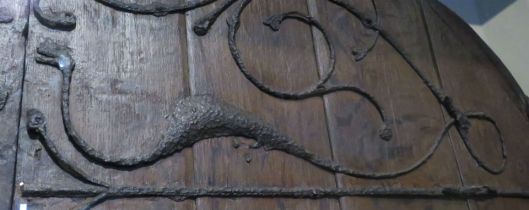
To the medieval mind dragons stood as a metaphor for the devil and all his works, the origin of pestilence and plague. The concept of a dragon could have evolved from travellers’ tales about fabulous beasts or even fossils. In one incarnation, dragons were represented as giant worms – indeed, the Old English for dragon is wyrm (or Old High German, wurm). A beautiful manifestation of the worm-like dragon is to be seen on the C13th infirmary doors from Norwich Cathedral, now in Norwich Castle.

Norwich Infirmary Doors.jpg

Norwich Castle Museum and Art Gallery

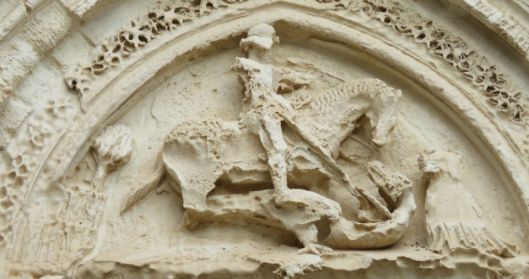
The more familiar version is of a four-legged, bat-winged creature usually seen writhing at the end of St George’s lance or St Michael’s sword. The fable of St George and the Dragon is thought to have originated in the east and brought back to this country following the crusades. St George is usually represented as a knight on horseback as can still (just about) be seen in this C14th carving from Ragusa, Sicily.

St George Ragusa.jpg

Dragons feature strongly in Norwich’s history. St George is the city’s patron and the Guild of St George, founded in 1385 [1], became a prominent social institution, celebrating the saint’s feast day and performing acts of charity for its members and the needy. In 1417 the power of the guild was greatly enhanced when it was granted a Royal Charter by Henry V, perhaps in recognition of its members who fought alongside him at Agincourt. In 1548 the guild lost its religious basis, transforming itself into the secular Company of St George that celebrated the arrival of the new mayor. However, the dragon still took part in non-religious processions; it was first mentioned as taking part in 1408, it survived Puritanism then became a civic player, performing in annual guild days when the mayor was inaugurated.

Norwich dragon.jpg

Snap the Dragon at Norwich Castle Museum and Art Gallery

Taunted by the chanting crowd the dragon would grab caps in its jaws, ransoming the headwear for a penny.

“Snap, Snap, steal a boy’s cap, give him a penny and he’ll give it back”

This C19th engraving gives a sense of the raucous nature of the guild day.

snap.jpg

In the marketplace,  outside the extant Sir Garnet (Wolseley )pub. (c) Picture Norfolk at Norfolk County Council

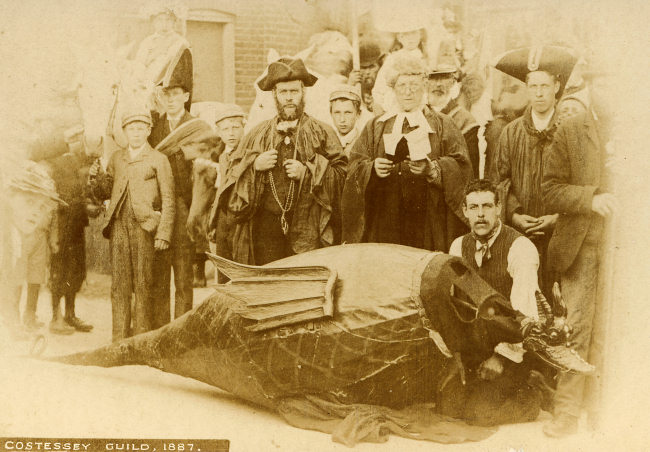
Although much of the pageantry disappeared after the passing of the Municipal Corporation Reform Act of 1835 it survived in mock pageants held in the district of Pockthorpe and in the nearby village of Costessey [1]. This 1887 photograph of the Costessey guild day nicely captures the flummery that accompanied the election of the ‘mayor’.

CostesseyGuildSnap.jpg

(c) Picture Norfolk at Norwich County Council

In 1951, Snap the Dragon was still being used in civic parades and is seen here accompanied by two whifflers (from Old English wifel for battle-axe) who, historically, carried weapons to clear the way through the crowd. The photograph is believed to be of the Pockthorpe Dragon, now stored by Norfolk Museums Service [2]

Festival procession snapdragon and whiffler [4008] 1951-06-24.jpg

(c) georgeplunkett.co.uk

Until the mid C20th another version of Snap was displayed in Back’s wine merchants in Haymarket, once known as the medieval Curat’s House [3], now landlocked behind a modern frontage (currently Fatface). During renovations the owner of a nearby shop discovered paperwork showing that Back’s used ‘Old Snap’ in their advertising.

Backs snapdragon.jpg

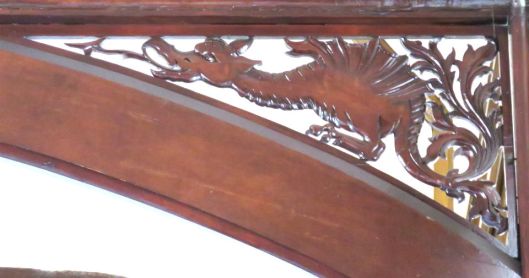
Probably the most famous Norwich dragon is to be found in Dragon Hall. In ca 1427, on the site of a previous building, wealthy textile merchant Robert Toppes [4] constructed a trading hall then known by the wonderful name, Splytts. Three-times mayor Toppes was member of the St George’s Guild, a fact celebrated in the beautifully-carved winged dragon in a roof spandrel.

dragon hall norwich3.jpg

Three pairs of dragons are to be found in the refectory roof of the Great Hospital, near the cathedral. The hospital has continuously provided for the needy since 1249, when it was built by Bishop Walter de Suffield to care for poor clergy, and is now a residential care home.

GtHospitalNorwich.jpg

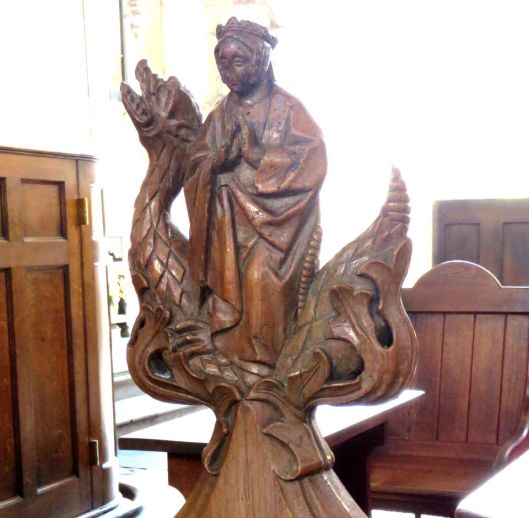
Also in the Great Hospital, in St Helen’s Church, is a fine example of the devil as the dragon. The dragon is said to have swallowed St Margaret of Antioch but her cross irritated the dragon, allowing her to break free. Here she is shown on a medieval pew end emerging from the dragon’s belly, illustrating her role as the patron saint of pregnancy and childbirth.

St Margaret.jpg

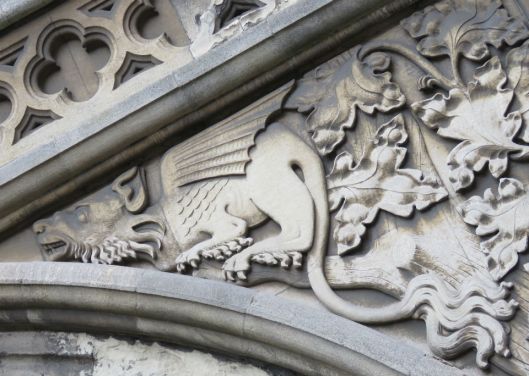
On St Ethelbert’s Gate of the nearby cathedral is another spandrel dragon, restored in the C19th. The dragon, facing an armed man/saint on the opposite side of the arch, may allude to a bloody C13th conflict between clergy and citizens for which 30 rioters were hanged [5]

spandrel St Ethelbert.jpg

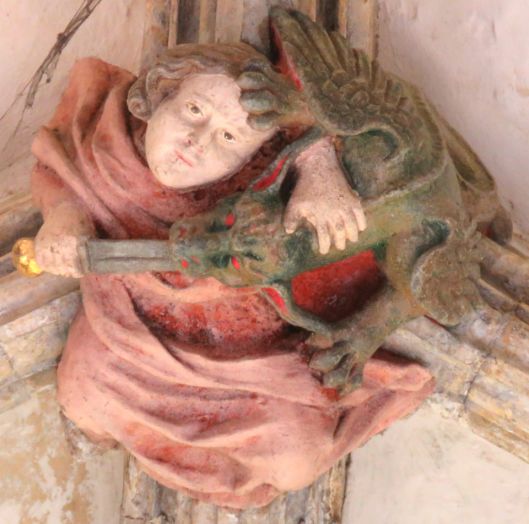
Norwich Cathedral contains over 1100 roof bosses carved in stone: this boss is from the cloisters [6]. The swordsman’s nonchalant gaze could almost come from a piece-to-camera on how to kill a dragon.

norwich cathedral boss.jpg

C14th, Cloisters, Norwich Cathedral

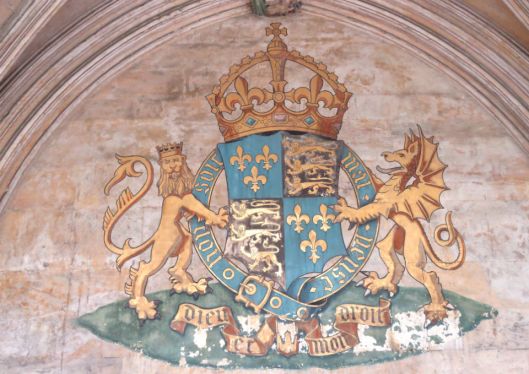
Only yards away a rampant dragon appears amongst a series of coats of arms painted in the arches of the cloisters (restored in the 1930s). These represent the worthies who entertained Queen Elizabeth I during her progress to Norwich in 1578. The arms below belong to the queen herself and incorporate the lion of England and the dragon of Wales derived from her grandfather Henry Tudor.

Elizabeth 1 coat of arms.jpg

The city’s allegiance to the Tudors is also expressed in the first two of these exuberantly-carved bench ends in the Mayor’s Court of the Guildhall. The greyhound (lower left), with jewelled collar around its neck, represents the Beaufort line of Henry VII’s mother Margaret while the Welsh dragon (centre) refers to Henry Tudor’s Celtic father. And because of its imagination and skill  I couldn’t resist adding (right) the greedy dragon from St Agnes Cawston (although the beast would be more frightening if its head were less like a labrador’s).

2dragons1gryhnd222.jpg

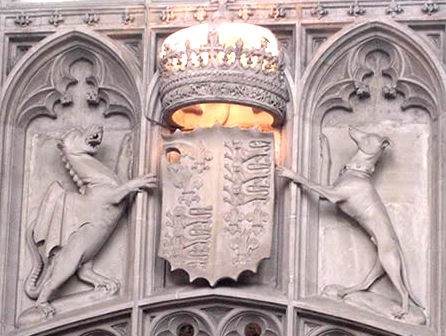
Visitors to King’s College Chapel Cambridge will be familiar with the dragon and greyhound from the numerous Royal Coat of Arms that Henry Tudor displayed to impress his entitlement to the throne.

Tudor arms.jpg

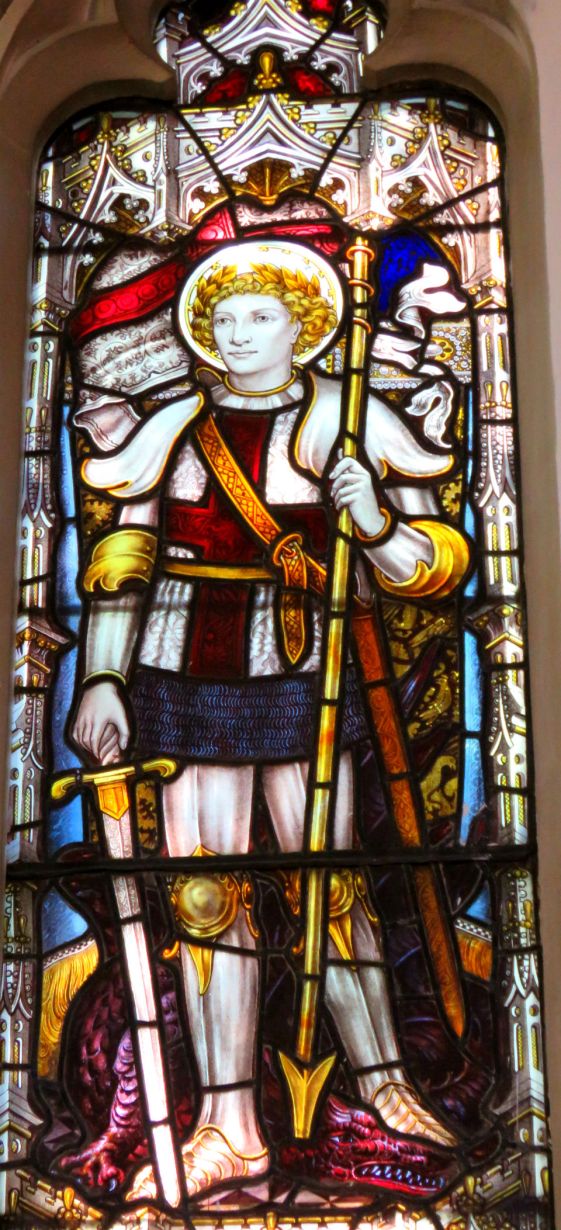
St George Tombland contains more dragons than any other Norwich church with the beast rendered in  cast bronze, a C16th Germanic relief plaque, a  weather vane as a font cover, and even some Snap-the-Dragons. The stained glass window of St George and the Dragon is by CC Powell 1907.

SGeorgeTombland.jpg

Here is one of Norfolk’s treasures, St George wielding a sword to vanquish the dragon; from the rood screen at St Helen Ranworth (late C15th).

St GeorgeRanworth2.jpg

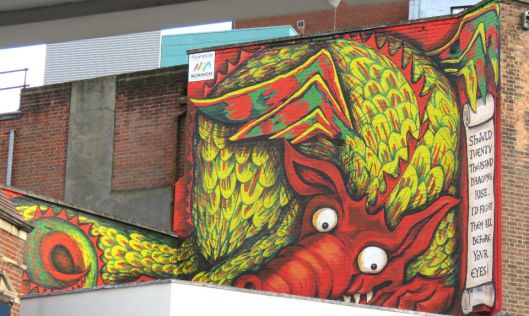
… and demonstrating that dragons are still alive in the city of dragons.

Should twenty thousand dragons rise, I’d fight them all before your eyes!

StreetDragon16.jpg

By Malca Schotten, 2016. Based on Snap, part of Norwich BID’s mural programme. Red Lion Street

Thanks to David Kingsley for the Back’s ‘Snap’ advertisement, to Clare Everitt of Picture Norfolk at Norfolk County Council for permission to use images, the staff of Norwich Castle Museum and Art Gallery for showing me their dragons, and Jumara Mulcahy of Norwich BID.

The Norwich Society helps people enjoy and appreciate the history and character of Norwich.   Visit: www.thenorwichsociety.org.uk

NorwichSocLogo.jpg

Sources

  1. http://www.dragonglow.co.uk/snap.htm
  2. http://www.nor-folk.co.uk/Norwich%20Dragon/aliens.html
  3. http://wp.me/p71GjT-3Zt
  4. http://wp.me/p71GjT-t
  5. http://wp.me/p71GjT-32e
  6. Rose, Martial and Hedgecoe, Julia (1997). Stories in Stone: The medieval roof carvings of Norwich Cathedral.  Herbert Press.

Read about Norwich’s dragons in http://www.heritagecity.org/events-festivals/norwich-dragon-festival/norwichs-dragons.htm

Share this:

  • Share on Facebook (Opens in new window) Facebook
  • Share on X (Opens in new window) X
  • Share on Pinterest (Opens in new window) Pinterest
  • Email a link to a friend (Opens in new window) Email
  • Print (Opens in new window) Print
Like Loading...

Decorative tiles

29 Thursday Sep 2016

Posted by reggie unthank in Art Nouveau, Arts and Crafts, Norwich history

≈ 7 Comments

Tags

Alphonse Mucha, Dante Gabriel Rosetti, Doulton tiles, George Skipper, Norwich architecture, William de Morgan

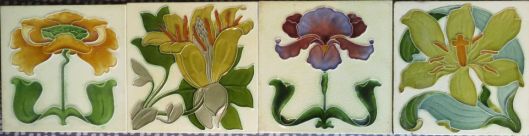
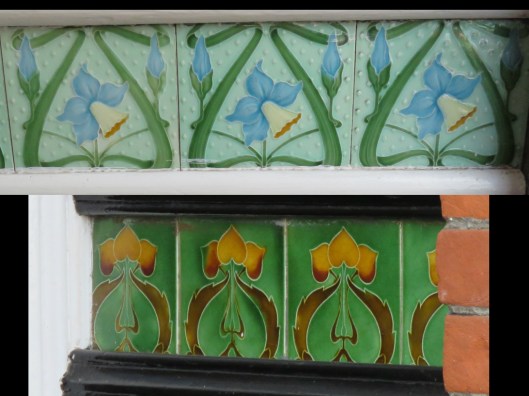
There are so few art nouveau buildings in this country but many homes around 1900 would have possessed beautiful examples of the art in the form of ceramic tiles. I used to collect them. They were used as inserts in fireplaces, as splash backs on washstands, panels in doorways and even as teapot stands. Tiles provided a relatively cheap and easy access to designers of the day such as William Morris, Walter Crane, Leon Solon and William de Morgan. The fourth tile below is a favourite, designed by Lewis F Day, a prominent member of the Arts and Crafts Movement.

FourTiles_3.jpg

Tiles 1 and 3 are by JH Barratt (1904); tiles 2 and 4 are by Pilkington’s (ca 1895) and designed by Lewis Foreman Day – the fourth bearing his raised initials. 

Similar tiles can be seen as decorative panels in porches around the Golden Triangle. Whitehall Road and Kingsley Road have good examples.

New2porches.001.jpeg

The Norwich foundry of Barnard Bishop and Barnards was internationally recognised for its Aesthetic Movement fireplaces for which Thomas Jeckyll had designed the japonaise motifs cast into the surface of their products. But by the time Jeckyll died in 1881 fashions had moved on and tiled inserts had become a major decorative element.

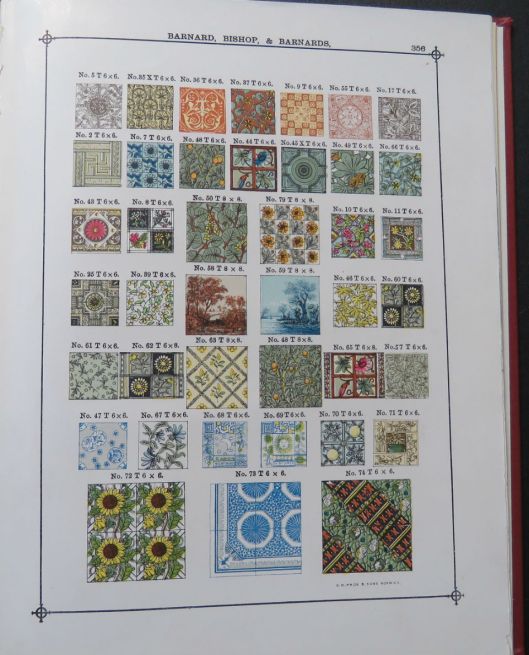
BBBBtilebook_1.jpg

A selection of tiles offered by Barnard Bishop and Barnards at their London showroom, 1884. Courtesy, Museum of Norwich at the Bridewell.

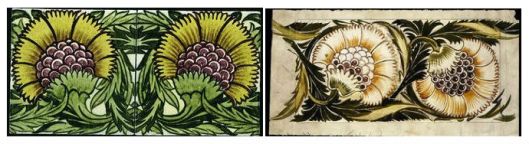
William de Morgan designed his most popular tile for Barnard Bishop and Barnards’ Norwich Ironworks. The fanned carnation is known as the BBB design in recognition of the fact that Barnards had given him his first large order for tiles to be placed in their cast-iron fireplaces [1].

WmdeMorgan.jpg

Wm de Morgan’s ‘BBB’ tiles (left) and one of his designs (right). In production from 1898. (c) Victoria and Albert Museum, London. 

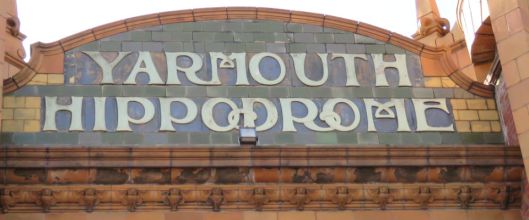
Great Yarmouth’s wonderful Hippodrome (1903) displayed these Art Nouveau letter tiles [9].

Yarmouth Hippodrome2.jpg

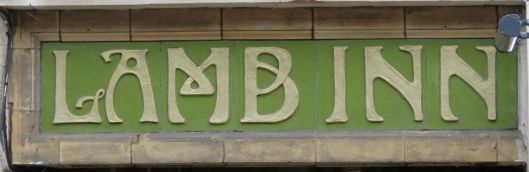
Similar tiles can be found in Norwich’s Haymarket Chambers, built by George Skipper (1901-2); these are incorporated into the facade above the narrow entrance to the Lamb Inn, situated in the courtyard behind.

LambInnTiles.jpg

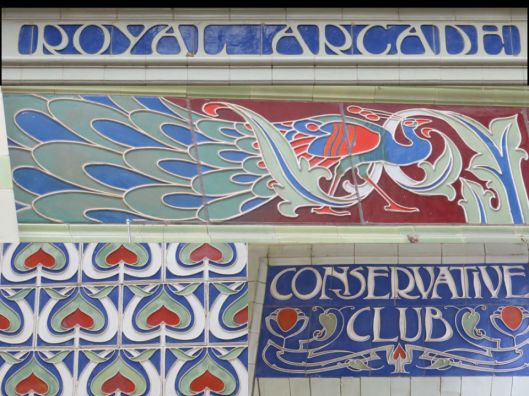
It is not known who made the tiles but a few years earlier Skipper commissioned Doulton’s WJ Neatby – of Harrod’s Food Hall fame – to produce these art nouveau tiles for The Royal Arcade (see previous article).

montage_1.jpg

Neatby decorated the spandrels of the central crossing of the arcade with tiles depicting a young woman who, in preliminary drawings, was intended to be holding a sign of the zodiac. In Brooklyn, at about the same time as the arcade was built (1899), Zaida Ben-Yusuf produced  what appears to be a self-portrait of a woman contemplating a pomegranate. The similarities are striking.

zodiac_pair960pxl.jpg

Left: Zodiac figure by WJ Neatby (1899); right: ‘The Odor of Pomegranates’ 1899 by Zaida Ben-Yusuf (ca 1899).

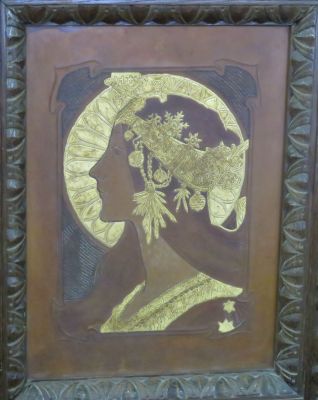
But recently, I saw this pressed leather panel decorating a cupboard in a junk shop. The figure is based on the 1896 Zodiac poster by Alphonse Mucha, surely the original inspiration for the models above?

MuchaZodiac.jpg

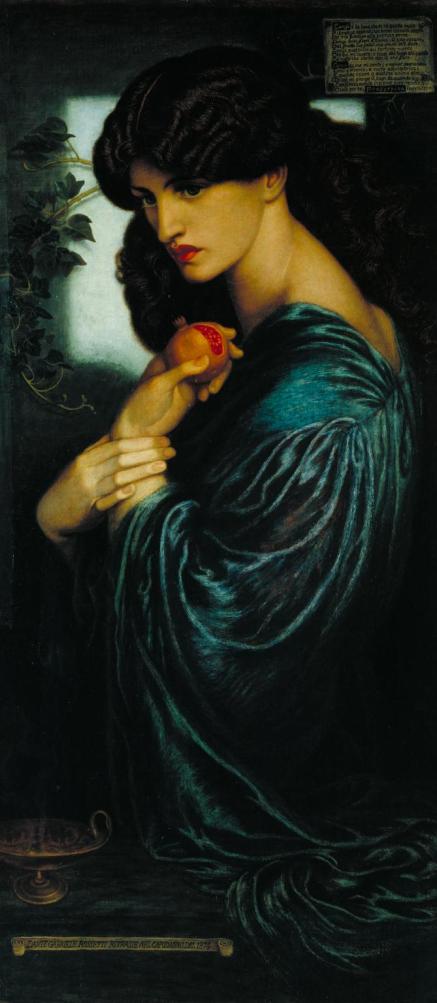
The 2016 exhibition at Tate Britain, ‘Painting with Light’ [3] examined the cross-referencing between early photographs and painting. In it, Ben-Yusuf’s photograph was compared with Dante Gabriel Rosetti’s painting of ‘Proserpine’, Empress of Hades(1874). Jupiter agreed to release Proserpine back to Earth provided she hadn’t tasted Hades’ fruit: but she had eaten a single seed. As the exhibition notes suggest, Rosetti may have been examining his feelings for his muse Jane, the wife of his friend William Morris, the model for his painting and his soon-to-be lover.

Proserpine.jpg

Proserpine 1874 Dante Gabriel Rossetti 1828-1882 http://www.tate.org.uk/art/work/N05064. Creative Commons

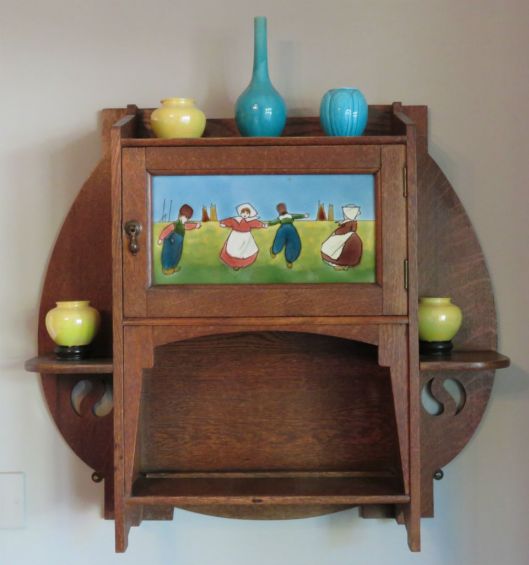
Patterns on tiles can be made in several ways. Raised outlines can be impressed on the blank during manufacture but tube-lining depends on the direct hand of the artist. For this, semi-liquid clay is squeezed through a nozzle onto a blank tile to form a raised outline and the areas between are then painted with coloured glazes before firing.

Shapland and Petter cabinet.jpg

Cabinet by Shapland and Petter of Barnstaple with tube-lined tile containing a Dutch scene; such scenes were popular ca 1900-1910. 

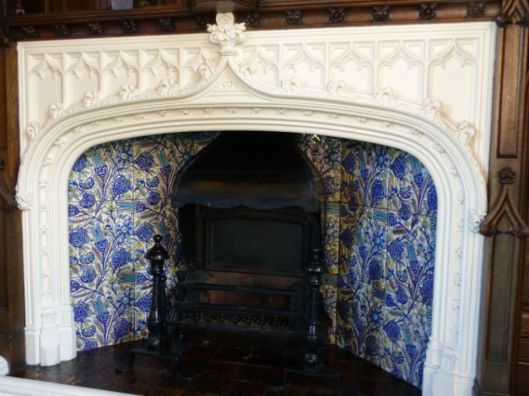
The Norwich Heritage Open Days 2016 gave access to two tiled fireplaces not normally seen by the public. The first is in Carrow Abbey. The C12th abbey was founded as a Benedictine nunnery and was considerably renovated (1899-1909) for mustard magnate J J Colman by Edward Boardman Jr, who had married into the Colman family.

Carrow Priory Prioress' parlour [3416] 1940-05-16.jpg

Carrow Abbey, prioress’ parlour (1940). Courtesy www.georgeplunkett.co.uk

This neo-Gothic fireplace has been decorated with beautiful, large, raised tiles in the Iznik style that had such an influential effect on William de Morgan during his ‘Persian’ phase. However, these tiles are not flat but embossed and there is nothing to indicate that de Morgan produced such moulded tiles.

Carrow Abbey tiles.jpg

Fireplace, Carrow Abbey. Courtesy Andy Maule.

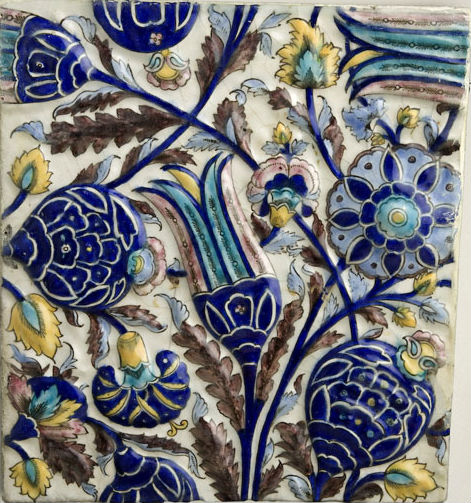
A prolonged trawl through the internet produced a tile in the identical pattern and colourway [4]. The labels says it is a Qajar Iznik-style tile, origin Iran, ca C19th. So, not by de Morgan but direct from his source of inspiration.

Qajar_Iznik-Style_Tile.jpg

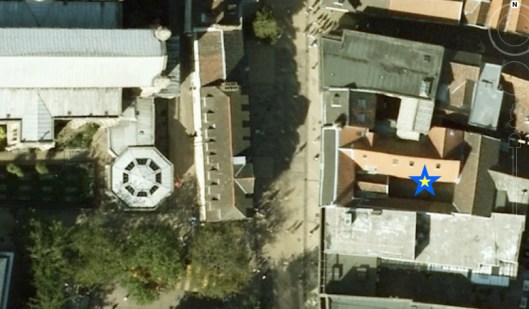
The second ‘Heritage Day’ fireplace is in Curat’s House (for online tour see [5]). The house at numbers 3-4 Haymarket – once Back’s pub and wine bar, now Fatface – is a well-preserved timber-framed medieval building secreted behind a later facade.

Curat's House Norwich.jpg

The hidden medieval Curat’s House (star) runs at right angles to Haymarket/Gentleman’s Walk. The Octagon is part of St Peter Mancroft. Google Earth (c) 2016 Infoterra Ltd & Bluesky

The late C15th-early C16th house was home to John Curat, mercer. Curat’s House was built on the site of an earlier house with a vaulted crypt that had been part of the Old Jewry – the Jewish quarter since the arrival of the Normans [6]. The overhanging jetties of the timber building are now disguised at ground floor level by the C20th shopfront and the upper floors by Georgian brickwork.

Curats House Norwich.jpg

The Delft tiles in the first floor fireplace are described as ‘original’ but tin-glazed blue and white tiles have been made ever since the C16th, first in The Netherlands then in England.  Delftware can be difficult to date with accuracy, as the tile below demonstrates…

G&G Delft tile480.jpg

‘Gilbert and George’ tile made in Spitalfields 1985 by Simon Pettet [7].

Another hidden gem: to the side of the covered courtyard in the ancient Maid’s Head Hotel in Tombland is a small, panelled Jacobean bar. It was supposed to have been the innkeeper’s snug and contains this lovely Dutch-tiled fireplace.

Maids Head.jpg

In contrast to ceramic tiles, where the decoration is painted as a surface glaze, encaustic tiles were made by pressing a pattern into wet clay then filling the impression with different-coloured liquid clays, or by compressing clay dusts under high pressure. Encaustic tiles had been around since the medieval period but their popularity peaked in the second half of the C19th, during the Gothic Revival. A fine example can be seen at the chapel of the former Norfolk and Norwich Hospital, designed by Thomas Henry Wyatt and  Edward Boardman in 1879-84.

NN chapel.jpg

Two identical marble tile mosaics, one in the Guildhall (left) and the other in the Norwich Technical Institute (later the School of Art, now Norwich University of the Arts, right), are thought to have been made around 1900 by craftsmen from the Italian community living in Ber Street. The two City Arms are identical but the backgrounds are different. The 28 bees could  reasonably represent the busy students of the Technical Institute but what was meant by the 22 shrimp-like motifs in the Guildhall (Anyone? Amanda Donnelly suggested silkworms).

Mosaic .jpg

About a decade later (1912), the School of Art at Great Yarmouth was designed by JW ‘Concrete’ Cockrill. Just before the restoration of this proto-modernist building in 2010 this fine tiled facade had been obliterated with white paint [8]. In contrast to the Art Nouveau curlicues on the Yarmouth Hippodrome [9], built by his son RS Cockrill in 1903, these tiles form an austerely geometric pattern reminiscent of the Viennese Secession. GYSchoolArt_1.jpg

Thanks to: Hannah Henderson (Museum of Norwich at The Bridewell), Andy Maule (for the Carrow Abbey photo) and Michelle Ivimey and Steve Ryan (of RMG Ltd, for access to the old N&N chapel).

The Norwich Society helps people enjoy and appreciate the history and character of Norwich.   Visit: www.thenorwichsociety.org.uk

NorwichSocLogo.jpg

Sources

  1. http://collections.vam.ac.uk/item/O78232/design-de-morgan-william/
  2. http://www.tate.org.uk/context-comment/articles/people-behind-pictures-painting-with-light
  3. http://www.tate.org.uk/context-comment/articles/people-behind-pictures-painting-with-light
  4. http://www.antiques.com/classified/Antique-Porcelain—Pottery/Antique-Tiles/Antique-Qajar-Iznik-Style-Tile—ADC-85
  5. http://www.oldcity.org.uk/norwich/tours/curathouse/index.php
  6. http://www.norfolkpubs.co.uk/norwich/cnorwich/nccuh.htm
  7. http://spitalfieldslife.com/2016/01/12/simon-pettets-delft-tiles/
  8. http://www.racns.co.uk/sculptures.asp?action=getsurvey&id=112
  9.  https://colonelunthanksnorwich.com/2016/03/25/art-nouveau-in-great-yarmouth/

Share this:

  • Share on Facebook (Opens in new window) Facebook
  • Share on X (Opens in new window) X
  • Share on Pinterest (Opens in new window) Pinterest
  • Email a link to a friend (Opens in new window) Email
  • Print (Opens in new window) Print
Like Loading...

Hands off our bollards!

24 Saturday Sep 2016

Posted by reggie unthank in Norwich history

≈ 7 Comments

Tags

Norwich architecture, Norwich buildings, victorian ironwork

Little things mean a lot

I’m breaking my three-weekly posting cycle to speak out against the city council’s attempts to remove decorative ironwork from one of the city’s conservation areas.

bollards2.jpgThe bollards in question guard the alleyway between Clarendon Road and Neville Street in the Heigham Grove Conservation Area. See the cast-iron railings on the adjacent house? The council’s own conservation appraisal of the area highlights these in its excellent document and says:
“Several surviving cast iron railings along Clarendon Road are particularly fine and rare examples of once common Victorian ironwork”.

Now, without consultation, the city council wants to replace these bollards to make the alleyway accessible to its mechanical sweepers. There must be a way to preserve them.

One argument for their removal is that the bollards are no older than the 1980s but the George Plunkett archive of historic Norwich clearly shows the same type of cast-iron bollard around the green outside St Gregory’s Church in 1931. So the pattern is at least 85 years old and almost certainly Victorian.

St Gregory's 1931.jpg

Courtesy georgeplunkett.co.uk

The same design can still be seen bordering the green today…

St Gregorys bollards.jpg

… and at other historically-sensitive sites, such as the steps from the market to St Peter Mancroft, the area around Bishop Bridge and steps between Davey Place and the Castle. This design is much more in keeping with these historical sites than the hollow-cast replacements.

two bollards_2.jpg

Clarendon bollard (left), Davey Place steps (right)

Why this matters  Norwich is a fine city, not because of its shopping malls, but because of the incredibly rich heritage that confronts visitors at every turn. It is the historical texture of the place – what John Litster of the Norwich Society calls ‘patina’ – that visitors find so rewarding. But we have to fight for it. Remember, it was only the casting vote of the mayor in 1924 that prevented our major tourist attraction – Elm Hill – from being demolished. The council meets to discuss the Clarendon bollards early next week so please act now.

What you can do  

  1. Sign this change.org petition https://www.change.org/p/norwich-city-stop-norwich-council-removing-original-victorian-bollards-from-conservation-areas
  2. e-mail Luke Powell of the Norwich Evening News who has been following this campaign. luke.powell@archant.co.uk
  3. Become engaged via The Norwich Society. Contact administrator John Litster on norwichsoc@btconnect.com

Share this:

  • Share on Facebook (Opens in new window) Facebook
  • Share on X (Opens in new window) X
  • Share on Pinterest (Opens in new window) Pinterest
  • Email a link to a friend (Opens in new window) Email
  • Print (Opens in new window) Print
Like Loading...

Stained Glass: Arts & Crafts to Art Nouveau

08 Thursday Sep 2016

Posted by reggie unthank in Arts and Crafts, Decorative Arts, Norwich history

≈ 3 Comments

Tags

Art Nouveau, Stained Glass

After writing about medieval church glass in a few posts this article is about the stained glass that decorated secular buildings in the late C19th/early C20th century (plus a few latecomers).

birdroundel2.jpg

Fanlight in office on All Saints’ Green, Norwich

But first, why the three hundred year gap in glass making until its revival in the mid-C19th?  Norwich was once an important centre for medieval glass painting  [1, 2]]. The kaleidoscopic appearance of this window, with a feathered angel playing a lute and a reflection of a disembodied hand doing the same above, suggests it was salvaged after one of the waves of destruction that followed the Protestant Reformation (C16-C17).

BaleGlass.jpg

C15th Norwich School painted glass from All Saints Bale, Norfolk [3] 

Medieval glass was almost exclusively religious. These C16th Norwich School roundels are refreshing for depicting non-biblical characters at work (plus a king enjoying the fruits of their labours)[4].

Roundels_Newest1.jpg

Four (of eight) ‘Labours of the Months’ roundels ca 1500-1525, attributed to John Wattock [4]. Clockwise from top left: ‘Pruning’, ‘A King Feasting’, ‘Harvesting Grapes’, ‘Sheltering from a Storm’.(c) Norwich Castle Museum and Art Gallery.

Painted vs stained glass. ‘Painted glass’ refers to the process of painting the pattern with a solution of metallic salts (e.g. silver nitrate) before firing, as in the medieval glass above. ‘Stained glass’ also includes pieces of coloured glass arranged in a pattern and held together by strips of lead.

After the puritanical rampage there was little ecclesiastical glass-making until the great religious revival of the C19th. In 1861, William Morris founded Morris, Marshall, Faulkner & Co with his Pre-Raphaelite friends, including Rosetti, Ford Madox Brown and Burne-Jones. The company initially focused on church glass but some of their patterns were applicable to the home. Taste-makers were keen to bring something of the Gothic/Arts and Crafts Revivals into their houses and the fashion for domestic stained glass can largely be traced to Morris & Co, for whom Edward Burne-Jones was a main designer [5].

Morris&Co_V&Anew.jpg

‘Penelope’, stained and painted glass panel, designed for Morris & Co by Edward Burne-Jones – a major designer for the firm ca 1864. (c) Victoria and Albert Museum, London

This large house in Eaton, Norwich was built in 1905 as a late example of the English Domestic Revival style.  The large window on the half-landing contains a series of nine painted-glass roundels based on the ‘Signs of the Zodiac’.

zodiac9.jpg

The remaining three signs of the zodiac are fitted into a round window to the side.

zodiac3.jpg

The hand-painted glass  below is very much in the Arts and Crafts tradition. It is in the 1852 Heigham house built by Robert Tillyard, a leather merchant and one of the founders of  the Norvic shoe factory  [6, and previous post].

KRobertsGlass_1.jpg

Stylistically, these paintings resemble Aesthetic Movement portraits of the 1870s-1880s. ‘Juliet’s’ strong chin, below, is reminiscent of Morris’ wife, Jane.

TillyardGirls.jpg

The top figure is unlabelled; the lower pair bear the names Juliet and Elaine. Could these be a romanticised version of Tillyard’s wife Julia and his daughter Ellen?

In contrast to the unique paintings of Tillyard’s family, the coloured glass panels that decorated so many late Victorian doors were made in large quantities. Realistically-painted  birds and flowers are typical of domestic glass of this period.

Brunswick_NewCompiled.jpg

Late Victorian stained glass door panels in the Golden Triangle, Norwich. The inset shows the left-hand panel containing painted bird and flowers.

CecilRd.jpg

Front door panel in a 1900 house Cecil Road, Norwich

Below, the flowers in the vase are not painted but assembled from individual pieces of coloured glass. The sinuous line of the leadwork and the move to abstraction anticipates the arrival of Art Nouveau.

UnthankRoad.jpg

Door panels in a house on Unthank Road

The house with the Arts and Crafts ‘Signs of the Zodiac’ glass (above) also has stained glass  (below) containing the stylised Mackintosh rose of the Glasgow School (ca 1905). This nicely illustrates how glass design developed: from its early Arts and Crafts origins through to the Art Nouveau that persisted in some form until the First World War.

MackintoshRose.jpg

The highly stylised, and less sinuous, Mackintosh rose – the more muscular version of Scottish art nouveau.

Comparison between Victorian-looking stained glass and the new designs of the early C20th shows the simplification that occurred once Art Nouveau struck: patterns were less fussy and designs tended towards the abstract.

ParisvUnthank.jpg

Left, a window from George Skipper’s Hotel de Paris, Cromer (1895) and, right, an Art Nouveau door panel from Unthank Road (ca 1910) illustrate different ways of handling a similar theme: the design on the left is mostly painted, the right is a mosaic of coloured glass set in lead.

The upper window lights around the dining room in the Hotel de Paris offer a scenic tour around Cromer. The glass paintings appear to have been skilfully copied from photographs.

CromerDuo2.jpg

Hotel de Paris Cromer dining room has painted roundels depicting sights around the area; here, the town itself

By contrast, Art Nouveau-influenced glass is hardly representational; flowers, for instance, were not necessarily identifiable, just generically floral.

Christchurch Rd.jpg

Stained glass fanlight and door panel on Christchurch Road

ParkLane.jpg

Two panels, bearing stylised flowers, and a fanlight in stained glass, Park Lane, Norwich

As part of this simplification the lead itself became an intrinsic part of the overall pattern. Of practical importance, the relatively small amount of stained glass allowed more light into the hallway.

ValentineSt.jpg

The colours here are subdued. Valentine Street, Norwich

MileEndRd.jpg

Larger houses ca 1900 had room for six-panel windows on the half-landing. Mile End Road, Norwich

LindleyRdFrontDr.jpg

Front door panel from an Arts and Crafts house (built 1904) on Lindley Street, Norwich

LindleyRdBayWndw.jpg

Upper lights in a bay window of the same house on Lindley Street

LindleyRdSideWndw.jpg

Hall window of Lindley Street house showing opalescent glass panels

George Skipper’s Royal Arcade (see previous post) is the city’s most expressive Art Nouveau building. This semi-circular stained glass panel above the east entrance contains birds flying amongst trees bearing stylised daisy-like flowers.

RoyalArcadeGlass.jpg

East end of Royal Arcade 1899

The Royal Arcade, with Art Nouveau tiles designed by WJ Neatby of Doulton Lambeth, is decorated with peacocks.  In this large stained glass window the repeated motifs resemble the eyes of peacocks’ feathers.

JamiesGlass.jpg

Back of The Royal Arcade, first floor Jamie’s Italian (not accessible to the public)

After the First World war, and the demise of Art Nouveau, stained glass door panels often depicted cosy, reassuring images, as in these adjoining houses in Cecil Road.

Ship_Windmill_New.jpg

Door panels from adjoining houses ca 1920-30

Although the glaziers of the interwar years rejected a return to the pared down geometry of the Art Nouveau, they were content to use other, more representational images from around 1900, like the sailing ship (see post on The Sailing Ship as an Arts and Crafts Motif).

TwoShips_new.jpg

Left: interwar house on Kett’s Hill; St Stephen’s Road ca 1905.


The Gatehouse PH (subject of previous post) was built in 1934. This turreted building also looks back to the Arts and Crafts style, with cartoon-like medieval glass to match.

GatehouseSix.jpg

Montage of cameos from The Gatehouse PH, Dereham Road. 

The Owl2.jpg

The benefits of reading. Above entrance of Mile Cross Branch Library, Aylsham Road, Norwich 1931

Toucan.jpg

The benefits of drinking. Advertising glass at The Ribs of Beef PH at Fye Bridge,Norwich


The Norwich Society helps people enjoy and appreciate the history and character of Norwich.   More details on their website www.thenorwichsociety.org.uk

NorwichSocLogo.jpg

Thanks to Keith Roberts, Grant Young and Gareth Lewis and all who let me photograph their glass.

Sources

  1. Woodforde, Christopher (1950). The Norwich School of Glass-Painting in the Fifteenth Century. Pub: Oxford University Press.
  2. See previous post on Norfolk’s stained glass angels http://wp.me/p71GjT-t
  3. http://www.norfolkchurches.co.uk/bale/bale.htm
  4. Vance, Francesca (2013). Stained Glass Roundels: the Labours of the Months.

    In,  Masterpieces: Art and East Anglia, exhibition catalogue (ed Ian Collins) SCVA.

  5. http://collections.vam.ac.uk/item/O8452/panel-morris-marshall-faulkner/
  6. Holmes, Frances and Michael (2013). The Story of the Norwich Boot and Shoe Trade. Pub: http://www.norwich-heritage.co.uk.

Share this:

  • Share on Facebook (Opens in new window) Facebook
  • Share on X (Opens in new window) X
  • Share on Pinterest (Opens in new window) Pinterest
  • Email a link to a friend (Opens in new window) Email
  • Print (Opens in new window) Print
Like Loading...
Newer posts →

Enter your email address to follow this blog and receive notifications of new posts by email.

Recent Posts

  • Gothick Norwich
  • The Sons of Flora
  • The United Friars: Charity and Enquiry in the Age of Reason
  • Plans for a Fine City
  • Three Unthank books in print

Recent Comments

Jonathan Dutton's avatarJonathan Dutton on The Nursery Fields of Eat…
Jacqui edgar's avatarJacqui edgar on Two Bs or not two Bs? Norfolk…
Unknown's avatarJapan goes on show |… on Jeckyll and the sunflower…
reggie unthank's avatarreggie unthank on Gothick Norwich
huroncityradio's avatarhuroncityradio on Gothick Norwich

Archives

  • December 2023
  • October 2023
  • April 2023
  • January 2023
  • November 2022
  • October 2022
  • July 2022
  • March 2022
  • February 2022
  • January 2022
  • December 2021
  • November 2021
  • October 2021
  • September 2021
  • August 2021
  • July 2021
  • June 2021
  • May 2021
  • April 2021
  • March 2021
  • February 2021
  • January 2021
  • December 2020
  • November 2020
  • October 2020
  • September 2020
  • August 2020
  • July 2020
  • June 2020
  • May 2020
  • April 2020
  • March 2020
  • February 2020
  • January 2020
  • December 2019
  • November 2019
  • October 2019
  • September 2019
  • August 2019
  • July 2019
  • June 2019
  • May 2019
  • April 2019
  • March 2019
  • February 2019
  • January 2019
  • December 2018
  • November 2018
  • October 2018
  • September 2018
  • August 2018
  • July 2018
  • June 2018
  • May 2018
  • April 2018
  • March 2018
  • February 2018
  • January 2018
  • December 2017
  • November 2017
  • October 2017
  • September 2017
  • August 2017
  • July 2017
  • June 2017
  • May 2017
  • April 2017
  • March 2017
  • February 2017
  • January 2017
  • December 2016
  • November 2016
  • October 2016
  • September 2016
  • August 2016
  • July 2016
  • June 2016
  • May 2016
  • April 2016
  • March 2016
  • February 2016
  • January 2016
  • December 2015

Categories

  • Aesthetic Movement
  • Amelia Opie
  • Art
  • Art Nouveau
  • Arts and Crafts
  • Decorative Arts
  • James Minns carver
  • Linnean Society
  • Norwich architect
  • Norwich Banking
  • Norwich buildings
  • Norwich Department Stores
  • Norwich history
  • Norwich libraries
  • Norwich maps
  • Norwich parks
  • Norwich School of Painters
  • Norwich streets
  • Paston Letters
  • River Wensum history
  • Shutter Telegraph
  • Sir Thomas Browne
  • Stained Glass
  • The Royal Society
  • Uncategorized

Meta

  • Create account
  • Log in
  • Entries feed
  • Comments feed
  • WordPress.com

Recent Posts

  • Gothick Norwich
  • The Sons of Flora
  • The United Friars: Charity and Enquiry in the Age of Reason
  • Plans for a Fine City
  • Three Unthank books in print

Recent Comments

Jonathan Dutton's avatarJonathan Dutton on The Nursery Fields of Eat…
Jacqui edgar's avatarJacqui edgar on Two Bs or not two Bs? Norfolk…
Unknown's avatarJapan goes on show |… on Jeckyll and the sunflower…
reggie unthank's avatarreggie unthank on Gothick Norwich
huroncityradio's avatarhuroncityradio on Gothick Norwich

Archives

  • December 2023
  • October 2023
  • April 2023
  • January 2023
  • November 2022
  • October 2022
  • July 2022
  • March 2022
  • February 2022
  • January 2022
  • December 2021
  • November 2021
  • October 2021
  • September 2021
  • August 2021
  • July 2021
  • June 2021
  • May 2021
  • April 2021
  • March 2021
  • February 2021
  • January 2021
  • December 2020
  • November 2020
  • October 2020
  • September 2020
  • August 2020
  • July 2020
  • June 2020
  • May 2020
  • April 2020
  • March 2020
  • February 2020
  • January 2020
  • December 2019
  • November 2019
  • October 2019
  • September 2019
  • August 2019
  • July 2019
  • June 2019
  • May 2019
  • April 2019
  • March 2019
  • February 2019
  • January 2019
  • December 2018
  • November 2018
  • October 2018
  • September 2018
  • August 2018
  • July 2018
  • June 2018
  • May 2018
  • April 2018
  • March 2018
  • February 2018
  • January 2018
  • December 2017
  • November 2017
  • October 2017
  • September 2017
  • August 2017
  • July 2017
  • June 2017
  • May 2017
  • April 2017
  • March 2017
  • February 2017
  • January 2017
  • December 2016
  • November 2016
  • October 2016
  • September 2016
  • August 2016
  • July 2016
  • June 2016
  • May 2016
  • April 2016
  • March 2016
  • February 2016
  • January 2016
  • December 2015

Categories

  • Aesthetic Movement
  • Amelia Opie
  • Art
  • Art Nouveau
  • Arts and Crafts
  • Decorative Arts
  • James Minns carver
  • Linnean Society
  • Norwich architect
  • Norwich Banking
  • Norwich buildings
  • Norwich Department Stores
  • Norwich history
  • Norwich libraries
  • Norwich maps
  • Norwich parks
  • Norwich School of Painters
  • Norwich streets
  • Paston Letters
  • River Wensum history
  • Shutter Telegraph
  • Sir Thomas Browne
  • Stained Glass
  • The Royal Society
  • Uncategorized

Meta

  • Create account
  • Log in
  • Entries feed
  • Comments feed
  • WordPress.com

Recent Posts

  • Gothick Norwich
  • The Sons of Flora
  • The United Friars: Charity and Enquiry in the Age of Reason
  • Plans for a Fine City
  • Three Unthank books in print

Recent Comments

Jonathan Dutton's avatarJonathan Dutton on The Nursery Fields of Eat…
Jacqui edgar's avatarJacqui edgar on Two Bs or not two Bs? Norfolk…
Unknown's avatarJapan goes on show |… on Jeckyll and the sunflower…
reggie unthank's avatarreggie unthank on Gothick Norwich
huroncityradio's avatarhuroncityradio on Gothick Norwich

Archives

  • December 2023
  • October 2023
  • April 2023
  • January 2023
  • November 2022
  • October 2022
  • July 2022
  • March 2022
  • February 2022
  • January 2022
  • December 2021
  • November 2021
  • October 2021
  • September 2021
  • August 2021
  • July 2021
  • June 2021
  • May 2021
  • April 2021
  • March 2021
  • February 2021
  • January 2021
  • December 2020
  • November 2020
  • October 2020
  • September 2020
  • August 2020
  • July 2020
  • June 2020
  • May 2020
  • April 2020
  • March 2020
  • February 2020
  • January 2020
  • December 2019
  • November 2019
  • October 2019
  • September 2019
  • August 2019
  • July 2019
  • June 2019
  • May 2019
  • April 2019
  • March 2019
  • February 2019
  • January 2019
  • December 2018
  • November 2018
  • October 2018
  • September 2018
  • August 2018
  • July 2018
  • June 2018
  • May 2018
  • April 2018
  • March 2018
  • February 2018
  • January 2018
  • December 2017
  • November 2017
  • October 2017
  • September 2017
  • August 2017
  • July 2017
  • June 2017
  • May 2017
  • April 2017
  • March 2017
  • February 2017
  • January 2017
  • December 2016
  • November 2016
  • October 2016
  • September 2016
  • August 2016
  • July 2016
  • June 2016
  • May 2016
  • April 2016
  • March 2016
  • February 2016
  • January 2016
  • December 2015

Categories

  • Aesthetic Movement
  • Amelia Opie
  • Art
  • Art Nouveau
  • Arts and Crafts
  • Decorative Arts
  • James Minns carver
  • Linnean Society
  • Norwich architect
  • Norwich Banking
  • Norwich buildings
  • Norwich Department Stores
  • Norwich history
  • Norwich libraries
  • Norwich maps
  • Norwich parks
  • Norwich School of Painters
  • Norwich streets
  • Paston Letters
  • River Wensum history
  • Shutter Telegraph
  • Sir Thomas Browne
  • Stained Glass
  • The Royal Society
  • Uncategorized

Meta

  • Create account
  • Log in
  • Entries feed
  • Comments feed
  • WordPress.com

Enter your email address to follow this blog and receive notifications of new posts by email. It's free, no junk.

Join 722 other subscribers

Recent Posts

  • Gothick Norwich
  • The Sons of Flora
  • The United Friars: Charity and Enquiry in the Age of Reason
  • Plans for a Fine City
  • Three Unthank books in print
  • The new Colonel Unthank’s Norwich book #3
  • Female Suffrage in Norwich
  • Norfolk Rood Screens
  • Norwich Guides: Ancient and Modern
  • Chapel in the Fields
  • Noël Spencer’s Norwich
  • Georgian Norwich
  • Cecil Upcher: soldier and architect
  • Sculptured Monuments #2
  • Sculptured Monuments
  • Madness
  • New Book: Colonel Unthank’s Norwich
  • AF Scott, Architect:conservative or pioneer?
  • Norwich Department Stores
  • Revolutionary Norwich
  • Parson Woodforde and the Learned Pig
  • A postscript on Eaton Nurseries
  • The Nursery Fields of Eaton
  • Vanishing Plains
  • Parson Woodforde goes to market
  • Norwich, City of the Plains
  • The Plains of Norwich
  • Twentieth Century Norwich Buildings
  • Thomas Browne’s World
  • The angel’s bonnet
  • After the Norwich School
  • A few of my favourite buildings
  • James Minns, carver
  • The Norwich Banking Circle
  • Behind Mrs Opie’s medallion
  • Norwich: shaped by fire
  • Street Names #2
  • Street names
  • The Norwich School of Painters
  • Going Dutch: The Norwich Strangers
  • The Captain’s Parks
  • Norfolk’s Napoleonic Telegraph
  • Catherine Maude Nichols
  • The Norfolk Botanical Network
  • City Hall Doors # 2
  • City Hall Doors # 1
  • Late Extra: The Norwich Pantheon
  • Pleasure Gardens
  • The absent Dukes of Norfolk
  • Nairn on Norwich
  • The Norwich Way of Death
  • Norwich: City of Trees
  • The Bridges of Norwich Part 2: Around the bend
  • The Bridges of Norwich 1: The blood red river
  • Norwich knowledge (libraries)
  • Street furniture: palimpsests
  • Putting Norwich on the map
  • Clocks
  • Faces
  • The Norwich coat of arms
  • New book: Colonel Unthank and the Golden Triangle
  • The Pastons in Norwich
  • Reggie through the underpass
  • Gildencroft and Psychogeography
  • Bullards’ Brewery
  • Post-medieval Norwich churches
  • The end of the Unthank mystery?
  • Barnard Bishop and Barnards
  • Public art, private meanings
  • Colonel Unthank rides again

Archives

  • December 2023
  • October 2023
  • April 2023
  • January 2023
  • November 2022
  • October 2022
  • July 2022
  • March 2022
  • February 2022
  • January 2022
  • December 2021
  • November 2021
  • October 2021
  • September 2021
  • August 2021
  • July 2021
  • June 2021
  • May 2021
  • April 2021
  • March 2021
  • February 2021
  • January 2021
  • December 2020
  • November 2020
  • October 2020
  • September 2020
  • August 2020
  • July 2020
  • June 2020
  • May 2020
  • April 2020
  • March 2020
  • February 2020
  • January 2020
  • December 2019
  • November 2019
  • October 2019
  • September 2019
  • August 2019
  • July 2019
  • June 2019
  • May 2019
  • April 2019
  • March 2019
  • February 2019
  • January 2019
  • December 2018
  • November 2018
  • October 2018
  • September 2018
  • August 2018
  • July 2018
  • June 2018
  • May 2018
  • April 2018
  • March 2018
  • February 2018
  • January 2018
  • December 2017
  • November 2017
  • October 2017
  • September 2017
  • August 2017
  • July 2017
  • June 2017
  • May 2017
  • April 2017
  • March 2017
  • February 2017
  • January 2017
  • December 2016
  • November 2016
  • October 2016
  • September 2016
  • August 2016
  • July 2016
  • June 2016
  • May 2016
  • April 2016
  • March 2016
  • February 2016
  • January 2016
  • December 2015

Follow me on Twitter

My Tweets

previous posts

  • About
  • Colonel Unthank and the Golden Triangle (Unthank #1)
  • Colonel Unthank’s Norwich #2
  • Contact
  • Latest Colonel Unthank’s Norwich Book #3
  • Posts

Blog at WordPress.com.

  • Subscribe Subscribed
    • COLONEL UNTHANK'S NORWICH
    • Join 722 other subscribers
    • Already have a WordPress.com account? Log in now.
    • COLONEL UNTHANK'S NORWICH
    • Subscribe Subscribed
    • Sign up
    • Log in
    • Report this content
    • View site in Reader
    • Manage subscriptions
    • Collapse this bar
 

Loading Comments...
 

    %d